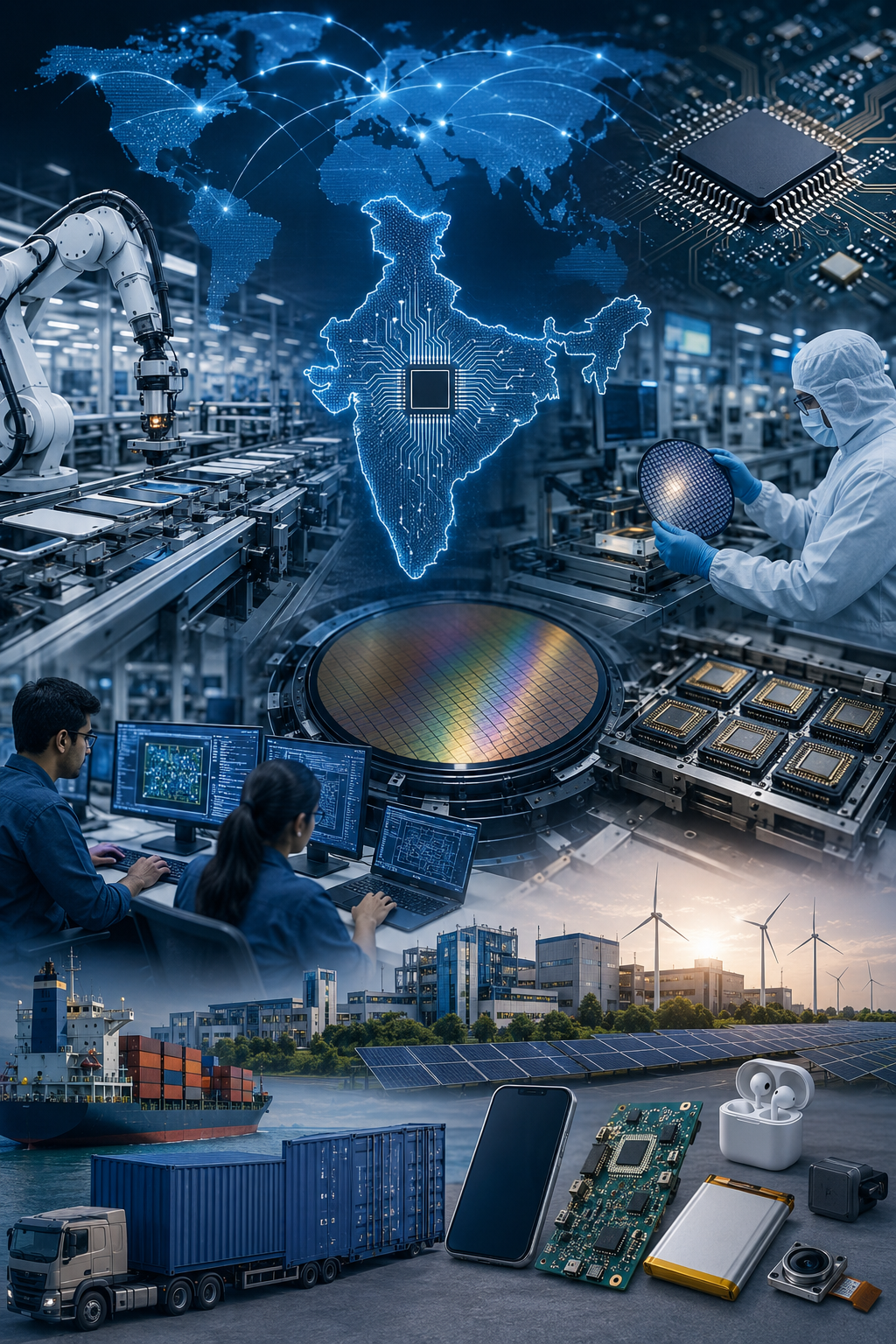
From Smartphone Assembly to Semiconductor Innovation, India Aims to Capture More Value in the Global Electronics Supply Chain
India's electronics industry has emerged as one of the fastest-growing sectors of the economy, driven by robust government support, rising domestic demand, and increasing participation from global technology companies. Over the past decade, the country has transformed itself into the world's second-largest mobile phone manufacturer by volume, while electronics exports have reached record levels.
However, as India celebrates its manufacturing milestones, industry experts believe the next challenge is far more complex. The country must move beyond being an assembly hub and build a comprehensive ecosystem that includes semiconductor manufacturing, electronic components, research and development (R&D), intellectual property (IP), and globally competitive technology brands.
With the launch of the Semicon 2.0 programme, expanded Production Linked Incentive (PLI) schemes, and a renewed focus on domestic component manufacturing, India is laying the foundation for its next industrial revolution. The question now is not whether India can manufacture electronics—but whether it can create more of the value behind every device it produces.
India's Electronics Industry Has Achieved Remarkable Scale
India's rise in electronics manufacturing has been nothing short of remarkable. A decade ago, the country was heavily dependent on imported smartphones and electronic devices. Today, it has become one of the world's largest production hubs for mobile phones, supplying both domestic and international markets.
According to industry estimates, India's mobile phone production has increased nearly ninefold over the last ten years, recording a compound annual growth rate (CAGR) of approximately 24%.
The manufacturing ecosystem has also expanded significantly, with production extending beyond finished smartphones to include:
-
Printed Circuit Board Assemblies (PCBAs)
-
Chargers and adapters
-
Lithium-ion batteries
-
Mechanical enclosures
-
USB cables
-
Packaging materials
-
Accessories and peripherals
Global technology companies have strengthened their manufacturing presence in India, making the country an increasingly important link in worldwide electronics supply chains.
Manufacturing Growth Does Not Yet Mean High Domestic Value Creation
Although production volumes have risen sharply, India's domestic value addition remains relatively modest compared to global manufacturing leaders.
Industry experts explain that electronics manufacturing should not only be measured by the number of products assembled but also by the amount of value generated within the country.
Currently, electronic components contribute only around 9% of India's total electronics production, significantly below the global average of approximately 42%.
During FY2023-24:
-
Total electronics production reached nearly ₹9.52 lakh crore
-
Domestically manufactured electronic components accounted for only ₹85,700 crore
This gap highlights the continued dependence on imported high-value components despite strong growth in final product assembly.
Domestic Value Addition Still Trails Global Manufacturing Leaders
A more meaningful measure of manufacturing maturity is domestic value addition—the percentage of a product's final value created within the country.
India's mobile phone industry currently achieves domestic value addition of approximately 18–20%, according to industry estimates.
By comparison, leading electronics manufacturing economies generate value addition of around 38–40%, reflecting their stronger presence in component manufacturing, semiconductor production, design, and intellectual property.
Closing this gap remains one of the biggest priorities for India's electronics policy.
Semiconductor Imports Continue to Dominate Supply Chains
Despite the rapid expansion of electronics manufacturing, India remains heavily dependent on imports for several critical technologies.
Among the most important imported components are:
-
Semiconductor chips
-
Display panels
-
Image sensors
-
Memory chips
-
Integrated circuits
-
Advanced manufacturing equipment
-
Precision electronic components
Trade data illustrates the scale of this dependence.
India recorded a semiconductor trade deficit of approximately $23.5 billion during 2024.
Additional deficits included:
-
Display Panels: $4.3 billion
-
Battery Cells: $2.7 billion
These figures demonstrate that while India assembles millions of electronic products annually, much of the underlying technology continues to originate overseas.
Government Shifts Focus from Assembly to Component Manufacturing
The success of Production Linked Incentive (PLI) schemes has encouraged policymakers to focus on strengthening the next layer of the manufacturing ecosystem.
Rather than concentrating solely on finished products, new initiatives aim to localize the production of critical components.
Electronics Components Manufacturing Scheme (ECMS)
The ECMS has been designed to encourage domestic production of:
-
Display modules
-
Camera modules
-
Printed circuit boards
-
Passive electronic components
-
Semiconductor packaging materials
-
Connectors and sensors
The objective is to reduce import dependence while creating a deeper manufacturing supply chain inside India.
Mobile Phone Manufacturing Scheme (MPMS)
The proposed ₹62,500 crore Mobile Phone Manufacturing Scheme seeks to encourage greater localization of smartphone components, improve supplier ecosystems, and enhance India's competitiveness as a global manufacturing destination.
Advanced Chemistry Cell Battery Programme
The government's ₹18,100 crore Advanced Chemistry Cell (ACC) PLI Scheme aims to establish 50 GWh of domestic battery manufacturing capacity.
This initiative is expected to support both electric vehicles and consumer electronics while reducing dependence on imported lithium-ion battery cells.
Semicon 2.0 Signals India's Long-Term Semiconductor Ambition
Semiconductors have become the foundation of modern technology, powering everything from smartphones and laptops to automobiles and artificial intelligence systems.
Recognizing this strategic importance, the government has approved the ₹1.27 lakh crore Semicon 2.0 Programme, one of India's largest industrial policy initiatives.
The programme focuses on six critical pillars:
-
Semiconductor fabrication
-
Chip packaging and testing
-
Compound semiconductors
-
Design ecosystem
-
Research and innovation
-
Manufacturing infrastructure
During the first phase, the government has already approved 12 semiconductor projects involving cumulative investments exceeding ₹1.64 lakh crore.
These include:
-
One silicon fabrication plant
-
One silicon carbide fabrication unit
-
Nine semiconductor packaging and testing facilities
Commercial production has already commenced at facilities developed by Micron, Kaynes, and CG Semi, while India's first silicon fabrication plant is expected to begin operations in 2028.
Why Semiconductor Packaging Could Become India's Biggest Near-Term Opportunity
Industry experts believe semiconductor packaging and testing—commonly known as OSAT (Outsourced Semiconductor Assembly and Test)—offers India one of the fastest pathways into higher-value semiconductor manufacturing.
Unlike fabrication plants, OSAT facilities:
-
Require substantially lower investment
-
Can become operational within two to three years
-
Develop skilled technical talent
-
Strengthen supplier ecosystems
-
Improve domestic semiconductor availability
A robust OSAT industry could serve as an important bridge between electronics assembly and advanced semiconductor manufacturing.
Chip Design Could Generate Higher Economic Value
While manufacturing receives most of the attention, experts argue that semiconductor design and intellectual property may offer even greater long-term opportunities.
India already hosts one of the world's largest semiconductor engineering talent pools, with thousands of engineers designing chips for global companies.
However, relatively few Indian firms own the chip architectures, software platforms, and intellectual property behind those products.
Developing indigenous semiconductor companies capable of designing and commercializing their own products could significantly increase India's share of global semiconductor value creation.
Industry leaders believe this segment requires:
-
Long-term patient capital
-
Strong startup ecosystems
-
Advanced testing infrastructure
-
Close collaboration between academia and industry
-
Supportive commercialization policies
Lessons from Asia's Electronics Success Stories
Several Asian economies followed a gradual approach toward building world-class electronics industries.
China
China initially established itself as an assembly hub before steadily expanding into:
-
Component manufacturing
-
Semiconductor packaging
-
Display manufacturing
-
Memory production
-
Advanced semiconductor fabrication
Today, it commands one of the world's most integrated electronics supply chains.
Malaysia
Malaysia focused first on semiconductor packaging and testing before moving into higher-end manufacturing.
Its success was driven by:
-
Stable industrial policies
-
Skilled engineering talent
-
Strong global partnerships
-
Long-term investment in infrastructure
Experts believe India's strategy increasingly mirrors this phased development model.
Building a Complete Electronics Ecosystem Will Take Time
Creating globally competitive electronics manufacturing requires much more than attracting factories.
Industry participants emphasize the need for sustained investment across several critical areas:
-
Component manufacturing
-
Research and development
-
Skilled workforce training
-
Advanced logistics infrastructure
-
Semiconductor ecosystem development
-
Product innovation
-
Technology commercialization
-
Domestic technology brands
Only by strengthening these foundations can India capture a larger share of the value generated within global electronics supply chains.
Investment Perspective: Electronics Sector Offers Long-Term Structural Growth
India's electronics manufacturing story is evolving from volume-driven growth to value-driven expansion. While smartphones remain the cornerstone of the industry's success, the next wave of opportunities is likely to emerge from semiconductor packaging, electronic components, battery manufacturing, industrial automation, and indigenous chip design.
Government initiatives such as Semicon 2.0, component manufacturing incentives, and battery localization programmes provide a strong policy framework for long-term industry development. However, meaningful gains in domestic value addition will depend on sustained investments in technology, innovation, supplier ecosystems, and skilled talent.
For long-term investors, companies operating in semiconductor packaging, electronics manufacturing services (EMS), precision components, specialty chemicals, industrial equipment, and semiconductor design could become key beneficiaries of India's ambition to establish itself as a global electronics manufacturing powerhouse.
Key Takeaways
-
India is now the world's second-largest mobile phone manufacturer by volume.
-
Domestic value addition in smartphones stands at 18–20%, well below global leaders.
-
Semiconductor imports remain India's largest electronics dependency.
-
The ₹1.27 lakh crore Semicon 2.0 programme aims to build a complete semiconductor ecosystem.
-
Component manufacturing, chip packaging, battery production, and semiconductor design represent the next phase of growth.
-
Long-term success will depend on increasing domestic value creation rather than simply expanding assembly capacity.