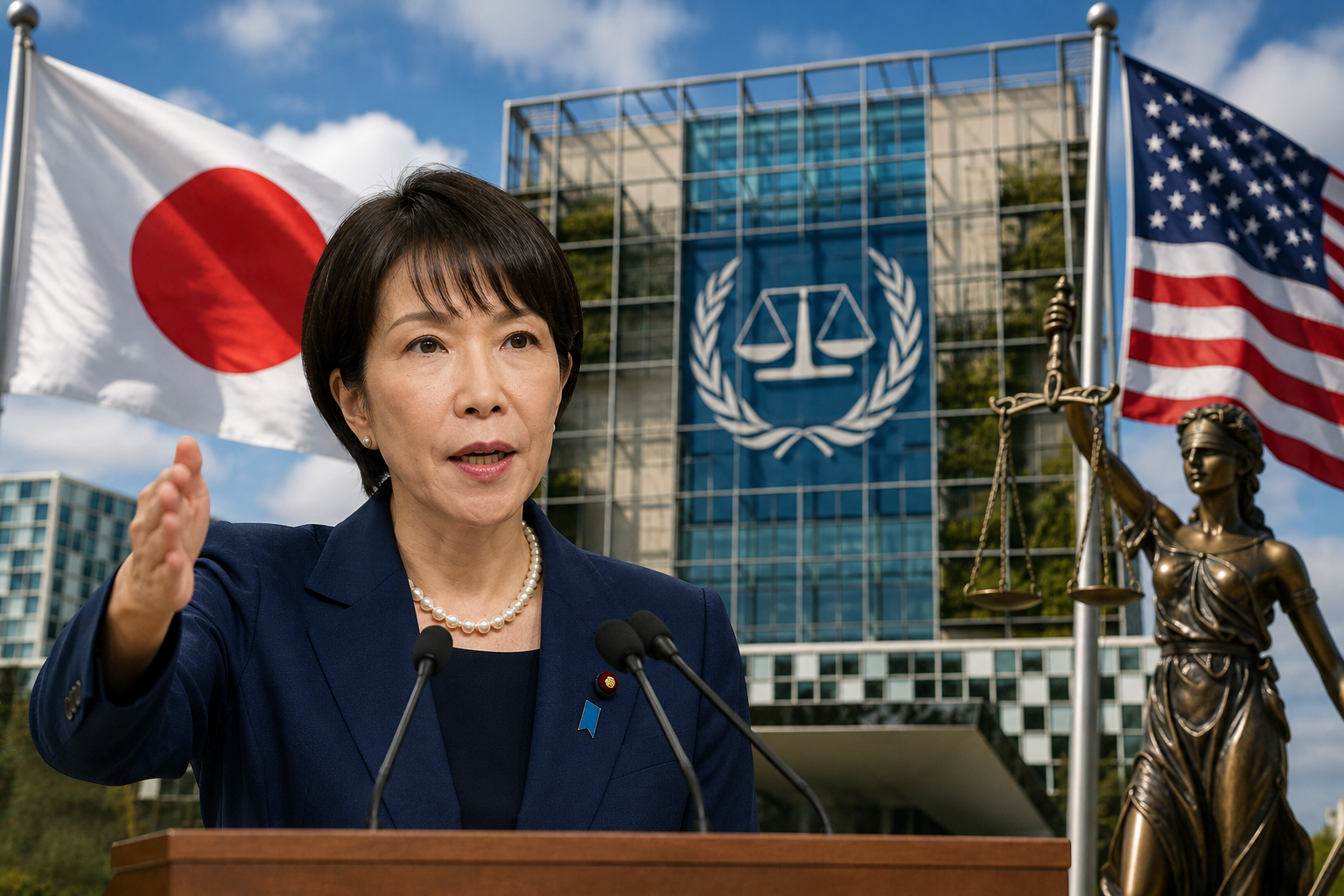
Tokyo says it will continue supporting International Criminal Court after Washington sanctions Japanese president Tomoko Akane
Japan has taken a firmer position in support of the International Criminal Court (ICC), with Prime Minister Sanae Takaichi saying Tokyo will protect the institution as it faces mounting pressure from the United States.
Takaichi's comments came after Washington sanctioned ICC President Tomoko Akane, a Japanese national, along with a senior trial lawyer. The move has added a new layer of tension between the United States and Japan, two close allies with deep defence and economic ties.
The Japanese prime minister said Tokyo had made repeated diplomatic efforts to persuade Washington not to target Akane but would continue to support her and the court.
Takaichi takes stronger position on US sanctions
Takaichi initially expressed regret over Washington's decision, but her latest comments were considerably stronger.
She said Japan, as the ICC's largest financial contributor, had a responsibility to protect the institution. She also said she shared a sense of crisis with Akane following the sanctions.
According to Takaichi, Japanese officials approached the US at multiple levels before the sanctions were imposed, urging Washington to reconsider its decision.
Tokyo is also keeping open the possibility of making further diplomatic representations to the US if circumstances require.
Why the ICC has become a flashpoint
The ICC has been at the centre of a long-running dispute with Washington over the court's jurisdiction.
The United States is not a party to the Rome Statute, the treaty that established the ICC, and has repeatedly rejected the court's authority over US citizens.
The Trump administration has argued that the ICC has exceeded its mandate and interfered with the sovereignty of countries that have not accepted its jurisdiction.
US Secretary of State Marco Rubio has also accused the court of being politicised and threatened further action aimed at weakening its ability to pursue cases involving American interests.
Israel-related cases have intensified tensions
The dispute between Washington and the ICC has also been intensified by the court's proceedings involving Israel.
In 2024, the ICC issued an arrest warrant for Israeli Prime Minister Benjamin Netanyahu over alleged war crimes linked to the Gaza conflict. Israel has rejected the allegations.
The United States has also disputed the court's authority in the case and has maintained that the ICC should not exercise jurisdiction over officials from countries that are not members of the court.
The issue has become particularly sensitive for Washington because of its close strategic relationship with Israel.
US opposition to ICC goes back years
The latest sanctions are not the first time Washington has taken punitive action against ICC officials.
During Donald Trump's first presidency, the US imposed sanctions on an ICC prosecutor and an aide after the court pursued an investigation into alleged US war crimes in Afghanistan.
The current administration's approach represents a continuation of that broader opposition, although the rhetoric surrounding the court has become more aggressive.
Washington has indicated that it wants to prevent the ICC from taking actions that it considers a threat to US sovereignty.
Japan faces a diplomatic balancing act
Japan's decision to defend the ICC presents Tokyo with a delicate diplomatic challenge.
The United States remains Japan's most important security partner, particularly as Tokyo faces growing geopolitical tensions in the Indo-Pacific.
At the same time, Japan has invested heavily in international institutions and rules-based mechanisms. Its financial and political support for the ICC makes the sanctions against Akane particularly significant.
Takaichi's comments indicate that Tokyo does not intend to abandon that support despite the disagreement with Washington.
Japanese lawmakers demand a stronger response
Pressure on the Japanese government has also increased domestically.
A multiparty group of lawmakers, including former Prime Minister Shigeru Ishiba and former Defence Minister Gen Nakatani, called for a clearer Japanese protest against the US sanctions.
The criticism suggests that the issue has support across political lines in Japan, rather than being limited to one faction within the ruling coalition.
For Takaichi, the challenge will be to demonstrate that Japan can defend an international institution while maintaining its critical strategic relationship with Washington.
What role does the ICC play?
The ICC was established in 2002 in The Hague to prosecute individuals accused of some of the world's most serious crimes, including genocide, war crimes and crimes against humanity.
Unlike national courts, the ICC is designed to address cases where domestic judicial systems are unable or unwilling to investigate and prosecute alleged perpetrators.
The court has issued arrest warrants involving senior political and military figures from several countries, including Russian President Vladimir Putin.
Its supporters argue that the ICC provides an important mechanism for accountability when national institutions fail to act.
Critics, meanwhile, argue that the court's jurisdiction can conflict with national sovereignty and that its investigations can become politically contentious.
Sanctions could create wider pressure on the court
The US action against ICC officials could have consequences beyond the individuals directly targeted.
Financial restrictions and travel limitations can make it more difficult for sanctioned officials to conduct international diplomacy and engage with institutions based in countries that cooperate with Washington.
If the US expands sanctions to include additional ICC officials, staff or organisations supporting the court, other governments could face greater pressure over their relationship with the institution.
Japan's response therefore carries significance beyond its bilateral relationship with the US.
A test for the rules-based international order
The confrontation comes at a time when international institutions are facing increasing pressure from geopolitical rivalries.
Japan's decision to defend the ICC highlights Tokyo's continued emphasis on international law, while Washington's position reflects concerns over sovereignty and the limits of international judicial authority.
The disagreement could become an important test of how traditional US allies respond when their commitment to international institutions conflicts with Washington's foreign-policy priorities.
What to watch next
The next stage will depend largely on whether the United States expands its campaign against the ICC and whether other major financial contributors publicly follow Japan's lead.
For Japan, further diplomatic engagement with Washington is likely to remain a priority. Tokyo will also need to determine how far it is prepared to go in providing financial and institutional support to the ICC.
The dispute is unlikely to immediately disrupt the broader US-Japan alliance, but it adds another sensitive issue to an already complex international environment.
At the heart of the disagreement is a fundamental question: how should international justice operate when major powers disagree over the authority of the institutions created to deliver it?