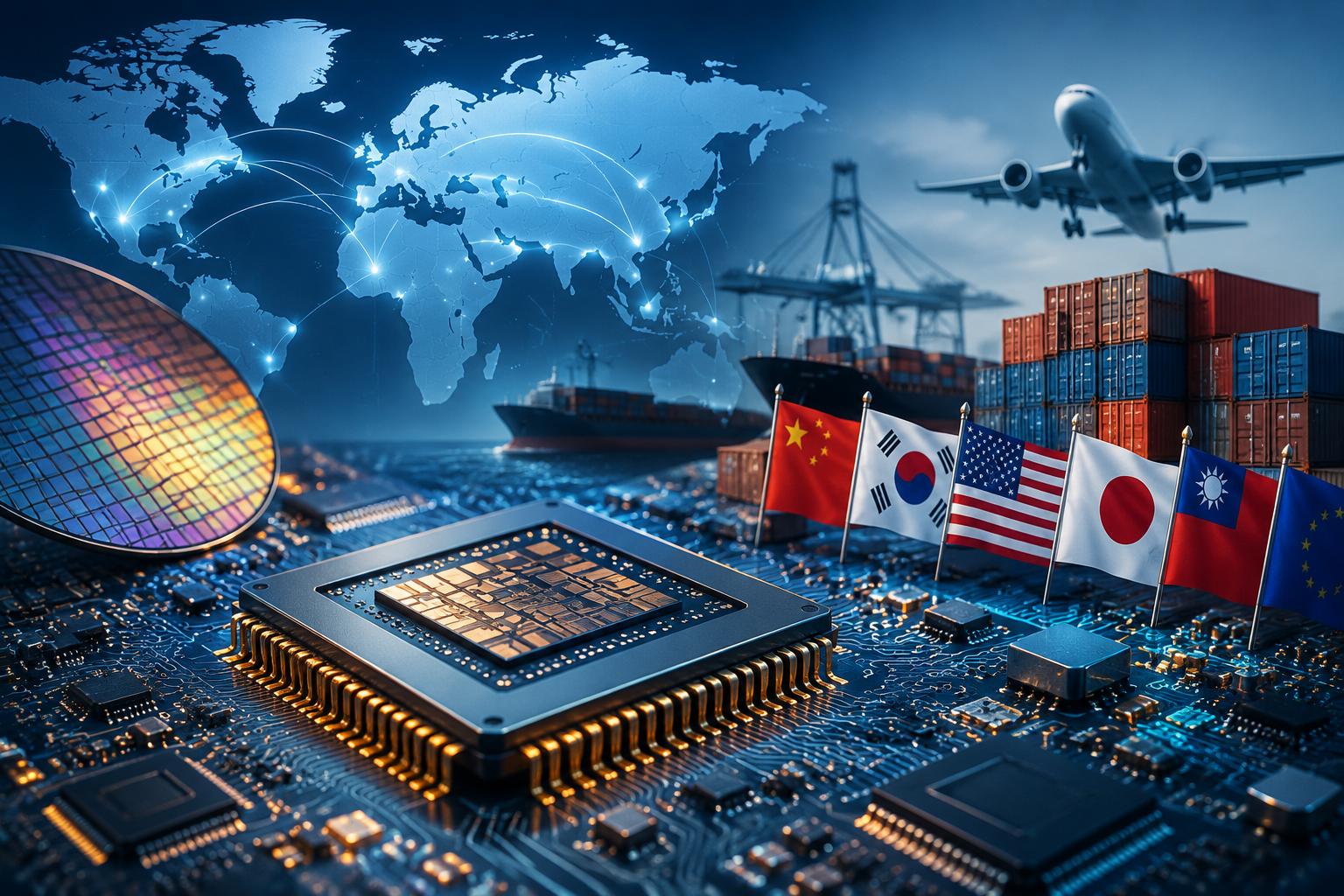
China, the US, South Korea and Japan Continue to Depend on Global Chip Trade Despite Massive Domestic Investments; Experts Say India's Success Will Be Defined by Supply Chain Integration Rather Than Import Elimination
India's ambitious semiconductor mission has become one of the country's most important industrial initiatives, with the government committing over ₹2 trillion in incentives and outlining a vision to become one of the world's top five semiconductor manufacturing hubs by 2032. As new fabrication plants, assembly units and packaging facilities take shape, a common question often arises—will India eventually stop importing semiconductor chips?
The experience of the world's leading semiconductor economies suggests the answer is no. Even countries that dominate global chip production continue importing billions of dollars worth of semiconductors every year because modern chip manufacturing is built on an interconnected global supply chain rather than complete domestic production.
China, despite decades of investment and one of the world's largest electronics manufacturing ecosystems, imported $386.5 billion worth of integrated circuits in 2024, making semiconductors its largest import category by value. Similarly, the United States, South Korea, Japan and Malaysia—all major semiconductor powerhouses—continue importing large volumes of chips because each country specializes in different parts of the semiconductor value chain.
For India, the lesson is clear: semiconductor self-reliance should not be measured by how few chips the country imports, but by how resilient, competitive and strategically important its domestic semiconductor ecosystem becomes.
Semiconductors: The Foundation of the Digital Economy
Semiconductors have evolved into the backbone of nearly every modern industry. From smartphones and laptops to electric vehicles, artificial intelligence and defence systems, chips power the technologies that define today's economy.
Their strategic importance has increased significantly as nations compete for leadership in advanced manufacturing and digital infrastructure.
Today, semiconductors are essential for:
-
Artificial Intelligence (AI)
-
Smartphones and consumer electronics
-
Data centres and cloud computing
-
Electric vehicles (EVs)
-
Renewable energy systems
-
Industrial automation
-
Telecommunications and 5G
-
Aerospace and defence technologies
-
Healthcare equipment
-
Robotics and Internet of Things (IoT)
This rapidly expanding demand has transformed semiconductors into one of the world's most strategically valuable industries.
Why No Country Can Build Every Type of Chip
Unlike many manufacturing sectors where products can be made within a single country, semiconductor production involves an extremely fragmented and specialized global ecosystem.
Manufacturing a single advanced chip requires hundreds of highly sophisticated processing steps spread across multiple countries, each possessing unique technological capabilities.
For example:
United States
The US leads in semiconductor architecture, chip design, Electronic Design Automation (EDA) software and high-performance processors through companies such as Nvidia, AMD, Qualcomm and Intel.
Taiwan
Taiwan dominates leading-edge semiconductor fabrication, manufacturing the world's most advanced chips through foundries such as TSMC.
South Korea
South Korea is the global leader in memory semiconductors, particularly DRAM and NAND flash memory, driven by Samsung Electronics and SK hynix.
Japan
Japan plays a critical role in semiconductor materials, silicon wafers, specialty chemicals and manufacturing equipment.
Netherlands
The Netherlands holds a virtual monopoly in Extreme Ultraviolet (EUV) lithography systems, which are indispensable for manufacturing advanced semiconductor nodes.
Because each country specializes in different technologies, international trade remains fundamental to the semiconductor industry.
China's Massive Imports Highlight the Reality of Global Integration
China provides perhaps the strongest example of why semiconductor imports remain unavoidable.
Despite investing well over $100 billion in domestic semiconductor development and operating the world's largest electronics manufacturing ecosystem, the country imported approximately $386.5 billion worth of integrated circuits during 2024.
Remarkably, China's semiconductor imports exceeded the value of its crude oil imports during the same period.
Yet Beijing continues to expand investments in:
-
Semiconductor fabrication
-
Equipment manufacturing
-
Materials development
-
Research and development
-
Domestic chip design companies
-
Packaging and testing facilities
Rather than eliminating imports, China's strategy focuses on reducing vulnerabilities while strengthening domestic capabilities.
Even Semiconductor Leaders Continue Importing
The trend extends well beyond China.
South Korea
Although South Korea dominates the global memory chip market, it imported around $60.7 billion worth of integrated circuits in 2024 to meet demand for logic chips, automotive semiconductors and specialized processors.
Malaysia
Malaysia has emerged as one of the world's largest semiconductor assembly and testing hubs. Nevertheless, it imported approximately $54.2 billion worth of chips during the year because it depends on imported wafers and advanced semiconductor components.
United States
Despite housing the world's largest semiconductor design companies, the United States imported around $41.3 billion worth of integrated circuits. Much of the manufacturing for American-designed chips continues to take place in Asia.
Japan
Japan remains indispensable in semiconductor materials and manufacturing equipment but still imported roughly $24.3 billion worth of integrated circuits.
India
India imported around $23.5 billion worth of semiconductors in 2024, reflecting the country's rapidly expanding electronics manufacturing and consumer demand.
These figures demonstrate that semiconductor imports are a feature of specialization rather than an indicator of industrial weakness.
Why Countries Continue Importing Chips
Several structural reasons explain why even advanced semiconductor economies rely on imports.
Technology Specialization
No country possesses expertise across every semiconductor category.
Capital Intensity
A cutting-edge semiconductor fabrication plant can cost more than $20 billion, making duplication of every manufacturing capability economically impractical.
Supply Chain Efficiency
Global specialization lowers production costs and accelerates technological innovation.
Rapid Technological Change
Semiconductor technology evolves quickly, requiring continuous upgrades and enormous research investments.
Economies of Scale
Producing every type of chip domestically would significantly increase manufacturing costs.
Consequently, countries focus on areas where they possess a competitive advantage while importing products more efficiently manufactured elsewhere.
China's Biggest Lesson: Build Resilience, Not Isolation
Industry experts increasingly believe that China's semiconductor strategy is centred on resilience rather than isolation.
Despite US export restrictions on advanced processors and manufacturing equipment, China continues to import essential technologies while simultaneously investing in:
-
Indigenous semiconductor equipment
-
Domestic manufacturing capacity
-
Chip design capabilities
-
Advanced materials
-
Local research ecosystems
The objective is to reduce strategic vulnerabilities without disconnecting from the global semiconductor market.
India's Semiconductor Mission Accelerates
India has now launched one of the largest semiconductor incentive programmes in its history.
Government support exceeds $21 billion, including the recently expanded ₹1.27 trillion Semiconductor Programme, aimed at developing an integrated semiconductor manufacturing ecosystem.
The government's roadmap includes:
-
Four to six semiconductor fabrication plants
-
Ten Outsourced Semiconductor Assembly and Test (OSAT) facilities
-
Six to ten compound semiconductor manufacturing units
-
Expansion of semiconductor research and design capabilities
Major projects already underway include:
-
Tata Electronics semiconductor fabrication plant
-
Micron Technology assembly and testing facility
-
Kaynes Technology semiconductor operations
-
CG Power semiconductor manufacturing initiatives
The Tata fabrication plant is expected to begin commercial production around 2028, marking a significant milestone for India's semiconductor journey.
India's Greatest Competitive Advantages
Experts believe India should initially focus on segments where it possesses natural strengths.
Semiconductor Design
India already hosts one of the world's largest semiconductor engineering talent pools.
Assembly and Packaging
OSAT and ATMP operations require relatively lower investment while generating significant employment.
Compound Semiconductors
Growing demand from electric vehicles, renewable energy and defence creates attractive opportunities.
Mature Manufacturing Nodes
Industrial, automotive and consumer electronics increasingly require mature semiconductor technologies.
Semiconductor Intellectual Property
India's software expertise provides a strong foundation for developing semiconductor IP.
Challenges That Still Need to Be Addressed
Although India's semiconductor outlook is promising, several structural challenges remain.
These include:
-
High capital requirements
-
Dependence on imported manufacturing equipment
-
Limited domestic semiconductor materials production
-
Need for highly specialized workforce development
-
Global competition for investment
-
Long project gestation periods
Addressing these challenges will require sustained policy support, private investment and international technology partnerships.
The Global Industry Is Moving Toward Collaborative Growth
Rather than competing to produce every semiconductor domestically, leading economies are increasingly focusing on creating resilient supply chains through strategic specialization.
Countries are investing in areas where they possess comparative advantages while strengthening partnerships across the semiconductor ecosystem.
This collaborative model is expected to define the future of global semiconductor manufacturing.