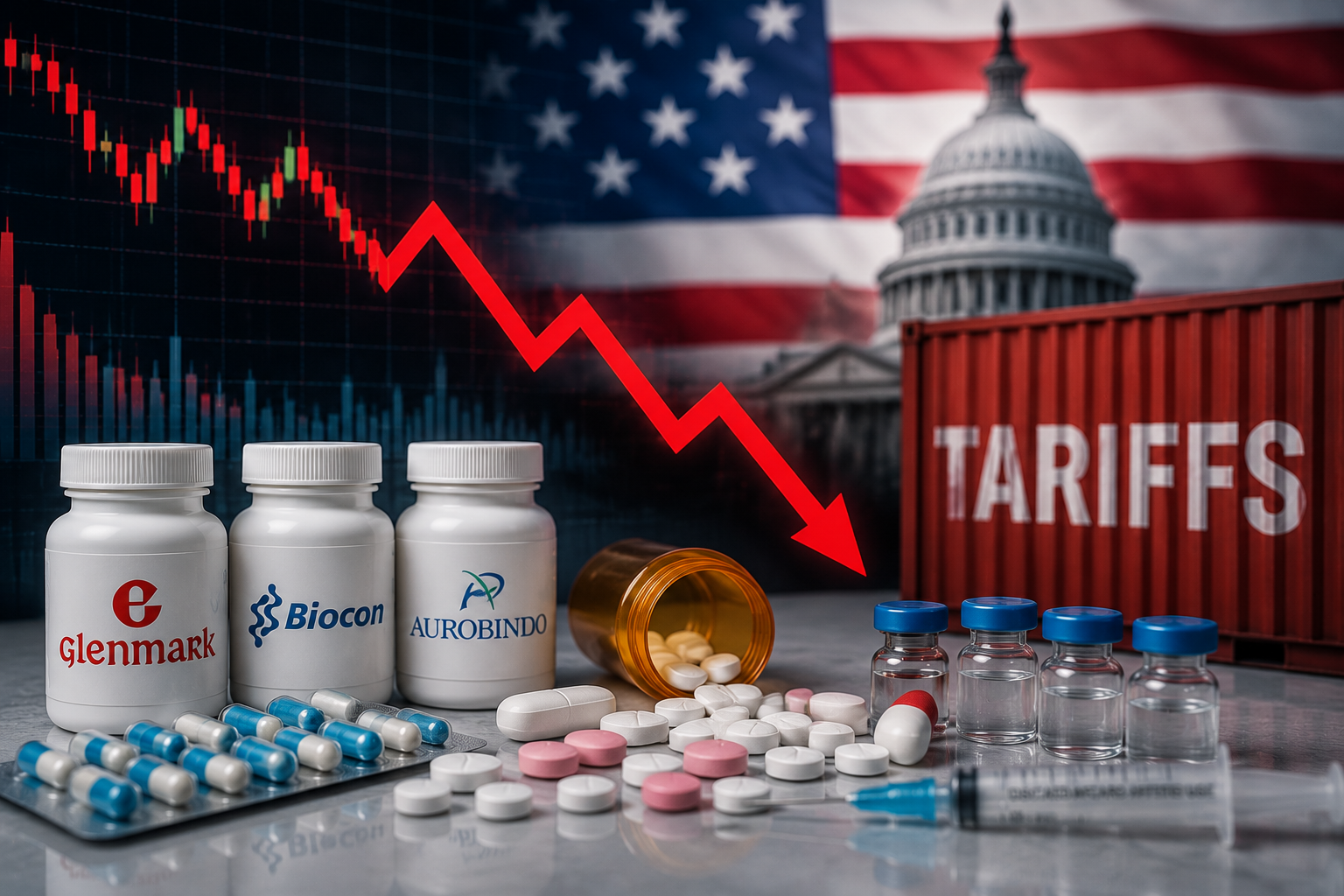
Glenmark, Biocon, Aurobindo, Cipla and Other Export-Focused Drugmakers Decline as Markets React to Proposed US Tariffs of Up to 200% on Generic Medicines
Indian pharmaceutical stocks witnessed sharp selling pressure on Wednesday after US President Donald Trump proposed a phased tariff framework on imported generic medicines, triggering concerns over the long-term outlook for one of India's largest export-oriented industries. The announcement led to broad-based declines across leading pharmaceutical counters, with investors booking profits after the sector's strong rally over the past several months.
The proposed tariff structure, aimed at encouraging pharmaceutical manufacturing within the United States, could eventually impose import duties of up to 200% on generic medicines manufactured outside the US. Although the proposal would not take effect immediately and important implementation details are still awaited, the announcement was enough to dampen investor sentiment across the pharmaceutical sector.
Market experts, however, believe the immediate financial impact on Indian drug manufacturers is likely to be limited, as the proposed tariffs are scheduled to begin only from August 2028, providing companies with significant time to evaluate strategic alternatives.
Nifty Pharma Becomes the Worst Performing Sector
The pharmaceutical sector emerged as one of the biggest losers during Wednesday's trading session.
The Nifty Pharma Index declined nearly 2% in intraday trade before recovering some of its losses later in the session. Even after the recovery, the sector continued to underperform the broader market.
The decline came despite only modest weakness in benchmark indices, highlighting that the selling was largely sector-specific and driven by concerns surrounding the proposed US tariff policy.
The sharp fall also reflected profit booking after the pharmaceutical index recently touched a new lifetime high.
Selling Pressure Across Leading Pharma Stocks
The weakness was visible across almost the entire pharmaceutical sector.
Among the major losers were:
-
Glenmark Pharmaceuticals
-
Biocon
-
Aurobindo Pharma
-
Ajanta Pharma
-
Zydus Lifesciences
-
Sai Life Sciences
-
Cipla
-
Piramal Pharma
Each of these stocks declined by nearly 3% during intraday trading.
Other companies such as:
-
Sun Pharmaceutical Industries
-
Lupin
-
Gland Pharma
-
Wockhardt
also traded lower as investors reduced exposure to export-oriented pharmaceutical businesses.
The broad-based decline indicated that investors were reacting to sector-wide uncertainty rather than company-specific developments.
Understanding Trump's Tariff Proposal
The proposed tariff plan represents another step in the Trump administration's broader strategy of encouraging domestic manufacturing across critical industries.
According to the announcement:
Phase One
Imported generic medicines will continue to attract zero import duty for two years beginning August 1, 2026.
Phase Two
From August 1, 2028, imported generic medicines would face a 100% tariff.
Phase Three
Beginning August 1, 2029, that tariff would increase further to 200% for companies that continue importing medicines without establishing manufacturing operations inside the United States.
The objective is to incentivize pharmaceutical companies to relocate manufacturing facilities to the US while strengthening domestic drug production capabilities.
Why Indian Pharma Is Particularly Vulnerable
India is widely regarded as the "Pharmacy of the World" and remains one of the largest suppliers of affordable generic medicines globally.
The United States is India's most important pharmaceutical export destination.
During FY26:
-
Pharmaceutical exports reached approximately $31 billion.
-
The US accounted for over 30% of India's total pharmaceutical exports.
-
Several listed companies derive a significant portion of their revenue from American healthcare markets.
Because of this dependence, any change in US pharmaceutical policy tends to have a disproportionate impact on investor sentiment toward Indian drug manufacturers.
Companies Most Exposed to the US Market
Several Indian pharmaceutical companies have substantial business exposure to the United States.
Among the most closely watched are:
-
Aurobindo Pharma
-
Dr. Reddy's Laboratories
-
Gland Pharma
-
Glenmark Pharmaceuticals
-
Lupin
-
Cipla
-
Zydus Lifesciences
-
Granules India
-
Sun Pharmaceutical Industries
These companies generate a significant share of revenue from generic medicines sold in the US market.
Any changes in pricing, regulatory requirements or tariff policies therefore have the potential to influence future earnings expectations.
Why the Market Reacted So Sharply
The immediate decline in pharmaceutical stocks was driven more by uncertainty than confirmed financial impact.
Investors typically react negatively whenever policy announcements create uncertainty regarding future profitability.
The possibility of significantly higher import duties naturally raised concerns regarding:
-
Export margins.
-
Pricing competitiveness.
-
Future manufacturing strategy.
-
Capital expenditure requirements.
-
Long-term earnings growth.
Since the detailed implementation framework has not yet been published, investors preferred reducing exposure until greater clarity emerges.
Strong Rally Also Triggered Profit Booking
Another important reason behind Wednesday's decline was valuation.
The pharmaceutical sector has been among India's strongest-performing sectors during 2026.
Performance highlights include:
-
Around 15% gain in the Nifty Pharma Index during calendar year 2026.
-
Approximately 7% appreciation over the past month alone.
-
Record highs achieved earlier this month.
Following such a strong rally, the sector was naturally vulnerable to profit booking after any negative headline.
Analysts believe part of Wednesday's decline reflected investors locking in gains rather than changing their long-term outlook.
Can the US Replace India's Generic Drug Industry?
Industry experts remain skeptical.
Establishing a competitive generic drug manufacturing ecosystem in the United States presents significant challenges.
Building pharmaceutical manufacturing capacity involves:
-
Land acquisition.
-
Plant construction.
-
Equipment installation.
-
Regulatory approvals.
-
Product validation.
-
US FDA inspections.
-
Commercial production.
Industry estimates suggest this process can take three to four years, substantially longer than the proposed transition period.
This makes rapid relocation of manufacturing highly unlikely.
India's Cost Advantage Remains Significant
One of India's biggest competitive strengths continues to be manufacturing efficiency.
According to industry estimates:
-
Manufacturing costs in India remain 40–60% lower than those in the United States.
-
India benefits from an integrated pharmaceutical supply chain.
-
Large-scale API production reduces input costs.
-
Extensive manufacturing clusters improve economies of scale.
-
Skilled scientific manpower supports operational efficiency.
These structural advantages are unlikely to disappear even if tariffs are eventually implemented.
Existing US Operations May Reduce the Impact
Many leading Indian pharmaceutical companies already maintain:
-
Manufacturing facilities.
-
Packaging plants.
-
Distribution centers.
-
Marketing subsidiaries.
-
Research operations.
Some companies may therefore be better positioned to adapt if future policy changes require additional local manufacturing.
The eventual impact will depend on:
-
Product categories.
-
Manufacturing footprint.
-
Transfer pricing.
-
Exemptions.
-
Final implementation guidelines.
Several Key Questions Remain Unanswered
Although the announcement attracted widespread attention, many important details are still unavailable.
Investors continue to await clarification regarding:
-
Which products will be covered?
-
Will essential medicines receive exemptions?
-
How will tariffs be calculated?
-
Will existing US manufacturing qualify?
-
What transition rules will apply?
-
Which companies may receive preferential treatment?
Until these issues are clarified, analysts believe it remains difficult to accurately estimate the financial impact.
Long-Term Industry Fundamentals Remain Strong
Despite current uncertainty, India's pharmaceutical industry continues to benefit from several structural growth drivers.
These include:
Growing Global Demand
An ageing global population continues to increase demand for affordable medicines.
Specialty Pharmaceuticals
Indian companies continue expanding into complex generics and specialty products.
Contract Manufacturing
Global pharmaceutical outsourcing remains an important growth opportunity.
Domestic Healthcare
India's own healthcare market continues expanding rapidly.
Biosimilars
The industry is increasingly investing in higher-value biologic medicines.
These long-term drivers remain largely unaffected by the current tariff proposal.
What Investors Should Monitor
Market participants will closely watch:
-
Formal White House notification.
-
Detailed implementation framework.
-
Responses from Indian pharmaceutical companies.
-
US manufacturing investment announcements.
-
Quarterly earnings commentary.
-
Export data.
-
Regulatory developments.
-
India-US trade negotiations.
These factors will provide greater clarity regarding the future direction of the sector.