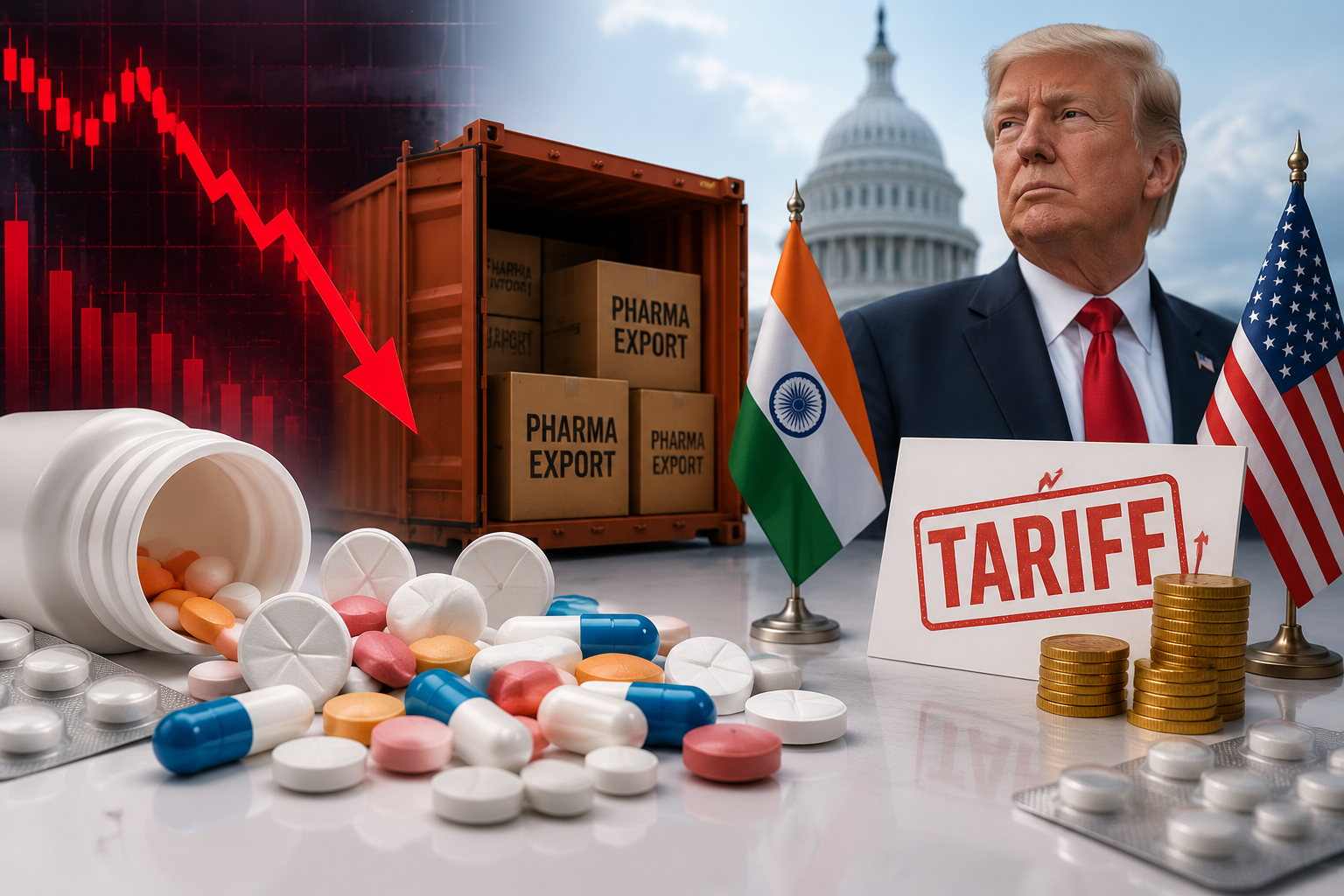
US Proposal Sparks Sell-Off Across Pharma Shares as Investors Assess Long-Term Export Risks; Industry Says Cost Economics Still Favour India
Indian pharmaceutical stocks came under significant selling pressure on Wednesday after US President Donald Trump proposed a phased tariff plan that could impose duties of up to 200% on imported generic medicines over the next three years. The announcement triggered concerns about the future of India's largest pharmaceutical export market, dragging the Nifty Pharma Index to the bottom of the sectoral performance chart.
Although the proposed tariffs would not take effect immediately, investors reacted cautiously to the possibility of a major policy shift in the US healthcare and pharmaceutical industry. Market participants fear that if implemented, the proposal could alter global supply chains, affect export profitability, and reshape the competitive landscape for Indian drug manufacturers.
Despite the immediate negative reaction in the equity market, industry experts believe the proposal faces significant practical and economic challenges, making its long-term impact far less certain than the initial market response suggests.
Pharma Stocks Lead Market Decline
The pharmaceutical sector witnessed broad-based selling soon after markets opened, with the Nifty Pharma Index falling around 1.6%, making it the weakest-performing sector on the National Stock Exchange.
Companies with substantial exposure to the US generic drug market were among the biggest losers.
Major declines included:
-
Cipla – down around 2.5%
-
Lupin – down around 2.5%
-
Sun Pharmaceutical Industries – down nearly 2%
-
Dr. Reddy's Laboratories – down over 1%
-
Aurobindo Pharma
-
Zydus Lifesciences
-
Torrent Pharmaceuticals
-
Alkem Laboratories
The broad-based decline reflected concerns that future earnings from the US market could come under pressure if the proposed tariffs are eventually implemented.
What Exactly Did Trump Announce?
In a post on his Truth Social platform, President Donald Trump outlined a roadmap for imposing tariffs on imported generic medicines as part of his "America First" manufacturing strategy.
According to the proposal:
Phase One
Imported generic medicines will continue to enjoy zero import duty until July 31, 2028.
Phase Two
Beginning August 1, 2028, a 100% tariff would be imposed on imported generic medicines.
Phase Three
From August 1, 2029, the tariff would increase further to 200%.
Trump stated that the objective is to encourage pharmaceutical companies to manufacture medicines inside the United States instead of relying on imports from countries such as India.
Why the US Market Is Critical for Indian Pharma
The United States remains by far the most important overseas market for India's pharmaceutical industry.
During FY26:
-
India's pharmaceutical exports reached a record $31.12 billion.
-
Exports to the US totaled approximately $9.47 billion.
-
The US accounted for more than 30% of India's total pharmaceutical exports.
Indian companies have built a dominant position in supplying affordable generic medicines to the US healthcare system over the past two decades.
A significant disruption to this market could affect revenue growth for several listed pharmaceutical companies.
FY26 Export Slowdown Was Already a Concern
Even before the latest announcement, exports to the United States had shown signs of moderation.
US-bound pharmaceutical exports declined nearly 10% during FY26 despite overall record exports by India.
Industry experts attributed the slowdown to:
-
Generic price erosion.
-
Inventory correction by US distributors.
-
High comparison base.
-
Product lifecycle changes.
-
Temporary supply-chain adjustments.
The latest tariff proposal has added another layer of uncertainty for exporters.
Can the US Build a Generic Manufacturing Ecosystem?
One of the biggest questions surrounding Trump's proposal is whether the United States can realistically develop sufficient domestic manufacturing capacity within the proposed two-year transition period.
Industry executives believe the challenge is enormous.
Building a pharmaceutical manufacturing ecosystem requires:
-
Construction of manufacturing facilities.
-
Installation of sophisticated production equipment.
-
US FDA inspections.
-
Product-specific approvals.
-
Technology transfers.
-
Validation batches.
-
Commercial launch approvals.
Experts estimate that completing this entire process typically requires three to four years, making the proposed timeline highly ambitious.
India's Manufacturing Advantage Remains Strong
Analysts believe India's biggest strength continues to be its cost competitiveness.
Manufacturing generic medicines in India remains significantly cheaper than producing the same products in developed markets.
Industry estimates suggest production costs in India are approximately 40–60% lower than in the United States due to:
-
Lower labour costs.
-
Established API ecosystem.
-
Large-scale manufacturing facilities.
-
Efficient supply chains.
-
Highly skilled pharmaceutical workforce.
-
Extensive regulatory experience.
Even if tariffs are eventually imposed, this structural cost advantage could continue to make Indian suppliers economically attractive for many products.
Existing US Operations May Cushion the Impact
Several leading Indian pharmaceutical companies already have:
-
Manufacturing facilities in the US.
-
Packaging units.
-
Distribution networks.
-
Local subsidiaries.
-
Strategic partnerships.
Analysts point out that the final tariff impact will depend on how products are imported, transferred, and priced within multinational corporate structures.
The absence of detailed implementation rules makes it difficult to estimate the actual financial impact on individual companies.
Higher Drug Prices Could Hurt American Consumers
Healthcare experts warn that aggressive tariffs on generic medicines may ultimately increase healthcare costs in the United States.
Generic medicines account for approximately 90% of all prescriptions dispensed across the country.
If import costs rise significantly:
-
Drug prices may increase.
-
Medicare spending could rise.
-
Medicaid expenditure may increase.
-
Insurance costs could move higher.
-
Medicine shortages may become more frequent.
Affordable generic medicines have played a crucial role in reducing healthcare costs in the US, making any disruption politically sensitive.
Industry Calls for Patience
Leading industry representatives have urged investors not to overreact until formal policy details are released.
Important questions remain unanswered:
-
Which products will be covered?
-
Will life-saving medicines receive exemptions?
-
How will transfer pricing be treated?
-
What valuation method will customs authorities adopt?
-
Which companies will qualify for exemptions?
-
Will existing manufacturing facilities be eligible?
Without these details, analysts believe forecasting the financial impact remains difficult.
Trump's Broader Push for Domestic Manufacturing
The latest proposal is part of a wider strategy aimed at bringing pharmaceutical manufacturing back to the United States.
Over the past two years, the Trump administration has introduced multiple tariff measures covering:
-
Patented medicines.
-
Pharmaceutical ingredients.
-
Drug manufacturing incentives.
-
Domestic production requirements.
Generic medicines had previously remained outside most of these measures, making this proposal a significant policy expansion.
Global Supply Chains May Not Change Overnight
Even if tariffs are implemented, analysts believe global pharmaceutical supply chains cannot be restructured quickly.
The pharmaceutical industry operates under stringent regulatory standards, requiring:
-
Product-specific approvals.
-
Manufacturing validation.
-
Supply-chain qualification.
-
Regulatory inspections.
-
Clinical documentation.
These factors make rapid relocation of manufacturing extremely difficult.
Many multinational companies may instead adopt a gradual diversification strategy rather than abandoning established manufacturing hubs like India.
Impact on Indian Pharma Companies
Companies with Higher US Generic Exposure
-
Dr. Reddy's Laboratories
-
Lupin
-
Aurobindo Pharma
-
Zydus Lifesciences
-
Cipla
-
Sun Pharma
These companies may witness increased investor scrutiny over the coming months.
Companies Better Positioned
Firms with:
-
Diversified geographic revenue.
-
Specialty drug portfolios.
-
Complex generic products.
-
Branded formulations.
-
Domestic market strength.
may prove relatively more resilient if policy uncertainty persists.
What Investors Should Monitor
Going forward, the market will closely watch:
-
Formal White House notification.
-
Legal framework for tariff implementation.
-
Product-specific exemptions.
-
US pharmaceutical manufacturing investments.
-
FDA approval timelines.
-
Indian government response.
-
Export data over the next several quarters.
-
Company management commentary during earnings calls.
These developments will determine whether the proposal evolves into a meaningful long-term challenge or remains largely a negotiating strategy