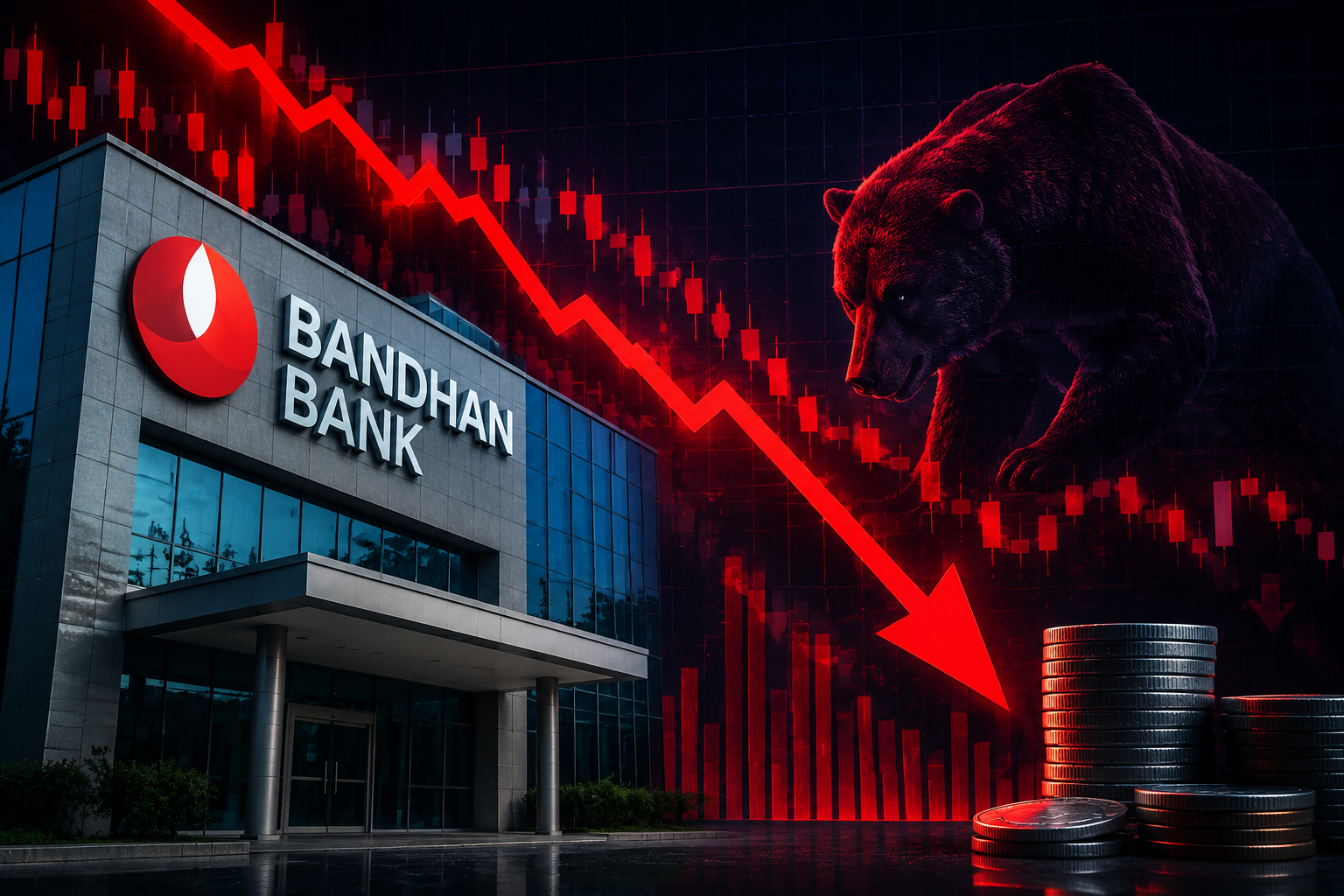
Revised RoA Guidance, Margin Pressure and Rising Operating Costs Weigh on Investor Confidence Despite Stable Asset Quality and Strong Loan Growth
Bandhan Bank Ltd. came under intense selling pressure on Wednesday after reporting a mixed set of first-quarter FY27 results and significantly lowering its profitability guidance for the current financial year. The stock plunged as much as 15% during intraday trading, wiping out a substantial portion of its recent gains, as investors reacted negatively to the bank's weaker earnings outlook and revised return expectations.
While the lender continued to report healthy business growth and improving asset quality, management's cautious commentary on margins and profitability overshadowed the positives, prompting several brokerage firms to cut earnings estimates and revise their outlook.
The sharp correction made Bandhan Bank one of the worst-performing banking stocks of the day and reflected growing investor concerns over the bank's ability to maintain profitability amid an increasingly competitive deposit environment.
Stock Hits Three-Month Low Amid Heavy Selling
Bandhan Bank shares declined to an intraday low of ₹177.50, marking their lowest level since late April 2026. The stock traded around ₹179–180 during the morning session, compared with a decline of less than 1% in the benchmark Sensex.
The fall also erased much of the recent rally, with the stock now trading nearly 19% below its 52-week high of ₹220.70, which it had touched only a week earlier.
Trading volumes surged sharply as institutional investors rushed to exit positions. More than 60 million shares changed hands on the NSE and BSE combined, over six times the stock's average trading volume, indicating strong participation from both domestic and foreign institutional investors.
The sharp spike in volumes suggests that the market's reaction was driven not only by retail selling but also by large institutional portfolio adjustments following the quarterly earnings announcement.
What Triggered the Sharp Fall?
The biggest reason behind the stock's decline was the management's decision to lower its FY27 exit Return on Assets (RoA) guidance.
Bandhan Bank now expects its RoA to reach 1.2%–1.4% by the end of FY27, compared with its earlier target of 1.6%–1.8%.
Although the revision may appear modest numerically, it carries significant implications for investors because RoA is one of the most important indicators of a bank's profitability and capital efficiency.
A lower RoA generally indicates reduced earnings generation from the bank's asset base, leading investors to reassess future earnings potential and valuation multiples.
The downgrade also signaled that management expects profitability challenges to persist longer than previously anticipated.
Mixed Quarterly Performance
Bandhan Bank delivered a quarter that showed resilience in business growth but weakness in profitability.
Key Operational Highlights
-
Healthy loan book expansion.
-
Stable Net Interest Margin (NIM) at 6.2%.
-
Continued improvement in asset quality.
-
Lower credit costs compared with the previous quarter.
-
Strong deposit mobilisation.
However, these positives were overshadowed by rising operating expenses, which significantly reduced operating profitability.
Operating Profit Declines
The bank reported a 19% year-on-year decline in Pre-Provisioning Operating Profit (PPoP).
The decline was primarily driven by:
-
Higher employee expenses.
-
Annual salary revisions.
-
Performance-linked incentives.
-
Increased gratuity provisions.
-
Continued investment in digital technology and IT infrastructure.
-
Lower non-interest income during the quarter.
These factors resulted in operating expenses increasing much faster than revenue growth, squeezing profitability.
Although technology investments are expected to improve efficiency over the long term, the immediate impact has been pressure on earnings.
Net Interest Margin Remains Stable—But Future Looks Challenging
One encouraging aspect of the quarter was that Net Interest Margin (NIM) remained broadly stable at 6.2%.
However, management acknowledged that achieving its earlier target of 6.5% NIM by the end of FY27 now appears increasingly difficult.
The bank cited persistent pressure on deposit costs as the primary reason.
Competition among banks for retail deposits has intensified over the past year, forcing lenders to offer higher interest rates to attract customers.
As funding costs rise, banks find it increasingly difficult to protect lending margins, especially when lending rates cannot increase at the same pace.
This margin compression remains one of the biggest concerns for banking investors.
Asset Quality Continues to Improve
Despite concerns surrounding profitability, Bandhan Bank continued to demonstrate improving credit quality.
Gross slippages and net slippages both improved sequentially during the quarter, while credit costs moderated slightly.
The bank maintained its FY27 credit cost guidance of 1.6%–1.8%, suggesting that management remains confident about the quality of its loan portfolio.
Lower credit costs provide a cushion for future profitability, although they may not be sufficient to offset the pressure from higher operating expenses.
Loan Growth Remains Healthy
Bandhan Bank retained its guidance of approximately 14% loan growth for FY27.
Strong loan growth indicates that credit demand remains healthy across the bank's core markets despite the challenging macroeconomic environment.
Management believes that continued business expansion will eventually support earnings recovery once margin pressures begin to ease.
However, analysts believe that higher funding costs may delay the full benefits of this growth.
Leadership Transition Raises Additional Questions
Adding to investor caution, the bank also announced a change in its senior leadership.
Chief Financial Officer Rajeev Mantri will step down on September 25, 2026, while Vinay Jain, currently Head of Finance & Accounts, will assume the role of Interim CFO from September 26, 2026 until March 31, 2027.
Although management described the transition as part of an orderly succession process, investors generally prefer stability in senior management during periods of earnings uncertainty.
What Brokerages Are Saying
JM Financial
JM Financial described the quarter as weaker than expected on profitability despite stable asset quality.
The brokerage believes earnings recovery will take longer due to:
-
Delayed margin expansion.
-
Higher operating expenses.
-
Slower operating leverage benefits.
It reduced FY27 and FY28 earnings estimates slightly while maintaining an "Add" recommendation with a target price of ₹220.
ICICI Securities
ICICI Securities highlighted that the bank's balance sheet continues to strengthen but acknowledged that pressure on funding costs is likely to limit profitability over the near term.
The brokerage expects deposit competition to remain intense, making margin improvement more difficult than previously anticipated.
Motilal Oswal Financial Services
Motilal Oswal adopted a more cautious stance.
The brokerage believes the revised guidance reflects:
-
Rising competition in deposits.
-
Global macroeconomic uncertainty.
-
Continued pressure on margins.
It reduced FY27 earnings estimates by 14% and FY28 estimates by 6%, while downgrading the stock to Neutral with a target price of ₹225.
Why Deposit Costs Matter So Much
One of the biggest structural challenges facing Indian banks today is the intense competition for deposits.
Banks have been aggressively raising deposit rates to attract retail savings, leading to higher funding costs across the industry.
For lenders like Bandhan Bank, whose profitability historically benefited from relatively low-cost deposits, this trend directly impacts Net Interest Margins and earnings.
Unless deposit costs stabilize or interest rates begin to decline, profitability may remain under pressure.
Valuation Reset Underway
The sharp correction in Bandhan Bank's share price suggests that investors are recalibrating valuation expectations.
Although the bank continues to trade at attractive valuation multiples compared to some private-sector peers, the market is now demanding greater visibility on:
-
Sustainable RoA improvement.
-
Margin recovery.
-
Cost rationalisation.
-
Consistent earnings growth.
Future valuation expansion is likely to depend on management's ability to restore profitability over the coming quarters.
Key Monitorables for Investors
Going forward, investors will closely watch:
-
Net Interest Margin trends.
-
Deposit growth and cost of funds.
-
Progress in reducing operating expenses.
-
Asset quality and credit costs.
-
Quarterly earnings momentum.
-
Execution under the new finance leadership.
-
Return on Assets improvement.
-
Return on Equity recovery.
The next two to three quarters are expected to be crucial in determining whether Bandhan Bank can regain investor confidence.