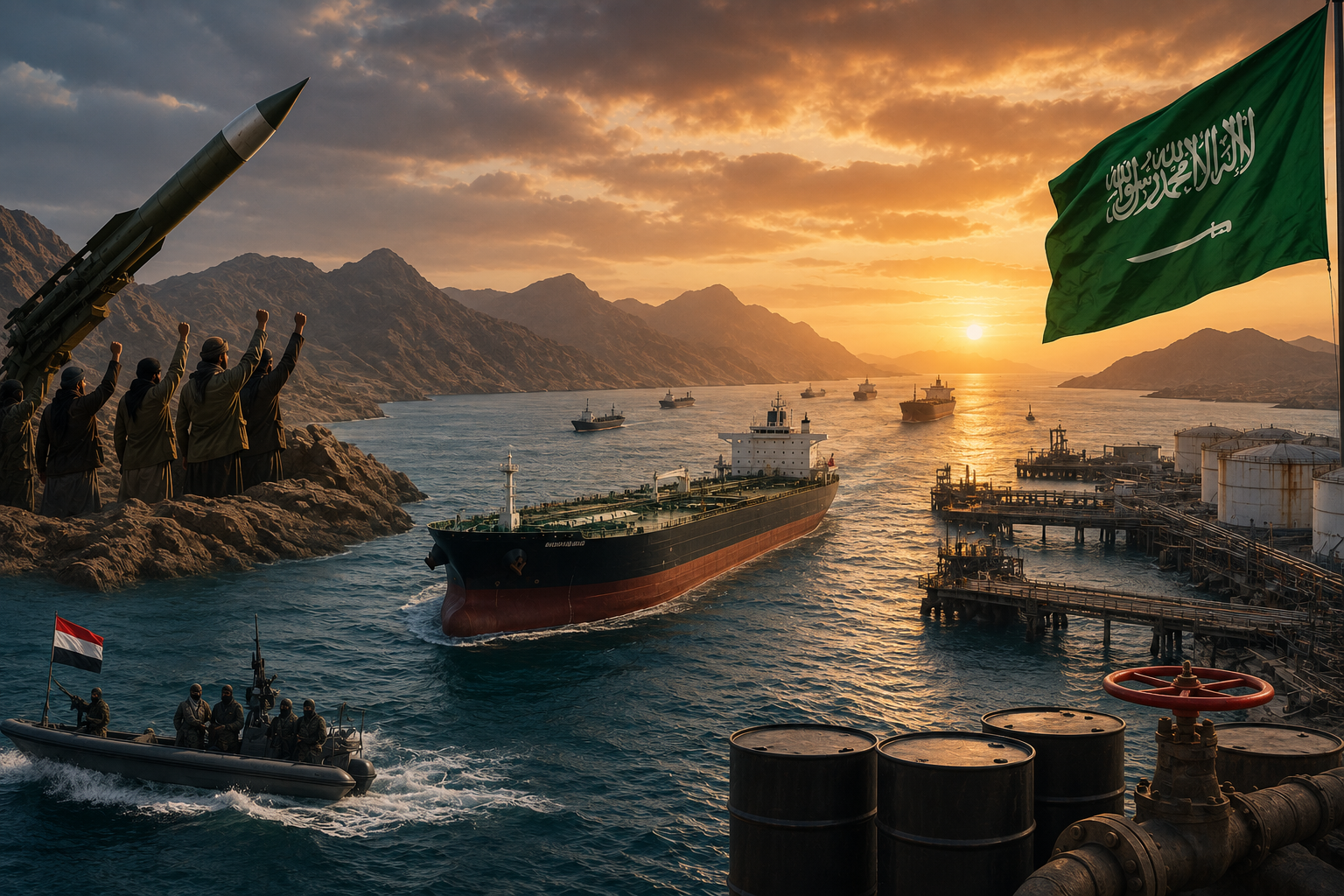
Threat to Bab el-Mandeb Strait Could Disrupt Saudi Crude Exports, Increase Shipping Costs and Fuel Global Inflation Concerns
The security situation in West Asia has taken another concerning turn after Yemen's Houthi movement announced a naval blockade on Saudi Arabia, threatening one of the world's most strategically important maritime trade routes. The development has heightened fears of fresh disruptions to global oil supplies, international shipping and energy markets, which have already been grappling with geopolitical tensions across the region.
The Houthis, officially known as Ansar Allah, declared what they described as an immediate maritime embargo on Saudi Arabia, warning that any further escalation would trigger a broader and more decisive response. The announcement follows recent military exchanges between the Houthis and Saudi-backed forces, renewing concerns over the stability of global energy supply chains.
For oil-importing nations, shipping companies and financial markets, the latest escalation has revived memories of previous Red Sea attacks that significantly disrupted global trade and pushed freight and insurance costs sharply higher.
Houthis Declare Maritime Embargo on Saudi Arabia
The Houthi leadership announced that it was imposing an immediate naval blockade against Saudi Arabia, describing the move as retaliation for what it called years of economic restrictions imposed on Yemen.
According to the group's statement, Saudi Arabia has maintained an economic blockade through restrictions on Yemeni ports and airports for more than a decade. The Houthis argued that the new maritime embargo represents a reciprocal response and warned that any military escalation by Saudi Arabia would be met with stronger action.
Although it remains uncertain how effectively the blockade can be enforced, the announcement has raised concerns among global energy traders and shipping operators.
Attack on Sanaa Airport Triggers Latest Escalation
The latest tensions follow an attack on Sanaa International Airport, which the Houthis blamed on Saudi Arabia.
Yemen's internationally recognised government, however, claimed responsibility for the operation, stating that the strike was intended to prevent an Iranian aircraft from landing in the capital.
Following the incident, the Houthis reportedly launched ballistic missiles targeting Saudi Arabia's Abha International Airport. Saudi authorities stated that their air defence systems successfully intercepted the missiles, preventing significant damage.
The exchange has further heightened military tensions in a region already facing multiple security challenges.
Bab el-Mandeb Strait Emerges as the New Flashpoint
At the heart of the crisis lies the Bab el-Mandeb Strait, one of the world's most important maritime chokepoints.
Situated between Yemen and the Horn of Africa, the narrow waterway connects the Red Sea with the Gulf of Aden and serves as the primary gateway between the Indian Ocean and the Suez Canal.
Every year, thousands of cargo vessels carrying crude oil, liquefied natural gas (LNG), manufactured goods and container shipments pass through this strategic corridor.
Industry estimates suggest that:
-
Around 10–12% of global trade passes through the route.
-
Nearly one-third of the world's container traffic depends on the corridor.
-
Millions of barrels of crude oil and petroleum products move through the strait every day.
Any prolonged disruption could have immediate consequences for global supply chains.
Saudi Arabia's Oil Export Strategy Faces New Challenges
Saudi Arabia has increasingly relied on Red Sea export routes after security concerns affected shipments through the Strait of Hormuz.
The kingdom transports crude oil through its East-West Pipeline, also known as Petroline, linking oil fields in eastern Saudi Arabia to the Red Sea export terminal at Yanbu.
From Yanbu, oil tankers pass through the Bab el-Mandeb Strait before reaching Asian and European markets.
A disruption along this route could:
-
Delay crude exports.
-
Increase transportation costs.
-
Reduce global oil availability.
-
Create volatility in international energy markets.
Energy analysts believe that even the threat of disruption is enough to influence crude oil prices.
Global Shipping Industry Could Face Fresh Disruptions
The maritime industry has been closely monitoring developments in the Red Sea since late 2023, when Houthi attacks on commercial vessels forced many shipping companies to reroute cargo around Africa.
If vessels are again forced to avoid the Bab el-Mandeb Strait and the Suez Canal, ships travelling between Asia and Europe may have to take the much longer Cape of Good Hope route.
Such diversions could add between 10 and 14 days to shipping schedules while increasing:
-
Fuel consumption.
-
Freight charges.
-
Marine insurance premiums.
-
Delivery timelines.
-
Logistics costs for global businesses.
The additional costs would likely be passed on to consumers, contributing to inflationary pressures worldwide.
Oil Markets Watch Geopolitical Risks Closely
Energy markets are particularly sensitive to disruptions involving key oil-producing regions.
Analysts estimate that several million barrels of petroleum products move through the Bab el-Mandeb Strait every day. Any interruption to this flow could tighten global supplies and increase benchmark crude prices.
The situation becomes even more significant if tensions simultaneously affect the Strait of Hormuz, another critical energy corridor through which a substantial portion of the world's crude oil exports passes.
Should both maritime routes experience prolonged disruptions, global oil availability could decline sharply, leading to higher fuel prices and greater market volatility.
Financial Markets Brace for Increased Volatility
Geopolitical risks often trigger heightened uncertainty across financial markets.
Investors typically respond by shifting investments toward safe-haven assets such as:
-
Gold.
-
US Treasury bonds.
-
US Dollar.
-
Defensive equity sectors.
Meanwhile, sectors that depend heavily on fuel costs—including airlines, logistics companies, shipping firms and chemical manufacturers—could experience increased earnings pressure if oil prices continue rising.
Conversely, upstream oil producers and energy companies may benefit from stronger crude prices.
Potential Impact on India's Economy
India, one of the world's largest crude oil importers, remains particularly exposed to developments in West Asia.
Higher international crude prices could lead to:
-
Increased import bills.
-
Pressure on the Indian rupee.
-
Higher transportation costs.
-
Rising inflation.
-
Challenges for government fiscal management.
Industries such as aviation, paints, chemicals, plastics and logistics may witness increased input costs if elevated crude prices persist.
However, Indian oil exploration and production companies could benefit from stronger international crude prices.
Who Are the Houthis?
The Houthis emerged in northern Yemen during the late 1990s as a religious and political movement representing followers of the Zaydi branch of Shia Islam.
The group gradually expanded its military capabilities and captured Yemen's capital, Sanaa, in 2014, leading to a prolonged civil war.
Since then, the Houthis have controlled large parts of northern Yemen while the internationally recognised government continues to operate from the southern city of Aden.
The movement has frequently been accused by Saudi Arabia and several Western countries of receiving military support from Iran, allegations that Tehran has consistently denied.
International Community Monitors Situation Closely
Governments and international organizations are expected to closely monitor developments in the coming days.
Any sustained disruption to maritime trade in the Red Sea could prompt greater naval deployments, diplomatic engagement and coordinated efforts to ensure freedom of navigation through one of the world's busiest commercial shipping lanes.
Energy traders, insurers and shipping companies are also assessing contingency plans as geopolitical uncertainty continues to rise.
Outlook
The Houthis' announcement of a naval blockade against Saudi Arabia marks another significant escalation in the ongoing conflict in West Asia. While the practical implementation of the blockade remains uncertain, the threat alone has intensified concerns over the security of critical global shipping routes and energy infrastructure.
With the Bab el-Mandeb Strait serving as a vital gateway for international trade and oil transportation, any prolonged disruption could reverberate across global supply chains, increase freight costs and push crude oil prices higher. The coming weeks will be crucial as governments, shipping operators and energy markets closely watch whether diplomatic efforts can prevent further escalation.