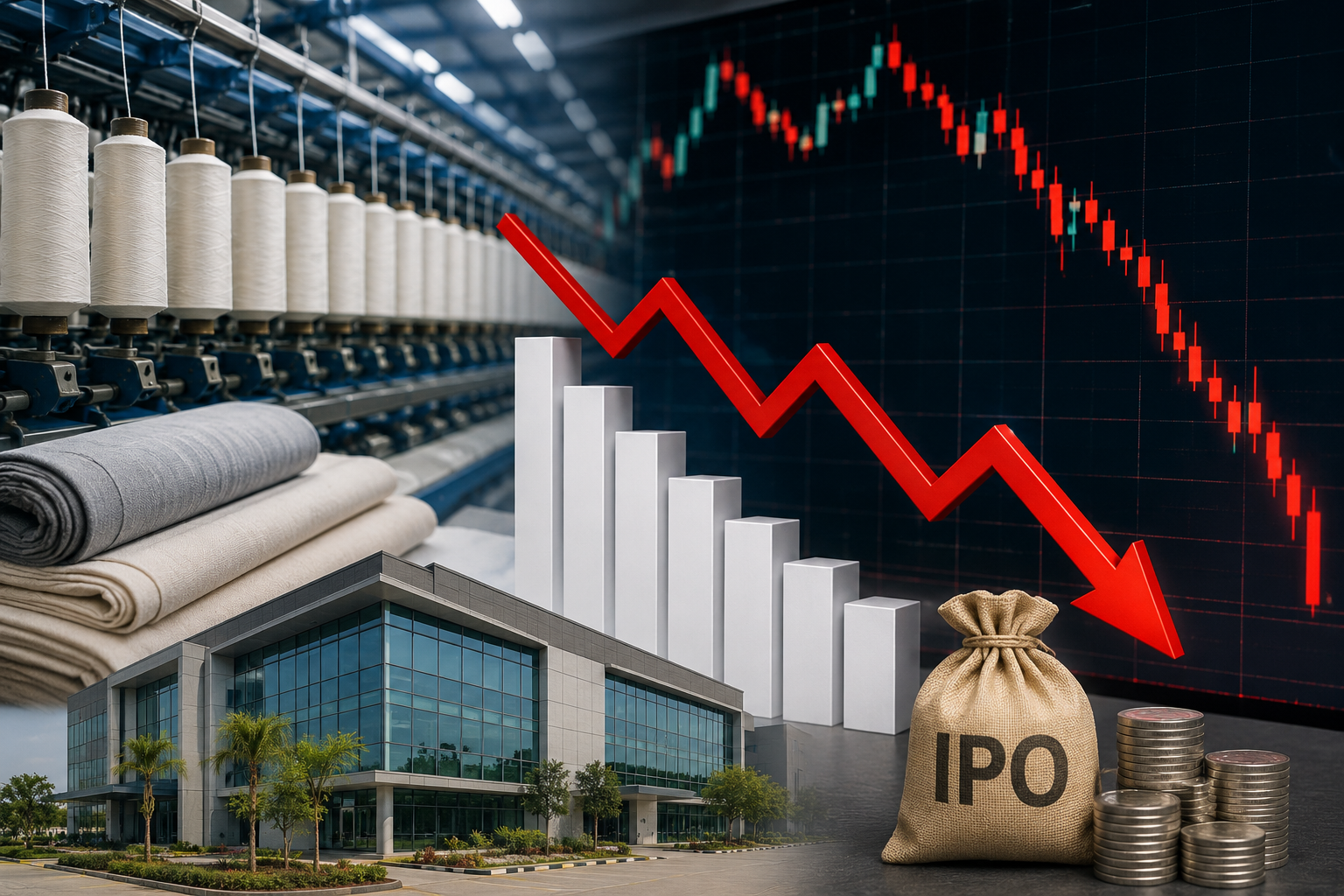
Textile Manufacturer Lists at Issue Price Before Sliding 5%; Investors Await Execution of Expansion Plans and Earnings Growth
Shares of Alpine Texworld Ltd witnessed a disappointing debut on the stock exchanges on Tuesday, listing at the issue price before falling to the 5% lower circuit during intraday trading. The weak performance reflected cautious investor sentiment, with the textile company's stock failing to deliver any listing gains despite a fully subscribed public issue and healthy financial performance.
The listing underscores the changing dynamics in India's primary market, where investors are increasingly focusing on valuations, institutional participation and long-term business prospects rather than subscription figures alone. While Alpine Texworld enters the listed space with ambitious expansion plans and an integrated manufacturing model, the stock's first trading session suggests that the market is adopting a wait-and-watch approach.
Stock Makes Flat Debut on Both Exchanges
Alpine Texworld made its stock market debut at ₹105 per share on both the BSE and the NSE, exactly matching the upper end of the IPO price band.
The flat listing meant that investors who were expecting listing gains did not receive any immediate premium over the issue price.
Shortly after listing, selling pressure intensified and the stock declined to ₹99.75, triggering the 5% lower circuit on the BSE. Once the lower circuit limit was reached, trading in the counter was temporarily halted.
The sharp decline after listing indicates that a section of investors preferred to exit immediately amid subdued market enthusiasm.
Market Capitalisation Begins at Over ₹400 Crore
Following its listing, Alpine Texworld entered the public markets with a market capitalisation of approximately ₹401.5 crore.
The company now joins India's listed textile manufacturing space at a time when the industry is witnessing gradual recovery in domestic demand, increased focus on exports and higher investments in modern manufacturing technologies.
The stock's future performance will largely depend on the company's ability to execute its expansion plans and maintain healthy profitability.
IPO Witnessed Moderate Subscription
The company's ₹126.2 crore Initial Public Offering (IPO) consisted entirely of a fresh issue of 1.20 crore equity shares, with no offer-for-sale component.
The IPO was priced in the range of ₹100 to ₹105 per share, with investors required to apply for a minimum lot of 142 shares.
Overall, the issue was subscribed approximately 1.4 times, reflecting moderate investor participation.
Category-wise subscription was as follows:
-
Retail Individual Investors (RII): 1.54 times
-
Qualified Institutional Buyers (QIB): 1.09 times
-
Non-Institutional Investors (NII): 1.09 times
While the issue was fully subscribed, the relatively modest demand from institutional investors may have contributed to the absence of a listing premium.
IPO Proceeds to Fund Manufacturing Expansion
The company intends to utilise the funds raised through the IPO primarily for capacity expansion and financial strengthening.
A major portion of the proceeds will be invested in establishing a new weaving unit at its proposed Manufacturing Unit-3 in Ahmedabad.
The expansion is expected to:
-
Increase grey fabric production capacity.
-
Improve operational efficiency.
-
Strengthen the company's integrated manufacturing capabilities.
-
Support future revenue growth.
The company will also use part of the proceeds to reduce existing borrowings, thereby improving its balance sheet and lowering finance costs.
Remaining funds will be allocated toward general corporate purposes and working capital requirements.
Integrated Textile Business Model
Alpine Texworld operates as an integrated textile manufacturer engaged in multiple stages of textile production.
Its operations include:
-
Cotton yarn manufacturing.
-
Grey fabric production.
-
Yarn sizing services.
-
Spinning operations.
-
Weaving activities.
The company's manufacturing facilities are located in Ahmedabad, Gujarat, and utilise automated machinery designed to improve production efficiency and maintain product quality.
Vertical integration allows the company to manage costs more effectively while ensuring better control over the production process.
Renewable Energy Supports Operations
An important feature of Alpine Texworld's manufacturing infrastructure is its investment in renewable energy.
The company has installed solar power plants at its manufacturing facilities to support production activities.
The use of renewable energy helps:
-
Reduce electricity costs.
-
Improve operational efficiency.
-
Lower carbon emissions.
-
Enhance long-term sustainability.
As environmental standards become increasingly important in global textile supply chains, such initiatives could strengthen the company's competitiveness.
Subsidiary Adds Production Capacity
Alpine Texworld also operates through its subsidiary, Alpine Cottweave LLP, which is engaged in weaving operations.
The subsidiary complements the parent company's integrated manufacturing strategy and contributes to overall production capabilities.
The combined operations provide flexibility in meeting customer requirements across different textile segments.
Strong Financial Performance Before Listing
Prior to listing, the company reported healthy financial performance for FY26.
On a consolidated basis, Alpine Texworld recorded:
-
Revenue: ₹342.7 crore
-
EBITDA: ₹47.4 crore
-
Profit After Tax (PAT): ₹21.7 crore
The steady profitability reflects efficient manufacturing operations and provides a solid base for future expansion.
Investors will now watch whether the planned capacity additions translate into higher revenues and improved earnings over the coming years.
Why Did the Stock Fall After Listing?
Several factors may explain the weak listing performance.
Lack of Listing Premium Expectations
Market expectations for listing gains remained limited due to moderate subscription levels and cautious grey market sentiment.
Profit Booking
Some successful IPO applicants may have exited immediately after listing to lock in available liquidity.
Broader Market Conditions
Weak sentiment in the broader equity market also weighed on investor appetite for newly listed stocks.
Institutional Participation
The relatively modest subscription from institutional investors reduced confidence regarding strong post-listing demand.
Growth Opportunities Going Forward
Despite the weak debut, Alpine Texworld has several long-term growth drivers.
Capacity Expansion
The new weaving facility could significantly increase production capacity.
Rising Domestic Textile Demand
India's expanding apparel and textile industry may support higher order inflows.
Export Opportunities
Integrated manufacturing may improve competitiveness in international markets.
Operational Efficiency
Automation and renewable energy investments could enhance margins over time.
Debt Reduction
Lower borrowings may strengthen profitability and improve financial flexibility.
Key Risks Investors Should Monitor
Alongside growth opportunities, investors should also consider potential risks.
These include:
-
Volatility in cotton prices.
-
Fluctuations in export demand.
-
Changes in global textile trade.
-
Raw material cost inflation.
-
Capacity utilisation at the new manufacturing facility.
-
Competition within India's textile industry.
The company's ability to manage these challenges will influence its long-term financial performance.
Outlook
Although Alpine Texworld's listing failed to generate immediate gains, the company's long-term investment case will depend less on its debut-day performance and more on operational execution. Successful commissioning of the new weaving unit, efficient deployment of IPO proceeds, continued profitability and expansion in textile demand could support earnings growth over the medium term.
As India's textile sector continues to modernise and expand, investors are likely to focus on Alpine Texworld's ability to convert its integrated manufacturing model into sustained revenue growth and improved shareholder value.