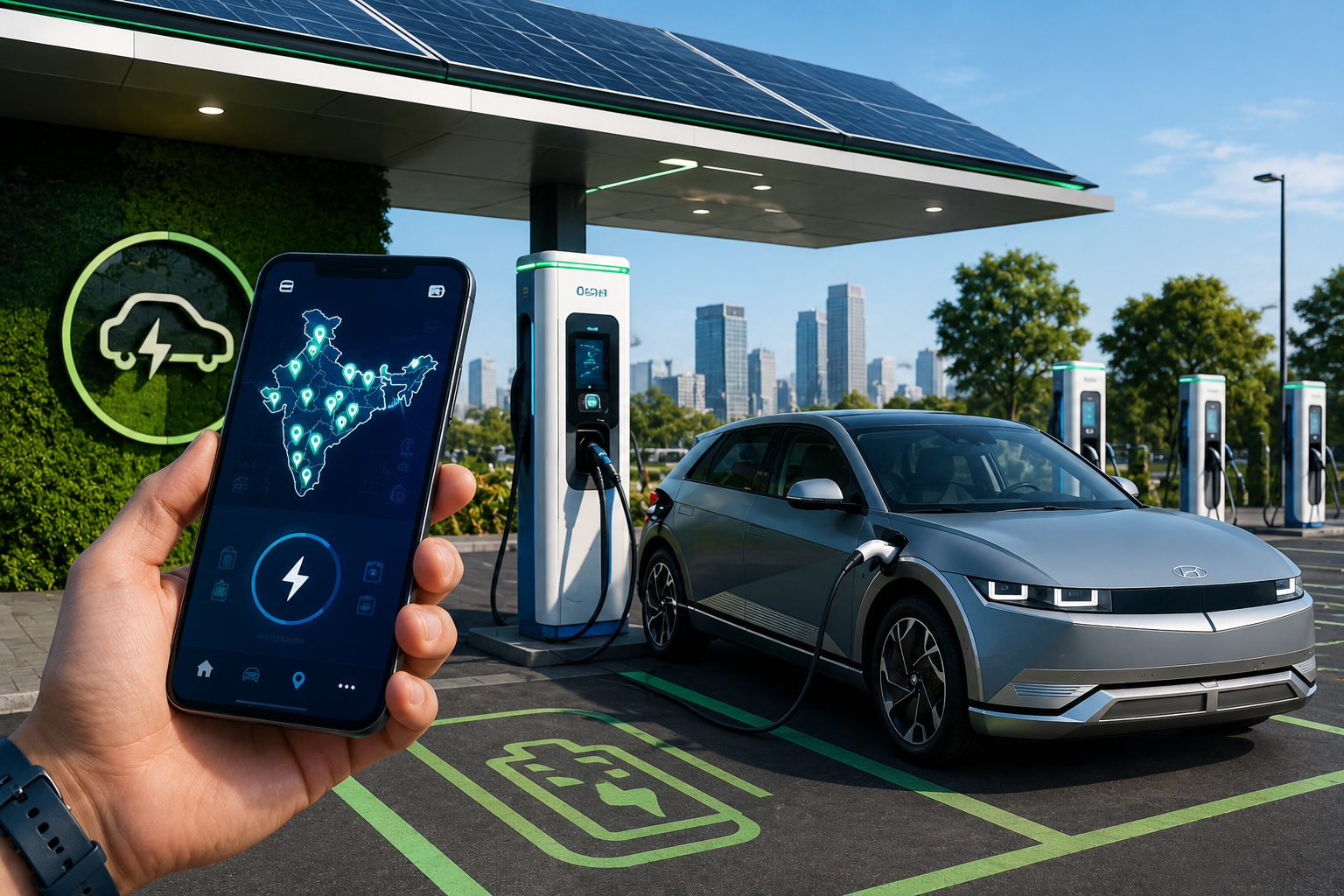
myHyundai App Now Offers Access to One of India's Largest Integrated EV Charging Networks; Company Targets 600 Proprietary DC Fast Charging Stations by 2030
Hyundai Motor India Ltd. (HMIL) has reached a significant milestone in India's electric mobility journey by providing access to more than 30,000 electric vehicle (EV) charging points through its myHyundai mobile application. The achievement strengthens Hyundai's commitment to building a comprehensive EV ecosystem while addressing one of the biggest barriers to electric vehicle adoption—charging accessibility.
The company has integrated multiple charging networks from leading Charge Point Operators (CPOs) into a single digital platform, enabling Hyundai EV owners to locate, access, and manage charging sessions without switching between multiple applications.
Alongside this milestone, Hyundai reaffirmed its ambitious infrastructure roadmap, announcing plans to expand its proprietary DC fast public charging network from the current 183 stations to 600 stations by 2030. The move reflects the automaker's long-term confidence in India's rapidly evolving EV market and its strategy to offer a seamless ownership experience beyond vehicle sales.
30,000 Charging Points Through a Single Digital Platform
The myHyundai application has evolved into an integrated mobility platform that provides Hyundai EV customers with access to one of the country's largest charging ecosystems.
Rather than relying on multiple charging applications from different operators, users can now locate and access thousands of charging stations through a single interface.
Key features include:
-
Live charging station availability
-
Navigation to nearby chargers
-
Integration with multiple Charge Point Operators
-
Digital charging management
-
Seamless user experience
-
Single-platform accessibility
This unified approach simplifies EV charging while significantly improving convenience for users across urban centers, highways, and emerging EV corridors.
Charging Infrastructure Becomes a Strategic Priority
Charging infrastructure has become one of the most important differentiators among automobile manufacturers entering the electric vehicle market.
While vehicle technology continues to evolve rapidly, customer confidence increasingly depends on the availability of reliable charging networks.
Hyundai's investment in both digital integration and physical charging infrastructure demonstrates that the company is focusing on the complete ownership experience rather than vehicle sales alone.
As India's EV ecosystem matures, companies capable of offering integrated mobility solutions are expected to enjoy stronger customer retention and brand loyalty.
Hyundai to Triple Its Fast-Charging Network
Speaking about the company's future roadmap, Hyundai Motor India Managing Director and CEO Tarun Garg reiterated the company's plan to significantly expand its proprietary charging network.
Current Network
-
183 proprietary DC fast charging stations
2030 Target
-
600 proprietary DC fast public charging stations
This expansion represents more than a threefold increase and will strengthen Hyundai's charging footprint across major cities, highways, and strategic travel corridors.
Fast chargers are particularly important because they can recharge EV batteries much faster than conventional AC chargers, reducing waiting times and making long-distance travel more practical.
Why Charging Infrastructure Matters
Despite growing consumer interest in electric vehicles, charging accessibility continues to remain one of the biggest concerns among potential buyers.
A widespread charging network helps address several challenges:
Reduced Range Anxiety
Drivers gain confidence knowing charging stations are widely available.
Improved Convenience
Integrated charging reduces the need to maintain multiple applications and payment systems.
Support for Long-Distance Travel
Fast chargers along highways make intercity EV travel increasingly feasible.
Higher EV Adoption
Better infrastructure encourages more consumers to transition from internal combustion engine vehicles to electric mobility.
India's EV Market Enters the Next Phase
India's electric vehicle industry is witnessing rapid structural transformation.
Several factors are driving long-term growth:
-
Government incentives under FAME and state EV policies.
-
Increasing investments by global automobile manufacturers.
-
Rising fuel prices encouraging EV adoption.
-
Falling lithium-ion battery costs.
-
Expansion of domestic battery manufacturing.
-
Greater environmental awareness.
-
Improved charging infrastructure.
Although passenger EV penetration remains relatively low, industry experts expect adoption to accelerate significantly over the next decade.
Digital Ecosystems Becoming a Competitive Advantage
Modern automobile companies are increasingly competing through software and connected services in addition to hardware.
Hyundai's myHyundai application has evolved into a comprehensive ownership platform offering:
-
Vehicle information.
-
Charging station locator.
-
Service scheduling.
-
Connected car features.
-
Vehicle health monitoring.
-
Customer support.
-
Digital ownership management.
Such integrated digital ecosystems enhance customer engagement while creating recurring touchpoints throughout the ownership lifecycle.
Hyundai's Broader Electrification Strategy
Charging infrastructure forms an important part of Hyundai's larger electrification roadmap for India.
The company's strategy focuses on:
Expanding EV Portfolio
Introducing new electric models across multiple price segments.
Building Charging Infrastructure
Increasing fast-charging availability nationwide.
Connected Mobility
Offering intelligent digital solutions for EV users.
Strategic Partnerships
Collaborating with leading charging operators to expand accessibility.
Sustainable Mobility
Supporting India's transition toward cleaner transportation.
This integrated strategy positions Hyundai as a full mobility solutions provider rather than solely an automobile manufacturer.
Competitive Landscape Intensifies
The Indian EV ecosystem has become increasingly competitive.
Leading automobile manufacturers are actively investing in charging infrastructure alongside vehicle launches.
Industry participants include:
-
Tata Motors
-
Mahindra
-
MG Motor India
-
BYD India
-
JSW MG
-
Kia India
-
Hyundai Motor India
Competition is gradually shifting from product offerings alone to complete ownership ecosystems that include charging, software, connectivity, and after-sales support.
Opportunities for Charging Operators
Hyundai's platform integration also creates opportunities for Charge Point Operators (CPOs).
As more charging networks become accessible through unified applications, operators benefit from:
-
Higher charger utilization.
-
Increased customer traffic.
-
Greater interoperability.
-
Improved digital payments.
-
Enhanced visibility among EV owners.
This collaborative ecosystem is expected to accelerate charging infrastructure expansion across India.
Challenges Remain
Despite strong momentum, several challenges continue to influence India's EV ecosystem.
Infrastructure Investment
Building nationwide charging networks requires substantial capital expenditure.
Grid Capacity
Electricity infrastructure must expand alongside EV adoption.
Standardization
Interoperability between charging operators remains important.
Technology Evolution
Rapid improvements in battery technology require continuous infrastructure upgrades.
Utilization Levels
Charging stations need sufficient usage to generate attractive returns on investment.
Addressing these issues will be critical for sustainable ecosystem development.
Industry Outlook Remains Strong
India is expected to witness one of the fastest-growing EV markets globally over the next decade.
Growth is likely to be supported by:
-
Government policy support.
-
Declining battery costs.
-
Higher consumer awareness.
-
Expanding charging infrastructure.
-
Increased model availability.
-
Corporate fleet electrification.
-
Growing renewable energy integration.
Companies investing early in charging infrastructure are expected to gain long-term competitive advantages as EV adoption accelerates.
What This Means for Investors
Hyundai's charging network expansion highlights a broader shift in the automotive industry from selling vehicles to building integrated mobility ecosystems. Companies that invest in charging infrastructure, digital connectivity, and customer services are likely to strengthen brand loyalty and create additional revenue opportunities beyond vehicle sales.
The continued expansion of Hyundai's proprietary fast-charging network also demonstrates management's confidence in India's long-term EV growth story, positioning the company to capitalize on rising demand for electric mobility solutions.