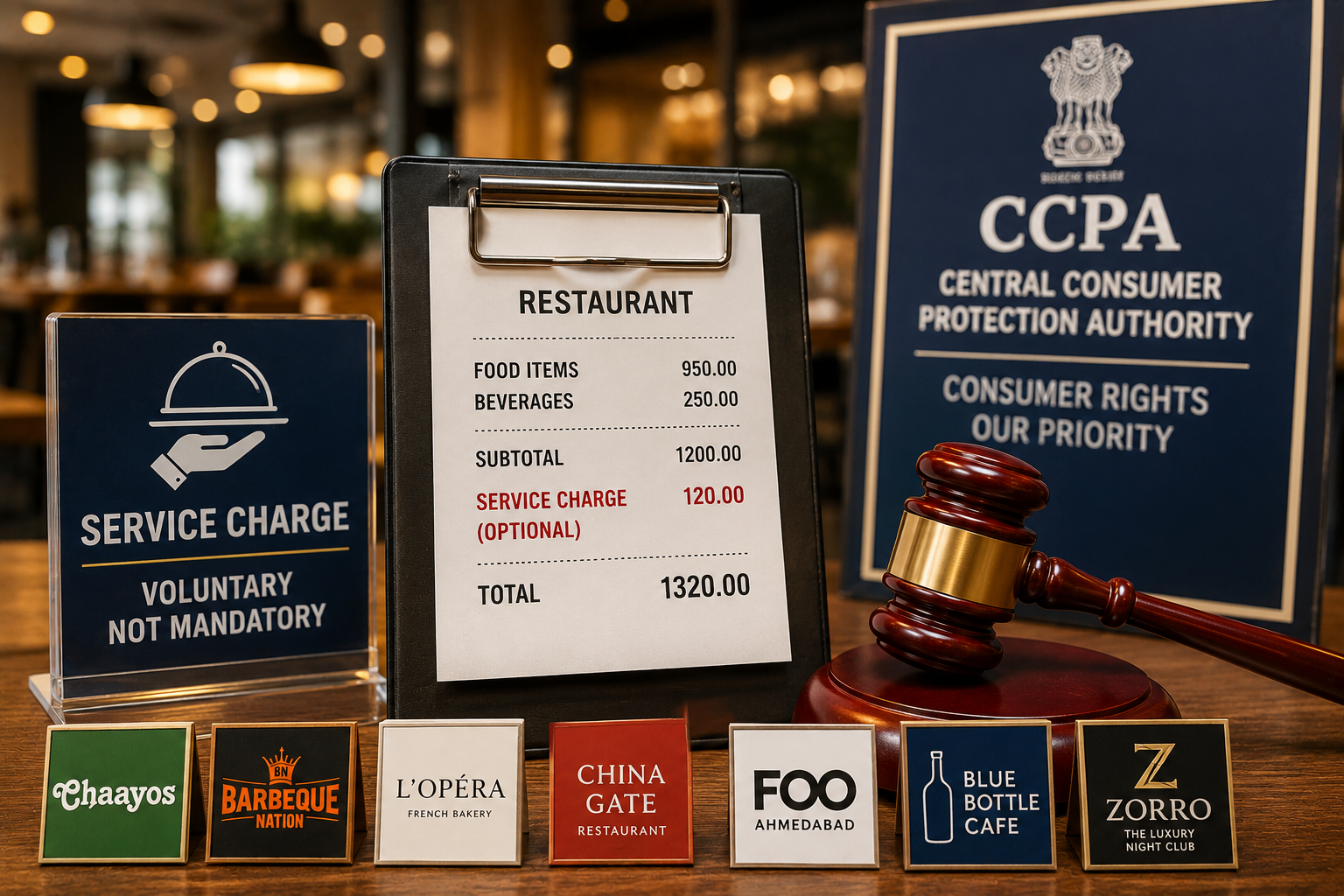
Consumer Watchdog Orders Refunds, Penalties and Billing System Changes as It Reinforces That Service Charges Are Entirely Voluntary Under Consumer Protection Law
The Central Consumer Protection Authority (CCPA) has intensified its action against restaurants allegedly imposing mandatory service charges on customers without their explicit consent. The consumer watchdog has initiated proceedings against 41 restaurants and hospitality establishments across the country after receiving multiple consumer complaints alleging that service charges were automatically added to bills without providing customers the option to refuse payment.
Among the well-known restaurant chains and establishments facing regulatory scrutiny are Chaayos, Fiesta Barbeque Nation, L'Opera French Bakery, China Gate Restaurant Pvt. Ltd., FOO Ahmedabad Restaurant, Cafe Blue Bottle in Patna, and Zorro – The Luxury Night Club.
The latest action underscores the government's growing focus on consumer rights, billing transparency, and fair business practices in India's rapidly expanding food service industry. The CCPA has reiterated that service charges are voluntary and cannot be imposed by default, collected under another name, or bundled into food bills.
Consumer Complaints Trigger Nationwide Investigation
The investigation began after consumers lodged complaints through the National Consumer Helpline (NCH), alleging that restaurants had added service charges to their invoices without obtaining explicit consent.
Several complainants submitted copies of restaurant bills showing service charges automatically included in the final amount payable.
Following a detailed review of the complaints, the CCPA concluded that such practices may constitute an unfair trade practice under the Consumer Protection Act, 2019, as customers must have the freedom to decide whether they wish to pay a service charge.
The authority observed that transparency and informed consent are fundamental principles of consumer protection.
Delhi High Court Strengthens Consumer Protection
The CCPA's enforcement action has received significant legal backing from the Delhi High Court, which upheld the validity of the authority's service charge guidelines in its March 28, 2025 judgment.
The Court ruled that:
-
Mandatory service charges are not legally enforceable.
-
Restaurants must comply with the CCPA guidelines.
-
Customers cannot be compelled to pay service charges.
-
Consumer choice must be respected.
The judgment has strengthened the legal framework governing restaurant billing practices across the country.
Chaayos Penalised for Automatic Service Charges
One of the most prominent cases involves Sunshine Teahouse Pvt. Ltd., which operates the popular café chain Chaayos.
The CCPA has directed the company to:
-
Pay a penalty of ₹50,000.
-
Refund the service charge collected from the complainant.
-
Modify its billing software across all outlets.
-
Ensure that future invoices comply with consumer protection guidelines.
The authority specifically instructed the company to prevent its billing systems from automatically adding service charges or similar fees.
Several Leading Restaurants Face Regulatory Action
Apart from Chaayos, the CCPA has issued final orders against several other restaurants and hospitality businesses.
These include:
-
Fiesta Barbeque Nation
-
China Gate Restaurant Pvt. Ltd.
-
L'Opera French Bakery Pvt. Ltd.
-
FOO Ahmedabad Restaurant
-
Cafe Blue Bottle
-
Zorro – The Luxury Night Club
Proceedings against the remaining establishments are still ongoing, and further regulatory action may follow as investigations continue.
What the CCPA Guidelines Clearly State
The CCPA first introduced comprehensive guidelines for hotels and restaurants in 2022 to protect consumer interests.
According to these guidelines:
Restaurants Cannot
-
Add service charges automatically.
-
Recover service charges under any other description.
-
Force customers to pay service charges.
-
Deny entry or services to customers refusing to pay.
-
Club service charges with food bills for GST calculation.
The authority has repeatedly clarified that service charges remain entirely optional.
Understanding the Difference Between Service Charge and Tip
Many customers mistakenly assume that service charges are compulsory.
However, there is a clear distinction between the two.
Service Charge
-
Levied by the restaurant.
-
Optional.
-
Requires customer consent.
-
Cannot be enforced.
Tip
-
Voluntary payment by the customer.
-
Based on satisfaction with service.
-
Given directly to service staff or through the establishment.
The CCPA maintains that customers alone should decide whether they wish to reward restaurant staff.
Consumer Rights Under the Consumer Protection Act
The Consumer Protection Act, 2019 provides customers with several important rights.
These include:
-
Freedom to choose.
-
Protection from unfair trade practices.
-
Transparent billing.
-
Clear pricing.
-
Access to grievance redressal.
Automatically imposing service charges without consent is viewed as inconsistent with these consumer rights.
How Customers Can Respond
Consumers who notice a service charge on their bill without prior consent should first request the restaurant to remove it before making payment.
If the issue remains unresolved, customers can:
-
File a complaint through the National Consumer Helpline.
-
Call 1915 or 8800001915.
-
Register complaints through official consumer grievance platforms.
-
Approach the Consumer Commission if necessary.
-
Preserve invoices and payment records as supporting evidence.
Prompt reporting helps regulators identify repeat violations and strengthen enforcement.
Impact on India's Restaurant Industry
The latest enforcement drive is expected to encourage restaurants to review their billing systems and compliance procedures.
Many establishments may now need to:
-
Upgrade billing software.
-
Remove automatic service charge settings.
-
Train billing staff.
-
Improve customer disclosures.
-
Strengthen internal compliance systems.
Companies that fail to align with the guidelines may face penalties, refund orders, and reputational risks.
Hospitality Businesses Face Higher Compliance Standards
The CCPA's action reflects a broader shift toward stronger consumer protection in India's hospitality sector.
Restaurant operators are increasingly expected to maintain:
-
Transparent pricing.
-
Accurate billing.
-
Fair consumer practices.
-
Digital compliance.
-
Better grievance resolution mechanisms.
Compliance has become an important aspect of brand reputation and customer trust.
Growing Consumer Awareness Is Changing Industry Practices
Consumers today are becoming increasingly aware of their legal rights.
The widespread availability of digital complaint platforms and government grievance mechanisms has made it easier for customers to challenge unfair billing practices.
As awareness increases, hospitality businesses are likely to adopt more transparent and customer-friendly billing policies to maintain trust and loyalty.
What Happens Next?
The CCPA is expected to continue reviewing complaints against the remaining restaurants currently under investigation.
Future regulatory action may include:
-
Additional financial penalties.
-
Mandatory refunds.
-
Billing software audits.
-
Compliance monitoring.
-
Consumer awareness initiatives.
The authority has indicated that enforcement against unfair billing practices will continue wherever violations are identified.
Broader Implications for India's Hospitality Sector
The latest crackdown highlights the increasing importance of consumer rights within India's organised food service industry.
Restaurants that embrace transparent pricing and voluntarily comply with consumer protection guidelines are likely to strengthen customer confidence while reducing regulatory risks.
The industry may also witness increased investments in billing technology, compliance management, and customer communication as businesses adapt to the evolving regulatory environment.