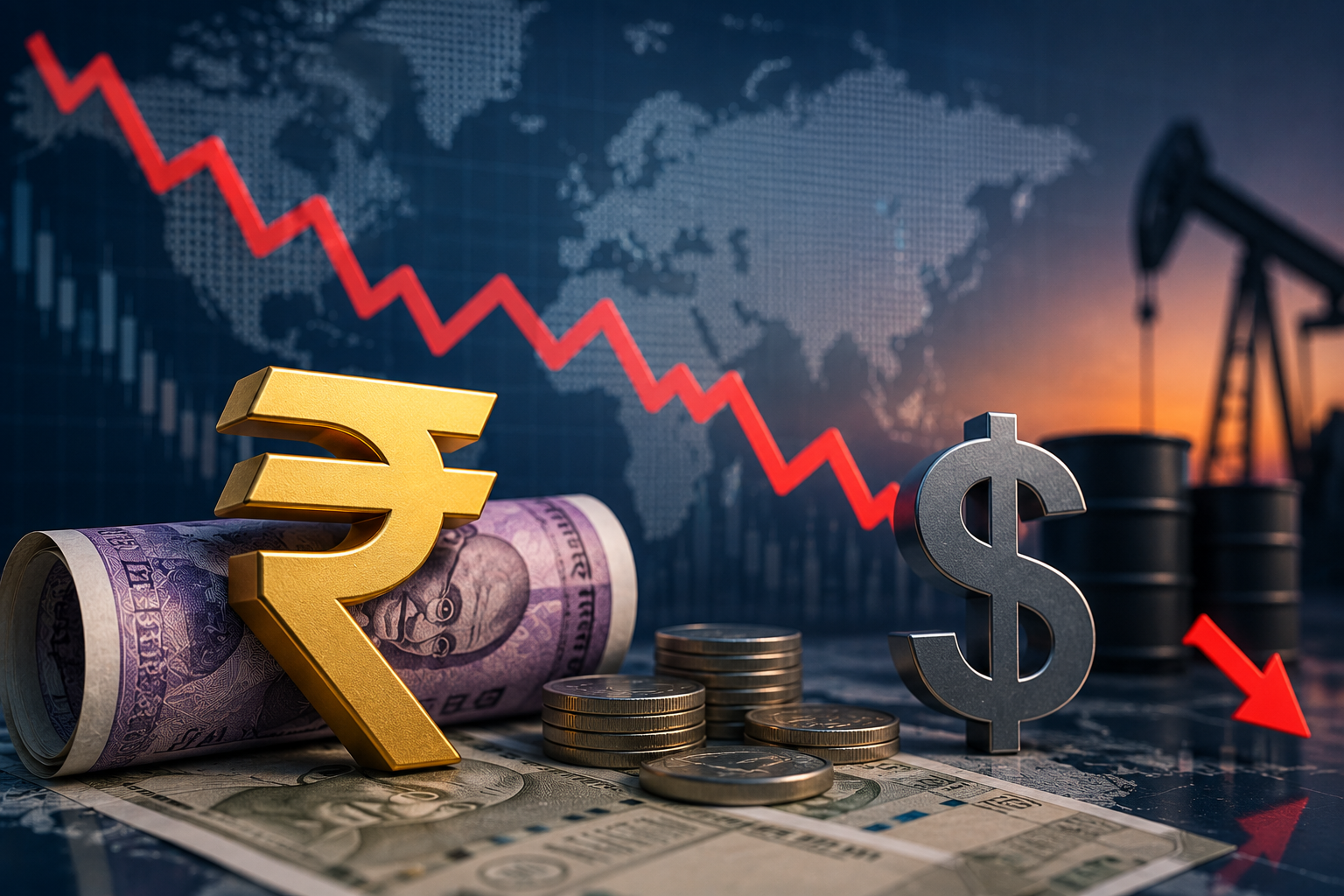
Indian Currency Weakens to 96.42 per Dollar Amid Rising Brent Crude, FII Outflows and Global Safe-Haven Demand
The Indian rupee came under renewed pressure on Monday, weakening against the US dollar as soaring crude oil prices and escalating geopolitical tensions in West Asia dampened investor sentiment. The domestic currency fell by 12 paise to 96.42 per US dollar in early trade after opening lower in the interbank foreign exchange market.
Market participants attributed the decline to a combination of rising global energy prices, persistent foreign institutional investor (FII) outflows, and increased demand for the US dollar as investors sought safety amid growing geopolitical uncertainty. While India's macroeconomic fundamentals remain stable, external developments continue to exert pressure on emerging market currencies, including the rupee.
Rupee Opens Lower After Previous Session's Recovery
The rupee started the trading session at 96.53 per US dollar, compared with Friday's closing level of 96.30, before recovering slightly to trade around 96.42.
The weakness reversed gains recorded in the previous session, when the rupee appreciated by 12 paise due to improved domestic market sentiment and easing US Treasury yields. However, fresh geopolitical developments over the weekend quickly shifted investor focus toward safe-haven assets, strengthening the US dollar and putting pressure on risk-sensitive currencies.
Currency dealers noted that heightened uncertainty in global financial markets has increased demand for the greenback, limiting any near-term recovery in the rupee.
Surging Crude Oil Prices Become the Biggest Concern
One of the primary reasons behind the rupee's weakness was the sharp rally in global crude oil prices.
Brent crude futures climbed to around $90.26 per barrel, reaching multi-month highs after fears of supply disruptions intensified in the Middle East. The latest escalation in regional conflict has raised concerns about shipping through the Strait of Hormuz, one of the world's most important oil transit routes.
India imports nearly 85% of its crude oil requirements, making the country particularly sensitive to fluctuations in global energy prices. Higher crude prices increase the country's import bill, widen the current account deficit, and place downward pressure on the domestic currency.
Economists believe that if oil prices remain elevated for an extended period, inflationary pressures could also rise, complicating the Reserve Bank of India's monetary policy outlook.
West Asia Tensions Fuel Global Safe-Haven Buying
Global financial markets remained cautious after fresh military developments heightened fears of a wider regional conflict.
The latest reports indicate increased military activity involving the United States and Iran, with missile strikes, retaliatory attacks, and growing security concerns across the Gulf region. The possibility of prolonged disruptions to global energy supplies has encouraged investors to move capital toward traditional safe-haven assets such as the US dollar.
Emerging market currencies, including the Indian rupee, often weaken during periods of heightened geopolitical uncertainty as investors reduce exposure to higher-risk assets.
Dollar Index Remains Resilient
The US Dollar Index (DXY) remained close to the 100.5 mark, reflecting continued strength of the American currency against a basket of six major global currencies.
Although the index slipped marginally during early trade, the dollar continued to benefit from strong global demand driven by geopolitical risks and cautious investor positioning.
A stronger dollar generally increases pressure on emerging market currencies and can also affect capital flows into developing economies.
Weak Equity Markets Add Pressure on the Rupee
Domestic equity markets also witnessed a weak start to the week, further impacting currency sentiment.
During early trading:
-
BSE Sensex declined by nearly 600 points.
-
Nifty 50 slipped around 170 points, falling below the 24,200 level.
The decline was largely driven by weakness in heavyweight banking, financial, and energy stocks as investors responded to rising global uncertainties.
Historically, falling equity markets often coincide with higher demand for foreign currency due to capital outflows from overseas investors.
Foreign Investors Continue to Withdraw Capital
Foreign Institutional Investors (FIIs) remained net sellers in Indian equities, extending the recent trend of overseas fund outflows.
According to exchange data, foreign investors sold ₹376.41 crore worth of equities during the previous trading session.
Persistent FII selling increases demand for US dollars as overseas investors repatriate capital, adding further pressure on the rupee.
Domestic Institutional Investors (DIIs) have continued to absorb a significant portion of foreign selling, helping maintain stability in the equity market.
India's Forex Reserves Offer Strong Cushion
Despite the rupee's weakness, India's external position remains robust.
Latest data released by the Reserve Bank of India (RBI) showed that the country's foreign exchange reserves increased to $675.16 billion, marking another week of healthy reserve accumulation.
The rise in reserves strengthens the RBI's ability to intervene in the foreign exchange market whenever excessive volatility emerges.
Analysts believe India's sizeable reserve buffer provides confidence to investors and reduces the risk of sharp currency depreciation even during periods of global uncertainty.
Key Drivers to Watch This Week
Market participants are expected to closely monitor several domestic and global developments that could influence the rupee's direction.
Global Factors
-
Brent crude oil prices and developments in energy markets.
-
Geopolitical tensions in West Asia.
-
US Dollar Index movement.
-
US Treasury yields.
-
Global risk sentiment.
Domestic Factors
-
Foreign Institutional Investor (FII) activity.
-
RBI's currency management strategy.
-
Domestic equity market performance.
-
Inflation expectations and macroeconomic data.
Any easing in geopolitical tensions or correction in crude oil prices could support a recovery in the rupee, while prolonged uncertainty may keep the currency under pressure.
Impact on the Indian Economy
A weaker rupee has mixed implications for the economy.
Potential Challenges
-
Higher crude oil import costs.
-
Rising inflationary pressures.
-
Increased expenses for import-dependent industries.
-
Pressure on India's current account deficit.
Potential Benefits
-
Improved competitiveness for exporters.
-
Higher earnings for IT and pharmaceutical companies with significant overseas revenue.
-
Better realizations for businesses receiving payments in foreign currencies.
The overall economic impact will largely depend on how long elevated oil prices and geopolitical tensions persist.
View
The rupee's decline reflects global risk aversion rather than any deterioration in India's economic fundamentals. Rising crude oil prices, heightened geopolitical tensions in West Asia, and continued foreign capital outflows have temporarily strengthened the US dollar and weighed on the Indian currency.
However, India's strong foreign exchange reserves, resilient domestic growth outlook, and the RBI's ability to manage excessive volatility provide important safeguards against sharp currency fluctuations. Investors should closely monitor developments in global energy markets and geopolitical events, as these are expected to remain the key drivers of the rupee in the near term.