Margin Pressure Triggers Sell-Off, But Analysts Maintain Bullish Outlook with Strong Growth and Target Prices Up to ₹1,050
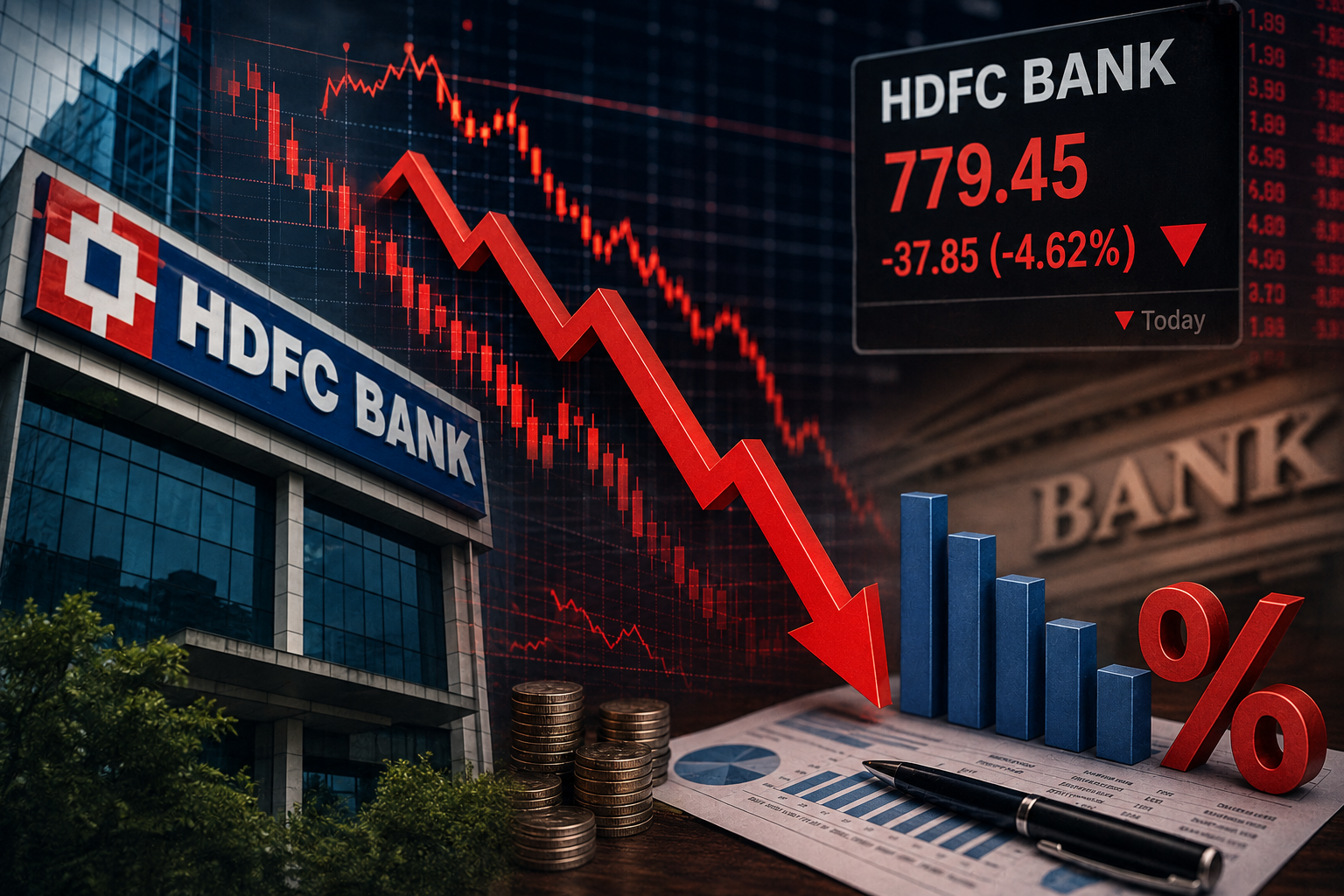
India's largest private sector lender, HDFC Bank, witnessed a sharp decline of nearly 5% in its share price on Monday after announcing its Q1FY27 financial results. While the bank reported steady profit growth and robust business expansion, investors reacted negatively to continued pressure on net interest margins (NIM) and weaker non-interest income.
Despite the market's immediate disappointment, leading brokerage firms have retained their positive stance on the stock, emphasizing that HDFC Bank's long-term fundamentals remain intact. Analysts believe the correction is driven more by short-term concerns than any structural weakness in the bank's business model.
Market Reacts to Margin Compression
HDFC Bank shares fell as much as 4.8% during intraday trade, making it one of the biggest drags on the Nifty Bank index. The stock slipped below ₹780 before recovering marginally, significantly underperforming the broader benchmark indices.
The decline came even though the bank delivered earnings broadly in line with market expectations. Investors were primarily concerned about shrinking margins and slower treasury-related income, both of which affected quarterly profitability.
Analysts note that after a strong rally over the past several months, the stock was priced for a stronger earnings surprise, making it vulnerable to profit booking following an "in-line" performance.
Q1FY27 Financial Highlights
HDFC Bank continued to post healthy earnings despite operating in a challenging interest-rate environment.
Key Numbers
| Particulars | Q1FY27 | YoY Growth |
|---|---|---|
| Net Profit | ₹19,060 crore | ▲ 5% |
| Net Interest Income (NII) | ₹33,535 crore | ▲ 6.7% |
| Total Deposits | ₹31.71 lakh crore | ▲ 14.7% |
| CASA Deposits | ₹7.01 lakh crore | ▲ 9.4% |
| Net Interest Margin (NIM) | 3.26% | Down from 3.38% QoQ |
| Gross NPA | 1.17% | Slight increase |
| Provisions | ₹3,060 crore | Stable |
The results highlight the bank's ability to continue expanding its balance sheet despite an environment of rising funding costs and intense competition for deposits.
Net Interest Margin Remains the Biggest Concern
The biggest takeaway from the quarter was the continued decline in the bank's Net Interest Margin (NIM), which narrowed to 3.26% from 3.38% in the previous quarter.
Margins came under pressure due to:
-
Higher cost of deposits
-
Elevated competition for retail deposits
-
Balance sheet adjustments following the HDFC Ltd merger
-
Slower repricing of loan assets
Although NIM contraction disappointed investors, management reiterated that margin recovery remains a medium-term objective as funding costs gradually normalize.
Lower Other Income Impacts Earnings Growth
Another factor that affected quarterly performance was a sharp decline in other income, which fell 41% year-on-year.
The previous year's corresponding quarter had included a one-time gain from the sale of a stake in HDB Financial Services, making this year's comparison less favorable.
Excluding this exceptional income, analysts believe HDFC Bank's operating performance remained largely stable.
Loan and Deposit Growth Continue to Impress
One of the strongest positives from the quarter was healthy business growth.
Loan Growth
The bank continued to expand its lending portfolio across:
-
Corporate Banking
-
SME Lending
-
Commercial Banking
-
Select Retail Segments
While retail loan growth remained moderate, management expects this segment to accelerate over the coming years.
Deposit Growth
Deposit mobilization remained strong.
Total deposits increased nearly 15% YoY, reflecting continued customer confidence in the bank's franchise despite intense competition across the banking sector.
The bank's CASA deposits crossed ₹7 lakh crore, although the CASA ratio remains an area of focus for future improvement.
Asset Quality Remains Among the Best in the Industry
Despite a marginal rise in non-performing assets, HDFC Bank continues to maintain one of the healthiest loan books among large Indian banks.
Asset Quality Snapshot
-
Gross NPA: 1.17%
-
Credit costs remain under control
-
Strong contingency provisions
-
Comfortable provision coverage
Analysts believe the bank remains well-positioned to manage future credit risks, including the transition to the Expected Credit Loss (ECL) framework.
Management Confident About Medium-Term Recovery
During the post-results interaction, management expressed confidence regarding future profitability.
The bank highlighted several growth drivers expected to support earnings:
Funding Cost Normalization
As deposit repricing stabilizes, funding costs are expected to ease, supporting margin expansion.
Retail Loan Expansion
Retail loans currently account for nearly 52% of the loan portfolio.
Management aims to gradually increase this share to around 60%, improving yields and profitability.
CASA Improvement
Improving the CASA mix remains a strategic priority as low-cost deposits help strengthen net interest margins.
Operating Leverage
Continued investments in digital banking and productivity improvements are expected to enhance cost efficiency over the coming years.
Brokerages Stay Bullish Despite the Sell-Off
Leading brokerage houses continue to view HDFC Bank as one of the strongest long-term banking investments.
Motilal Oswal Financial Services
-
Rating: Buy
-
Target Price: ₹1,050
The brokerage believes the earnings miss was largely limited to NIM, while overall business growth remained healthy.
Nirmal Bang
-
Rating: Buy
-
Target Price: ₹1,020
According to the brokerage, strong loan growth, healthy deposits, disciplined operating expenses, and comfortable asset quality support long-term earnings growth.
Systematix
-
Rating: Buy
-
Target Price: ₹950
Systematix expects gradual margin recovery through improved funding costs and a higher share of retail loans, maintaining confidence in the bank's long-term earnings trajectory.
What Could Drive the Next Leg of Growth?
Several factors could support HDFC Bank's future performance:
1. Falling Interest Rates
Lower funding costs could help improve margins.
2. Strong Credit Demand
Healthy demand from retail, SME, and corporate borrowers may sustain double-digit loan growth.
3. Digital Banking Expansion
Continued investment in technology is expected to improve customer acquisition and operational efficiency.
4. Cross-Selling Opportunities
The integration with HDFC Ltd continues to create opportunities across mortgages, insurance, wealth management, and retail banking.
5. Better CASA Mobilization
A higher proportion of low-cost deposits could significantly improve profitability over the medium term.
Key Risks to Monitor
Investors should continue monitoring:
-
Net Interest Margin trends
-
Deposit cost movement
-
CASA ratio improvement
-
Retail loan growth
-
Credit quality
-
RBI monetary policy decisions
-
Competitive intensity in the banking sector
These factors will largely determine earnings growth over the next few quarters.
View
HDFC Bank's Q1FY27 results reinforce the bank's operational strength despite short-term profitability pressures. While the decline in net interest margins triggered a sharp correction in the stock price, the bank continues to deliver healthy loan growth, robust deposit mobilization, stable asset quality, and disciplined risk management. With multiple brokerages maintaining 'Buy' recommendations and target prices between ₹950 and ₹1,050, the recent weakness appears to reflect short-term market sentiment rather than any deterioration in fundamentals.
For long-term investors, HDFC Bank remains one of India's highest-quality banking franchises, supported by a strong balance sheet, diversified lending portfolio, superior governance, and significant opportunities for sustainable earnings growth as funding costs normalize and margin expansion resumes.