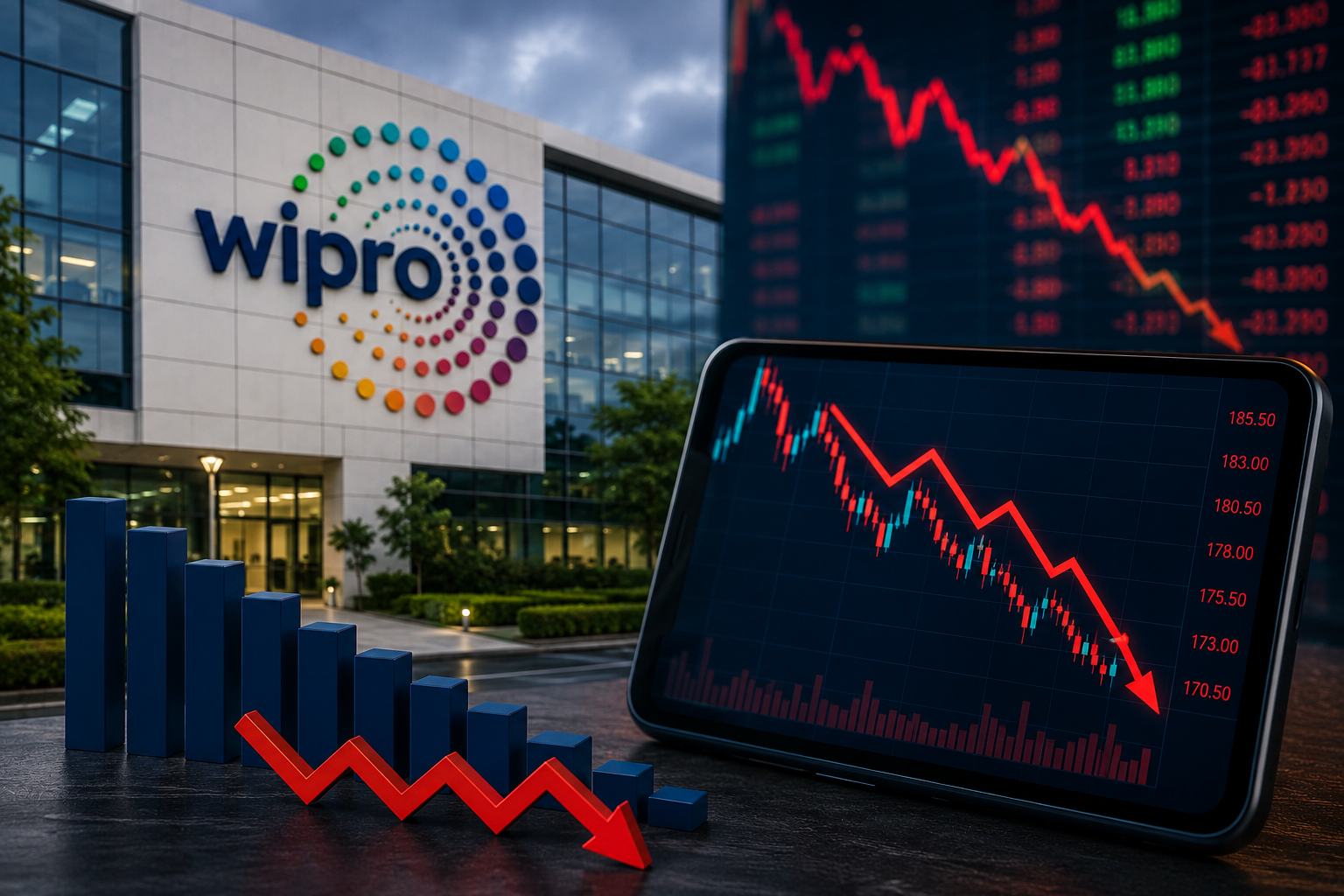
IT major reports sluggish profit growth, margin pressure and cautious revenue outlook as brokerages trim earnings estimates and remain wary of recovery
Shares of Wipro Ltd. came under pressure on Friday after the IT services giant reported a weaker-than-expected performance for the first quarter of FY27 and issued a subdued revenue outlook for the coming quarter. The disappointing earnings, softer operating margins and cautious management guidance dampened investor sentiment, making Wipro one of the biggest losers on the Nifty 50 despite a strong rally in the broader market.
The stock fell as much as 2.5% in early trade, opening at ₹173.55 before recovering slightly to trade around ₹175 during the morning session. The decline came even as benchmark indices gained nearly 1%, highlighting the market's disappointment with the company's quarterly performance and near-term growth prospects.
The latest results indicate that Wipro continues to face headwinds from delayed client spending decisions, slower project execution and rising investments in emerging technologies, particularly artificial intelligence (AI).
Q1 Performance Falls Short of Market Expectations
For the quarter ended June 2026, Wipro reported a mixed set of financial results that failed to meet analyst expectations.
The company posted a net profit of ₹3,325 crore, reflecting less than 1% year-on-year growth, while profit declined 4.7% sequentially from the previous quarter.
Revenue from operations increased 10.6% year-on-year to ₹24,478.6 crore, supported by steady execution across existing client engagements and favourable currency movements.
However, both revenue and profit came in below Bloomberg consensus estimates, which had projected:
-
Net Profit: ₹3,460 crore
-
Revenue: ₹24,737 crore
The earnings miss reinforced concerns that Wipro's recovery remains slower than several of its industry peers.
Core IT Services Business Shows Limited Growth
Although consolidated revenue posted double-digit growth, Wipro's core IT Services business remained under pressure.
Revenue from the IT Services segment increased by only 1% year-on-year, highlighting the continued weakness in discretionary technology spending across global markets.
The company's management stated that clients continue to prioritise:
-
Cost optimisation initiatives
-
Operational efficiency
-
Vendor consolidation
-
Selective technology investments
Longer decision-making cycles and delayed project approvals continue to affect revenue growth, particularly in discretionary digital transformation projects.
Q2 Revenue Guidance Remains Conservative
Investor disappointment intensified after management issued a cautious outlook for the September quarter.
Wipro expects IT Services revenue to be between $2.574 billion and $2.627 billion, implying sequential growth of -1.5% to +0.5%.
Although the guidance was marginally ahead of some market expectations, it still signals another quarter of limited growth.
The forecast suggests that macroeconomic uncertainties, geopolitical tensions and cautious enterprise technology spending continue to weigh on business momentum.
Operating Margins Come Under Pressure
Another area of concern was profitability.
Wipro reported weaker-than-expected operating margins as the company continued investing heavily in future growth initiatives.
Several factors contributed to the margin decline:
-
Annual employee wage revisions
-
Ramp-up costs for newly won large contracts
-
Acquisition integration expenses
-
Continued investments in Artificial Intelligence (AI)
-
Higher employee-related costs
While management expects productivity improvements to gradually offset some of these costs, analysts believe margin recovery may take longer than previously anticipated.
Large Deal Pipeline Remains Healthy but Execution Delayed
The company continued to secure significant business during the quarter, although conversion into revenue remains slower than expected.
Wipro reported:
-
Large Deal Total Contract Value (TCV): $1.6 billion
-
Total Bookings: $3.4 billion
Despite a healthy pipeline, management acknowledged that several large projects have experienced implementation delays as clients continue to reassess spending priorities.
This has resulted in slower revenue recognition despite improving order inflows.
Artificial Intelligence Reshaping Client Spending
Artificial Intelligence continues to transform enterprise technology spending patterns.
According to management, AI-driven productivity improvements are enabling clients to optimise existing IT budgets rather than significantly expanding overall technology expenditure.
Although AI represents a major long-term opportunity for IT service providers, it is also reducing demand for certain traditional outsourcing services, creating short-term growth challenges for companies across the sector.
Wipro continues to increase investments in AI capabilities, cloud services and digital transformation platforms to strengthen its competitive positioning.
Brokerages Turn More Cautious
Following the quarterly results, several leading brokerage firms maintained a cautious stance on the stock.
Equirus Securities – Reduce
Equirus retained its 'Reduce' recommendation, highlighting:
-
Weak revenue guidance
-
Margin miss
-
Slow project execution
-
Delayed conversion of large deals into revenue
The brokerage believes the turnaround remains slower than expected despite an improving deal pipeline.
Motilal Oswal Financial Services – Neutral
Motilal Oswal maintained a 'Neutral' rating while lowering its earnings estimates.
The brokerage expects:
-
Another year of flat-to-negative organic growth
-
Continued pressure on margins
-
Higher investments in AI and digital capabilities
-
Delayed recovery in discretionary spending
It also reduced FY27 earnings estimates to reflect weaker near-term profitability.
Antique Stock Broking – Hold
Antique reiterated its 'Hold' recommendation, noting that the June quarter remained weaker than anticipated.
According to the brokerage:
-
IT Services revenue missed expectations.
-
EBIT margin declined to around 16%.
-
Large deal wins remained below recent trends.
-
Client demand continues to focus primarily on cost optimisation.
The brokerage also lowered earnings estimates for FY27 and FY28 due to weaker growth expectations.
Dividend Provides Some Comfort
Despite the softer operational performance, Wipro's Board declared an interim dividend of ₹2 per share.
The dividend underscores the company's commitment to returning capital to shareholders while maintaining a strong balance sheet.
However, the announcement had limited impact on investor sentiment as the market remained focused on earnings growth and future guidance.
Industry Faces Broader Headwinds
The challenges confronting Wipro reflect broader trends across the global IT services industry.
Technology companies continue to face:
-
Slower discretionary spending
-
Longer sales cycles
-
Pricing pressure
-
Rising investment requirements in AI
-
Geopolitical uncertainties
-
Macroeconomic volatility
While spending on cloud infrastructure, cybersecurity and AI remains relatively healthy, many enterprises continue to postpone large-scale digital transformation programmes.
What Investors Should Watch Going Forward
Market participants will closely monitor several key developments over the coming quarters:
AI Monetisation
How effectively Wipro converts AI investments into revenue opportunities.
Large Deal Execution
Whether recently signed contracts begin contributing meaningfully to revenue growth.
Margin Recovery
Management's ability to improve profitability despite continued investments.
Client Spending Trends
Any improvement in discretionary technology budgets across North America and Europe.
Revenue Growth
Signs of sustained acceleration in the core IT Services business.
Investment Outlook
Wipro's June quarter results underline the challenging environment currently facing the global IT services industry. While the company continues to invest aggressively in next-generation technologies, strengthen its deal pipeline and expand digital capabilities, the pace of revenue growth remains slower than investors had anticipated.
The cautious guidance for the September quarter suggests that a meaningful turnaround is unlikely in the immediate future. Continued pressure on margins, delayed project execution and conservative enterprise technology spending are expected to keep earnings growth subdued over the near term.
Nevertheless, Wipro retains several structural strengths, including a strong global client base, healthy cash generation, a robust balance sheet and growing capabilities in artificial intelligence, cloud computing and cybersecurity. As global IT spending gradually recovers and AI-led transformation projects gain momentum, the company could be well-positioned to benefit from the next phase of digital investment.
For investors, the coming quarters will be crucial in determining whether Wipro can successfully convert its expanding deal pipeline and AI investments into sustainable revenue growth and improved profitability. Until then, market sentiment is likely to remain cautious, with greater emphasis on execution, margin recovery and management commentary during each earnings season.