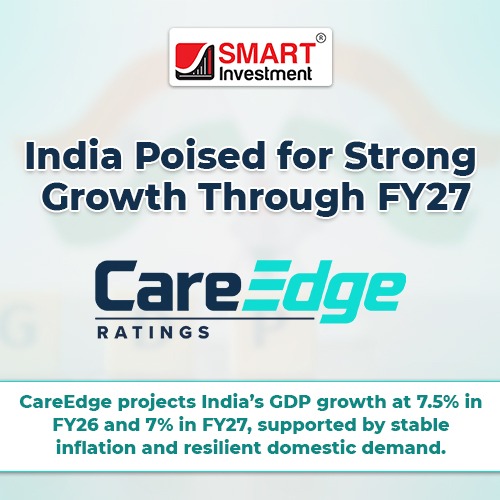
India is expected to have strong growth in FY26–FY27 amid stable inflation and comfortable fiscal position: CareEdge Ratings
- GDP growth expected to be healthy at 7.5% in FY26 and 7% in FY27.
- Expect CAD to remain manageable at ~1% of GDP in FY26 and FY27.
- Estimate that the Central government will meet its fiscal deficit target of 4.4% in FY26, with continued fiscal consolidation likely to lower it to 4.2–4.3% in FY27.
- Projects USD/INR to remain around 89-90 levels in FY27
- Project India’s goods exports to contract by around 1% in FY26 as against a growth of 0.1% in FY25
Mumbai, 17th December, 2025: CareEdge Ratings projects India’s GDP growth at 7.5% in FY26 and 7.0% in FY27, supported by resilient domestic demand and stable macro fundamentals. It expects inflation to remain benign, with average CPI inflation projected at 2.1% in FY26, before normalising to around 4% in FY27.
In a media webinar on ‘Outlook for The Indian Economy in 2026’ hosted by Rajani Sinha, Chief Economist, CareEdge Ratings, it projects the Current Account Deficit (% GDP) at ~1% in FY26 and FY27. It estimates that the Centre will meet its fiscal deficit target of 4.4% in FY26, with continued fiscal consolidation likely to lower it to 4.2–4.3% in FY27. It expects, 10-year G-sec yields to range between 6.4%-6.6% by end-FY26, while USD/INR is projected to trade around 89-90 by end-FY27.
Rajani Sinha, Chief Economist, CareEdge Ratings said, “India’s macroeconomic outlook remains constructive heading into FY27. Even with external uncertainties lingering, the Indian economy is expected to record healthy growth of 7% in FY27. The growth momentum will be supported by factors like comfortable inflation, lower interest rates and lower tax burden. Likely US-India trade deal would provide further impetus.”
India’s CAPEX cycle is showing early signs of revival as reflected by strong growth in order book of capital good companies. Foreign investors are also making a note of India’s growth opportunity, getting reflected in a jump in gross FDI inflows into the country, specially in the new age sectors like EV, renewables, electronics, data centre and AI infrastructure. Factor market reforms like the new labour code will give further confidence to domestic and global investors.
Global Economy Navigating Turbulent Waters
According to CareEdge Ratings, Global economic conditions remain challenging, with global growth expected to stay below pre-pandemic average levels. However, India’s growth is projected to hold up relatively well in comparison with other economies. It notes that maturing global value chains have led to stalling of globalisation around 2012, with cross-border trade and investment losing momentum due to a surge in trade restrictions amid rising geopolitical tensions. It highlights that global FDI net inflows as a percentage of GDP have declined since the Global Financial Crisis, with subsequent shocks adding further pressure.
CareEdge Ratings notes that monetary easing has begun in parts of the world, with few exceptions. In the year so far, the policy rates were increased in Japan and Brazil to combat higher inflation. Meanwhile, policy rates were cut in UK and US despite an inflationary pressure in the respective countries. It also highlights that a gradual shift away from the US dollar is underway as economies seek greater resilience in an uncertain global environment. There is a growing prominence of other actively traded currencies with rising bilateral trade being conducted in local currencies. Furthermore, the sharp rise of central banks’ net purchases of gold is indicative of a shift toward asset safety and hedging against uncertainty. The DXY has depreciated by ~9% in 2025 so far.
Domestic Economy Remains on a Resilient Footing
As per CareEdge Ratings, healthy agricultural activity, reduced income tax burden, GST rationalisation, RBI rate cuts, festive demand and front-loading of exports supported growth in H1 FY26. It expects GDP growth to moderate to around 7% in H2 FY26 as the impact of export front-loading fades and consumption demand normalises after the festive season. By Q4 FY26, the low base effect is likely to wane, and the deflator is expected to rise from current low levels. It projects real GDP growth to be at 7.5% in FY26 and 7% in FY27. Meanwhile, nominal GDP growth is projected at 8.3%, lower than the budgeted 10.1% for FY26.
CPI inflation stayed benign in the year so far, with 75% of the items in the CPI basket witnessing inflation below 4%, thereby implying broad-based moderation in inflation. While higher prices of precious metal prices kept the core inflation elevated, excluding precious metals, core inflation stood at 2.4% in November. Inflation bottomed out in October and is expected to rise to around 3% in Q4 FY26. CPI inflation is projected to average at 2.1% in FY26. With low base of FY26, CPI inflation is expected to average 4% in FY27.
The Centre’s gross tax collection has recorded weak growth of 4% (y-o-y) in 7M FY26 as against budgeted growth of 12.5% for the full year. However, non-tax revenues have risen sharply by 22%, aided by a higher RBI dividend of Rs 2.7 trillion. Revenue expenditure has remained largely flat during 7MFY26, even as capital expenditure continued to record healthy double-digit growth. Overall, revenue shortfall from slower growth in tax collections is expected to be offset by RBI’s higher dividend transfer and lower revenue spending. We estimate that the government will meet its fiscal deficit target of 4.4% in FY26.
CareEdge Ratings expects that the Centre will be able to bring down the debt to around 50 (+/-1) % by the end of FY31 from the estimated 56.1% in FY25. We have based this on the assumption of nominal GDP growth averaging ~10.7% in the next five years. Laying a debt trajectory will give the Government the flexibility to manoeuvre the fiscal deficit target for each year depending on the growth prospects. The Government may go little slower on fiscal consolidation, with the fiscal deficit to GDP likely to be budgeted at 4.2-4.3% in FY27.
CareEdge Ratings notes that India’s CAPEX cycle is showing early signs of revival, though the outlook remains cautious. Top sectors driving India Inc’s capital expenditure include oil & gas (19% share), power (15%), telecom (10%), automobile and ancillaries (9%), iron & steel (7%) and non-ferrous metals (5.5%). While order books of a sample of capital goods companies recorded a sharp 20.7% year-on-year growth in FY25, with the momentum continuing into H1 FY26. CareEdge Ratings estimates capex in the power generation sector (across listed and unlisted companies) to grow at a CAGR of 8% over FY26–FY28. Within this, investments in renewable energy (including storage) are expected to expand at a faster CAGR of 13% over the same period. It notes that private sector investment announcements (CMIE data) rose to a high of Rs 14.2 trillion in H1 FY26, wherein investment announcements were led by the manufacturing sector.
On merchandise export performance, it highlights that India’s shipments to the US have seen a decline across most category, following the imposition of 50% US reciprocal tariffs from end-Aug. Labour-intensive sectors such as gems and jewellery, textiles and ready-made garments showed a sharp contraction in exports in Sep-Oct. On other hand, market shares for UAE and Hong Kong have risen in India’s gems & jewellery exports, while UAE and China have gained share in India’s textile exports. CareEdge Ratings notes that these are early indications of rising market share of exports to other destinations; Shifts in export market dynamics remain a key monitorable going ahead.
It projects India’s goods exports to contract by around 1% in FY26 as against a growth of 0.1% in FY25. It highlights that the encouraging performance in services exports is likely to continue with a projected growth of 8.5% in FY26 Vs 13.6% in FY25.
It notes that while gross FDI inflows have improved over the past year, higher profit repatriation and increased FDI outflows from India have weighed on net FDI inflows. It highlights strong growth in greenfield investments across sectors such as semiconductors, electronics and electrical equipment, EV components, and basic metals. Outward FDI from India averaged USD 22 billion in FY24–FY25, marking a 58% increase from the USD 14 billion average recorded during FY21–FY23. Indian firms expanded their global footprint, particularly in Europe, South America and Africa, with investments spanning in sectors like telecom, automotive, energy, defence, pharmaceuticals, ports and steel.
CareEdge Ratings highlights that India remains an attractive FDI destination. As per CareEdge’s estimate, India’s risk adjusted return on inward FDI remains robust at 7.2%. On a risk-adjusted basis, India ranks second only to Indonesia among the major countries analyzed. The risk adjusted returns for some of the other emerging economies like Mexico is at 6.6%, South Africa 4.5%, and Philippines 4.3%, as per our assessment.
(Disclosures: At the time of writing this article, author, his clients & dependent family members may have positions in the stocks mentioned above. The author, his firm, his clients or any of his dependent family members may make purchases or sale of the securities mentioned in website. Author may have positions in above stocks so have vested interest obviously in their going up or down as the case may be.
Disclaimer: Investing in any equity is risky. Our recommendations are based on reliable & authenticated sources believed to be true & correct, and also is technical analysis based on & conceived from charts. Investors should take their own decisions. We assume no responsibility for any transactions undertaken by them. The author won't be liable or responsible for any legal or financial losses made by anybody. Investors must take advice from their financial advisors before investing in any stocks.)