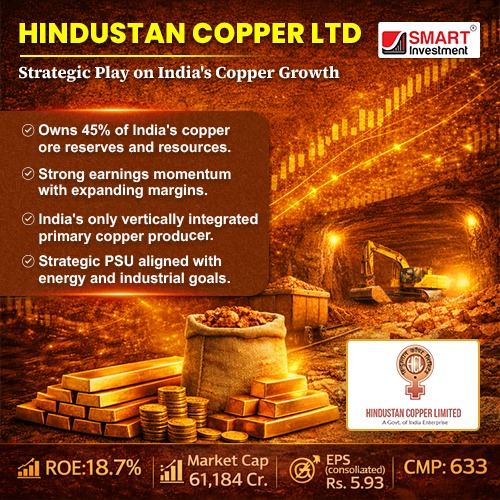
Hindustan Copper Ltd.
About the Company:
Hindustan Copper Limited (HCL), a Miniratna Category-1 Status Company is a Central Public Sector Undertaking (CPSE) under the administrative control of Ministry of Mines, Government of India. The Company is engaged in Exploration, Exploitation, Mining of Copper and Copper Ore including Beneficiation of Minerals, Smelting and Refining. Company works copper mines & concentrator plants in Malanjkhand Copper Project at Madhya Pradesh (MCP), Khetri Copper Complex at Rajasthan (KCC) and Indian Copper Complex, Ghatsila at Jharkhand (ICC). Presently, HCL is operating Smelter & Refinery Plant at ICC and Gujarat Copper Project, Gujarat (GCP) for production of copper cathode and thereafter conversion of Cathode to Copper Wire Rod at Taloja Copper Project, Taloja, Maharashtra (TCP).
The President of India is holding 66.14% of the equity capital in the Company as at 31 March, 2025. The Company is the only vertically integrated producer of primary refined copper in India. The Company markets copper cathodes, copper wire bar, continuous cast copper rod and by-products, such as anode slime (containing gold, silver, etc.), copper sulphate and sulphuric acid.
India’s Total copper ore reserves/resources stand at 1660 million tonnes and India’s copper Ore reserves is 164 million tonnes. Rajasthan leads with 52.25% of India's copper ore, followed by Madhya Pradesh (23.28%) and Jharkhand (15.14%). HCL has 160.48 million tonnes of copper ore reserves with an average grade of 1.32%.and reserves/resources of 755.32 million tonnes at an average grade of 0.95% (UNFC system). It owns all the operating mining leases of copper ore in India and has access to about 45% of India’s copper ore reserves and resources as of FY25.
Mining & Beneficiation Hubs
HCL’s core strength lies in its underground copper mining and beneficiation operations, concentrated in mineral-rich belts:
- Malanjkhand Copper Project (MCP), Madhya Pradesh
Malanjkhand is HCL’s largest copper mining asset and a critical contributor to domestic copper ore supply. The project operates an underground mine along with a beneficiation plant and has the highest ore milling capacity of 25 lakh tonnes per annum, supported by a workforce of over 300 employees. Its central location makes it strategically important for future capacity expansion.
2. Khetri Copper Complex (KCC), Rajasthan
Located in the Aravalli copper belt, KCC operates underground mines and a beneficiation plant with an ore milling capacity of 18 lakh tonnes per annum. The complex employs close to 500 personnel, making it one of HCL’s largest employment centres and a key contributor to northern India’s copper output.
3. Indian Copper Complex (ICC), Jharkhand
Situated in eastern India, ICC integrates underground mining with beneficiation operations. With an ore milling capacity of 4 lakh tonnes per annum and a workforce of around 270 employees, ICC provides regional balance to HCL’s mining operations and supports supply continuity.
Downstream & Value-Added Operations
Beyond mining, HCL maintains a downstream presence to convert copper into value-added products:
4. Taloja Copper Project (TCP), Maharashtra
TCP houses a continuous copper wire rod plant with a capacity of 0.6 lakh tonnes per annum. Currently operating under a third-party tolling arrangement, the unit strengthens HCL’s presence in western India and connects the company directly with electrical and industrial end-users.
5. Gujarat Copper Project (GCP), Gujarat
The Gujarat facility was designed for secondary smelting and refining with a refined copper capacity of 0.5 lakh tonnes per annum. While currently not in operation, the asset represents latent downstream optionality, especially relevant during periods of tight copper supply or policy push for domestic refining.
Corporate & Strategic Presence:
HCL’s corporate headquarters in Kolkata anchors its eastern operations and provides oversight across all locations. In addition, the company has expanded its strategic reach through:
- Joint Ventures such as KABIL (focused on critical minerals overseas) and Chhattisgarh Copper Limited
- MoUs with global and domestic entities including international miners, PSUs and infrastructure players
- A Centre of Excellence aligned with premier technical institutions, supporting mining technology and process innovation
KPI:
|
CMP |
633 |
|
52 - week high / low |
Rs. 639 / 184 |
|
Dividend % (consolidated) |
0.26% |
|
ROE |
18.7% |
|
BV(Rs.) |
30.9 |
|
Sales (Rs.) |
2,294 Cr. |
|
Debt to Equity |
0.05 |
|
P/E ratio |
107 |
|
EPS (consolidated) |
Rs. 5.93 |
|
P/B ratio |
20.5 |
|
Market Cap (Rs.) |
61,184 Cr. |
|
Face value (Rs.) |
5 |
|
PEG Ratio |
14.2 |
|
EVEBITDA |
64.1 |

Financial Results:
Latest Quarterly Performance (FY26 – Recent Quarter)
Hindustan Copper Limited has delivered a strong set of quarterly numbers, reflecting both favourable copper prices and improved operational performance.
- Revenue from operations: ~₹720–730 crore, registering over 30% year-on-year growth
- Profit After Tax (PAT): ~₹180–185 crore, marking a sharp 80%+ YoY increase
- Net Profit Margin: ~25%, significantly higher than historical averages
- Earnings Per Share (EPS): ~₹1.9 for the quarter
The sharp rise in profitability highlights operating leverage, improved realisations and better cost absorption at the mining and beneficiation level.
Sequential Trend (Q1 vs Q2 FY26)
- Revenue and profit improved quarter-on-quarter, indicating that earnings momentum is not limited to one-off factors
- Q1 FY26 PAT stood around ₹130–135 crore, which expanded meaningfully in Q2
- Margin expansion was supported by higher throughput and favourable copper price movements
This sequential improvement points to operational stability and scalability.
FY25 Full-Year Performance — A Record Year
FY25 marked a breakout year for Hindustan Copper Limited:
- Revenue from operations: ~₹2,070 crore (highest ever)
- Profit Before Tax: ~₹630+ crore
- Profit After Tax: ~₹465–470 crore
- EBITDA Margin: ~38%
The record performance reflects a combination of:
- Higher copper prices
- Better utilisation of mining assets
- Improved operational efficiency

Margin & Profitability Analysis
- Operating margins have consistently remained in the 35–40% range in recent quarters — strong for a mining PSU
- Net margins have expanded sharply, touching mid-20% levels
- Rising margins suggest that incremental revenue is flowing disproportionately to the bottom line
This indicates a favourable cost structure, where fixed costs are largely absorbed and additional volumes/pricing improve profitability.

Balance Sheet & Financial Strength
- HCL maintains a relatively low-debt balance sheet, providing flexibility for future capex and expansion
- Rising profits have strengthened reserves and net worth
- Improved cash generation supports internal funding of growth projects without excessive leverage
Earnings Quality & Sustainability
- Profit growth is supported by core operations, not accounting gains
- Cash flows are improving in line with reported earnings
- However, earnings remain linked to global copper prices, making results sensitive to commodity cycles
Market Implication
The strong earnings momentum has:
- Re-rated HCL as a structural copper play, rather than a purely cyclical PSU
- Attracted both retail and institutional investor interest
- Increased sensitivity to any sharp correction in copper prices or global demand
Key Financial Risks to Monitor
- Volatility in global copper prices
- Rising operating costs (energy, mining expenses)
- Execution risk in mine expansion and capacity utilisation
- Elevated valuations after strong stock performance
Strategic Importance:
Copper is emerging as one of the most critical metals in India’s economic and energy transformation, and Hindustan Copper Limited (HCL), as the country’s only integrated primary copper producer, occupies a strategic position at the centre of this growth cycle.
The refined copper consumption mix highlighted in the accompanying charts clearly shows that copper demand is deeply linked to long-term development sectors, rather than discretionary consumption.

At a global level, refined copper demand is dominated by:
- Equipment manufacturing (32%)
- Building & construction (26%)
- Infrastructure (17%)
- Transport (13%)
- Industrial applications (12%)
This indicates that over 75% of global copper consumption is driven by sectors that expand with electrification, urbanisation and industrial growth.

In India, the consumption profile reflects a similar but more infrastructure-heavy trend:
- Building & construction – 24%
- Infrastructure – 19%
- Industrial usage – 17%
- Transportation – 11%
- Consumer durables – 12%
- Diverse applications – 17%
The Indian mix underscores copper’s role as a nation-building metal, embedded in housing, power, transport and manufacturing.
Government Policy Tailwinds Strengthen the Demand Outlook
The growth drivers highlighted in the visual directly align with India’s policy priorities, significantly enhancing the strategic relevance of HCL:
- Make in India and PLI schemes are boosting domestic manufacturing of electronics, equipment and consumer durables — all copper-intensive segments.
- 100 Smart Cities, Metro & Railway expansion, and National Highway development are driving sustained demand for power cables, transformers and electrical systems.
- Renewable energy expansion, with a 500 GW target by 2032, requires large quantities of copper for solar, wind and grid infrastructure.
- Electric Vehicle adoption, supported by the PM-EV drive with ₹10,900 crore funding, materially increases copper usage per vehicle compared to ICE vehicles.
- Aatmanirbhar Bharat in defence further strengthens demand for specialised copper applications.
These initiatives collectively point to multi-year visibility in copper consumption growth, rather than a short-term commodity upcycle.
Why HCL Becomes Strategically Critical
Against this demand backdrop, HCL’s importance increases for three key reasons:
- Domestic Supply Security
India remains heavily dependent on copper imports. HCL, with ownership of India’s primary copper ore resources, plays a critical role in reducing strategic vulnerability. - Direct Leverage to Infrastructure & Energy Transition
Unlike downstream fabricators, HCL benefits directly from volume growth across infrastructure, renewable energy, EVs and electrification — sectors that dominate both global and Indian copper consumption. - Alignment with National Priorities
As a government-controlled enterprise with mining rights, HCL is structurally aligned with long-term national objectives rather than short-term margin optimisation.
Conclusion:
As Hindustan Copper Limited navigates through a period of unprecedented global demand dynamics, its strategic position in India’s metal landscape has never been more relevant. Across recent quarters, HCL has demonstrated robust financial momentum, with rising revenues, improving margins and earnings growth that outpaces top-line expansion. Against this backdrop, the broader copper market trend adds a compelling structural dimension to the company’s investment narrative.
Globally, copper has been one of the standout commodities in recent times. Prices surged sharply in 2025, reaching multi-year highs as supply disruptions, trade dynamics and strong industrial demand collided with a tightening pipeline of mined output. Into early 2026, copper futures continue to trade at historically elevated levels, up substantially from a year ago — reflecting not just short-term speculative interest but deeper demand support from infrastructure, electrification and clean-energy technologies.
Market forecasts paint a nuanced but overall bullish long-term picture. Near term, some analysts expect prices to remain strong, supported by supply deficits and persistent demand from sectors like renewable energy, power grids and electric vehicles. Even if cyclical headwinds or mild corrections emerge, medium and long-term fundamentals point to robust consumption growth, with demand expected to rise significantly over the next decade as global electrification and industrialisation trends gain traction.
For HCL, these market dynamics translate into more than just pricing tailwinds. They align with India’s strategic priorities — infrastructure build-out, renewable energy expansion, urbanisation and industrial policy support — which together drive structural and sustainable copper demand. In such an environment, HCL’s integrated mining-to-market footprint offers not only revenue leverage but also a competitive edge in capturing value across the copper chain.
Yet, investors should balance enthusiasm with caution. Copper remains a commodity subject to supply cycles, macroeconomic fluctuations and geopolitical influences that can amplify volatility. HCL’s earnings will continue to reflect these global price swings, and short-term gains must be weighed against long-term discipline in investment, mine development and cost management.
Overall, Hindustan Copper stands out as a high-beta strategic play on both India’s growth trajectory and the broader renaissance in copper markets worldwide. Its solid operating performance, improving financial health and alignment with enduring demand trends make it a compelling candidate for long-term investors who are prepared for cyclicality but focused on structural value creation.
HET ZAVERI
info@smartinvestment.in
(Disclosures: At the time of writing this article, author, his clients & dependent family members may have positions in the stocks mentioned above. The author, his firm, his clients or any of his dependent family members may make purchases or sale of the securities mentioned in website. Author may have positions in above stocks so have vested interest obviously in their going up or down as the case may be.
Disclaimer: Investing in any equity is risky. Above information is for educational purpose only. It is based on reliable & authenticated sources believed to be true & correct. Investors should take their own decisions. We assume no responsibility for any transactions undertaken by them. The author won't be liable or responsible for any legal or financial losses made by anybody. Investors must take advice from their financial advisors before investing in any stocks.)