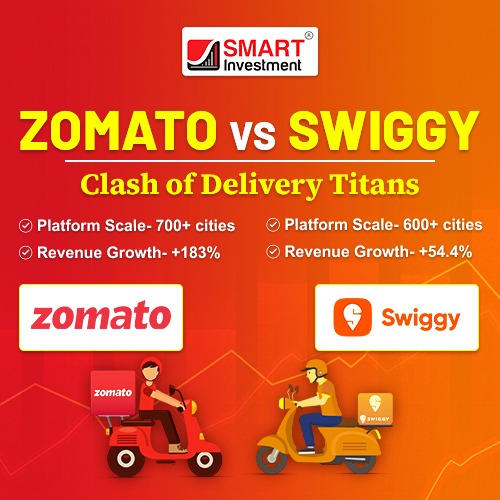
CLASH OF Food Delivery and Quick Commerce Giants – Zomato Vs Swiggy
ABOUT THE COMPANIES
Swiggy Limited (formerly Bundl Technologies Pvt. Ltd.) is one of India’s largest digital conveniences and on-demand delivery platforms, headquartered in Bengaluru. Founded in 2014, Swiggy began as a restaurant food-delivery service and has since evolved into a diversified hyperlocal platform spanning food delivery, quick commerce (Instamart), pickup-and-drop (Swiggy Genie), and dining-out experiences. The company leverages a technology-driven logistics model that connects consumers, delivery partners, and merchants through an integrated digital ecosystem. Swiggy’s core revenue streams include delivery and convenience fees, commissions from partner merchants, advertising income, and subscription services such as Swiggy One. Its operational scale now extends across more than 600 cities in India, supported by an extensive logistics network and over 350,000 active delivery partners.
Eternal Limited (formerly Zomato Limited) is one of India’s largest digital food and convenience platforms, headquartered in Bengaluru. Founded in 2008, the company has evolved from a restaurant discovery and food delivery platform into a diversified hyperlocal ecosystem encompassing multiple verticals — food delivery (Zomato), quick commerce (Blinkit), B2B restaurant supplies (Hyperpure), and dining and going-out services. Eternal operates on a technology-driven, asset-light logistics model that integrates consumers, restaurants, delivery partners, and merchant suppliers through a unified digital platform. The company’s revenue model is driven by commissions from partner restaurants, delivery charges, advertising, subscription services, and sales from inventory-led businesses like Blinkit and Hyperpure. Over the years, Eternal has built a strong presence across more than 700 cities in India and continues to expand its ecosystem across food, grocery, and lifestyle convenience segments.
|
Other KEY Metric |
Swiggy |
Eternal (Zomato) |
|
Food Delivery GOV |
₹8,542 crore |
₹8,300–₹8,500 crore |
|
Quick Commerce GOV |
₹7,022 crore |
₹5,000–₹5,500 crore |
|
Quick Commerce YoY Growth |
+107% |
+150% |
|
Active Dark Stores |
1,102 |
1,816 |
|
AOV (Quick Commerce) |
₹697 |
₹620–₹650 |
|
Contribution Margin (Food) |
+2.8% |
~2–3% |
|
Contribution Margin (Quick Commerce) |
-2.6% |
-3% to -4% |
|
Users (MTUs) |
22.9 million |
20.8 million |
|
Delivery Partners |
~3.5 lakh |
~3 lakh (est.) |
|
Key Focus |
Efficiency, profitability |
Scale, market leadership |
Business to Business Comparison Segment Wise:
- Food Delivery Segment
|
Metric |
Swiggy |
Eternal (Zomato) |
Commentary |
|
Gross Order Value (GOV) |
₹8,542 crore |
~₹8,300–₹8,500 crore (est.) |
Comparable scale in core food delivery; both show steady demand recovery. |
|
GOV Growth (YoY) |
+18.8% |
+20–22% |
Both achieved moderate, sustainable growth in food delivery post-pandemic normalization. |
|
Monthly Transacting Users (Food) |
~17.2 million |
~20.8 million (overall users) |
Zomato maintains a marginally larger user base due to stronger brand penetration. |
|
Contribution Margin |
+2.8% of GOV |
~2–3% of GOV |
Both companies have turned contribution-positive in food delivery; profitability driven by lower discounts and better efficiency. |
|
Avg. Order Value (AOV) |
₹420–₹450 |
₹380–₹420 |
Swiggy’s AOV slightly higher, reflecting stronger metro presence and premium order mix. |
|
Key Focus Areas |
Retention, premiumization (Instamart synergy) |
Efficiency, advertising monetization |
Both focusing on profitability in food delivery vertical. |
- Quick Commerce Segment:
|
Metric |
Swiggy (Instamart) |
Eternal (Blinkit) |
Commentary |
|
Gross Order Value (GOV) |
₹7,022 crore |
₹5,000–₹5,500 crore (est.) |
Swiggy Instamart currently larger by order value; Blinkit growing faster from smaller base. |
|
YoY Growth |
+107.6% |
+150–160% |
Both segments showing hyper-growth; Blinkit has accelerated expansion in Tier I & II cities. |
|
Contribution Margin |
-2.6% |
-3% to -4% |
Both operating near break-even levels; Swiggy’s contribution loss narrowing faster. |
|
Average Order Value (AOV) |
₹697 |
₹620–₹650 |
Swiggy’s Instamart has higher AOV due to diversified non-grocery basket. |
|
Active Dark Stores |
1,102 |
1,816 |
Blinkit has broader geographic reach; Swiggy has higher throughput per store. |
|
Orders per Dark Store per Day |
~1,025 |
~900–950 (est.) |
Swiggy’s network shows higher productivity due to denser urban coverage. |
|
Key Strategy |
Focus on profitability, efficiency, non-grocery expansion |
Rapid store addition, brand-led volume growth |
Swiggy prioritizes margin discipline; Blinkit focuses on market capture. |
- Other Verticals:
|
Business Vertical |
Swiggy |
Eternal (Zomato) |
Remarks |
|
B2B Supply Chain |
N/A |
Hyperpure |
Eternal’s Hyperpure supplies raw materials to restaurants; adds diversification but lower margin. |
|
Pick-Up and Drop Service |
Swiggy Genie |
N/A |
Swiggy operates Genie as an on-demand courier model, offering ancillary revenue. |
|
Subscription Model |
Swiggy One |
Zomato Gold / Zomato Pro |
Both use subscription ecosystems for loyalty and retention. |
|
Dining-Out / Events |
Limited |
Zomato Dining & Zomaland |
Eternal benefits from cross-segment synergies with its dining ecosystem. |
|
Capital Strength |
₹10,000 crore fundraise approved (QIP) |
Strong free cash reserves; previous fundraises completed |
Both maintain strong liquidity positions to support expansion. |
Results and KPI Comparisons as of Q2Fy26:
|
|
Swiggy |
Eternal |
|
Market Cap |
Rs. 1,00,083 Cr. |
Rs. 2,95,304 Cr. |
|
CMP |
Rs. 401 |
Rs. 306 |
|
52 – High / LOW |
Rs. 617 / 297 |
Rs. 368 / 190 |
|
FV |
Rs. 1 |
Rs. 1 |
|
Sales |
Rs. 18,925 Cr. |
Rs. 31,995 Cr. |
|
PAT |
Rs. - 4,173 Cr. |
Rs. 188 Cr. |
|
RoCE |
-29.2% |
2.66 % |
|
EPS |
Rs. -17.5 |
Rs. 0.19 |
|
PE |
- |
1571 |
|
PEG Ratio |
- |
49.8 |
|
Return on 3 years |
- |
67.5% |
|
P/Bv |
- |
9.58 |
|
Debt to Equity |
0.25 |
0.11 |
|
Dividend Yield |
0 % |
0% |
|
EVEBITDA |
-32.8 |
156 |
|
Revenue Growth YoY |
+54.4% |
+183% |
Swiggy Limited reported strong top-line growth in Q2 FY26, led by consistent expansion across both its core food delivery and quick-commerce (Instamart) segments. Despite higher operating expenses and network expansion costs, the company delivered sequential improvement in contribution margins and operational efficiency.
- Revenue from Operations: ₹5,561 crore, up 54.4% year-on-year, supported by higher order volumes and growth in quick-commerce.
- Gross Order Value (GOV): ₹16,683 crore, up 47.6% YoY, reflecting broad-based demand recovery.
- Food Delivery GOV: ₹8,542 crore, up 18.8% YoY, with stable average order values and rising frequency in Tier-I cities.
- Quick Commerce (Instamart) GOV: ₹7,022 crore, up 107% YoY, driven by expansion of dark stores and category diversification beyond groceries.
- Adjusted EBITDA: Loss of ₹695 crore, showing quarter-on-quarter improvement as cost optimization efforts took effect.
- Net Loss: ₹1,092 crore, widening from the prior year due to higher fulfillment and marketing costs.
- Operating Margins: Improved sequentially, with food delivery achieving a positive contribution margin of +2.8% of GOV and Instamart nearing break-even at –2.6%.
- Cash Flow: Net cash outflow narrowed to ₹749 crore, indicating progress toward reduced cash burn.
- Key Drivers: Volume growth, improved order density, better utilization of delivery partners, and growing adoption of high-margin non-grocery categories.
Overall, Swiggy demonstrated strong momentum in revenue growth and meaningful strides toward profitability, particularly within its food-delivery vertical.
Eternal Limited (Zomato)
Eternal Limited (formerly Zomato) delivered record quarterly revenue in Q2 FY26, primarily fueled by the rapid scale-up of its quick-commerce arm, Blinkit. However, profitability contracted due to elevated marketing and infrastructure costs, even as the company remained net profitable for the quarter.
- Revenue from Operations: ₹13,590 crore, up 183% year-on-year, reflecting strong consolidated growth across food delivery, Blinkit, and Hyperpure.
- Total Income: ₹13,942 crore, including other income sources.
- Net Profit (PAT): ₹65 crore, down 63% YoY from ₹176 crore, as higher investments in Blinkit and promotional activity weighed on margins.
- Total Expenses: ₹13,813 crore, up 188% YoY, primarily due to increased inventory, employee, and fulfillment costs.
- Food Delivery Revenue: Approximately ₹2,485 crore, up 23% YoY, driven by stable order growth and increased restaurant onboarding.
- Quick Commerce (Blinkit) Revenue: Approximately ₹9,891 crore, up 756% YoY, reflecting rapid scale-up and strong category expansion beyond essentials.
- EBITDA Performance: Remained positive on a consolidated basis but declined sequentially due to cost pressures from Blinkit’s network expansion.
- Operational Highlights: Blinkit expanded to 1,816 dark stores; food delivery monthly transacting users grew to ~24 million; contribution margins in food delivery remained positive.
- Strategic Focus: The company continues to strengthen cross-platform synergies between food delivery, Blinkit, and Hyperpure, while maintaining profitability discipline in its core operations.
Eternal’s Q2 results underscore its market leadership in scale and diversification, with strong revenue acceleration balanced against near-term margin pressures from aggressive growth investments.
Industry Outlook
India’s online food delivery and quick-commerce industry continues to exhibit robust structural growth, underpinned by rising digital adoption, increasing disposable incomes, and the ongoing shift in consumer behavior toward on-demand convenience. The sector’s total addressable market (TAM) for food delivery is estimated to exceed USD 25 billion by FY28, growing at a CAGR of 18–20%, while the quick-commerce segment is projected to scale from USD 2.8 billion in FY25 to over USD 11 billion by FY28, registering a CAGR of 45–50%.
Urbanization, improved internet penetration, and time-constrained lifestyles continue to fuel demand across Tier I and Tier II cities. Additionally, category diversification beyond food and grocery—such as beauty, personal care, home essentials, and pharmacy—has expanded the frequency and relevance of these platforms in daily consumer life.
At the same time, the industry is entering a consolidation and efficiency phase, where players are focusing less on discount-driven volume growth and more on sustainable unit economics. As a result, profitability and operational productivity are expected to improve gradually over the next 6–8 quarters. AI-led demand forecasting, hyperlocal supply-chain optimization, and dark-store automation will further enhance delivery precision, cost efficiency, and consumer experience.
Regulatory clarity, improved partner economics, and the evolution of last-mile infrastructure are likely to support the industry’s next growth phase. However, competitive intensity in quick commerce and potential saturation in high-frequency metro markets may moderate near-term growth momentum, prompting players to prioritize margin discipline and ecosystem synergies.
Comparative Positioning
Swiggy and Eternal (Zomato) remain the two dominant players shaping India’s on-demand convenience landscape, with both maintaining extensive logistics networks, deep consumer penetration, and diversified business portfolios.
- Swiggy is strategically positioned as an efficiency-driven operator, emphasizing cost optimization, order density, and profitability. Its focus on technology-led operational control, a higher average order value (AOV), and improving contribution margins places it on a steady path toward EBITDA break-even. The company’s measured expansion strategy and focus on unit-level profitability could yield sustainable financial performance once top-line growth stabilizes.
- Eternal (Zomato), on the other hand, operates at greater scale and diversification, integrating food delivery, quick commerce (Blinkit), and B2B supplies (Hyperpure) under a unified ecosystem. While its aggressive expansion in Blinkit has compressed margins, Eternal’s platform synergies, extensive restaurant partnerships, and strong brand recall position it for long-term market leadership. The company’s ability to sustain profitability in core food delivery while scaling quick commerce will be the key determinant of its valuation trajectory.
Both companies are leveraging cross-vertical integration—Swiggy through Instamart and Swiggy One, Eternal through Blinkit and Zomato Gold—to deepen user engagement and maximize customer lifetime value. Over the medium term, both are expected to converge toward improved contribution profitability as discount intensity declines and per-order economics strengthen.
Conclusion
The comparative analysis of Swiggy and Eternal highlights an industry transitioning from hypergrowth to operational maturity. While Eternal currently leads in revenue scale and platform breadth, Swiggy demonstrates superior control over cost structures and efficiency metrics. The competitive landscape is likely to remain duopolistic in the near term, with both companies focusing on differentiated strategies: Eternal emphasizing market capture and ecosystem integration, and Swiggy emphasizing profitability and operational resilience.
From a fundamental perspective, sustained growth in digital consumption, rapid category diversification, and improving logistics efficiency will drive value creation across the sector. Investors and analysts should monitor key parameters such as contribution margins, cash-flow trends, order frequency, and the pace of EBITDA break-even in the quick-commerce verticals.
In conclusion, India’s on-demand delivery industry remains a long-duration growth story—with Swiggy and Eternal poised as dual leaders in the evolution of a convenience-driven digital economy. The medium-term outlook remains positive, supported by scalable business models, strong consumer adoption, and increasing operational discipline, though profitability timelines will continue to vary based on execution strategies and capital allocation efficiency.
Comparative Analysis by: HET ZAVERI
info@smartinvestment.in
(Disclosures: Above mentioned is not an investment advice, it’s just a comparison of two likewise companies of same sector which may help in taking advised decisions for investors. At the time of writing this article, author, his clients & dependent family members may have positions in the stocks mentioned above. The author, his firm, his clients, or any of his dependent family members may make purchases or sale of the securities mentioned in website. Author may have positions in above stocks so have vested interest obviously in their going up or down as the case may be.
Disclaimer: Investing in any equity is risky. Our recommendations are based on reliable & authenticated sources believed to be true & correct, and also is technical analysis based on & conceived from charts. Investors should take their own decisions. We assume no responsibility for any transactions undertaken by them. The author will not be liable or responsible for any legal or financial losses made by anybody. Investors must take advice from their financial advisors before investing in any stocks.)