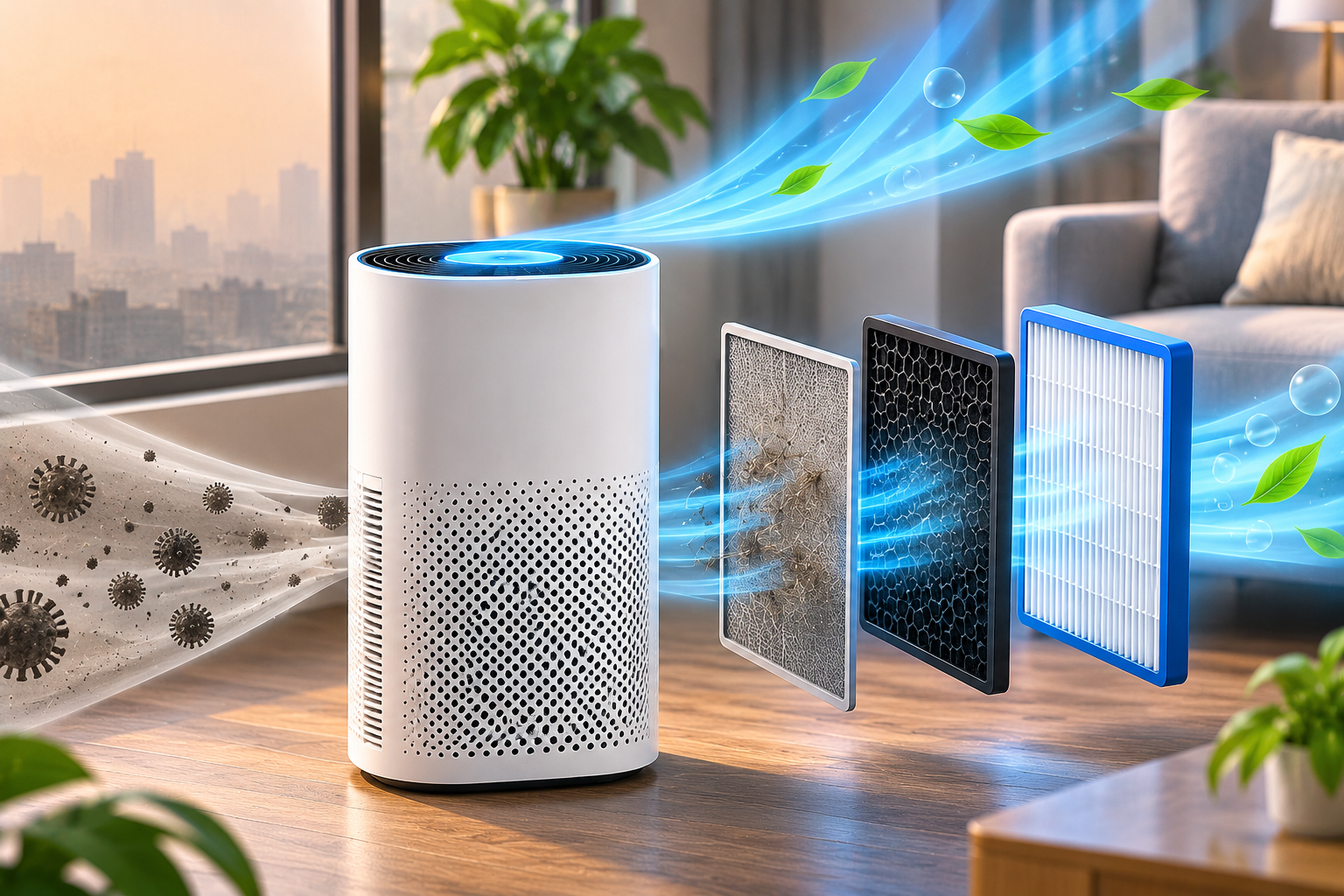
As Delhi-NCR and several other Indian cities battle deteriorating air quality, air purifiers are becoming increasingly popular. But how effective are they, what pollutants can they remove, and what should consumers check before buying one?
As outdoor air pollution worsens across parts of India, particularly during the winter months, households are increasingly turning to air purifiers to improve indoor air quality.
Delhi-NCR has been among the regions witnessing a sharp rise in demand for these devices as pollution from vehicular emissions, stubble burning, construction activity and other sources pushes particulate pollution higher.
On Monday, Delhi's air quality index (AQI) stood at 216 at 7 am, placing it in the 'poor' category, according to real-time data from the Central Pollution Control Board (CPCB).
Among the pollutants that raise the greatest concern are PM10 and PM2.5. PM10 consists of particles measuring 10 micrometres or less in diameter, while PM2.5 refers to much finer particles measuring 2.5 micrometres or less. Because of their small size, these particles can remain suspended in the air and penetrate deep into the respiratory system.
This raises an important question: can an air purifier actually remove these pollutants from indoor air?
How Does an Air Purifier Work?
An air purifier essentially works by continuously circulating indoor air through one or more filtration stages.
The device draws polluted air through an intake, passes it through filters that capture or absorb contaminants, and then releases the treated air back into the room.
Most conventional air purifiers combine several filtration technologies because different pollutants require different methods of removal.
The effectiveness of the overall system depends not only on the filter but also on airflow, room size, filter condition and how frequently the device circulates indoor air.
Pre-Filter Captures Larger Particles
The first filtration stage is generally a pre-filter.
It is designed to capture relatively large particles such as household dust, hair, pet fur and other visible debris before the air reaches the finer filtration layers.
The pre-filter plays an important role because it prevents larger particles from quickly accumulating on the main filter.
Many pre-filters can be cleaned periodically, although consumers should follow the manufacturer's maintenance instructions.
Activated Carbon Tackles Odours and Gases
The next stage in many air purifiers is an activated carbon filter.
Unlike a mechanical particulate filter, activated carbon works primarily through adsorption. Certain gases and odour-causing molecules adhere to the large internal surface area of the carbon material.
This can help reduce cooking odours, smoke and some volatile organic compounds (VOCs) released by products such as paints, adhesives and cleaning chemicals.
However, the effectiveness of a carbon filter depends on factors including the quantity and quality of activated carbon used and the nature and concentration of the pollutant.
HEPA Filter Is Critical for PM2.5
For fine particulate pollution, the HEPA (High Efficiency Particulate Air) filter is generally the most important component.
HEPA filters consist of a dense network of fibres through which air passes. Fine particles are captured by a combination of mechanisms as they move through the filter.
These can include fine dust, pollen, mould spores and other airborne particles.
According to Eurovent Certita Certification, HEPA filters should remove at least 99.95 per cent of airborne particles under the relevant testing conditions.
This makes high-quality HEPA filtration particularly relevant for households concerned about PM2.5 and other fine particulate pollution.
However, consumers should distinguish between the performance of a filter under controlled testing conditions and the performance of the complete purifier inside a real room.
Can Air Purifiers Remove PM10 and PM2.5?
A properly designed purifier equipped with an effective particulate filter can substantially reduce airborne PM10 and PM2.5 inside a room.
PM10 particles are relatively larger and can generally be captured effectively by mechanical filtration. PM2.5 is more challenging because the particles are much smaller, making the efficiency and design of the filtration system particularly important.
The purifier must also circulate enough air through the filter. A highly efficient filter attached to an undersized device may not clean a large room effectively.
This is why consumers should consider the purifier's recommended room size and airflow performance rather than choosing a device solely on the basis of its HEPA label.
What About UV, Ionisers and Other Technologies?
Some air purifiers incorporate additional technologies such as ultraviolet (UV) light, ionisers or electrostatic filtration.
These systems work differently from conventional mechanical filters and may be marketed for specific applications.
However, consumers should examine such technologies carefully. Certain ionisation and photocatalytic systems can potentially produce ozone or other by-products.
For households primarily concerned about particulate pollution, the basic combination of effective mechanical filtration, adequate airflow and appropriate room coverage remains particularly important.
Room Size Matters More Than Many Buyers Realise
One of the most common mistakes when buying an air purifier is focusing exclusively on the filter specification.
A purifier needs to process sufficient quantities of air to meaningfully improve the air quality in a room.
An undersized unit may struggle to circulate enough air, particularly in larger rooms or spaces with high pollution loads.
Consumers should therefore check the manufacturer's recommended room size and airflow specifications before making a purchase.
A purifier designed for a bedroom may not be sufficient for a large living room.
One Purifier May Not Clean the Entire House
Air does not automatically circulate evenly between separate rooms.
Walls, closed doors, furniture and other physical barriers can restrict airflow. As a result, a purifier operating in one bedroom will not necessarily provide the same level of filtration throughout an entire house.
For this reason, consumers should generally consider the purifier's performance in the specific room where it is being used.
During periods of severe outdoor pollution, keeping doors and windows closed can also help prevent polluted outdoor air from continuously entering the room.
Filter Maintenance Is Essential
Even a high-quality purifier can become less effective if its filters are not maintained properly.
Filters accumulate dust and other pollutants over time. As they become clogged, airflow can be restricted, potentially reducing the purifier's ability to process air efficiently.
Filter replacement intervals vary depending on the device, operating conditions and pollution levels.
Homes located in heavily polluted environments may put greater loads on filters than homes in areas with cleaner outdoor air.
Consumers should therefore follow the manufacturer's cleaning and replacement recommendations rather than waiting until the purifier's performance visibly deteriorates.
Air Quality Sensors Add Convenience
Many modern air purifiers are equipped with sensors that monitor changes in indoor air quality.
Depending on the model, the sensor can detect changes in particulate levels and automatically adjust fan speed.
In automatic mode, the purifier can increase airflow when pollution levels rise and reduce fan speed once conditions improve.
Some devices also provide real-time air-quality readings through displays or smartphone applications.
These features can make it easier for consumers to monitor indoor conditions, although sensor readings should not automatically be treated as equivalent to measurements from regulatory-grade monitoring equipment.
Air Purifiers Are Not a Substitute for Pollution Control
An air purifier can help reduce indoor concentrations of airborne pollutants, but it does not eliminate the sources of pollution.
Indoor pollution can originate from cooking, smoking, cleaning products, paints, dust and other activities.
At the same time, outdoor pollution can enter through doors, windows and other openings.
During periods when outdoor pollution is particularly high, opening windows may increase the amount of polluted air entering the home. At other times, appropriate ventilation remains important for managing indoor pollutants.
The objective should therefore be to combine filtration with sensible source control and appropriate ventilation practices.
What Should Consumers Check Before Buying?
Consumers considering an air purifier should look beyond marketing claims and examine several practical factors.
Filter quality: Check the type and quality of particulate filtration, particularly if PM2.5 is the main concern.
Airflow and room coverage: Ensure the device is appropriately sized for the room in which it will operate.
Filter replacement cost: The purchase price is only part of the total cost of ownership. Replacement filters can represent a significant recurring expense.
Noise levels: A purifier intended to run for long periods should operate at an acceptable noise level, particularly in bedrooms and workspaces.
Energy consumption: Continuous operation can increase electricity use, making energy efficiency another consideration.
Sensor and automatic modes: These features can make operation more convenient, particularly when pollution levels fluctuate.
Ozone generation: Consumers should be cautious about technologies that may generate ozone or other potentially undesirable by-products.
Market Outlook
The worsening air-quality situation in major Indian cities is likely to keep consumer interest in indoor air-quality products elevated, particularly during the winter pollution season.
For the consumer electronics and home-appliance industry, this creates opportunities across air purifiers, replacement filters, indoor air-quality sensors and related products.
However, sustained demand will depend on consumers becoming more aware of the recurring cost of filter replacement and the actual performance of different technologies.
For buyers, the key takeaway is that a purifier's effectiveness depends on the complete system—not simply the presence of a HEPA filter. Appropriate room capacity, adequate airflow, regular maintenance and sensible control of pollution sources are all critical to achieving cleaner indoor air.