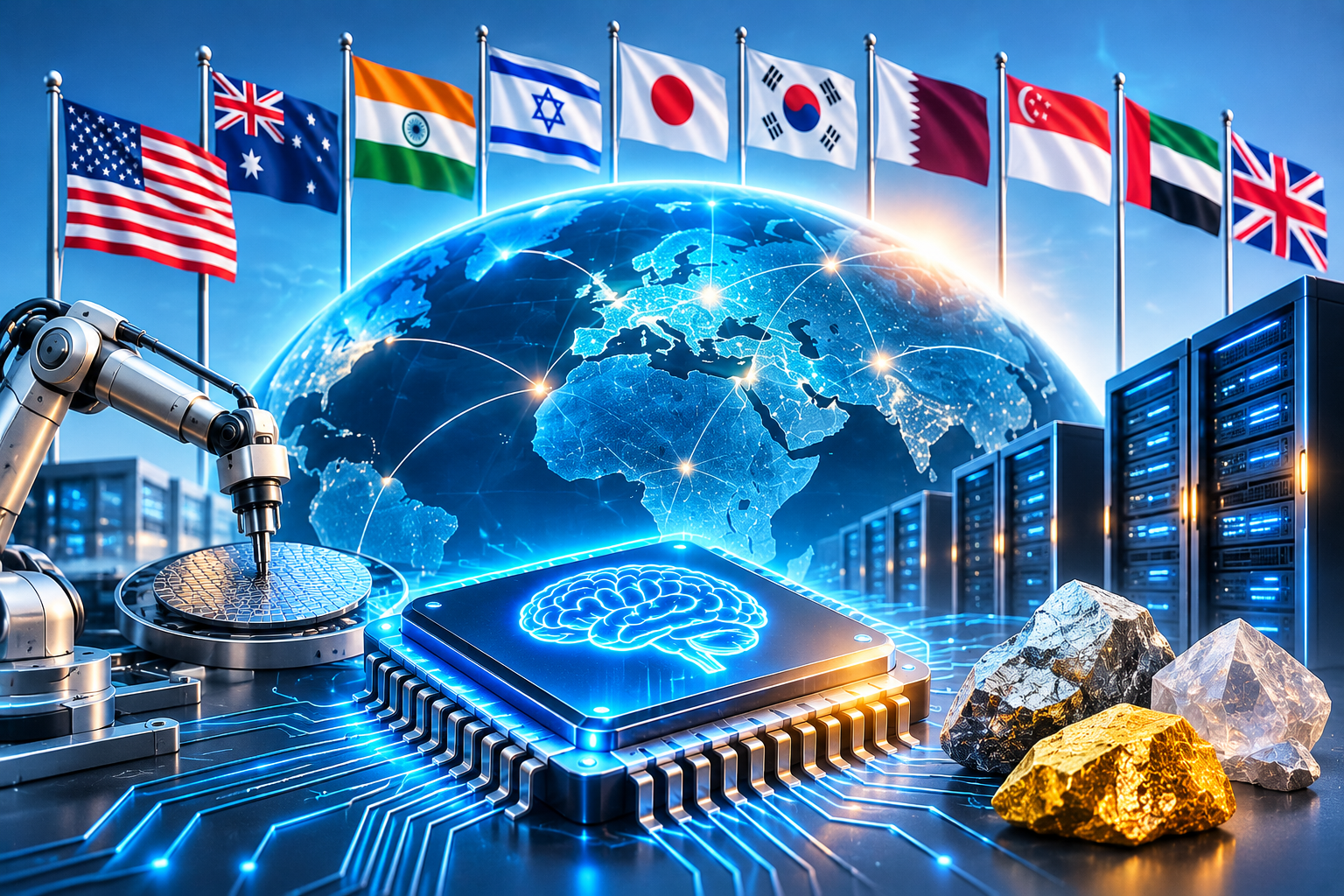
The San Francisco Declaration brings together India, the US and eight other nations to strengthen cooperation on critical AI infrastructure, semiconductors, minerals, cybersecurity and supply-chain resilience
India, the United States and eight other countries have signed a landmark declaration aimed at strengthening the security and resilience of artificial intelligence (AI) supply chains, as global competition for advanced technologies and semiconductor resources intensifies.
The San Francisco Declaration brings together the Governments of the US, Australia, India, Israel, Japan, South Korea, Qatar, Singapore, the United Arab Emirates (UAE) and the United Kingdom.
The agreement treats the protection of critical artificial intelligence and advanced-technology supply chains as a shared responsibility, with participating countries seeking to reduce vulnerabilities across the infrastructure and resources needed to develop and deploy next-generation AI systems.
Economic Security Becomes Central to AI Strategy
The declaration states that economic security is fundamental to national security and establishes a common understanding of the sensitive technologies and critical infrastructure supporting what the US Government refers to as "Super Intelligence" supply chains.
The agreement comes as governments increasingly view access to semiconductors, advanced computing, critical minerals, energy and data-centre infrastructure as strategic assets.
AI development requires a complex ecosystem that stretches from semiconductor manufacturing and advanced packaging to computing infrastructure, cloud platforms, networking equipment and energy supply. Disruptions at any point in this chain can affect the ability of companies and countries to deploy advanced AI systems.
The participating nations have therefore agreed to work collectively to protect key parts of this ecosystem.
Pax Silica Enters a New Phase
The declaration was signed during a meeting of the founders of the US-led Pax Silica initiative, convened by US Under Secretary of State for Economic Affairs Jacob Helberg.
The Pax Silica initiative was announced by the US in December last year with the objective of strengthening supply chains for silicon and other minerals that are critical to semiconductor production and advanced technologies.
The latest declaration expands the initiative's focus from securing raw materials to developing a broader framework covering AI infrastructure, technology adoption, investment and supply-chain security.
According to the US State Department, the San Francisco Declaration is intended to convert the coalition's common principles into practical cooperation.
Five Working Groups to Drive Cooperation
The participating countries have agreed to establish five working groups to translate the declaration into concrete action.
The groups will focus on pro-innovation policy frameworks, adoption of Super Intelligence across important economic sectors, cooperation throughout the AI supply chain, safe harbours and supply-chain security hubs, and AI security and resilience.
This structure could allow member nations to coordinate policies across several stages of the technology ecosystem rather than limiting cooperation to semiconductor production.
It also creates a framework for countries to share expertise, encourage investment and strengthen resilience against supply disruptions.
Semiconductors at the Centre of the Strategy
Semiconductors are likely to remain one of the most important components of the initiative.
Advanced AI models require powerful processors, high-bandwidth memory and sophisticated semiconductor manufacturing capabilities. These technologies are concentrated in a relatively small number of countries and companies, creating potential vulnerabilities in the global supply chain.
The participating nations include several major technology and semiconductor hubs.
The US is home to leading chip designers, AI companies and semiconductor equipment businesses. Japan and South Korea play important roles in semiconductor materials, memory and manufacturing. The UK has significant capabilities in chip design and advanced research, while Singapore is an important electronics and manufacturing hub.
India, meanwhile, is seeking to build a larger semiconductor manufacturing and electronics ecosystem while expanding its role in technology services and AI.
India’s Strategic Role Gains Importance
For India, participation in the initiative could strengthen its position in the emerging global technology supply chain.
India has been seeking to expand domestic semiconductor manufacturing, electronics production, data-centre capacity and AI capabilities while attracting global technology investment.
Closer cooperation with countries involved in Pax Silica could create opportunities for technology partnerships, manufacturing investment and diversification of supply chains.
India's large digital economy and growing pool of technology professionals also provide a potential advantage as companies look to expand AI development and deployment beyond traditional technology centres.
The initiative could therefore complement India's broader push to establish itself as an important destination for advanced technology investment.
Critical Minerals Become Increasingly Important
The AI supply chain does not begin with processors and servers. It depends on a range of raw materials and minerals required to manufacture semiconductors, electronics, batteries, power systems and other infrastructure.
China currently plays a significant role in several areas of the global critical-minerals ecosystem, making supply diversification a strategic priority for several governments.
Pax Silica's original focus on silicon and other minerals reflects the growing recognition that control over raw materials can influence technological competitiveness.
The new declaration could encourage participating nations to develop alternative sources, processing capabilities and strategic partnerships.
AI Infrastructure and Energy Demand
The expansion of AI is also creating a rapidly growing requirement for data centres and electricity.
Advanced AI models require substantial computing power, while large-scale data centres require reliable electricity, cooling systems and high-speed connectivity.
This means that AI supply-chain security increasingly extends beyond chips and minerals to include energy infrastructure, data centres, networking systems and cloud computing.
Countries participating in the declaration could therefore have an incentive to coordinate investments across these interconnected sectors.
Security and Resilience Take Priority
The declaration also places significant emphasis on security.
AI systems can be used across critical industries, making vulnerabilities in models, computing infrastructure or supply chains potentially consequential for national security and economic stability.
The proposed working group on security and resilience is expected to address these concerns while strengthening cooperation among participating nations.
The emphasis on "safe harbours" and supply-chain security hubs could also encourage the development of trusted technology ecosystems where companies can operate under clearer security standards.
Global Technology Competition Intensifies
The agreement comes against the backdrop of intensifying competition between the US and China across semiconductors, artificial intelligence, advanced computing and critical minerals.
The US and its partners are increasingly seeking to build resilient technology networks that reduce dependence on vulnerable or concentrated supply chains.
Rather than relying exclusively on domestic production, the latest initiative points toward a network of trusted partners that can collectively strengthen the technology ecosystem.
For businesses, this could eventually influence where semiconductor plants, data centres, AI infrastructure and advanced manufacturing facilities are built.
Investment Implications
The declaration could have implications across several investment themes.
Semiconductors: Greater emphasis on supply-chain resilience could accelerate investments in chip manufacturing, semiconductor equipment, materials and advanced packaging.
Data centres: Increasing AI adoption is likely to support demand for data centres, cloud infrastructure, networking equipment and power infrastructure.
Critical minerals: Governments may increasingly encourage alternative sources and domestic processing of minerals required for advanced technology.
Cybersecurity: Greater focus on securing AI infrastructure could create additional opportunities for cybersecurity and technology-risk management companies.
Indian technology ecosystem: India's participation could strengthen the country's position as a destination for AI, semiconductor, electronics and digital-infrastructure investments.
Market Outlook
The San Francisco Declaration marks an important shift in the global AI race, with supply-chain security becoming almost as important as developing more powerful AI models.
For investors, the agreement reinforces the long-term investment case around semiconductors, AI infrastructure, data centres, cybersecurity, critical minerals, power infrastructure and advanced electronics.
India's participation is particularly significant because the country is simultaneously expanding its semiconductor ambitions, digital infrastructure and AI ecosystem. Greater integration with a network of technology-focused partner countries could improve opportunities for domestic companies and attract additional global capital.
However, the economic impact will depend on how quickly the declaration translates into actual investment, manufacturing capacity and cross-border technology partnerships.
The key factors to monitor will be new semiconductor and AI-infrastructure investments, critical-mineral agreements, data-centre expansion, government incentives and the emergence of India as a larger node in trusted global technology supply chains.