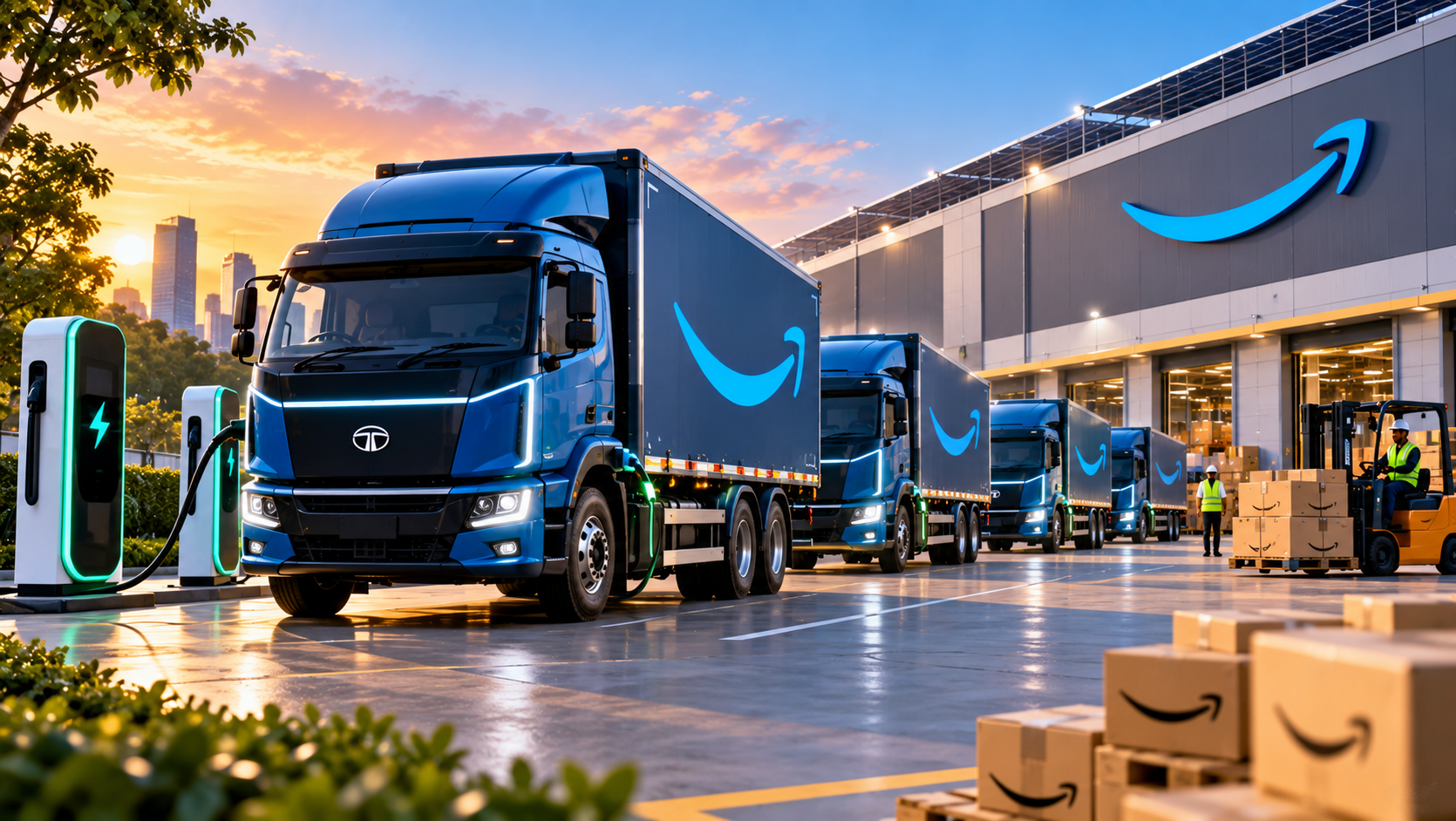
The companies plan to introduce 3,000 electric trucks across Amazon’s transportation network in India over the next three years, strengthening efforts to decarbonise freight movement and improve logistics efficiency.
Tata Motors and Amazon have announced a collaboration to deploy 3,000 electric trucks across Amazon’s transportation network in India over the next three years. The initiative marks a significant step towards electrifying commercial freight transportation and reducing the environmental impact of the country’s rapidly expanding e-commerce logistics sector.
The initial fleet of electric trucks was flagged off by Union Heavy Industries Minister H D Kumaraswamy on Tuesday. The collaboration is expected to support the adoption of cleaner transportation solutions as businesses seek to improve operational efficiency while reducing their dependence on conventional fossil-fuel-powered vehicles.
Initial Fleet Marks Beginning of Three-Year Deployment Plan
Under the partnership, the companies plan to progressively introduce electric trucks into Amazon’s logistics operations. A senior Amazon executive confirmed that the entire fleet of 3,000 vehicles is expected to be deployed within three years.
The rollout will expand the use of electric vehicles in commercial transportation, a segment that plays a crucial role in moving goods between warehouses, distribution centres and delivery hubs. Electric trucks could become increasingly important for e-commerce companies managing large shipment volumes and extensive transportation networks.
The deployment will also provide an opportunity to expand the practical use of electric commercial vehicles in logistics operations, where vehicle utilisation, operating costs, charging infrastructure and route planning are important considerations.
Government Highlights Importance of Freight Electrification
Union Heavy Industries Minister H D Kumaraswamy welcomed the partnership, describing the deployment of 3,000 electric trucks as a significant collaboration between Tata Motors and Amazon.
The minister noted that electric passenger vehicles and two-wheelers have made encouraging progress in India, but electrification of commercial transportation is equally important.
As the Indian economy grows, demand for freight movement is expected to increase alongside industrial activity, e-commerce transactions and consumer spending. Kumaraswamy emphasised that the expansion of the logistics sector must be accompanied by improvements in energy efficiency.
The initiative aligns with the broader objective of encouraging cleaner mobility solutions across different vehicle categories. While passenger vehicles receive considerable attention in discussions about electric mobility, the adoption of electric trucks could also contribute to reducing emissions from goods transportation.
Electric Trucks Could Improve Logistics Efficiency
The growing popularity of online shopping has increased the need for reliable and efficient transportation networks. E-commerce companies depend on trucks to move packages between fulfilment centres, sorting facilities and regional distribution hubs before shipments reach customers.
Introducing electric trucks into these operations could offer potential benefits, particularly on routes where vehicles follow predictable schedules and return regularly to designated facilities. Such routes can make it easier to plan charging requirements and manage fleet utilisation.
Electric vehicles generally have fewer moving parts in their powertrains than conventional internal-combustion vehicles, potentially reducing certain maintenance requirements. However, the overall economic benefits depend on factors such as vehicle acquisition costs, electricity prices, charging infrastructure, battery performance, payload capacity and daily distance travelled.
The success of the planned deployment will therefore depend not only on the number of vehicles introduced but also on their ability to meet the operational requirements of large-scale logistics networks.
Implications for India's Electric Commercial Vehicle Market
The partnership could provide additional momentum to India's electric commercial vehicle ecosystem. Large fleet operators can play an important role in accelerating adoption by creating demand for vehicles, charging facilities and supporting services.
A deployment of this scale may also help generate operational experience in areas such as battery management, vehicle scheduling, charging arrangements and the economics of electric freight transportation. Such experience could inform future fleet electrification decisions across logistics, retail and other commercial sectors.
For Tata Motors, the collaboration represents an opportunity to expand the use of its electric commercial vehicle offerings in a demanding, high-utilisation business environment. For Amazon, the initiative supports efforts to incorporate lower-emission transportation solutions into its logistics network.
However, the wider impact will depend on the pace of deployment, the availability of suitable charging infrastructure and the extent to which electric trucks can deliver competitive operating economics across different routes.
Market Outlook
The Tata Motors–Amazon partnership highlights the growing commercial importance of electric mobility beyond passenger vehicles. As e-commerce volumes and freight transportation requirements increase, fleet electrification could emerge as a potential growth area for India's commercial vehicle and automotive supply chains.
Investors tracking Tata Motors and the electric vehicle ecosystem may watch the execution of the three-year deployment plan, demand for electric commercial vehicles, charging infrastructure development and the economics of large-scale fleet operations. The collaboration is strategically encouraging, but its financial impact on Tata Motors will depend on vehicle volumes, margins, utilisation and broader business performance. The announcement alone does not establish the scale of any near-term earnings contribution.