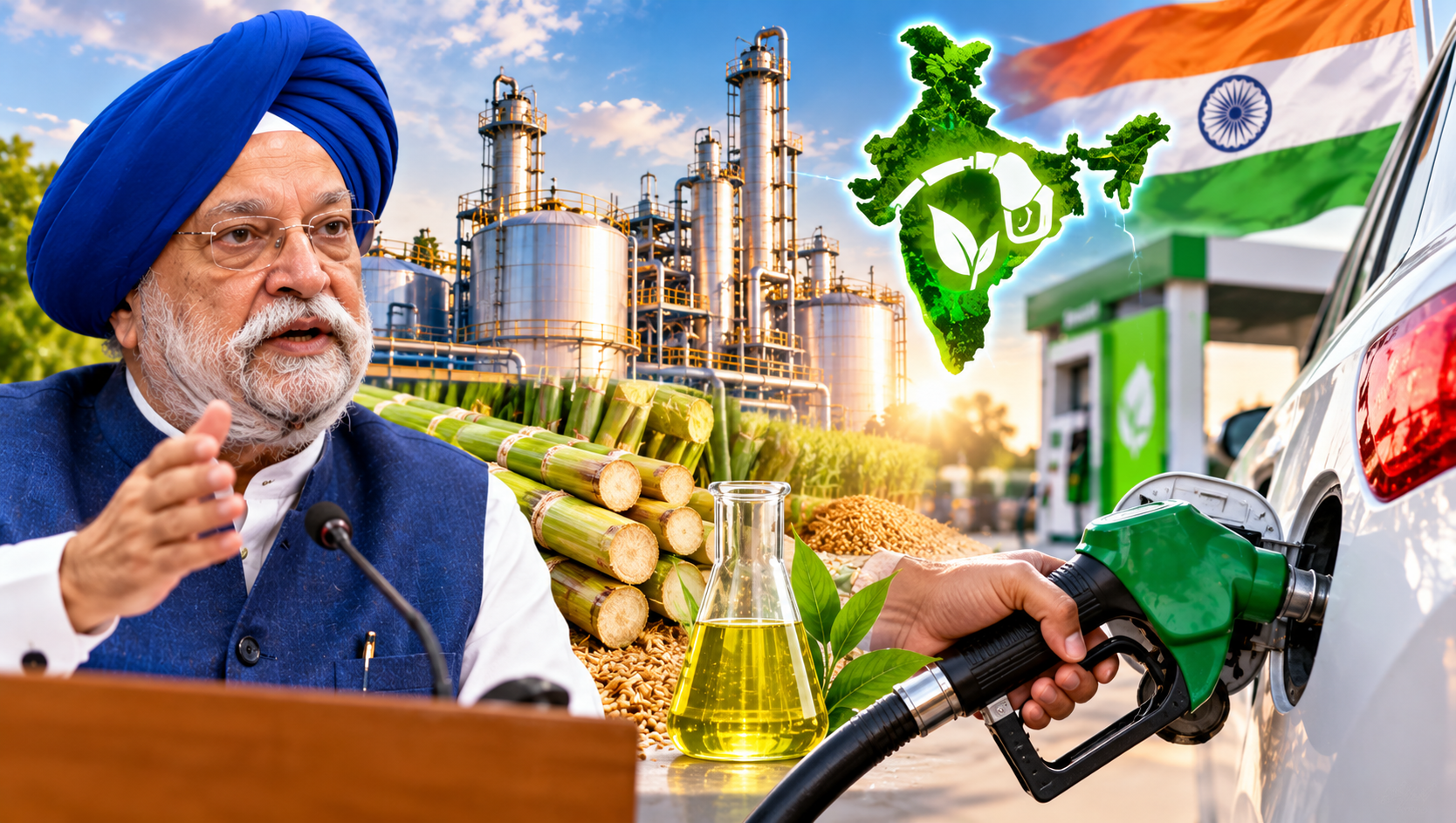
The government will continue with its existing E20 petrol target as it focuses on reducing crude oil import dependence, supporting farmers and addressing concerns surrounding ethanol-blended fuel.
Government Rules Out Higher Ethanol Blending Target for Now
India has no immediate intention of increasing ethanol blending in petrol beyond the existing 20% level, Union Petroleum and Natural Gas Minister Hardeep Singh Puri said on Tuesday. His remarks indicate that the government intends to maintain its current E20 target for now, even as the country explores technologies capable of supporting higher ethanol concentrations.
Speaking during the inauguration of the 29th Energy Technology and Innovation Meet in South Goa, Puri defended the government's biofuel programme and dismissed what he described as misleading claims about E20 petrol. The three-day event, organised by the Ministry of Petroleum and Natural Gas, focuses on accelerating energy innovation from research to commercialisation.
The minister's statement comes amid continuing public discussions about the compatibility of ethanol-blended petrol with older vehicles, fuel efficiency and potential engine-related concerns. Although the government has achieved its 20% blending target, the latest comments suggest that any further increase in the nationwide blending requirement is not an immediate policy priority.
Ethanol Blending Central to India's Energy Security Strategy
India has been expanding ethanol blending as part of a broader effort to reduce its dependence on imported crude oil. Petroleum imports account for a substantial share of the country's energy requirements and expose the economy to fluctuations in international oil prices, geopolitical tensions and disruptions in global supply chains.
By blending domestically produced ethanol with petrol, India aims to substitute a portion of its petroleum consumption with renewable fuel derived from agricultural feedstocks. This strategy can help reduce demand for imported crude, support domestic energy production and create additional markets for agricultural commodities.
E20 petrol contains 20% ethanol and 80% petrol. The nationwide transition to this blend represents a major step in India's biofuel policy, which has progressively increased blending targets over the years.
A higher domestic ethanol supply could also improve energy diversification. However, the programme's long-term success depends on the availability and cost of feedstocks, production capacity, distribution infrastructure, vehicle compatibility and the environmental impact of producing biofuels.
Government Highlights Savings and Benefits for Farmers
Puri said the introduction of E20 petrol had helped the government save approximately ₹1.60 lakh crore. He added that around ₹1.40 lakh crore had been channelled back to farmers, highlighting the agricultural benefits associated with the ethanol programme.
Ethanol production creates an additional market for feedstocks such as sugarcane and grains. For the agricultural sector, this can provide another source of demand and potentially improve income opportunities for farmers and related businesses.
The government has also promoted ethanol production as a way to strengthen the connection between agriculture and the energy sector. By encouraging domestic production, policymakers aim to make farmers contributors to the country's energy supply chain, in addition to their traditional role in food production.
However, the economic benefits depend on several factors, including crop prices, procurement policies, water availability, distillery utilisation and the cost of converting agricultural products into fuel. The broader impact on food security and agricultural resource allocation will also remain important considerations as the sector expands.
E20 Fuel Concerns and Vehicle Compatibility
The minister's remarks also addressed public concerns about the use of E20 petrol, particularly in older vehicles. Puri argued that vehicles designed to comply with the relevant specifications are intended to operate on the blended fuel, while acknowledging that older vehicles could face compatibility issues.
Vehicles manufactured before 2003 were specifically mentioned in his comments. However, compatibility can vary depending on a vehicle's manufacturing year, engine design, fuel-system materials and manufacturer specifications. Vehicle owners should therefore consult their owner's manuals or authorised service centres to determine the recommended ethanol blend for their models.
Ethanol has different chemical and combustion properties from conventional petrol. Depending on vehicle design and operating conditions, higher ethanol concentrations can affect fuel consumption, cold-start performance and the durability of certain fuel-system components.
Some motorists have also raised concerns about mileage after switching to ethanol-blended petrol. Because ethanol contains less energy per litre than petrol, fuel economy can vary with the blend, vehicle technology and driving conditions. The actual impact differs from one vehicle to another.
Puri rejected claims suggesting widespread engine damage, arguing that the scale of India's vehicle population would make such problems evident if they were occurring on a comparable scale. He also referred to a legal dispute involving claims about engine damage. Such assertions and individual disputes do not, by themselves, establish the overall safety or performance of E20 across all vehicle categories.
E100 Rules Open the Door to Higher-Ethanol Vehicles
While the government has ruled out an immediate increase in the national blending target, regulatory changes are creating scope for vehicles capable of operating on much higher ethanol concentrations.
The Ministry of Road Transport and Highways recently notified amendments to the Central Motor Vehicles Rules, 1989, allowing for flex-fuel vehicles that can run on blends containing up to E100, or nearly pure ethanol.
Flex-fuel vehicles are designed to operate on different ethanol-petrol mixtures. Depending on their specifications, they may be capable of using blends such as E85, which contains 85% ethanol, or E100.
This technology differs from conventional petrol vehicles, which are approved for specified fuel blends. Flex-fuel engines and fuel systems are designed to accommodate the different properties of higher-ethanol fuels.
Automakers, including Toyota Motor Corporation, Tata Motors and Hyundai Motor Company, have been exploring or developing flex-fuel technologies for India. Wider adoption, however, will depend on vehicle availability, production costs, consumer demand, fuel-distribution infrastructure and the economics of ethanol production.
The regulatory move should not be interpreted as an announcement of an immediate nationwide shift to E85 or E100. Instead, it establishes a framework for compatible vehicles and provides room for the market to develop as technology and infrastructure evolve.
Ethanol Industry Faces Opportunities and Execution Challenges
India's ethanol expansion has created opportunities for sugar mills, grain processors, distillery operators, equipment suppliers and companies involved in fuel storage and transportation. Increased blending requirements in previous years encouraged investments in production capacity and supported the development of a domestic biofuel supply chain.
Maintaining the E20 target could provide a degree of policy visibility for producers that have invested in distilleries and associated infrastructure. At the same time, the absence of an immediate increase beyond 20% means that future growth will depend on factors beyond a higher blending mandate, including demand, operating efficiency, feedstock availability and export or alternative-use opportunities where permitted.
The sector also faces challenges. Ethanol production from sugarcane can involve significant water consumption, while grain-based production is sensitive to agricultural output and competing demand for food and feed. Changes in feedstock prices can affect production economics and the financial performance of distillery operators.
Storage, transportation and quality-control systems are equally important. Puri referred to concerns about the transportation of blended fuel, including the use of tankers for different purposes. Effective segregation, handling and quality assurance are necessary to maintain fuel standards throughout the supply chain.
For investors, the distinction between policy support and company-level profitability is important. A favourable policy environment does not automatically translate into higher earnings for every company in the ethanol ecosystem. Feedstock costs, capacity utilisation, debt levels, capital expenditure and government procurement arrangements can significantly influence returns.
What the E20 Policy Means for India's Oil Import Bill
India's reliance on imported crude makes energy diversification an important economic priority. Higher domestic ethanol use can displace some petrol consumption and help reduce exposure to international crude prices, although the actual savings depend on production costs, import prices, blending volumes and other market variables.
The policy also has implications for the country's external balance. Lower crude import requirements can help moderate the petroleum import bill and potentially ease pressure on the current account, particularly when international oil prices are elevated.
Nevertheless, ethanol blending is only one component of India's wider energy strategy. Improvements in fuel efficiency, electric mobility, public transport, domestic oil and gas production, renewable electricity and alternative fuels will also influence the country's long-term energy requirements.
The government's decision to maintain the current blending target for now suggests a focus on consolidating the existing programme while the automotive industry and fuel supply chain adapt to ethanol-blended petrol.
Market Outlook
The government's decision to retain the 20% ethanol-blending target for the time being provides greater near-term policy clarity for companies already operating within India's biofuel ecosystem. Sugar producers, ethanol manufacturers, distillery operators and suppliers of fuel-handling infrastructure may continue to benefit from established blending demand, although individual company performance will depend on costs, capacity utilisation and regulatory developments.
The introduction of rules permitting E100-compatible flex-fuel vehicles could create longer-term opportunities for automotive manufacturers, engine technology developers and fuel-system suppliers. However, widespread commercial adoption will require suitable vehicles, reliable fuel availability and competitive economics.
Investors should monitor changes in ethanol procurement prices, feedstock availability, distillery utilisation, fuel-quality standards and future government blending policies. Any eventual move beyond E20 could alter demand expectations across the industry, but the minister's latest comments indicate that such an increase is not currently planned.
For the broader economy, the continuation of E20 supports India's efforts to diversify its energy mix and reduce crude oil import dependence. The programme's ultimate benefits will depend on balancing energy security, agricultural income, environmental sustainability and consumer concerns over vehicle compatibility and operating costs.