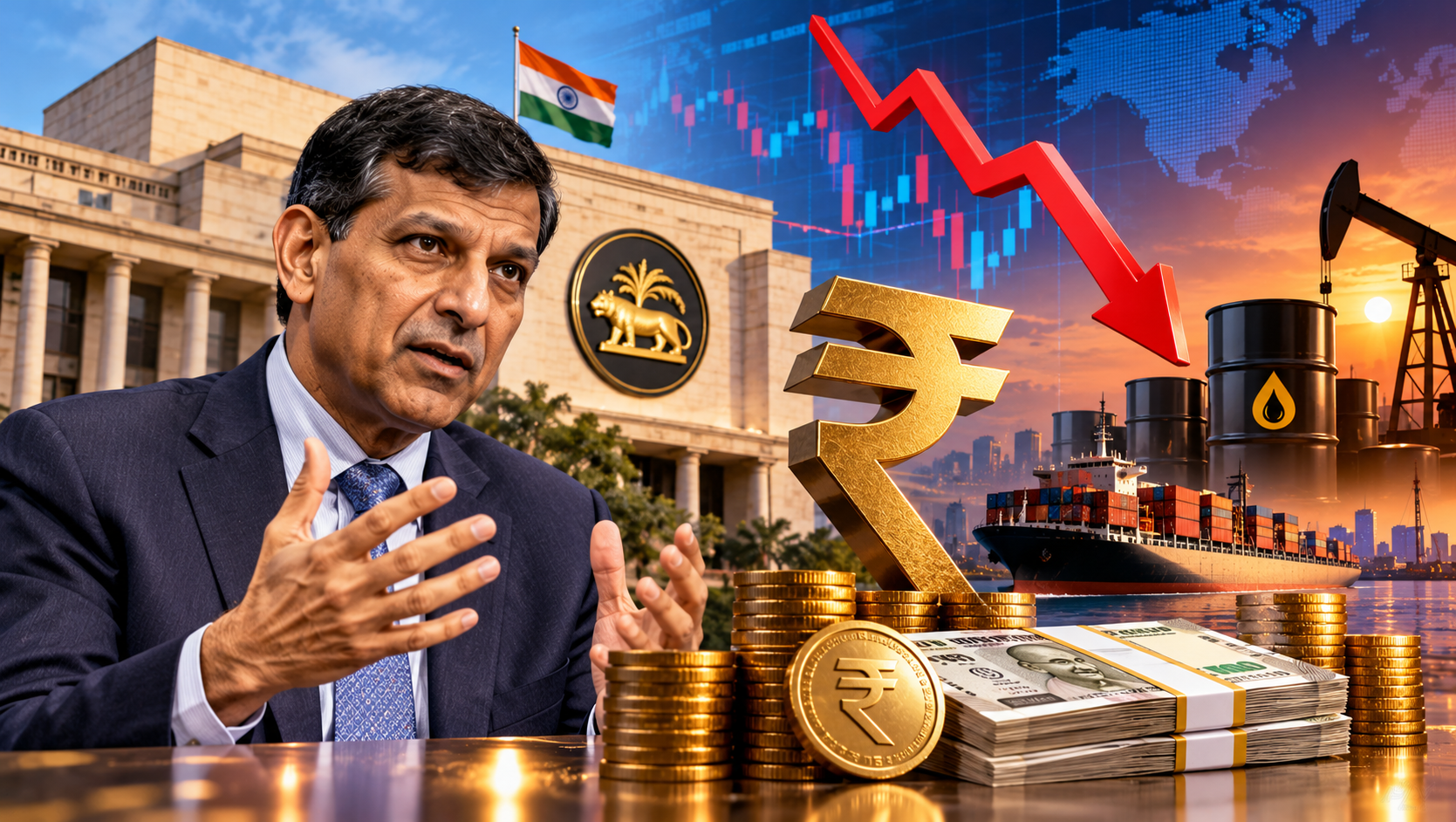
Former RBI governor Raghuram Rajan urges policymakers to avoid targeting a fixed exchange-rate level as the rupee weakens against the US dollar. Elevated crude oil prices, rising US Treasury yields and foreign investor outflows are adding pressure on the currency, highlighting the need for a balanced approach to foreign exchange intervention.
Former Reserve Bank of India (RBI) governor Raghuram Rajan has cautioned India against using its foreign exchange reserves excessively to defend the rupee, arguing that policymakers should focus on broader economic stability rather than attempting to maintain the currency at a particular level.
In an interview with Reuters on Tuesday, October 27, 2026, Rajan said India should avoid becoming overly concerned about a specific exchange rate. He advised a measured response to the rupee's depreciation, emphasising that some weakening of the currency can be beneficial under certain economic conditions.
The rupee has lost approximately 6% of its value against the US dollar so far in 2026, making it the second-worst-performing currency in Asia, according to the supplied report. It touched a record low of ₹96.96 per dollar in May.
The currency has faced pressure from elevated global crude oil prices, rising US Treasury yields and sustained foreign equity outflows. These factors have complicated the RBI's efforts to manage exchange-rate volatility while protecting domestic financial stability.
Rajan Calls for a Measured Response to Rupee Depreciation
Rajan's central message is that India should not panic in response to the rupee's decline. Instead, policymakers should assess whether the current depreciation represents an unusually severe disruption or reflects broader global economic conditions.
He argued that currency depreciation is not necessarily harmful in every situation. A weaker rupee can make Indian goods relatively more competitive in international markets, potentially supporting exports and helping domestic producers compete with overseas suppliers.
However, depreciation also makes imported goods more expensive, particularly crude oil, natural gas and other commodities priced in dollars. The overall economic impact therefore depends on the balance between export competitiveness, import costs, inflation and the country's external financing requirements.
Rajan's position highlights the importance of distinguishing between disorderly currency movements and a gradual adjustment to changing global economic conditions.
Rather than defending a predetermined exchange-rate level, the policy priority should be to prevent excessive volatility and maintain confidence in India's financial system.
High Crude Oil Prices Add to Pressure on the Rupee
India's dependence on imported energy makes the rupee particularly sensitive to movements in international crude oil prices.
When oil prices rise, Indian refiners and other importers generally require more dollars to purchase the same volume of energy. This can increase demand for foreign currency and put additional downward pressure on the rupee.
Higher oil prices can also widen India's current account deficit if the value of imports rises faster than export earnings and other external receipts.
Rajan warned that the current account deficit could widen further if crude oil prices remain elevated. The risk could become more pronounced if geopolitical tensions disrupt energy supplies or damage critical infrastructure in the Gulf region.
A renewed escalation of conflict in the Middle East could increase oil prices and intensify pressure on energy-importing emerging economies, including India.
The consequences would extend beyond the currency market. Higher energy costs could increase transportation and manufacturing expenses, raise inflationary pressures and affect household purchasing power.
For policymakers, the challenge is to manage these risks without committing excessive financial resources to defending a particular rupee level.
Rising US Treasury Yields and Foreign Outflows Complicate the Outlook
Global financial conditions have added another layer of pressure on India's currency.
When US Treasury yields rise, dollar-denominated assets can become more attractive to international investors, depending on their assessment of risk and expected returns. This can encourage capital to move away from emerging markets, particularly when investors become more cautious about global economic or geopolitical developments.
Foreign equity outflows can increase demand for dollars as investors convert rupee proceeds into foreign currency. Such transactions can intensify short-term pressure on the domestic currency.
The combination of higher US yields, foreign investor withdrawals and expensive energy imports has therefore created a challenging environment for the rupee.
These pressures are not entirely within the RBI's control. Domestic monetary policy and foreign exchange intervention can influence market conditions, but they cannot permanently eliminate the effects of global interest rates, capital flows or changes in international commodity prices.
The sustainability of India's external position will consequently depend on a combination of prudent macroeconomic management, export competitiveness, stable capital flows and manageable import costs.
RBI Faces a Delicate Foreign Exchange Management Challenge
The RBI has stepped up intervention to limit the risk of a sharp and disorderly decline in the rupee. Currency intervention can help moderate excessive volatility, improve market functioning and prevent abrupt exchange-rate movements from destabilising the broader financial system.
However, intervention has limits. Selling dollars to support the rupee reduces foreign exchange reserves, while prolonged pressure on the currency can make repeated intervention increasingly expensive.
According to the supplied report, India has deployed approximately half of the more than $140 billion secured through special measures earlier in 2026 to support the currency and absorb surplus banking-system liquidity.
Rajan cautioned against quickly using funds raised through special arrangements to defend a specific exchange-rate level. He referred to the resources mobilised through Foreign Currency Non-Resident (Banking), or FCNR(B), deposits and argued that using those funds primarily to defend a predetermined level could undermine the purpose of securing them.
His remarks underscore the need to preserve sufficient external buffers to deal with future shocks, particularly when global energy prices and geopolitical risks remain uncertain.
The objective of foreign exchange management is generally to limit excessive volatility rather than guarantee that the currency will remain at a fixed value.
Currency Weakness Can Support Exports but Increase Import Costs
A weaker rupee can have both positive and negative implications for the Indian economy.
Exporters earning revenue in dollars may benefit when foreign currency receipts translate into more rupees. Indian products and services can also become more competitively priced for international buyers, depending on how exchange rates move in competing economies.
Sectors with significant overseas revenue may receive a translation benefit from rupee depreciation. However, the actual impact on profitability depends on their imported input costs, foreign currency liabilities, hedging arrangements and pricing power.
Import-dependent industries face the opposite challenge. Companies purchasing crude oil, electronic components, machinery, chemicals and other internationally traded inputs may experience higher costs when the rupee weakens.
If businesses pass these costs on to customers, inflationary pressures could increase. If they absorb the additional expenses, their profit margins may come under pressure.
The impact on the wider economy therefore depends on the duration and scale of depreciation, the movement in global commodity prices and the ability of businesses to adjust their operations.
Rajan's comments suggest that currency depreciation should be evaluated in the context of the economy's overall competitiveness and external balance rather than treated as an economic setback in itself.
RBI Governor Has Not Ruled Out Monetary Policy Measures
The RBI's response to currency pressure remains an important factor for financial markets.
Earlier in October, RBI Governor Sanjay Malhotra did not rule out the use of monetary policy measures to help stabilise the rupee, according to the supplied report.
However, policymakers must balance currency stability against domestic economic priorities. Changes in interest rates can influence capital flows and financial conditions, but they also affect borrowing costs, consumption, investment and economic growth.
Using monetary policy primarily to support the currency could create trade-offs if domestic inflation and growth conditions require a different approach.
The RBI therefore faces the challenge of coordinating exchange-rate management with its broader responsibilities for inflation control and financial stability.
The appropriate response will depend on the persistence of external pressures, domestic inflation trends, capital flows and the behaviour of the currency market.
Lessons From India's Previous Currency Crisis
Rajan took charge as RBI governor in 2013, when India was grouped among the so-called "Fragile Five" economies facing significant external financing concerns.
At the time, global financial market volatility and concerns about emerging-market vulnerabilities placed pressure on the rupee. India subsequently pursued measures intended to strengthen external stability and improve confidence in its financial position.
Rajan's latest comments draw attention to the importance of maintaining policy credibility and sufficient foreign exchange buffers during periods of market stress.
A country's ability to withstand currency volatility depends not only on the size of its reserves but also on its current account position, external debt profile, export capacity and investor confidence.
Maintaining adequate reserves provides a cushion against unexpected disruptions, while allowing the currency to adjust to economic fundamentals can reduce the need for prolonged intervention.
For India, the challenge is to preserve confidence in the rupee without using external reserves in a way that leaves the economy less prepared for future shocks.
Market Outlook
The rupee's near-term direction is likely to remain sensitive to crude oil prices, US Treasury yields, foreign investor flows and geopolitical developments. A prolonged increase in energy costs could widen India's current account deficit and intensify pressure on the currency, while easing oil prices or renewed foreign investment inflows could provide relief.
Rajan's comments reinforce the argument for a balanced currency-management strategy in which the RBI focuses on limiting excessive volatility rather than defending a particular exchange-rate level at any cost. The level and adequacy of foreign exchange reserves will remain important indicators of India's capacity to manage external shocks.
For equity and bond markets, persistent rupee weakness could create challenges through higher imported inflation, increased costs for import-dependent companies and uncertainty around interest-rate expectations. Export-oriented businesses may receive some support from improved currency competitiveness, although the benefits will vary by sector.
Investors should monitor RBI policy signals, foreign exchange reserve trends, crude oil prices, US bond yields and foreign portfolio investment flows. The broader outlook will depend on whether global pressures ease and India can maintain external stability without compromising its longer-term growth objectives.