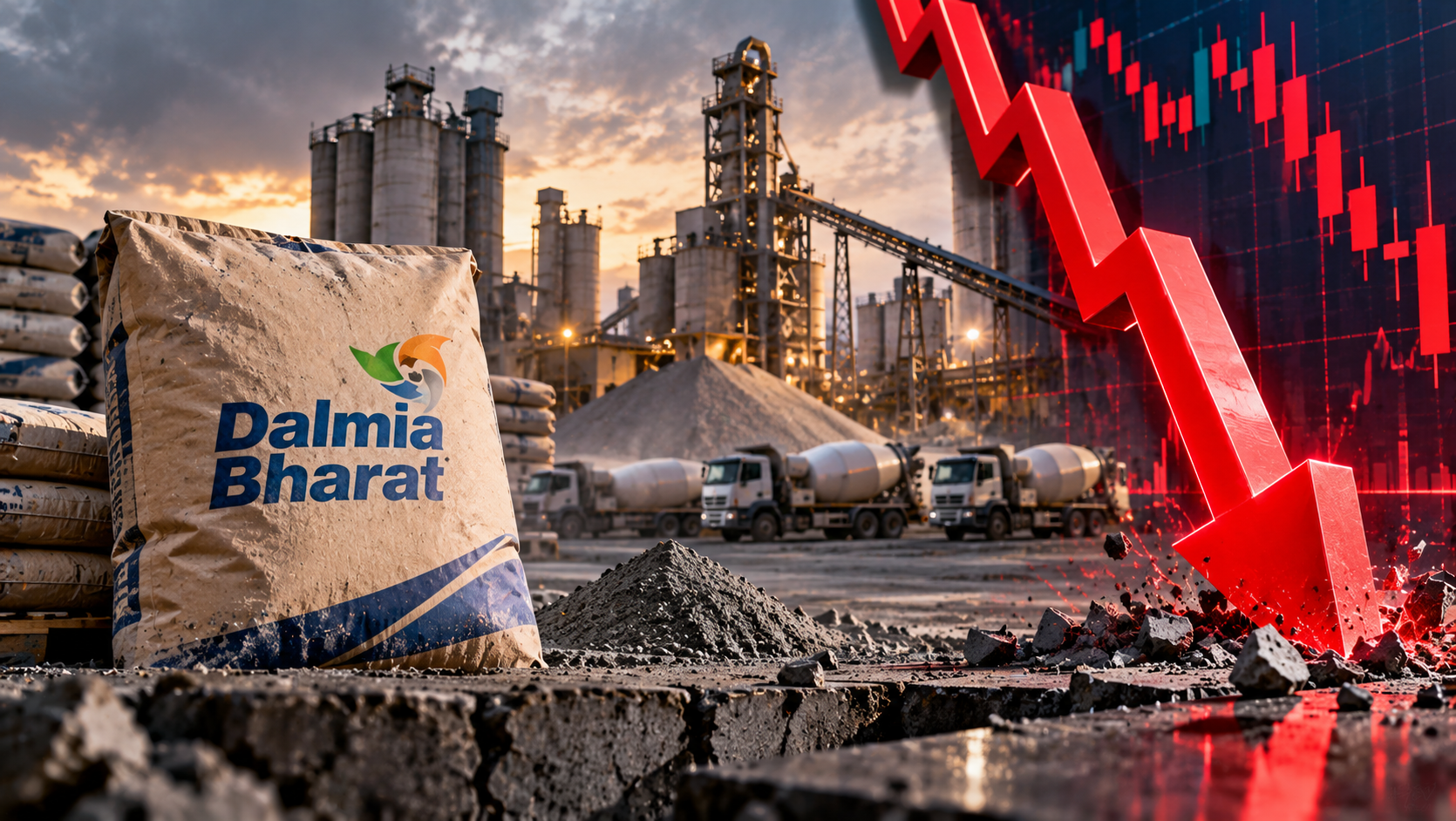
Dalmia Bharat reported a net loss of ₹205 crore in Q2FY27 against a profit of ₹239 crore a year ago, as higher operating costs and exceptional charges weighed on earnings despite revenue growth. JM Financial downgraded the stock to ‘Add’ from ‘Buy’ and cut its target price to ₹1,825.
Dalmia Bharat Shares Come Under Pressure
Shares of cement manufacturer Dalmia Bharat fell sharply in early trade on Tuesday, October 27, 2026, touching a fresh 52-week low as investors reacted to the company’s weak second-quarter performance.
The stock opened around 5% lower at ₹1,545 on the National Stock Exchange (NSE), compared with its previous close of ₹1,625.80. Selling pressure subsequently pushed the share price to an intraday low of ₹1,526.10, representing a decline of more than 6%.
At around 9:45 AM, the stock was trading approximately 4% lower at ₹1,563, while the benchmark Nifty 50 remained largely flat. The sharp fall indicated that investors were concerned not only about the reported quarterly loss but also about the deterioration in operating profitability.
Dalmia Bharat Swings to a Loss in Q2FY27
Dalmia Bharat reported a net loss of ₹205 crore for the July–September quarter of FY27, marking a significant reversal from the net profit of ₹239 crore recorded in the corresponding quarter of the previous financial year.
The change in profitability came despite an improvement in revenue, highlighting the pressure that rising operating expenses and exceptional charges can place on earnings.
Revenue from operations increased 4% year-on-year to ₹3,563 crore in Q2FY27, compared with ₹3,417 crore in Q2FY26. However, the increase in revenue was insufficient to offset the decline in operating earnings.
The divergence between revenue growth and profitability suggests that the company faced challenges in translating higher sales into stronger earnings during the quarter.
EBITDA Falls 29% as Operating Costs Rise
Dalmia Bharat’s operating performance weakened considerably during the reporting period. EBITDA declined 29% year-on-year to ₹493 crore from ₹696 crore in the year-ago quarter.
The EBITDA margin contracted to 13.8% from 20.37%, indicating a substantial reduction in operating profitability. EBITDA per tonne, an important measure of profitability in the cement industry, also fell to ₹698 from ₹1,013 in the corresponding quarter last year.
These indicators suggest that cost pressures had a significant impact on the company’s ability to generate operating earnings from its cement business.
For cement manufacturers, profitability per tonne is influenced by several factors, including fuel and power costs, freight expenses, raw material prices, regional selling prices and capacity utilisation. A deterioration in this metric can limit the benefits of higher sales volumes or revenue growth.
The latest results therefore raise questions about how quickly Dalmia Bharat can restore its operating margins, particularly if cost pressures persist or pricing conditions remain challenging.
Exceptional Charges Add to the Earnings Pressure
Dalmia Bharat recognised an exceptional loss of ₹339 crore during Q2FY27. The charge was related to impairment of certain assets and a separation scheme for eligible employees.
Exceptional items can significantly influence reported net profit or loss in a particular quarter. Asset impairment charges generally reflect a reduction in the carrying value of assets, while employee separation costs may arise from restructuring or workforce-related measures.
The exceptional loss was an important factor behind the weak reported result. However, investors also need to consider the decline in EBITDA and margins, which points to pressure on underlying operating performance.
The key question for the coming quarters will be whether profitability improves as the company absorbs these charges, manages operating costs and integrates its acquired cement assets.
JM Financial Downgrades Dalmia Bharat to ‘Add’
Following the quarterly results, JM Financial downgraded Dalmia Bharat to ‘Add’ from ‘Buy’ and reduced its target price to ₹1,825 from ₹2,225.
The brokerage indicated that EBITDA came in below expectations, primarily because operating costs were higher than anticipated. It also revised its earnings estimates to account for the weaker Q2FY27 performance and the expected initial profitability dilution associated with the ramp-up of acquired JPA cement assets.
JM Financial cut its estimated EBITDA for FY27–FY29 by 10–12% and lowered its target enterprise value-to-EBITDA multiple by one notch to 11 times.
The revised target price reflects a more cautious assessment of the company’s near-term earnings outlook. Nevertheless, the brokerage’s ‘Add’ rating indicates that it has not abandoned the longer-term investment case entirely.
Investors should note that a brokerage target price is an estimate rather than a guaranteed future market price. Actual performance will depend on earnings delivery, industry conditions, execution and broader market sentiment.
Capacity Expansion Remains a Long-Term Priority
Despite the near-term earnings challenges, Dalmia Bharat continues to pursue its capacity expansion strategy.
According to JM Financial, the company remains on track to increase its cement manufacturing capacity to 67 million tonnes per annum (mtpa) by FY28, from approximately 55 mtpa currently.
The expansion is intended to strengthen the company’s presence across India and support its ambition of becoming a pan-India cement player.
A larger manufacturing footprint could help Dalmia Bharat improve its geographic reach, serve a wider customer base and participate in demand growth across different regions. However, capacity expansion alone does not guarantee higher returns.
The financial benefits will depend on how effectively the company utilises its additional capacity, controls costs, integrates acquired assets and maintains healthy realisations. If new capacity takes time to reach optimal utilisation, depreciation, financing and operating expenses could weigh on profitability in the initial stages.
The pace at which the company converts its expanded capacity into sustainable cash flows will therefore remain an important factor for investors.
What Investors Should Monitor After the Q2 Results
Dalmia Bharat’s latest quarterly performance highlights several factors that could influence its stock price and earnings outlook.
1. EBITDA per tonne: The decline to ₹698 from ₹1,013 a year ago makes unit profitability an important indicator to monitor. A recovery could signal improved pricing, cost control or a better operating mix.
2. Margin recovery: Investors will look for signs that the EBITDA margin can improve from 13.8%. The extent of any recovery will depend on operating expenses, fuel and power costs, freight charges and cement realisations.
3. Integration of acquired assets: The ramp-up of acquired JPA cement assets could affect near-term profitability. Execution, utilisation levels and integration costs will be important determinants of the eventual benefits.
4. Capacity utilisation: Expansion towards 67 mtpa by FY28 could support long-term growth, but the financial outcome will depend on demand and the company’s ability to utilise the added capacity efficiently.
5. Exceptional items and cash generation: Investors should distinguish between one-off accounting charges and recurring operating pressures. Cash flow, working capital requirements and capital expenditure will provide additional insight into the company’s financial position.
6. Cement demand and pricing: Demand from housing, infrastructure and construction activity, together with regional cement prices, will influence the industry’s ability to absorb additional capacity and sustain profitability.
Dalmia Bharat Share Price: Risks and Opportunities
The sharp decline in Dalmia Bharat shares reflects concerns about weak earnings, contracting margins and the possibility that profitability could take time to recover.
The positive side of the longer-term investment case rests on capacity expansion, the potential benefits of acquired assets and the company’s ambition to broaden its national presence. If operating costs moderate and capacity utilisation improves, earnings could recover over time.
However, the risks remain significant. Revenue growth has not translated into stronger operating earnings, EBITDA per tonne has fallen, and the company faces the challenge of ramping up additional capacity while maintaining profitability. A slower-than-expected recovery could put further pressure on earnings estimates and market valuations.
The stock’s fall to a 52-week low does not, by itself, establish that the shares are undervalued. Investors need to assess the company’s normalised earnings potential, cash flows, capital expenditure commitments and valuation before drawing conclusions.
Market Outlook
Dalmia Bharat’s Q2FY27 results have brought the cement manufacturer’s profitability challenges into sharper focus. Revenue increased by 4% year-on-year, but EBITDA declined 29%, margins contracted significantly and the company reported a net loss of ₹205 crore. The exceptional charge of ₹339 crore further affected the reported result.
The near-term outlook will depend on whether operating performance stabilises, margins recover and the company manages the initial costs associated with capacity expansion and acquired assets. JM Financial’s lower target price and reduced earnings estimates underline the need for greater caution until there is clearer evidence of an earnings recovery.
For investors, the next few quarters will be important in determining whether the current weakness is primarily a temporary setback or a sign of more persistent profitability challenges. Monitoring EBITDA per tonne, capacity utilisation, operating costs and cash generation will be essential when evaluating the company’s progress.