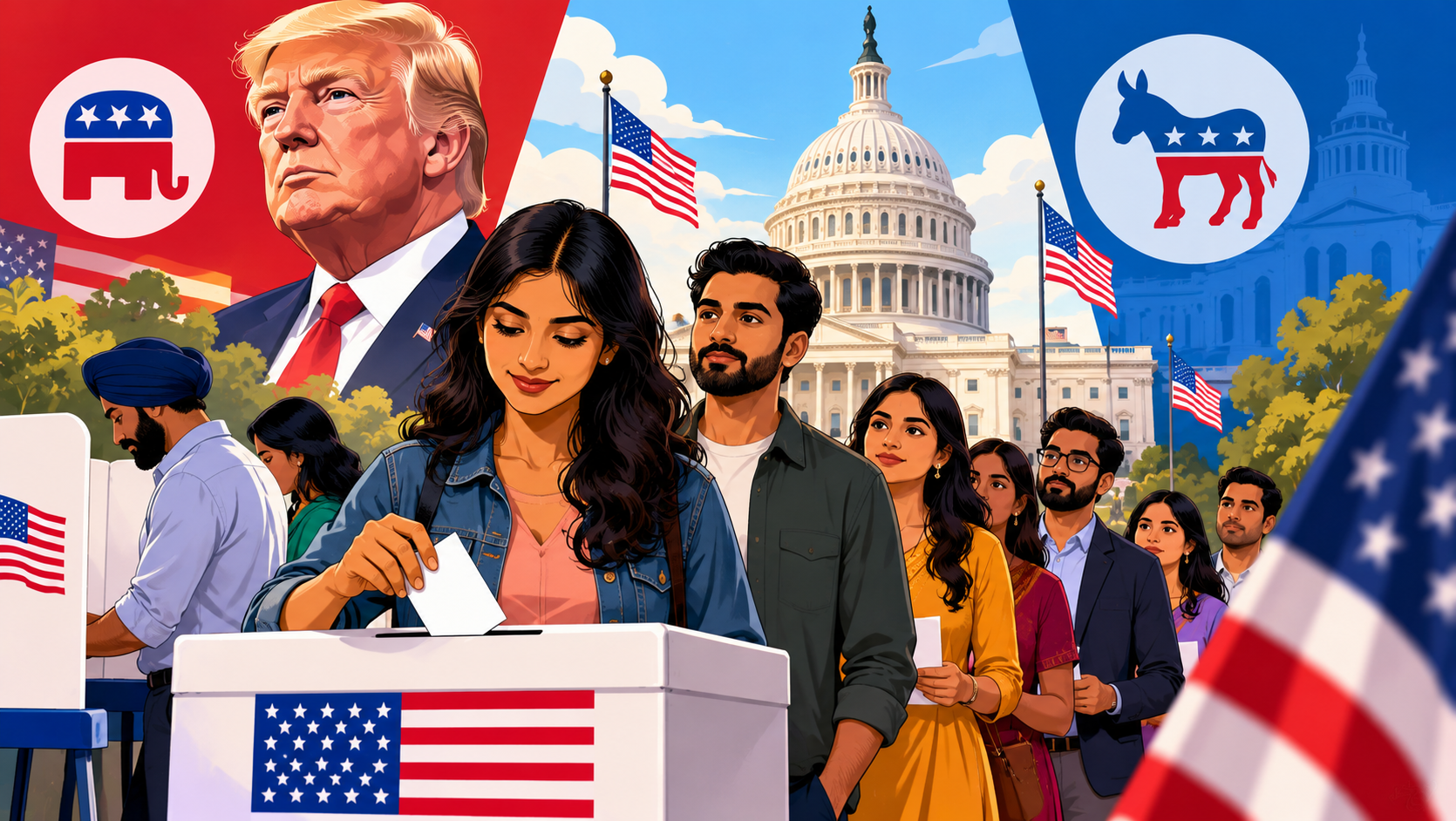
Cost of living, healthcare, jobs and education emerge as key concerns ahead of the November 3 US midterm elections, while survey findings highlight the potential influence of South Asian voters in closely contested states.
A section of South Asian American voters who supported Donald Trump in the 2024 US presidential election may be reconsidering their political preferences ahead of the November 3, 2026, midterm elections. According to a survey conducted by advocacy group Indian American Impact, 25% of South Asian Americans who voted for Trump in 2024 now intend to support Democratic candidates.
The findings suggest that economic pressures, access to healthcare, employment concerns and experiences of discrimination could influence voting decisions within the South Asian American community.
The survey also points to the potential electoral significance of this demographic in closely contested states, where relatively small changes in voter preferences can affect the outcome of congressional and other elections.
Survey Shows Possible Shift Among Trump’s 2024 Supporters
The survey found that 67% of South Asian American respondents who voted for Trump in 2024 continued to support Republican candidates, while 25% said they planned to vote for Democrats in the upcoming midterm elections.
Among respondents who voted for Kamala Harris in the 2024 presidential election, 96% said they intended to support Democratic candidates in the midterms.
The results indicate that most respondents who previously supported Trump remained aligned with Republicans, even as a notable minority expressed an intention to switch parties.
However, stated voting intentions do not necessarily translate into actual ballots. Turnout, candidate selection, campaign activity and developments before election day could influence the final outcome.
The findings should therefore be interpreted as a snapshot of voter sentiment rather than a prediction of the election result.
Cost of Living and Healthcare Top Voter Concerns
Economic issues featured prominently in the survey, with respondents identifying household affordability and access to essential services as major concerns.
The key issues cited by respondents were:
| Issue | Share of respondents |
|---|---|
| Cost of living | 65% |
| Healthcare | 53% |
| Jobs and wages | 33% |
| Education | 28% |
The cost of living was the most frequently mentioned concern, followed by healthcare. These issues reflect the direct impact that economic conditions and public policy can have on household budgets and financial security.
Rising expenses can influence how voters assess the performance of elected representatives, particularly when housing, healthcare, education and everyday necessities account for a substantial share of family income.
Employment opportunities and wage growth are also important considerations, especially for younger voters and households seeking to improve their financial position.
The survey suggests that economic priorities may play a significant role in determining how South Asian American voters approach the midterm elections.
Indian Americans Account for 87% of Survey Respondents
The survey covered 800 registered South Asian American voters. Indian Americans accounted for 87% of respondents, while the remaining 13% included people of Pakistani, Bangladeshi, Sri Lankan, Nepali, Bhutanese, Maldivian, Afghan, Khmer and Burmese backgrounds.
The sample provides insight into the political preferences and concerns of the surveyed community. However, the results should not automatically be treated as representative of every South Asian American voter.
The available report does not specify all methodological details, including the survey's margin of error, sampling method and fieldwork dates. These details are important when assessing how confidently the findings can be applied to the wider population.
Nevertheless, the results highlight the importance of understanding South Asian Americans as a diverse electorate whose voting preferences may vary according to economic circumstances, local issues and individual experiences.
Discrimination Emerges as a Significant Concern
Beyond economic issues, the survey identified discrimination as another important concern among respondents.
Approximately 90% said they had experienced discrimination or knew someone who had experienced it. Within this group, 48% reported that they had personally faced discrimination.
The findings indicate that experiences related to identity and social acceptance may influence political attitudes for a substantial section of the surveyed community.
Vasant Bhatt, a 21-year-old second-generation Indian American who had interned on Senator Ted Cruz's election campaign in 2024, said in a social media post that he had voted for Democratic nominee James Talarico. He cited concerns about xenophobia, racial resentment and attacks on his identity.
Individual experiences do not establish a uniform political preference across an entire community. However, the survey suggests that discrimination and questions of representation could form part of the broader discussion influencing voter decisions.
Trust in Elected Officials Remains a Concern
The survey also highlighted dissatisfaction with political representation and the perceived responsiveness of elected officials.
According to the findings:
-
78% said their vote could bring about change.
-
79% felt elected officials quickly lost touch with ordinary people.
-
67% said public officials did not care about the views of people like them.
-
43% felt they had no say in government decisions.
-
16% said they had not voted in any general election since 2020.
These responses suggest a combination of political engagement and dissatisfaction. While many respondents believe voting can influence outcomes, a substantial proportion also feel disconnected from elected representatives.
For political campaigns, this presents a challenge as well as an opportunity. Candidates may need to demonstrate how their policies address everyday concerns rather than relying solely on party loyalty or broad campaign messaging.
The findings also underline the importance of voter mobilisation, particularly among people who have not participated consistently in previous elections.
Michigan and Texas Could Be Important Electoral Battlegrounds
The survey highlighted the potential importance of South Asian voters in states where elections are often closely contested.
Michigan, for example, is home to approximately 187,000 South Asian residents. The survey report cited nearly 30,000 registered South Asian voters who did not vote in the state's 2022 elections, compared with a margin of roughly 19,000 votes in its 2024 Senate race.
Texas has more than 700,000 South Asian residents, according to the figures cited in the report. Nearly 100,000 registered South Asian voters in the state did not vote in 2022.
These figures illustrate why political campaigns may focus on voter registration, turnout and engagement within the community.
However, the number of South Asian residents is not the same as the number of eligible or registered voters. Electoral influence also depends on voter participation, geographic concentration, candidate preferences and the competitiveness of individual races.
The survey identified California, Texas, New Jersey, New York, Washington, Illinois, Pennsylvania and Georgia among the states with substantial Indian American communities.
In closely contested states such as Georgia, Pennsylvania, Michigan and North Carolina, even a relatively small shift in turnout or voting preferences could matter in a tight race.
Why the South Asian American Vote Matters
South Asian Americans represent a diverse electorate with varied economic interests, political views and personal priorities. Their voting behaviour can be shaped by national economic conditions, immigration policy, healthcare, education, employment and experiences within their communities.
The latest survey indicates that party preferences within this electorate are not entirely fixed. While many respondents remain aligned with the party they supported in 2024, some appear willing to reconsider their choices ahead of the midterms.
For Republicans, retaining previous supporters may require addressing concerns about affordability, employment and representation. For Democrats, attracting voters who previously supported Trump could depend on presenting credible policy proposals and demonstrating responsiveness to their concerns.
Both parties may also seek to increase turnout among registered voters who have not participated in recent elections.
Ultimately, the impact of South Asian American voters will depend not only on their stated preferences but also on whether they vote and how their choices are distributed across competitive electoral districts.
What the Survey Means for the November 3 Midterms
The findings point to three important considerations ahead of the US midterm elections.
First, economic concerns remain central to voter sentiment. Cost of living and healthcare ranked substantially higher than the other issues listed in the survey.
Second, political loyalty may be changing for some voters. The reported intention of 25% of South Asian Americans who backed Trump in 2024 to support Democrats suggests that a segment of the electorate may be open to changing its vote.
Third, turnout could be decisive in closely contested races. The survey's findings on non-voting and political dissatisfaction suggest that campaigns will need to engage voters who feel disconnected from the political system.
These factors do not guarantee a particular electoral outcome. Actual results will depend on candidates, local issues, campaign strategies, turnout and developments closer to election day.
The survey nevertheless provides an indication of the concerns that may shape political discussions among South Asian American voters in the final stretch before the midterms.
Conclusion
The Indian American Impact survey highlights a potentially important shift in the intentions of some South Asian American voters who supported Donald Trump in 2024. While 67% of those respondents continued to favour Republicans, 25% said they planned to support Democrats in the November 3 midterm elections.
Cost of living, healthcare, jobs and wages, education, discrimination and dissatisfaction with political representation emerged as important concerns.
The findings reinforce the importance of this electorate in competitive states, but they should not be interpreted as a definitive forecast. The extent to which these preferences translate into election results will depend on turnout and the issues that dominate the campaign in the coming days.