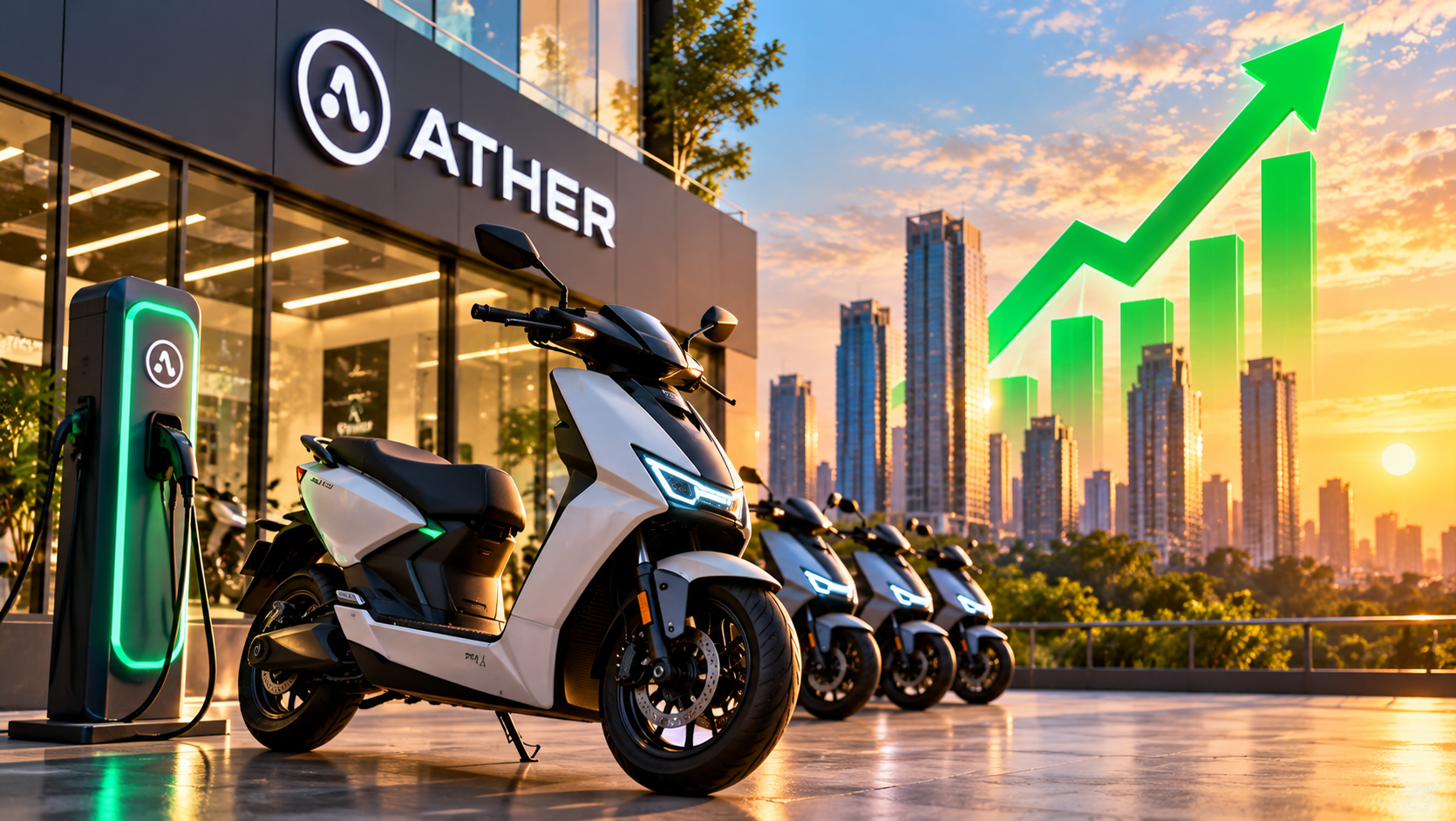
Ather Energy shares extend their rally after the electric two-wheeler maker reports its first-ever quarterly net profit of ₹1.26 crore for Q2 FY27. Strong vehicle sales, rising customer enquiries, improving margins and plans to add 225,000 units of annual production capacity strengthen the growth outlook, although sustained profitability remains a key challenge.
Shares of Ather Energy continued their upward momentum on Tuesday, October 27, 2026, as investors responded positively to the company's improved financial performance and expansion plans. The electric two-wheeler manufacturer's stock rose as much as 6% intraday to ₹1,660 on the BSE, extending its rally to approximately 20% over two trading sessions.
The rally followed the company's announcement that it had recorded its first-ever consolidated profit after tax (PAT) of ₹1.26 crore in the July–September quarter of FY27. Strong growth in vehicle sales, improved operating margins and rising customer interest supported the performance.
Ather Energy has also announced plans to increase its annual production capacity by an additional 225,000 units by the second quarter of FY28. The expansion is intended to address rising demand and reduce capacity constraints as the company seeks to strengthen its position in India's competitive electric two-wheeler market.
However, investors will need to assess whether the company can sustain profitability as production increases, commodity costs remain elevated and new facilities move towards commercial operations.
Ather Energy Shares Gain 20% in Two Sessions
Ather Energy shares advanced sharply following the company's Q2 FY27 results. During Tuesday's session, the stock gained around 6% intraday to ₹1,660 on the BSE.
At approximately 9:58 AM, the shares were trading 5% higher at ₹1,656.70, even as the BSE Sensex declined around 0.20%. A combined 5.57 million equity shares changed hands on the NSE and BSE during the first 43 minutes of trading, indicating heightened market participation.
At 10:29 AM, the stock was quoted at ₹1,664.40, up ₹89.40 or 5.68% for the day. It traded between ₹1,607 and ₹1,673.20 during the session, according to the reported market data.
The stock's 52-week range stood between ₹588.65 and ₹1,744, placing the latest price relatively close to its reported yearly high.
The sharp two-day advance suggests that investors welcomed the company's transition to quarterly profitability and its plans to expand production. Nevertheless, a rapid price increase can also raise expectations for future earnings, making subsequent quarterly results important for determining whether the rally can be sustained.
Q2 FY27 Results: Revenue Rises 63%, Vehicle Sales Grow 42%
Ather Energy delivered a substantial improvement in operating performance during the September quarter.
| Key Financial and Operating Metric | Q2 FY27 Performance |
|---|---|
| Vehicle sales volume | 93,211 units |
| Year-on-year vehicle sales growth | 42% |
| Quarter-on-quarter vehicle sales growth | 12% |
| Total operating income | ₹1,464 crore |
| Year-on-year revenue growth | 63% |
| EBITDA | ₹74.2 crore |
| EBITDA margin | 0.8% |
| Gross margin | 21% |
| Consolidated profit after tax | ₹1.26 crore |
Vehicle sales increased 42% year-on-year to 93,211 units, while operating income rose 63% to ₹1,464 crore. The growth indicates that the company benefited from higher volumes and stronger operating activity.
Ather also reported a significant improvement in profitability compared with the previous year. Consolidated PAT stood at ₹1.26 crore, compared with a loss of ₹154 crore in the year-ago quarter.
The company recorded EBITDA of ₹74.2 crore, marking its second consecutive EBITDA-positive quarter. Its EBITDA margin improved to 0.8%, compared with a negative 2.7% in Q1 FY27.
Gross margin also increased to 21% from 20% in the preceding quarter, despite higher input costs.
These figures indicate that Ather is moving towards a more sustainable operating model. However, its net profit remains extremely small relative to revenue, leaving limited room for operational setbacks or cost increases.
First-Ever Quarterly Profit Marks an Important Milestone
The reported PAT of ₹1.26 crore represents an important milestone for Ather Energy, which has been investing in manufacturing capacity, product development, distribution and market expansion.
For an electric vehicle manufacturer operating in a competitive and capital-intensive industry, achieving profitability requires more than increasing sales. The company must also improve manufacturing efficiency, manage component costs, optimise its product mix and maintain disciplined spending.
Ather's positive EBITDA over two consecutive quarters suggests that its core operations are moving in the right direction. However, EBITDA profitability does not automatically translate into strong net earnings or free cash flow.
The company's latest net profit remains thin, meaning relatively small changes in input costs, incentives, operating expenses or production efficiency could affect the bottom line.
Investors will therefore look for sustained profitability across multiple quarters rather than treating a single profitable quarter as conclusive evidence of a permanent turnaround.
Customer Enquiries Surge 109% as Pre-Orders More Than Double
Demand indicators were another positive element in Ather Energy's Q2 FY27 performance.
The company reported that customer enquiries increased 109% year-on-year to approximately one million. Pre-orders also more than doubled to around 180,000 during the quarter.
According to the company, customer demand outpaced available production capacity, with its Hosur manufacturing facility operating at approximately 98% utilisation during peak production in Q2 FY27.
The figures point to strong customer interest in Ather's electric two-wheelers. However, enquiries and pre-orders should not be treated as equivalent to completed sales. Conversion rates, cancellations, delivery timelines and the company's ability to manufacture vehicles at scale will determine how much of this interest translates into revenue.
Management has indicated that existing stores could support an additional 18,000–20,000 monthly retail sales based on current demand estimates. Expanding manufacturing capacity is therefore a key part of the company's plan to convert customer interest into deliveries.
Ather Plans to Add 225,000 Units of Annual Capacity
Ather Energy's board has approved plans to expand annual production capacity across its manufacturing facilities by an additional 225,000 units.
The expansion will take place at its Hosur facility in Tamil Nadu and its new AURIC manufacturing plant in Chhatrapati Sambhajinagar, Maharashtra.
Hosur Facility Expansion
Ather plans to increase annual production capacity at Hosur by 75,000 units, from 420,000 to 495,000 units. The additional capacity is expected to be operational by December 2026.
The expansion is intended to ease production constraints at an existing facility that has been operating at high utilisation during peak demand.
AURIC Facility Expansion
The company's new AURIC facility is expected to begin commercial production in phases from December 2026. Phase 1 is planned to have an annual capacity of 500,000 units.
Ather also plans to add another 150,000 units of annual capacity at the facility, taking its planned capacity there to 650,000 units. The additional capacity is expected to commence production by Q2 FY28.
Once these expansions are completed, Ather's combined installed annual production capacity across Hosur and AURIC is expected to reach approximately 1.14 million units.
The company plans to invest around ₹122 crore across the two facilities to support the capacity enhancements.
The expansion could give Ather greater flexibility to meet demand, improve delivery availability and support future product launches. However, the financial benefits will depend on how quickly the new capacity is commissioned and utilised.
Konarc Could Expand Ather's Addressable Market
The planned introduction of the mass-market Konarc model is another potential growth driver identified by ICICI Securities.
Ather has traditionally been associated with the premium end of the electric two-wheeler market. A product positioned to appeal to a broader customer base could help the company reach buyers who are more sensitive to upfront purchase prices.
According to ICICI Securities, the quarter's performance was encouraging because volume growth was accompanied by an improvement in unit economics. The brokerage also identified Konarc's market acceptance as an important factor to monitor.
The success of a mass-market product will depend on its pricing, range, performance, reliability, charging convenience and overall ownership costs. Competition from established manufacturers and other electric two-wheeler brands could also influence adoption.
Management has indicated that it does not intend to increase prices further over the next few quarters. Konarc could potentially improve affordability while supporting margins, although this will need to be demonstrated through actual sales and profitability data.
If the product gains traction, it could expand Ather's potential customer base. If adoption is slower than expected, the benefits of the company's capacity expansion could take longer to materialise.
ICICI Securities Identifies Key Growth Triggers and Risks
ICICI Securities maintained a broadly positive assessment of Ather Energy's operating outlook, highlighting improving demand, better unit economics and the company's manufacturing expansion.
The brokerage noted the sharp rise in customer enquiries and pre-orders, alongside management's estimates of additional monthly retail sales potential through existing stores.
However, it also identified several risks that investors should monitor.
Thin net profit: Although Ather recorded a quarterly profit for the first time, PAT of ₹1.26 crore remains modest relative to operating income of ₹1,464 crore.
Commodity inflation: Higher input costs could put pressure on margins, particularly if the company cannot fully offset them through operational efficiencies or product pricing.
Margin sustainability: Part of the recent margin improvement reportedly came from temporary SKU and incentive management. Investors will need to assess whether the gains can be maintained through normal operating conditions.
Capacity utilisation: New manufacturing capacity will take time to ramp up. If production expands faster than demand, underutilised facilities could weigh on efficiency and profitability.
Product acceptance: Konarc's commercial success will be important in determining whether Ather can expand beyond its existing customer base.
The brokerage's assessment suggests that the operating outlook has improved, but the next phase will require evidence that demand growth can translate into sustained earnings.
India's Electric Two-Wheeler Market: Growth Opportunities and Competition
India's electric two-wheeler market continues to attract manufacturers seeking to benefit from changing consumer preferences, improvements in battery technology and the expansion of charging infrastructure.
Electric scooters can offer lower running costs than conventional petrol-powered vehicles, although the overall economic benefit varies with purchase price, battery life, electricity tariffs, maintenance requirements and usage patterns.
For manufacturers, increasing volumes can improve production efficiency and spread fixed costs across a larger number of vehicles. However, the industry also faces challenges, including price competition, battery and component costs, technology upgrades and the need to build consumer confidence.
Ather's latest performance suggests that demand is strengthening, but long-term success will depend on product reliability, after-sales service, charging convenience and the company's ability to deliver vehicles at competitive prices.
The planned increase in production capacity could support growth, provided that demand remains strong enough to absorb the additional output.
What Investors Should Watch Next
Ather Energy's future performance will depend on several measurable operating and financial indicators.
-
Monthly vehicle registrations and deliveries: Whether demand translates into sustained retail sales growth.
-
Konarc acceptance: Whether the new product attracts additional customers without weakening profitability.
-
Capacity expansion: Whether Hosur and AURIC meet their planned commissioning timelines.
-
Gross and EBITDA margins: Whether the recent improvement continues despite commodity inflation.
-
Net profitability: Whether quarterly earnings rise meaningfully beyond the initial profit of ₹1.26 crore.
-
Working capital and cash flow: Whether growth and capacity expansion can be funded without placing undue pressure on the balance sheet.
-
Competitive positioning: Whether Ather can maintain its market position against established manufacturers and emerging EV brands.
These indicators will help determine whether the company is progressing from a period of improving operating performance towards a more durable growth and profitability model.
Market Outlook
Ather Energy's latest results mark a positive development for the electric two-wheeler maker. Vehicle sales grew 42% year-on-year, operating income increased 63%, EBITDA remained positive for a second consecutive quarter, and the company reported its first-ever quarterly PAT of ₹1.26 crore.
The planned addition of 225,000 units of annual production capacity could support future growth, while the proposed Konarc model offers an opportunity to broaden the company's customer base. Strong enquiries and pre-orders provide encouraging demand signals, although their conversion into actual deliveries remains crucial.
The key challenge is to turn these improvements into sustained profitability. A very thin net profit, commodity-cost pressures, possible delays in capacity ramp-up and uncertainty over the acceptance of new products remain important risks.
The stock's approximately 20% rally over two sessions reflects improving investor expectations following the results. Going forward, the durability of that momentum will depend on whether Ather can consistently increase deliveries, maintain margins and improve net earnings as production expands.
For investors, the central question is no longer simply whether Ather can grow sales, but whether it can convert that growth into consistent and meaningful profits.