Government Plans 20% More Police Deployment After Widespread Riots; Bond Yields Rise as Political and Fiscal Concerns Intensify
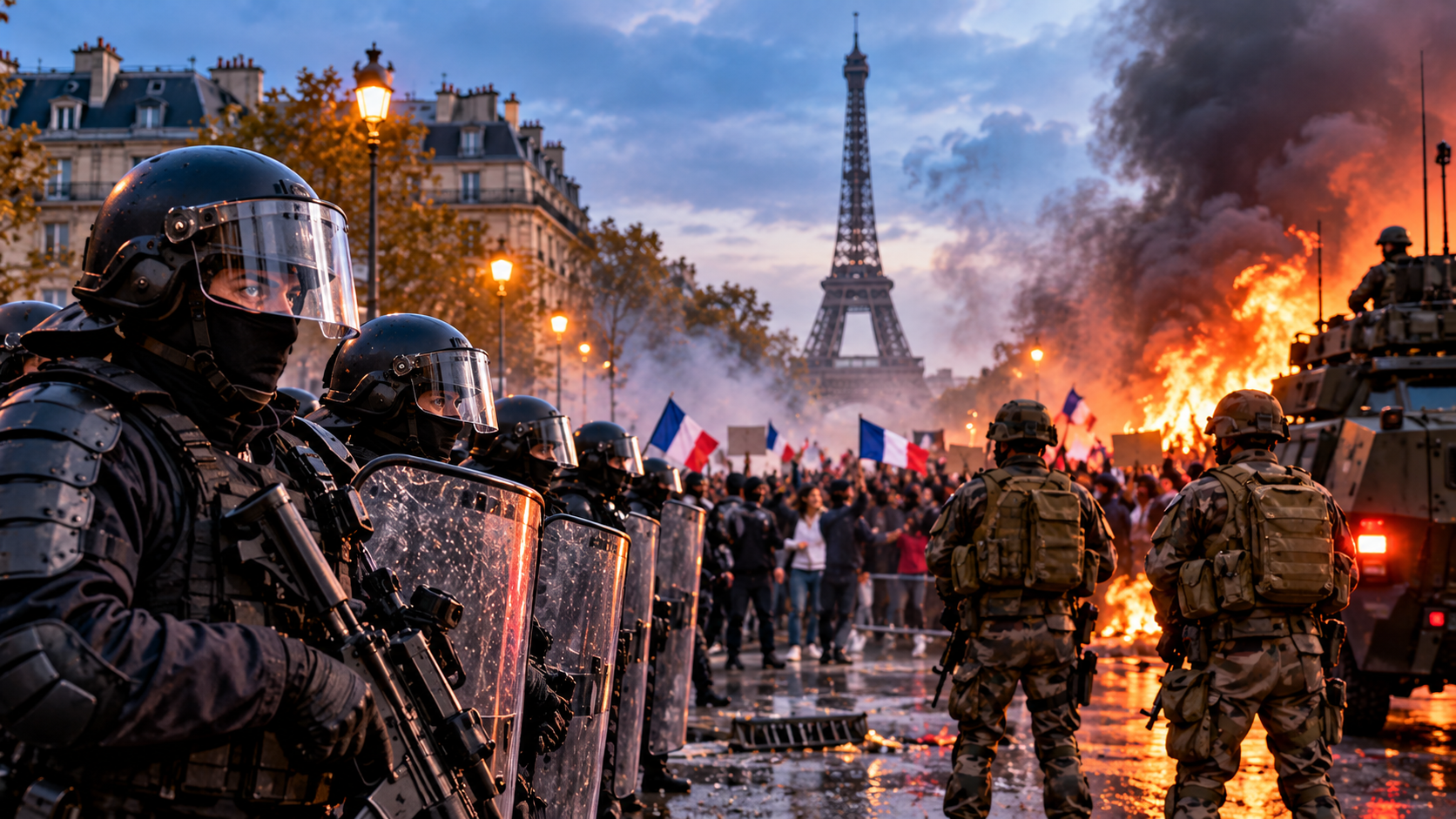
France is preparing for another round of demonstrations on Saturday, October 24, as authorities strengthen security measures following the widespread unrest that erupted during last weekend's cost-of-living protests. The government is increasing police deployment, placing military personnel on standby to protect sensitive locations and preparing specialised equipment to prevent further violence.
The security measures come at a challenging time for President Emmanuel Macron's administration, which is facing public anger over living costs, concerns about public services and mounting pressure to control the country's budget deficit. The unrest is also raising concerns among investors about France's financial stability and the broader economic consequences of prolonged demonstrations.
According to the French Interior Ministry, the number of police officers deployed this weekend will be 20% higher than during the previous Saturday's demonstrations. Authorities are preparing for protests across several major cities, with security operations expected to extend well beyond Paris.
France Increases Police Deployment and Places Military on Standby
French authorities are preparing a significantly expanded security operation to prevent a repeat of last weekend's violence.
The previous round of unrest reportedly resulted in the looting of approximately 3,000 stores and around 2,700 arrests. The scale of the incidents has prompted the government to reinforce security arrangements ahead of the next demonstrations.
Interior Minister Laurent Nuñez said specialised intervention units, which are generally deployed for high-risk operations such as counterterrorism missions, could be called upon if required. Military personnel will assist in protecting sensitive buildings and other important locations.
The security arrangements also include helicopters, water cannons and armoured Centaure vehicles. These resources are intended to help authorities respond quickly if demonstrations escalate into violent confrontations.
Thierry Clair, national secretary of the Unsa Police union, said the situation was not limited to the French capital, with several cities expected to experience large-scale security operations.
The union representative also indicated that at least 75% of the police force would be mobilised, with officers postponing scheduled leave to support the operation.
The expanded deployment reflects the government's determination to maintain public order, although the effectiveness of the measures will depend on the scale of the demonstrations and the ability of authorities to prevent isolated incidents from spreading.
Macron Government Faces Growing Pressure Over Cost of Living
The latest demonstrations are being organised under the banner of a second round, or Acte II, of a broader movement demanding better public services and greater government support for households struggling with the cost of living.
The movement brings together a diverse group of participants, including students, trade unions, social media figures and left-wing political organisations.
Rising living expenses and dissatisfaction with government policies have become central themes of the protests. President Macron, who is approaching the final months of his second presidential term, is facing significant political pressure as the government attempts to balance public demands with fiscal constraints.
The demonstrations also come amid wider concerns about the affordability of everyday necessities, including fuel, transportation and other household expenses.
For the government, the challenge is to contain the unrest without deepening public dissatisfaction. While stronger security measures may reduce the risk of widespread violence, restrictions on demonstrations could intensify criticism from groups that view protest as an essential democratic right.
Restrictions on Demonstrations Trigger Political Backlash
President Macron said on Thursday that local authorities would approve only demonstrations organised by labour unions over the weekend. He also called for a pause in demonstrations in the coming days, arguing that restoring calm was necessary.
The government's position has attracted criticism from left-wing political leaders and trade unions.
Manon Aubry, a lawmaker from the left-wing France Unbowed party, described the crackdown as a major attack on the right to protest. The CGT trade union said maintaining public order was the government's responsibility but criticised what it called repressive tactics.
The disagreement highlights a difficult balance between protecting public safety and preserving the right to peaceful assembly.
Authorities are attempting to prevent further looting, property damage and confrontations between protesters and security personnel. Critics, however, argue that restrictions could deepen tensions if demonstrators believe their concerns are being suppressed rather than addressed.
The handling of the protests could therefore become an important political issue in the months ahead, particularly as France approaches its next electoral cycle.
France's Bond Market Comes Under Pressure
The unrest is unfolding against a backdrop of fiscal concerns and political uncertainty that have already unsettled investors in French government debt.
France is working to reduce its budget deficit, and the combination of economic pressures, political disagreements and social unrest has complicated the government's task.
According to the reported market data, the premium on French 10-year government bonds over German equivalents widened by 16 basis points to 175 basis points on Thursday. This was the highest level since late 2011, reflecting growing investor concern about France's risk profile relative to Germany.
The widening spread indicates that investors are demanding a higher yield to hold French government debt compared with German bonds, which are widely used as a benchmark for euro-area sovereign risk.
Italian government bonds also faced pressure, with the yield gap between Italian and German 10-year bonds widening by 11 basis points to 127 basis points. Italy has also experienced protests and road blockades linked to soaring fuel prices.
The developments suggest that investors are paying close attention to the relationship between social stability, government finances and sovereign borrowing costs across Europe.
Higher government bond yields can increase borrowing expenses over time, potentially limiting the funds available for public services, infrastructure and other spending priorities.
Moody's Rating Decision Adds to Investor Concerns
France's sovereign credit rating is another factor being watched closely by financial markets.
Moody's, which assigns France an investment-grade sovereign rating above the level assigned by S&P Global Ratings, was expected to review the country's rating on Friday, according to the report.
A potential downgrade could add to market concerns if it signals a weaker assessment of France's fiscal outlook or institutional stability. However, the impact would depend on the agency's reasoning, the rating decision itself and whether investors had already priced in the possibility of a change.
A rating action does not automatically trigger a financial crisis. Nevertheless, it can influence investor perceptions, borrowing costs and the investment decisions of institutions with specific credit-rating requirements.
For France, the central challenge remains convincing markets that the government can restore fiscal discipline while responding to public dissatisfaction.
Paris Businesses Prepare for Further Disruption
Businesses in Paris are taking precautions ahead of Saturday's demonstrations.
Several shops, including luxury retailers, have boarded up windows, increased security arrangements or prepared to remain closed during the protests. These steps are intended to reduce the risk of damage and protect employees, customers and merchandise.
The potential economic consequences extend beyond retail stores. Restaurants, hotels, transport operators and other businesses may experience reduced customer activity if residents and tourists avoid areas affected by demonstrations.
The Louvre, Musée d'Orsay and Picasso Museum were reported to be closing on Saturday because of the anticipated unrest. Such closures could affect tourism-related activity and disrupt plans for visitors to the French capital.
The luxury sector is also monitoring the situation. Kering, the group that owns brands including Gucci and Balenciaga, said it remained vigilant regarding potential riot threats.
Carrefour warned that social unrest could weigh on its earnings for the year, highlighting how prolonged demonstrations can affect companies through store closures, reduced customer traffic, security expenses and interruptions to normal business activity.
The overall economic impact will depend on the duration and intensity of the unrest. Short-lived disruptions may have a limited effect, but repeated episodes of violence could place greater pressure on consumer confidence and business performance.
Marseille and Lyon Introduce Additional Restrictions
The security response is not confined to Paris.
Marseille and Lyon have reportedly banned demonstrations scheduled for Saturday and extended curfews as authorities seek to prevent further unrest.
Meanwhile, the central French city of Orléans is preparing for heightened security around a congress organised by Marine Le Pen's far-right National Rally party. Left-wing groups are planning a counter-demonstration that could attract tens of thousands of participants.
The possibility of rival political gatherings has added another layer of complexity to the security operation.
Authorities will need to manage large crowds, protect public infrastructure and prevent clashes between opposing groups. The situation could also test coordination between local police forces, national security agencies and other emergency services.
The nationwide nature of the protests means that disruptions could occur simultaneously in multiple cities, placing additional demands on police resources.
Macron Criticises Foreign Leaders Over Comments on France
The unrest has also attracted international political attention.
Macron pushed back against criticism from foreign leaders, including US President Donald Trump and Israeli Prime Minister Benjamin Netanyahu, who have commented on the situation amid their own political considerations.
Speaking to reporters in Doha, Macron criticised leaders whom he accused of making politically motivated remarks about France's domestic difficulties.
His response underlines the government's sensitivity to international commentary at a time when the country is facing both internal unrest and scrutiny of its economic position.
Although foreign political statements are unlikely to determine the immediate course of the protests, they have added an international dimension to an already contentious domestic situation.
Market Outlook
France's renewed protests introduce additional uncertainty for European financial markets at a time when investors are already monitoring government debt, fiscal sustainability and political stability. The immediate market focus will be on whether Saturday's demonstrations remain peaceful or trigger another wave of violence and business disruption.
French government bonds: The widening spread between French and German 10-year yields indicates elevated investor concern. Further political instability, disappointing fiscal developments or an unfavourable credit-rating decision could maintain pressure on French bonds. Conversely, a peaceful weekend and credible steps towards fiscal consolidation could help ease some concerns.
European equities: Retailers, tourism operators, hospitality businesses and luxury-goods companies may face short-term pressure if demonstrations lead to store closures, lower footfall or property damage. Broader market sentiment will also depend on whether the unrest remains localised or becomes a prolonged economic disruption.
Euro and investor sentiment: Continued uncertainty surrounding France's political and fiscal outlook could weigh on confidence in European assets. However, currency movements will also depend on interest-rate expectations, economic data and developments elsewhere in the global economy.
What investors should watch: Key developments include the scale of Saturday's demonstrations, the government's security response, Moody's rating decision, movements in French-German bond spreads and any fresh indications of fiscal policy changes.