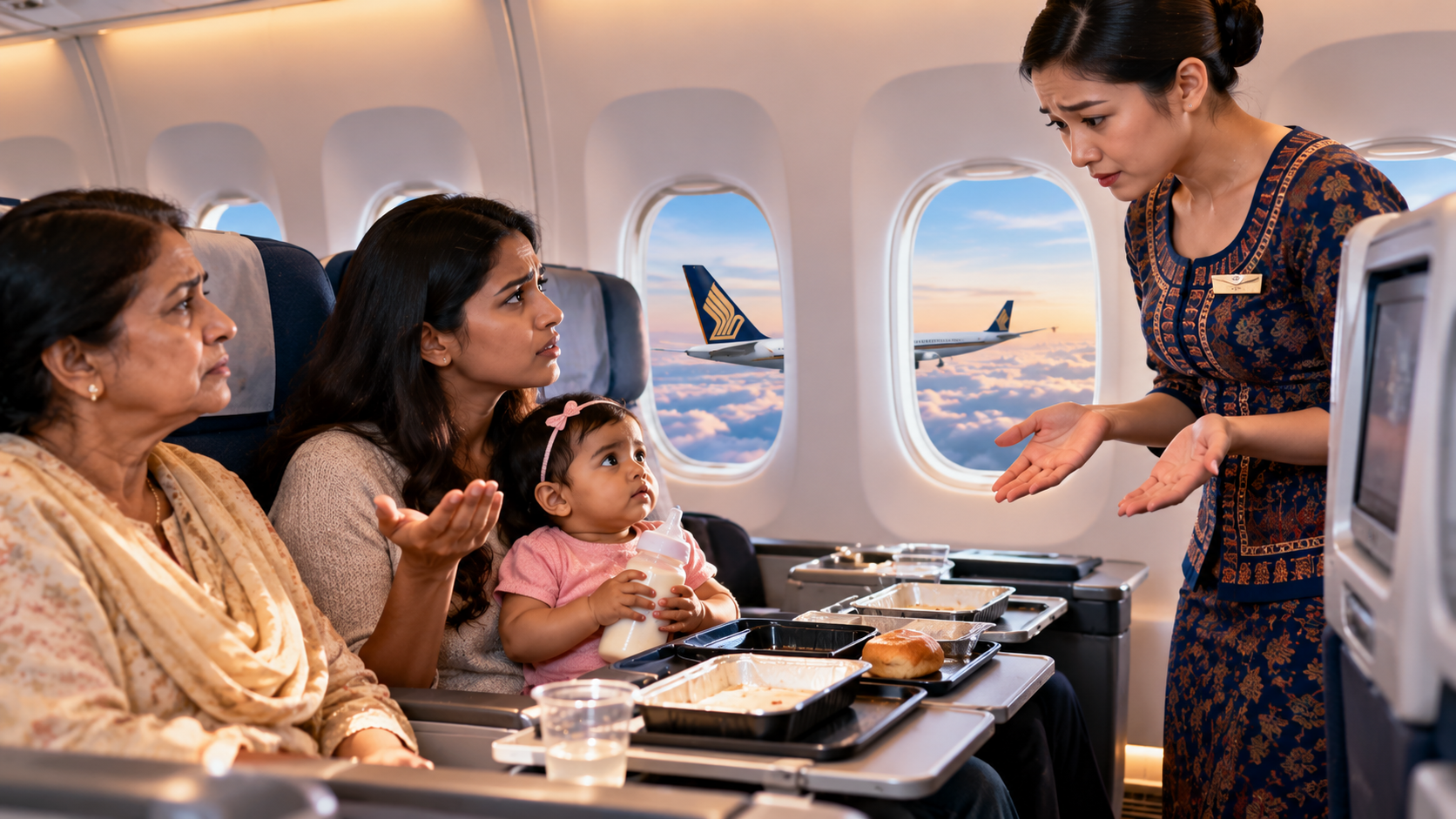
Punjab State Consumer Commission Finds Deficiency in Service After Family Complains of Inadequate Meals and Lack of Milk for Infant
Singapore Airlines has been directed to pay ₹50,000 in compensation after the Punjab State Consumer Disputes Redressal Commission held the airline liable for deficiency in service in a case involving allegations of inadequate food during a 15-hour international flight from Delhi to Melbourne.
The complaint was filed by Jaspreet Singh, who alleged that his wife, 11-month-old daughter and mother-in-law did not receive adequate food during their journey on March 4, 2020. The family specifically raised concerns about the availability of milk for the infant, highlighting the difficulties passengers can face when essential food requirements are not adequately addressed during long-haul travel.
In an order dated October 7, 2026, the state commission directed the airline to pay consolidated compensation for the mental agony and harassment suffered by the complainant, along with litigation expenses. The payment was ordered to be made within 45 days.
The decision reinforces the importance of providing reasonable onboard services during long-distance flights and highlights the responsibilities of airlines towards passengers, including families travelling with young children.
What Was the Complaint Against Singapore Airlines?
The dispute arose after Singh's family travelled from Delhi to Melbourne on Singapore Airlines in March 2020.
According to the complaint, his wife, infant daughter and mother-in-law were not provided proper food during the approximately 15-hour journey. The family also alleged that milk was not made available for the 11-month-old child.
Following the journey, Singh contacted the airline through email to raise his concerns. The airline initially indicated that it would investigate the matter. However, it later responded that no request for vegetarian or special meals had been registered and advised Singh to contact his travel agent.
Singh subsequently approached the consumer dispute redressal system, arguing that the airline had failed to provide adequate service during the journey.
The complaint raised an important question: Can an airline avoid responsibility for providing ordinary meals simply because a passenger has not requested a special meal in advance?
The state commission ultimately rejected the airline's defence, emphasising that the obligation to provide ordinary meals during a long-haul flight is distinct from the requirement to arrange special dietary options.
Consumer Commission Rejects Airline's Defence
Singapore Airlines argued that the passengers had not requested special meals and that food from its regular menu had been provided during the flight.
However, the state commission found that the absence of a special meal request did not remove the airline's responsibility to provide ordinary meals.
The commission also noted that the airline had not produced sufficient evidence to establish that the passengers had received adequate food during the journey.
The distinction between ordinary and special meals was central to the case. While passengers may need to request certain dietary arrangements in advance, the commission held that the airline could not rely solely on the absence of such a request to defend the complaint about basic onboard meal service.
The decision highlights the importance of maintaining appropriate service standards and keeping reliable records of services provided to passengers.
For airlines, this may include ensuring that onboard catering procedures are followed and that passenger complaints can be investigated using adequate documentation.
District Consumer Commission Had Earlier Ordered a Refund
Before the matter reached the state commission, Singh had approached the District Consumer Commission at Ropar.
He sought a refund of ₹1.25 lakh, along with ₹10 lakh in compensation for the alleged hardship caused to his family.
In January 2023, the district commission directed the airline and the travel agent to refund the ticket fare with annual interest of 7%. It also ordered payment of ₹25,000 in compensation and ₹11,000 towards litigation expenses.
Singapore Airlines challenged the district commission's order before the Punjab State Consumer Disputes Redressal Commission.
After reviewing the dispute, the state commission modified the relief granted to the complainant.
Why Was the Compensation Reduced to ₹50,000?
Although the state commission found the airline liable for deficiency in service, it concluded that refunding the entire ticket fare would be disproportionate because the passengers had completed their journey.
The commission considered the hardship alleged by the family, particularly the difficulties associated with travelling for an extended period with an infant.
It consequently reduced the relief to consolidated compensation of ₹50,000 for mental agony and harassment, along with litigation expenses.
The payment was directed to be made within 45 days.
The ruling illustrates how consumer commissions may distinguish between establishing a deficiency in service and determining an appropriate remedy. Even where a service provider is found responsible, the compensation awarded may depend on the circumstances of the case, the nature of the hardship and the proportionality of the relief.
What the Decision Means for Airline Passengers
The ruling serves as a reminder that passengers are entitled to expect reasonable service standards during air travel.
Long-haul flights require careful planning, particularly for families travelling with infants, elderly passengers or individuals with specific dietary needs.
Although special meals and other individual requirements may need to be requested in advance, the commission's decision indicates that airlines cannot automatically use the absence of a special meal request as a defence against complaints concerning ordinary meals.
Passengers who believe that an airline has failed to provide the services reasonably expected under their travel arrangements may consider the following steps:
-
Keep booking records: Preserve tickets, boarding passes, meal requests and other relevant travel documents.
-
Raise complaints promptly: Contact the airline through its official customer-service channels and retain copies of correspondence.
-
Document the issue: Record relevant details about the service problem, including the flight, date and nature of the complaint.
-
Retain supporting evidence: Keep receipts, written responses and other records that may help establish what happened.
-
Explore consumer remedies: If the complaint remains unresolved, passengers may consider approaching the appropriate consumer dispute redressal authority, depending on the circumstances and applicable law.
The outcome of an individual complaint will depend on the available evidence and the applicable legal framework. The ruling does not mean that every complaint about onboard catering will automatically result in compensation.
Implications for Singapore Airlines and the Aviation Industry
The case highlights the reputational importance of service quality in the competitive international aviation industry.
Airlines compete not only on ticket prices and route networks but also on punctuality, cabin comfort, catering, customer support and the handling of complaints.
A service-related dispute can become more significant when it involves vulnerable passengers or essential requirements during a long journey. Clear communication, reliable onboard procedures and effective complaint resolution can help airlines reduce disputes and maintain customer confidence.
For aviation companies, operational consistency is particularly important on long-haul routes, where passengers may have limited alternatives if a service problem arises during the flight.
The case also underscores the value of maintaining adequate records. When a complaint reaches a consumer commission, documentation of meals served, special requests received and the steps taken to resolve a grievance may become important evidence.
Market Outlook
The consumer commission's decision is primarily a service-quality and consumer-protection matter rather than a major financial development for Singapore Airlines. Nevertheless, it highlights an important operational consideration for airlines: customer experience and complaint management can influence brand reputation, customer loyalty and long-term competitiveness.
For the aviation sector, sustained passenger demand must be supported by reliable operations, consistent service standards and effective customer support. Airlines also need to balance service quality with catering, staffing and other operating costs.
Investors following aviation companies should focus on broader financial indicators, including passenger traffic, yields, load factors, operating expenses, fuel prices, capacity expansion and profitability. An isolated consumer dispute should not, by itself, be treated as evidence of a material change in a company's financial outlook.