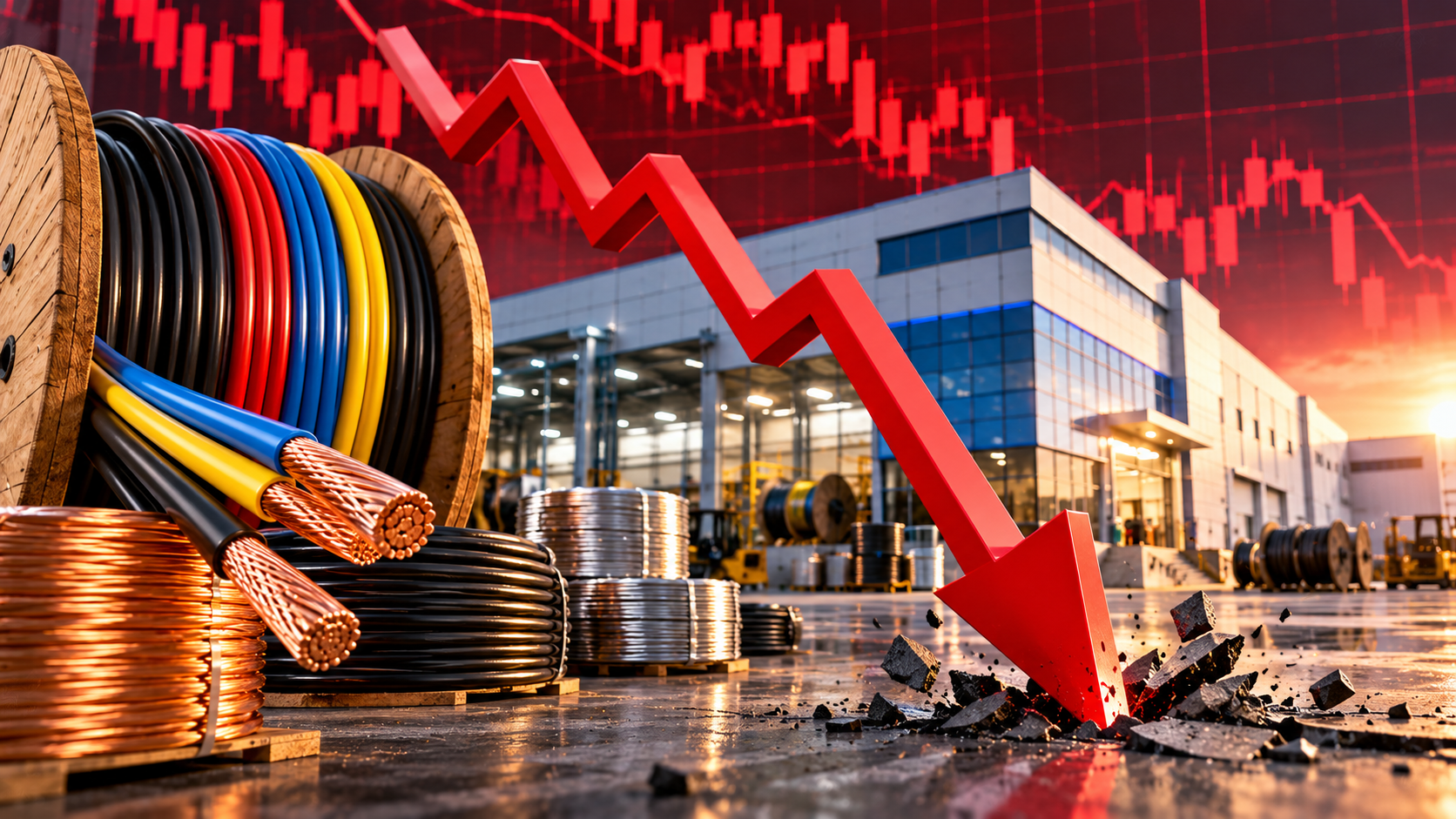
KEI Industries shares came under heavy selling pressure after Q2 FY27 results highlighted weaker-than-expected cable and wiring margins and a loss in the EPC business. Despite strong revenue and profit growth, investors remain focused on profitability and execution risks.
KEI Industries Ltd witnessed sharp selling pressure on Thursday, October 22, 2026, with its share price falling nearly 10% intraday to ₹3,816 on the BSE. The decline brought the stock close to its 52-week low, as investors reacted to operating margin concerns following the company's September-quarter results.
The wires and cables manufacturer reported strong year-on-year growth in revenue, EBITDA and profit after tax for the second quarter of FY27. However, concerns over lower-than-expected margins in its cables and wires (C&W) business and losses in its engineering, procurement and construction (EPC) segment weighed on sentiment.
Trading activity also increased significantly, with the average volume more than doubling. Approximately 1.2 million shares changed hands across the NSE and BSE by 10:14 AM, indicating heightened investor participation during the sell-off.
KEI Industries Share Price Nears 52-Week Low
KEI Industries shares touched an intraday low of ₹3,816 on the BSE during Thursday's trading session. The stock's 52-week low stood at approximately ₹3,729–₹3,730, recorded in January 2026.
The shares had previously reached a 52-week high of ₹5,931.40 on August 18, 2026. From that peak, the stock had corrected approximately 36%, reflecting a substantial decline from its recent highs.
At 11:19 AM, KEI Industries was trading at ₹3,902.80, down ₹327.60, or 7.74%, for the session. The difference between the intraday low and the quoted price illustrates the stock's volatility during the trading day.
The sharp correction suggests that investors are reassessing the company's earnings quality and margin outlook despite its strong reported growth. However, a decline in share price alone does not establish whether the stock is undervalued or overvalued.
KEI Industries Q2 FY27 Results: Revenue Rises 38.5%
KEI Industries reported strong financial growth in the July–September quarter of FY27, supported by demand across its wires and cables business.
Key financial highlights included:
-
Revenue: ₹3,776 crore, up 38.5% year-on-year.
-
EBITDA: ₹377 crore, an increase of 39.8% year-on-year.
-
Profit after tax (PAT): ₹262 crore, up 29% year-on-year.
-
EBITDA margin: Approximately 10%, improving by 9 basis points year-on-year.
-
Order book: ₹5,185 crore at the end of Q2 FY27.
EBITDA, or earnings before interest, tax, depreciation and amortisation, measures operating profitability before these expenses. Although EBITDA grew faster than revenue, analysts highlighted specific segment-level issues that affected the market's reaction to the results.
The company's EBITDA margin improved compared with the year-ago period, but the performance was not uniformly strong across all business segments. Investors are likely to examine whether the company can sustain its growth while improving profitability in the coming quarters.
Cables and Wires Business Drives Revenue Growth
The cables and wires business remained the principal contributor to KEI Industries' quarterly performance.
Revenue from cables increased 40% year-on-year to ₹3,669 crore. Domestic cables and wires revenue grew 46%, while exports increased 7% compared with the corresponding quarter last year.
The broad-based growth reflects demand across domestic and export markets. KEI manufactures a wide range of power cables, including products used in power transmission, distribution, industrial applications and infrastructure projects.
However, Motilal Oswal Financial Services noted that C&W margins were below its estimates. This suggests that the strong increase in sales did not translate into operating profitability at the level expected by the brokerage.
For investors, the key issue is whether the company can improve margins through pricing, product mix, operational efficiency and effective management of raw material costs.
EPC Business Reports a Loss During the Quarter
KEI Industries also operates in the engineering, procurement and construction segment, providing turnkey solutions for infrastructure projects.
During Q2 FY27, the EPC business reported a loss, according to the brokerage commentary. This was one of the factors contributing to concerns over the quality and consistency of the company's operating performance.
EPC projects can involve complex execution schedules, procurement requirements and project-specific cost risks. Delays, cost overruns or differences between estimated and actual project expenses can affect profitability.
The segment's reported loss does not, by itself, establish a long-term deterioration in the business. Investors will need to monitor project execution, new order wins, working-capital requirements and the segment's ability to return to profitability.
KEI Industries reported stainless-steel wire revenue of ₹63 crore and EPC revenue of ₹104 crore during the quarter.
Motilal Oswal Maintains Buy Rating
Motilal Oswal Financial Services said KEI Industries' Q2 FY27 EBITDA was broadly in line with its estimates. Strong revenue growth in the cables and wires and EPC segments supported the operating performance, but the brokerage highlighted lower-than-expected C&W margins and the EPC business's quarterly loss.
The brokerage remained structurally positive on the cables and wires sector, citing long-term growth drivers. It maintained a ‘Buy’ rating at the time of its result update, while indicating that its assumptions would be reviewed after the company's earnings conference call scheduled for October 22, 2026.
The brokerage's positive sector view should be distinguished from the near-term risks highlighted in the results. A favourable long-term industry outlook does not guarantee that a company's share price will rise, and the investment case can change as earnings estimates, valuations and operating conditions evolve.
Investors should also distinguish between a brokerage rating and a confirmed future outcome. The share price will depend on the company's subsequent financial performance, market conditions and investor expectations.
Raw Material Costs Remain a Key Factor
KEI Industries operates a raw-material-intensive business. According to the cited credit-rating rationale, raw materials account for approximately 75–77% of total operating costs.
Major inputs include copper, stainless-steel strips and rods, galvanised iron wires, PVC, DOP and aluminium. Changes in the prices of these materials can influence production costs and margins.
The company's contracts generally include a mix of fixed-price and variable-price arrangements. KEI typically maintains approximately 2–2.5 months of inventory for which prices have already been fixed, while most orders are executed within around three months.
This inventory and execution structure can provide some protection against adverse raw material price movements. Nevertheless, sudden changes in commodity prices may still affect profitability, depending on contract terms, inventory costs and the speed at which selling prices can be adjusted.
Foreign-exchange movements are another factor to monitor. The company benefits from a natural hedge to a large extent, according to the rating rationale, but it generally does not hedge its exposure. Consequently, sharp currency movements can still affect profitability, even though rupee depreciation may be beneficial in certain circumstances.
Infrastructure Demand Offers Long-Term Growth Potential
The long-term outlook for the wires and cables sector is supported by infrastructure development, electricity transmission and distribution requirements, industrial expansion and construction activity.
KEI's presence across multiple cable categories and customer segments provides exposure to several of these demand drivers. Its order book of ₹5,185 crore at the end of Q2 FY27 offers visibility into work to be executed, although an order book does not automatically translate into revenue or profit within a specific period.
The company's diversified geographical presence and broad customer base have also helped mitigate certain uncertainties arising from the West Asia crisis and disruptions in global supply chains, according to the cited rating-agency assessment.
However, investors will need to evaluate whether sector demand translates into sustainable earnings growth for KEI. Competition, raw material prices, project execution and the company's ability to protect margins will remain important determinants of performance.
Key Factors Investors Should Monitor
Investors tracking KEI Industries may focus on the following indicators over the next few quarters:
-
C&W margins: Whether margins recover to levels expected by analysts as demand and product mix evolve.
-
EPC profitability: Whether the company returns the EPC business to profitability and executes projects within expected costs.
-
Revenue and order-book conversion: Whether strong demand and the existing order book translate into timely revenue recognition and cash generation.
-
Raw material prices: Changes in copper, aluminium and other input costs, along with the company's ability to pass on cost increases.
-
Working capital: Inventory levels, receivables and cash-flow requirements as the business expands.
-
Export performance: Whether export growth strengthens beyond the reported 7% year-on-year increase.
-
Management commentary: Updates on demand, pricing, capacity, margins and the outlook shared during the earnings conference call.
These factors can help investors assess whether the recent decline reflects short-term disappointment or a more persistent challenge to earnings expectations.
Market Outlook
KEI Industries' Q2 FY27 results demonstrated strong business growth, with revenue increasing 38.5%, EBITDA rising 39.8% and net profit advancing 29% year-on-year. Nevertheless, the stock's sharp fall highlights the market's sensitivity to operating margins and segment-level profitability.
The company's strong domestic cables and wires revenue and sizeable order book remain positive indicators. At the same time, below-estimate C&W margins, an EPC loss and exposure to raw material and currency movements require continued monitoring.
Motilal Oswal's maintained ‘Buy’ rating reflects its constructive long-term view of the sector, but the brokerage also acknowledged the need to reassess assumptions after the earnings conference call. Investors should avoid relying on a single quarter's revenue growth or a brokerage rating when evaluating the stock.
The coming quarters will be important in determining whether KEI can convert strong demand into consistent margin improvement and sustainable earnings growth. Until clearer evidence emerges, volatility may remain elevated as the market weighs the company's long-term opportunities against its near-term execution challenges.