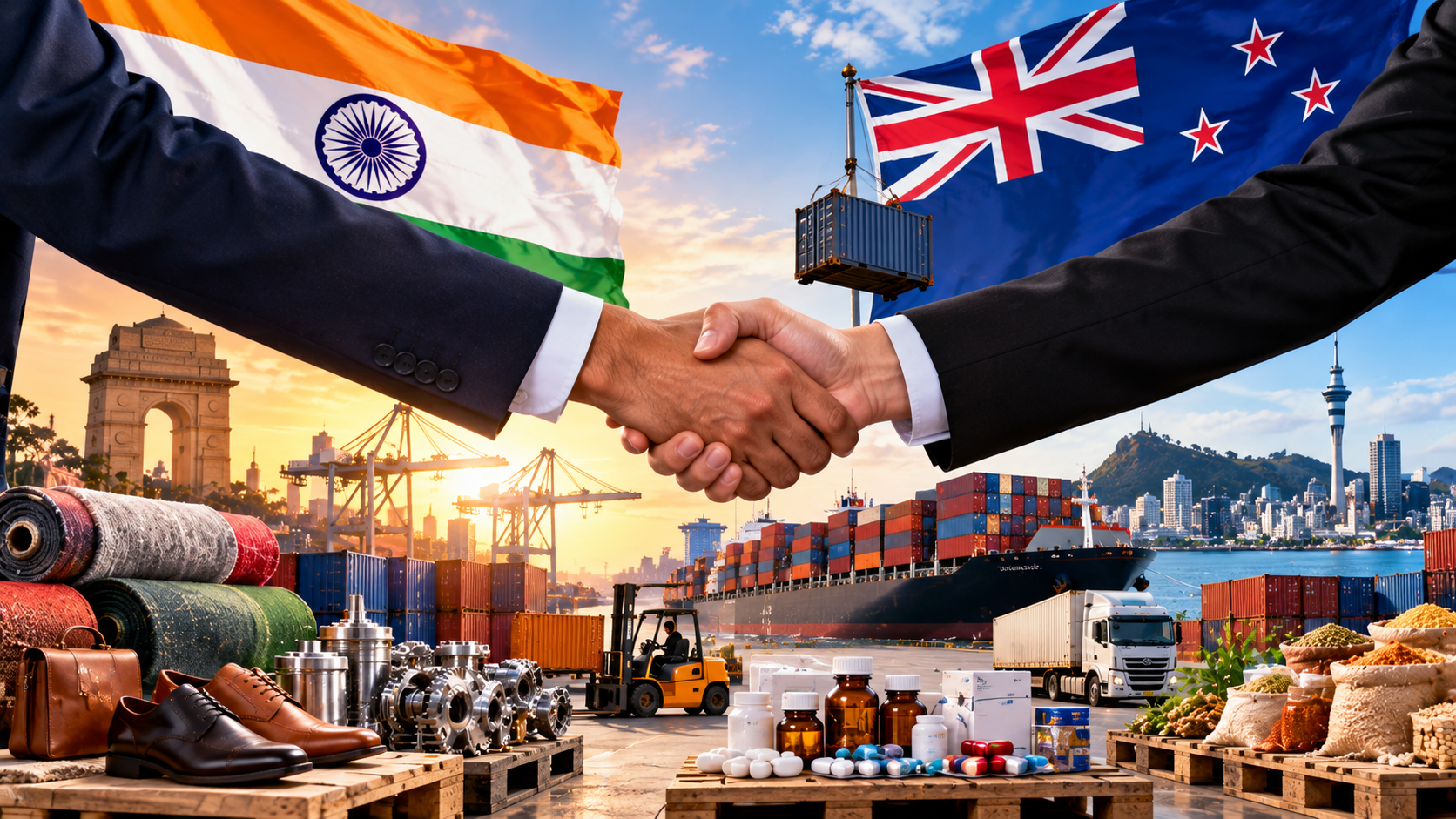
With the India-New Zealand Free Trade Agreement taking effect on October 20, Indian exporters could gain duty-free access across New Zealand's tariff lines, creating fresh opportunities for engineering, textiles, pharmaceuticals, chemicals and other sectors.
The Confederation of Indian Industry (CII) has urged Indian exporters, particularly micro, small and medium enterprises (MSMEs), to move quickly to capitalise on opportunities under the India-New Zealand Free Trade Agreement (FTA), which came into effect on October 20, 2026.
Sanjay Budhia, Chairman of the CII National Committee on Exports and Managing Director of Patton International Ltd, advised exporters to establish direct relationships with New Zealand buyers, understand product-specific rules of origin and make effective use of government export-support schemes.
The agreement is intended to strengthen trade and investment ties between the two countries by improving market access and reducing trade barriers. For Indian businesses, it could create opportunities to expand overseas sales, diversify export destinations and reach customers in additional international markets.
India Gets Duty-Free Access Across New Zealand's Tariff Lines
One of the key benefits highlighted by CII is duty-free access for Indian exporters across all tariff lines in New Zealand under the agreement.
According to Budhia, tariffs of up to 10% on products such as engineering goods, textiles, leather and footwear have been reduced to zero under the pact.
Lower import duties can make Indian products more competitive in the New Zealand market by reducing the tariff burden faced by importers. Depending on pricing arrangements and market conditions, these savings may help exporters improve competitiveness, expand sales or offer more attractive prices to buyers.
However, the actual benefits for individual businesses will depend on the product being exported, compliance with the agreement's rules of origin and other applicable import requirements.
MSMEs Encouraged to Engage Directly With New Zealand Buyers
CII has encouraged MSMEs to act early rather than wait for trade opportunities to develop automatically. Exporters are advised to identify potential buyers, understand demand patterns and assess how their products fit the requirements of the New Zealand market.
Smaller businesses could benefit from the improved tariff environment, particularly in labour-intensive industries where export competitiveness can be sensitive to price differences.
Establishing reliable distribution channels, maintaining consistent product quality and meeting delivery commitments will remain essential for converting improved market access into actual orders.
Budhia also highlighted the importance of checking product-specific rules of origin. These provisions determine whether goods qualify for preferential tariff treatment under the agreement. Exporters will therefore need to maintain appropriate documentation and verify the requirements applicable to their products before claiming benefits.
Engineering, Textiles, Leather and Pharmaceuticals Among Potential Beneficiaries
The agreement is expected to create opportunities across a broad range of Indian industries, including engineering goods, chemicals, plastics, electronics, pharmaceuticals and processed foods.
Labour-intensive sectors such as textiles, leather and footwear may also benefit from the removal of tariffs that previously increased the cost of Indian products in New Zealand.
For engineering and industrial manufacturers, improved tariff access could support efforts to expand overseas customer networks. Chemical, electronics and pharmaceutical companies may also explore new business relationships, subject to applicable product standards, regulatory approvals and import requirements.
The scale of the opportunity will differ by sector. Exporters will need to assess local competition, customer preferences, logistics costs and the ability to supply products consistently before committing resources to the market.
New Zealand Could Serve as a Gateway to Pacific Markets
Budhia noted that New Zealand could also serve as a gateway to wider Oceania and Pacific Island markets.
For Indian businesses seeking to diversify exports beyond traditional destinations, this could provide an opportunity to develop regional commercial relationships and explore additional markets over time.
However, access to New Zealand under the FTA does not automatically provide preferential access to other countries. Exporters will need to examine the separate trade rules, customs procedures and market-entry requirements applicable in each destination.
Building a regional export strategy may therefore require local partnerships, reliable logistics and a clear understanding of demand across different markets.
Simpler Certification and Compliance Procedures Could Reduce Costs
In addition to tariff reductions, the agreement includes measures intended to streamline certain regulatory and certification procedures.
CII highlighted provisions involving sanitary and phytosanitary (SPS) measures, technical barriers to trade (TBT), electronic certification, and the acceptance of Good Manufacturing Practice (GMP) and Good Clinical Practice (GCP) inspection reports, as applicable.
These measures could help reduce duplication and compliance-related expenses for eligible businesses by making documentation and regulatory processes more efficient.
For companies operating in regulated sectors, such as pharmaceuticals and processed foods, administrative efficiency can be an important factor in determining the cost and speed of entering an overseas market.
Nevertheless, exporters must continue to meet applicable safety, quality, labelling and regulatory requirements. Streamlined procedures should not be interpreted as a blanket exemption from product-specific standards.
Export Promotion Mission Could Support Businesses
Budhia urged exporters to make full use of government initiatives such as the Export Promotion Mission while exploring opportunities under the FTA.
Export-support programmes can help eligible businesses address some of the practical challenges involved in entering international markets. The availability and terms of specific support will depend on the relevant scheme's guidelines and eligibility conditions.
For MSMEs, a structured export strategy could include identifying suitable products, researching potential buyers, preparing compliant documentation, calculating landed costs and arranging reliable shipment and payment processes.
Businesses should also assess whether their production capacity and working capital can support additional orders before pursuing rapid expansion.
What Indian Exporters Should Do Next
To make effective use of the agreement, exporters can focus on several practical steps:
-
Identify suitable products: Assess which products have competitive pricing and demand potential in New Zealand.
-
Contact buyers: Build relationships with importers, distributors and potential business partners.
-
Check rules of origin: Verify product-specific eligibility and maintain the required supporting documents.
-
Review compliance requirements: Understand relevant certification, quality, safety and import procedures.
-
Calculate export economics: Evaluate shipping costs, insurance, payment terms, exchange-rate exposure and profit margins.
-
Explore government support: Review the eligibility and conditions of applicable export-promotion schemes.
-
Plan for repeat orders: Ensure adequate production capacity, consistent quality and reliable delivery schedules.
These steps can help businesses convert the agreement's formal tariff benefits into commercially viable export opportunities.
Market Outlook
The India-New Zealand FTA creates a potentially important opportunity for Indian exporters by eliminating tariffs across New Zealand's tariff lines and seeking to streamline selected compliance procedures. Engineering goods, textiles, leather, footwear, chemicals, electronics, pharmaceuticals and processed foods are among the sectors that could explore expanded market access.
For MSMEs, the agreement may offer a route to diversify exports and establish new international customer relationships. However, the gains will not be automatic: businesses must meet rules of origin, comply with applicable regulations and remain competitive on price, quality and delivery.
The next phase will depend on how quickly Indian companies engage with New Zealand buyers and translate improved market access into sustained orders. Exporters that prepare carefully, understand the agreement's requirements and build dependable commercial relationships will be better positioned to explore its potential benefits.