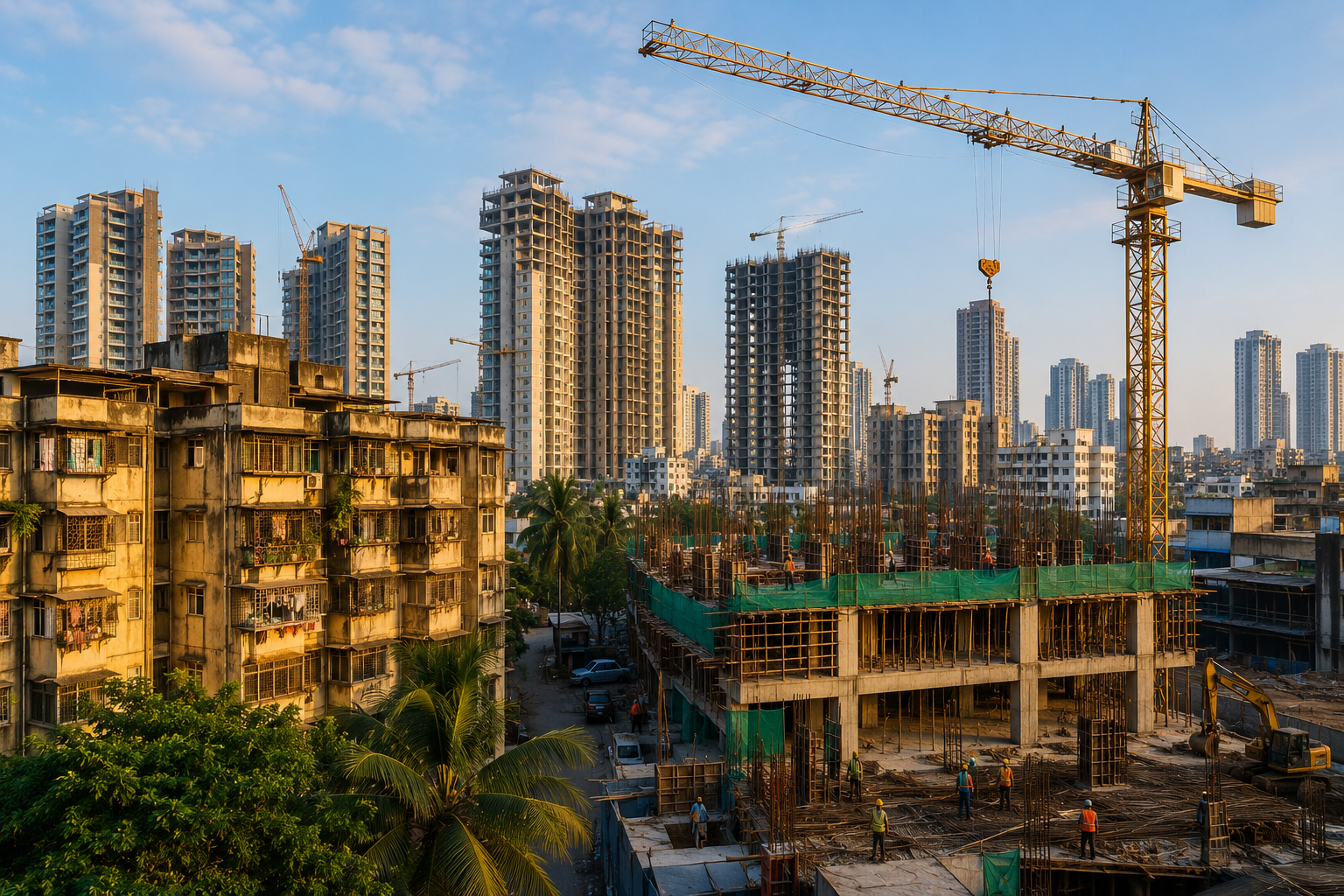
Redevelopment becomes a key source of residential supply as ageing buildings, slum clusters and self-redevelopment projects expand across Mumbai
Mumbai's residential real estate market is undergoing a structural transformation as redevelopment increasingly becomes the primary route for creating new housing supply in the land-constrained city. According to a JLL-Naredco report, redevelopment accounted for around 15 per cent of housing sales between 2025 and the first half of 2026, up sharply from approximately 6 per cent during 2016-2021.
The rise marks an important change in the city's property market. Redevelopment is no longer limited to individual ageing buildings or isolated housing societies. Large residential clusters, slum rehabilitation projects and self-redevelopment initiatives are increasingly contributing to Mumbai's housing pipeline.
More than 1,000 redevelopment projects have been launched since 2020, representing around 13 per cent of the city's overall residential supply. With vacant developable land becoming increasingly scarce, the existing urban landscape is emerging as the principal source of future housing inventory.
Redevelopment sales overtake new launches
One of the strongest indications of this structural change is that redevelopment-led housing sales have begun to outpace new launches.
This reflects both the growing supply of redevelopment projects and the willingness of homebuyers to purchase newly built homes in established neighbourhoods.
Redevelopment offers developers an opportunity to create new inventory in locations where acquiring large vacant land parcels would otherwise be extremely difficult or prohibitively expensive.
For homebuyers, the model can provide access to modern apartments in established locations with existing schools, hospitals, retail centres, transport links and employment opportunities.
Mumbai's limited land availability drives the transformation
Mumbai's geography has historically constrained the expansion of its residential market.
The scarcity of large developable parcels has pushed land prices higher and made conventional greenfield development increasingly difficult in many established locations.
Redevelopment addresses this constraint by unlocking value from properties that already exist.
Instead of expanding the city outward, developers can increase the efficiency of existing land through higher-density redevelopment, subject to applicable planning and regulatory provisions.
This makes redevelopment a structural rather than temporary trend for Mumbai's real estate sector.
13,500 cessed buildings create a massive redevelopment pipeline
The city's ageing building stock provides another powerful catalyst.
Mumbai has approximately 13,500 cessed buildings that require urgent replacement, according to the report.
A significant portion of this ageing stock is concentrated in established parts of the city and suburbs where land values are already high.
The redevelopment of these buildings could create substantial new housing supply while addressing concerns related to structural safety and ageing infrastructure.
However, converting this potential into completed projects requires resolution of ownership, tenant, rehabilitation, approval and financing issues.
Western Suburbs emerge as a major redevelopment hub
The Western Suburbs have become a particularly important redevelopment market.
Borivali, Malad, Andheri, Vikhroli and Goregaon together account for approximately 36 per cent of projects launched since 2020.
The Western Suburbs represented around 35-45 per cent of redevelopment launches and sales during 2025 and the first half of 2026.
The region benefits from strong residential demand, established social infrastructure and improving connectivity.
As transportation infrastructure expands, redevelopment activity could spread further into suburban micro-markets where ageing buildings coexist with rising demand for modern housing.
Premium corridors continue to appreciate
Redevelopment is also taking place in some of Mumbai's most expensive residential locations.
Worli has capital values of approximately ₹1-1.15 lakh per square foot, while Bandra-Khar commands around ₹90,000-95,000 per square foot.
The report indicates that values in Worli have risen by approximately 25-28 per cent over three years, while Bandra-Khar has recorded growth of around 25-30 per cent.
In the Kandivali-Borivali corridor, values have increased around 20-25 per cent and currently stand at approximately ₹32,000-37,000 per square foot.
Rising property values can improve redevelopment feasibility by increasing the potential revenue available from additional saleable inventory.
Established neighbourhoods become more valuable to developers
One of the major advantages of redevelopment is that developers do not have to create demand from scratch.
Established neighbourhoods already have residential communities, schools, healthcare facilities, shopping destinations and transport connectivity.
Redevelopment can therefore focus on replacing ageing structures while benefiting from an existing ecosystem.
This can reduce some of the location-related risks associated with greenfield projects, although project execution and approvals remain major challenges.
Slum redevelopment reaches unprecedented scale
Slum redevelopment represents another major component of Mumbai's transformation.
The JLL-Naredco report identifies approximately 1,202 active slum redevelopment projects covering around 321,858 hutments across 2,156 acres.
The scale of the current pipeline is particularly notable because the acreage involved is nearly four times the total area completed during the three decades following the formation of the Slum Rehabilitation Authority in 1995.
The development indicates a transition towards larger and more integrated urban redevelopment programmes.
Large cluster projects change the economics of redevelopment
The growing emphasis on cluster development is changing the scale of opportunities available to developers.
Large projects allow multiple buildings or settlements to be planned together rather than being redeveloped independently.
This can potentially improve the efficiency of infrastructure, roads, open spaces, rehabilitation housing and community facilities.
Large clusters can also create more significant commercial opportunities for developers because additional development potential can be planned across a broader area.
However, these projects require substantially more capital and coordination.
Dharavi remains a major redevelopment opportunity
The Dharavi redevelopment project is among the most prominent examples of large-scale urban transformation.
Projects of this scale can potentially create new residential, commercial and community infrastructure while reorganising existing settlements.
The economic impact can extend beyond housing through improvements in roads, public facilities, commercial activity and employment opportunities.
At the same time, large rehabilitation projects require careful execution because of their scale, the number of affected residents and the complexity of existing land and occupancy arrangements.
Juhu Lane-Gilbert Hill and Goregaon projects highlight scale
Other major redevelopment initiatives demonstrate the growing size of Mumbai's project pipeline.
The Juhu Lane-Gilbert Hill cluster covers approximately 101 acres, while the Goregaon Motilal Nagar redevelopment scheme spans around 420 acres.
Such projects highlight the shift from building-by-building redevelopment towards larger urban clusters.
If successfully executed, large developments can materially change the character of entire neighbourhoods rather than individual properties.
Policy changes could accelerate large slum projects
Regulatory changes are also supporting the redevelopment ecosystem.
A policy reform introduced in November 2025 removed individual consent requirements for large slum clusters exceeding 50 acres.
Under DCPR 2034, the consent threshold has been reduced to 51 per cent.
The regulations also provide for FSI of up to 4.0 for eligible cluster and slum redevelopment projects.
These provisions could improve project feasibility and reduce some of the challenges associated with securing individual approvals across very large settlements.
The effectiveness of the reforms will ultimately depend on implementation and the ability of stakeholders to resolve project-level issues.
Self-redevelopment gains momentum
Self-redevelopment is emerging as another important trend, with more than 1,600 active proposals.
Under the self-redevelopment model, housing societies take greater responsibility for the development process instead of handing the entire project to a traditional developer.
This can provide societies with greater control over project planning, financial structures and the utilisation of development potential.
It can also potentially increase the share of economic benefits retained by existing residents.
However, self-redevelopment requires societies to manage financing, approvals, contractors, consultants, legal processes and construction risks.
The increase in proposals indicates that housing societies are becoming more willing to explore this alternative model.
Infrastructure could unlock new redevelopment corridors
Infrastructure investment is expected to play a major role in shaping Mumbai's next phase of redevelopment.
Metro Lines 4, 6 and 11, the Coastal Road and the Borivali-Thane Twin Tunnel are among the projects expected to improve connectivity.
Improved transport links can increase the attractiveness of residential locations and potentially raise land values.
Developers may increasingly target redevelopment opportunities around transport corridors because improved accessibility can support both sales and rental demand.
Metro expansion could strengthen suburban demand
The expansion of Mumbai's Metro network is particularly relevant to redevelopment.
Improved public transport can reduce commuting times and make suburban neighbourhoods more attractive to homebuyers.
This could increase demand for newly redeveloped apartments in areas where ageing housing stock is substantial.
For developers, proximity to major transit infrastructure can improve the marketability of projects and potentially support higher pricing.
Rising property values improve redevelopment feasibility
Redevelopment economics are closely linked to property prices.
When residential prices rise, developers have greater potential to monetise the sale component of a project after accounting for rehabilitation and construction costs.
This can make previously marginal projects financially viable.
However, higher construction costs, financing expenses and regulatory obligations can offset some of the benefits of rising selling prices.
Developers therefore need to carefully evaluate the economics of each project rather than assuming that higher property values automatically translate into higher profitability.
Construction costs remain a key risk
The redevelopment model is sensitive to construction costs.
Steel, cement, labour, financing and other project expenses can significantly affect developer margins.
Large projects may also face cost escalation if construction timelines extend.
A prolonged approval process can increase financing costs and delay revenue generation.
Developers with strong balance sheets may therefore have an advantage because they can withstand longer project cycles and manage funding requirements more effectively.
Financing becomes increasingly important
The growing size of Mumbai's redevelopment pipeline will require substantial capital.
Developers must finance rehabilitation, construction, temporary accommodation, approvals and other project expenses before receiving the full benefit of sales.
This creates opportunities for banks, non-banking financial companies, private credit funds and real estate investment platforms to participate in the redevelopment financing ecosystem.
At the same time, lenders need to carefully assess title, approvals, cash flows, project feasibility and developer track records.
Organised developers could gain market share
The complexity of redevelopment could gradually favour larger and more professionally managed developers.
Companies with strong financial resources, regulatory capabilities and experience dealing with housing societies may be better equipped to undertake large redevelopment projects.
The market could therefore witness further consolidation as smaller developers face difficulty managing increasingly complex projects.
Institutional capital may also increasingly prefer developers with transparent governance, strong execution records and established project pipelines.
Redevelopment can modernise Mumbai's housing stock
Beyond its economic significance, redevelopment can address an important urban challenge.
Many ageing buildings were constructed several decades ago and may no longer meet modern requirements for safety, infrastructure, parking, accessibility and amenities.
Redevelopment can replace such structures with modern buildings and upgraded utilities.
It can also improve the overall quality of the urban environment when undertaken at the cluster level.
Social rehabilitation remains essential
Large-scale redevelopment must also address the interests of existing residents and occupants.
Rehabilitation arrangements, temporary relocation and possession timelines are critical components of project success.
Delays can create financial and social difficulties for residents.
Consequently, transparent agreements, strong project governance and timely execution will remain essential as redevelopment expands.
Rental markets could also benefit
The redevelopment cycle could influence Mumbai's rental market as well.
Newly constructed buildings with modern amenities can attract tenants willing to pay premiums for improved housing quality and connectivity.
Locations benefiting from Metro expansion or major road infrastructure could see additional rental demand.
This could create opportunities for investors and landlords in redeveloped residential corridors.
Impact on Mumbai's urban landscape
The scale of redevelopment activity means that the impact will extend well beyond individual projects.
Neighbourhoods with large concentrations of ageing buildings could experience substantial changes in density, building quality and commercial activity.
New roads, open spaces, community facilities and modern housing could alter local urban patterns.
Over time, redevelopment could effectively create a new Mumbai without requiring the city to expand geographically.
Key challenges could slow execution
Despite the strong opportunity, redevelopment remains a complex process.
Regulatory approvals, title issues, resident negotiations, rehabilitation arrangements and financing can all cause delays.
Large cluster projects are particularly exposed to execution risks because they involve numerous stakeholders.
Developers also need to maintain sufficient financial liquidity throughout long project cycles.
Therefore, the size of the redevelopment pipeline should not be interpreted as equivalent to immediately available housing supply.
What investors should monitor in the real estate sector
For investors tracking Mumbai-focused real estate companies, several indicators will become increasingly important.
These include the number of redevelopment projects secured, approvals obtained, construction commencement, sales velocity and project-level profitability.
The quality of the developer's balance sheet and access to financing will also remain important.
Investors should additionally track property-price trends, construction-cost inflation and regulatory developments.
Companies that consistently convert redevelopment opportunities into completed projects could gain a competitive advantage as the sector expands.
Mumbai's redevelopment cycle could remain a long-term growth engine
The combination of scarce land, ageing buildings, strong housing demand and infrastructure investment provides a powerful foundation for continued redevelopment activity.
The increase in redevelopment's share of housing sales to 15 per cent demonstrates that the segment has already become an important part of Mumbai's property market.
The substantial pipeline across conventional redevelopment, slum rehabilitation and self-redevelopment suggests that the opportunity extends across multiple categories.
The next phase is likely to focus increasingly on execution, consolidation and institutionalisation of the redevelopment market.
Market Outlook
Mumbai's housing market is undergoing a structural transition in which redevelopment is increasingly replacing conventional greenfield development as a major source of new residential supply.
The rise in redevelopment's share of housing sales from approximately 6 per cent during 2016-2021 to 15 per cent during 2025-H1 2026 is a strong indication of this shift. More than 1,000 projects launched since 2020, approximately 13,500 cessed buildings requiring replacement, 1,202 active slum redevelopment projects and more than 1,600 self-redevelopment proposals provide a substantial long-term pipeline.
The Western Suburbs are likely to remain a key redevelopment corridor, while premium markets such as Worli and Bandra-Khar could continue to benefit from strong demand and limited land availability. Infrastructure expansion through Metro corridors, the Coastal Road and major road projects could further support redevelopment-led value creation.
For developers, the opportunity is significant but execution will determine profitability. Strong balance sheets, regulatory expertise, access to capital, resident-management capabilities and proven project execution are likely to become increasingly important competitive advantages.
Over the medium to long term, Mumbai's redevelopment cycle could remain a major growth engine for the real estate sector. However, investors should distinguish between announced project pipelines and projects that have secured approvals and entered active construction, while closely tracking sales, costs, funding requirements and completion timelines.