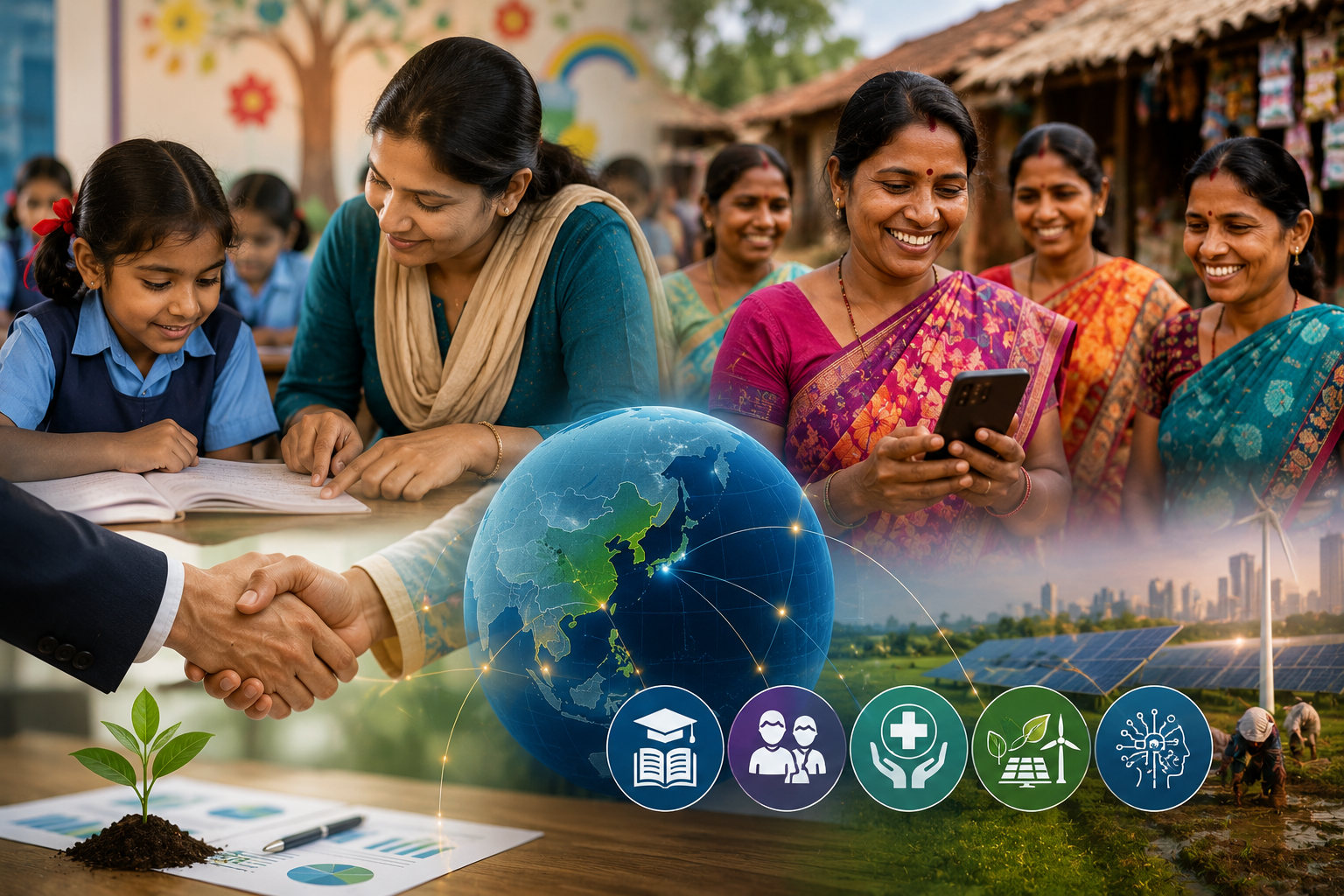
PAA supports Rocket Learning and She Leads Bharat: Udyam as it deepens focus on education, rural women, climate, healthcare and AI-led solutions
The Philanthropy Asia Alliance (PAA), a collaborative philanthropy initiative established by Singapore-based Temasek Trust, is expanding its network in India by backing two impact ventures focused on early-childhood education and economic opportunities for rural women.
PAA has announced support for Rocket Learning, an early-age education initiative, and Frontier Innovations' She Leads Bharat: Udyam, a digital-first programme aimed at connecting rural women shopkeepers with rural commerce through Frontier Markets' artificial intelligence-powered application, Meri Saheli.
The move comes as global philanthropic institutions increasingly look beyond traditional grant-making towards collaborative models that can identify promising solutions, test them at scale and eventually connect them with government programmes or private capital.
PAA has also added Mumbai-based strategic philanthropy organisation Dasra to its India network, strengthening its presence in one of Asia's largest and most diverse social-impact markets.
PAA expands its India network
With Dasra joining the alliance, PAA's Indian membership now includes four major philanthropic organisations.
Its India network comprises:
-
Aditya Birla Education Trust
-
Shiv Nadar Foundation
-
Bharti Airtel Foundation
-
Dasra
Globally, PAA has built a network of around 110 funder members spanning the Americas, Asia-Pacific, Europe and West Asia.
The organisation's objective is to bring together funders with common interests and create collaborative platforms capable of supporting programmes through multiple stages of development.
Two new India ventures receive support
The latest announcements cover two different areas of India's development landscape.
Rocket Learning focuses on early education
Rocket Learning works in the early-childhood education space.
The focus on early learning reflects growing recognition that educational outcomes are influenced significantly by children's experiences during their formative years.
Technology and community-based interventions can potentially expand access to learning resources and improve engagement among children and caregivers.
PAA sees potential for lessons from India's experience to eventually inform programmes in other countries.
She Leads Bharat: Udyam focuses on rural women
Frontier Innovations' She Leads Bharat: Udyam targets rural women shopkeepers and entrepreneurs.
The initiative uses a digital-first approach to connect women running rural shops with commerce opportunities through Frontier Markets' Meri Saheli application.
The model combines digital technology with rural commerce and women's economic participation.
If successfully scaled, such initiatives could help improve access to markets, products, information and business opportunities for women entrepreneurs in rural communities.
Why India is important for global philanthropy
India presents a unique combination of scale, diversity and technological adoption.
The country faces major challenges in areas such as healthcare, education, climate resilience, livelihoods and rural development.
At the same time, India has developed a growing ecosystem of technology companies, social enterprises, foundations and non-government organisations working on these challenges.
This makes India both a significant market for social-impact interventions and a potential source of solutions that can be adapted elsewhere.
PAA CEO Shaun Seow said the next 12 months could be particularly significant for the organisation's India strategy, with a pipeline of programmes and funders being evaluated.
PAA focuses on three major themes
PAA's activities are broadly organised around three key mandates:
Health
The organisation is exploring programmes that can improve health outcomes and strengthen healthcare systems.
Inclusive development
This includes education, livelihoods, women's economic empowerment and access to opportunities for underserved communities.
Climate
Climate change and resilience are becoming increasingly important areas of intervention, particularly as extreme weather events affect health, agriculture and livelihoods.
India provides opportunities across all three areas because of its large population and diverse socioeconomic conditions.
India is producing solutions with regional potential
PAA believes India is not simply a destination for philanthropic capital but can also serve as a source of solutions for other Asian countries.
The country's experience with large-scale digital public infrastructure, community programmes and technology adoption provides an environment in which innovative models can be tested.
Successful interventions could subsequently be adapted for Southeast Asia and other emerging markets.
However, PAA emphasises that solutions cannot simply be copied from one country to another.
Local culture, institutions, languages, government policies and community structures can significantly affect the success of a programme.
From pilot projects to large-scale impact
One of PAA's central ideas is to create a pathway from pilot projects to broader implementation.
A programme may initially receive support from one or more philanthropic organisations.
If the model demonstrates measurable results, it could then potentially receive:
-
Government support
-
Larger philanthropic funding
-
Institutional capital
-
Private-sector participation
-
Policy backing
-
International expansion
This approach attempts to bridge the gap between promising pilot programmes and large-scale social impact.
$615 million mobilised across more than 300 programmes
In approximately three years of operations, PAA has mobilised around $615 million across more than 300 programmes.
The figure illustrates the scale of the collaborative-philanthropy model being developed by the organisation.
Instead of individual foundations independently funding similar initiatives, collaborative platforms can bring funders together around common objectives.
This can potentially reduce duplication and enable larger, more coordinated interventions.
Five communities bring specialised funders together
PAA also creates specialised communities within its broader membership.
Funders interested in specific themes can collaborate through these groups.
Areas of focus include:
-
Energy transition
-
Ocean philanthropy
-
Health for human potential
-
Climate
-
Inclusive development
This structure allows participants to share knowledge, identify projects and potentially coordinate funding around common challenges.
Climate change creates new opportunities for India
One area attracting increasing attention is climate resilience.
India is increasingly exposed to extreme heat, particularly in urban areas and among outdoor workers.
Extreme temperatures can affect worker productivity, health and household incomes.
PAA is examining solutions that could protect workers from heat-related risks.
Parametric insurance could protect vulnerable workers
One potential model involves parametric insurance, where payouts are triggered when a predefined measurable event occurs.
For example, workers could potentially receive compensation when temperatures cross a predetermined threshold, reducing the need to work under dangerous conditions.
Such mechanisms can provide a form of financial protection against climate-related disruptions.
If successful, similar approaches could potentially be adapted for other countries facing extreme heat.
Agriculture emerges as another climate focus
PAA has also supported agricultural programmes focused on climate-friendly rice cultivation in partnership with the Gates Foundation.
Pilot projects are being developed across:
-
South India
-
Indonesia
-
Laos
The multi-country approach allows organisations to assess how agricultural practices can be adapted to different farming systems.
Local institutions determine scalability
Agricultural programmes demonstrate why local conditions matter when scaling solutions.
In some markets, farmer cooperatives provide an established mechanism for reaching large groups of farmers.
India's cooperative structures can therefore facilitate certain types of agricultural interventions.
In countries without comparable structures, organisations may need to develop different methods to reach individual farmers.
This makes local partnerships essential to successful cross-border expansion.
Healthcare could become another major collaboration area
PAA is also exploring opportunities in healthcare.
The organisation has held discussions with the Piramal Foundation around tuberculosis-related work.
Tuberculosis remains a major public-health challenge in both India and Indonesia, creating scope for organisations in the two countries to share knowledge and develop collaborative approaches.
The opportunity extends beyond funding to include technology, data, research and community-level implementation.
Artificial intelligence changes the scale of impact solutions
AI has emerged as an increasingly important component of PAA's strategy.
The organisation, together with the Gates Foundation and Temasek Foundation, is supporting a pilot across five Southeast Asian countries focused on infectious-disease surveillance.
The objective is to investigate how machine-learning systems can help identify pathogens, viruses and bacteria.
Such technology could potentially complement traditional public-health surveillance systems.
AI could help identify disease outbreaks faster
AI systems can process large volumes of information and identify patterns that may not be immediately visible through conventional analysis.
For example, information about the location of a potential outbreak could be combined with travel or event data.
Large concerts, festivals or other mass gatherings can create significant movement of people between cities.
Combining such information with health data could potentially help researchers understand transmission pathways more quickly.
Responsible AI is a central challenge
The expansion of AI also creates new risks.
One major issue is data representation.
Many existing datasets are heavily weighted towards English-language information.
In countries such as India, where hundreds of languages and dialects are used, this can result in systems that do not adequately represent the populations they are intended to serve.
Increasing the availability of local-language datasets could make AI applications more representative.
AI and education could converge
AI could also play an increasing role in education.
Potential applications include:
-
Personalised learning
-
Local-language educational content
-
Teacher assistance
-
Early identification of learning gaps
-
Automated learning support
-
Educational resource distribution
However, responsible implementation will require safeguards around children's data, algorithmic bias and human oversight.
Building an Asia-wide impact ecosystem
PAA's broader strategy extends beyond individual projects.
The organisation wants to strengthen connections between India, Southeast Asia, West Asia and China.
These regions face several common challenges, including climate change, healthcare access, agricultural productivity and education.
Creating stronger links between funders and organisations across these markets could allow successful ideas to travel more quickly.
India could become a launchpad for Asian solutions
India's large domestic market gives impact ventures an opportunity to test whether a solution can work at scale.
If an initiative succeeds across India's diverse conditions, it may have potential for adaptation elsewhere.
However, the model must be localised.
An education solution designed for India may need different curriculum integration in the Philippines.
Similarly, an agricultural intervention that works through Indian cooperatives may require a completely different distribution mechanism in another country.
Digital infrastructure strengthens India's position
India's rapid adoption of digital technologies creates another advantage for impact ventures.
Digital platforms can potentially reduce the cost of reaching large populations and make it easier to deliver services across geographically dispersed communities.
This is particularly relevant to rural commerce, education, financial inclusion and healthcare.
The expansion of smartphone and internet usage can also create new channels for delivering information and services.
Women's economic participation remains a major opportunity
The She Leads Bharat: Udyam initiative highlights the broader opportunity around rural women's entrepreneurship.
Women operating small shops and businesses often function as important economic links within rural communities.
Digital tools can potentially help them improve:
-
Product access
-
Market connectivity
-
Business information
-
Customer reach
-
Inventory management
-
Financial decision-making
The success of these models will ultimately depend on whether technology translates into measurable improvements in income and business sustainability.
Philanthropy is moving towards measurable outcomes
The PAA model reflects a broader shift in the global philanthropic ecosystem.
Funders are increasingly interested in measurable impact rather than simply providing financial support.
This means programmes may be evaluated on indicators such as:
-
Number of beneficiaries
-
Improvement in learning outcomes
-
Income generated
-
Healthcare outcomes
-
Reduction in climate vulnerability
-
Adoption of new practices
-
Cost per beneficiary
-
Long-term sustainability
Measurable outcomes can also make it easier to attract additional funding.
Government partnerships could unlock scale
For many social-impact programmes, government adoption is critical to achieving national or regional scale.
A private foundation may successfully demonstrate a programme in a limited number of districts, but government systems can potentially expand it across much larger populations.
This is why PAA's model places emphasis on developing solutions that can eventually work alongside government policy.
Private capital could follow successful programmes
Another potential pathway is the transition from philanthropic funding to private capital.
Once an initiative demonstrates a sustainable business model and measurable social impact, impact investors and other forms of institutional capital may become interested.
This can create a more sustainable funding ecosystem and reduce reliance on grants.
The transition will not be possible for every social-impact programme, but it could be relevant for areas such as rural commerce, climate insurance, healthcare technology and education technology.
Key opportunities for India's impact ecosystem
The expansion of PAA highlights several areas where India could attract increased impact-oriented capital.
Education
Early-childhood development, digital learning and personalised education.
Rural entrepreneurship
Technology-enabled commerce and women's economic empowerment.
Climate resilience
Heat protection, parametric insurance and climate-smart agriculture.
Healthcare
Tuberculosis, infectious-disease surveillance and preventive healthcare.
Artificial intelligence
Disease detection, education and local-language technology.
Agriculture
Climate-friendly cultivation and technology-enabled farmer support.
Key challenges to watch
Despite the significant opportunity, impact programmes face several challenges.
Scalability
A solution that works in one community may not automatically work across a much larger population.
Local adaptation
Cultural and institutional differences can limit cross-border replication.
Funding continuity
Long-term programmes require sustained financial support.
Data quality
AI-based solutions depend on reliable and representative datasets.
Responsible technology
AI applications must address privacy, bias and accountability.
Measurement
Demonstrating measurable impact can be difficult for programmes involving long-term social outcomes.
What PAA's India expansion means
The addition of Dasra and support for two Indian ventures indicate that PAA is moving beyond a limited network towards a broader India strategy.
The organisation's focus on collaborative funding means its influence could extend beyond the two ventures announced currently.
Its pipeline of potential programmes and funders suggests that additional initiatives could emerge in healthcare, climate, inclusive development and technology.
What investors and businesses should watch
The growing impact ecosystem could create opportunities for businesses operating at the intersection of technology and social development.
Areas worth watching include:
-
AI-based healthcare
-
Climate-tech
-
Digital education
-
Rural fintech
-
Agricultural technology
-
Women's commerce platforms
-
Parametric insurance
-
Digital public infrastructure
-
Health surveillance
-
Local-language AI
These sectors could increasingly attract attention from philanthropic capital, impact investors and strategic corporate partners.
Market Outlook
The expansion of the Philanthropy Asia Alliance in India signals a broader shift towards collaborative, technology-enabled and scalable approaches to social development.
The immediate focus on early-childhood education and rural women's commerce provides a starting point, but PAA's larger India opportunity extends across healthcare, climate resilience, agriculture and artificial intelligence.
India's scale gives successful social-impact ventures an opportunity to demonstrate whether solutions can work across diverse populations. If those models produce measurable outcomes, they could potentially attract government partnerships, additional philanthropic funding and private impact capital.
The growing use of AI could further accelerate this ecosystem, particularly in health surveillance, education and rural commerce. However, responsible data use, local-language representation and adaptation to community-level needs will remain essential.
For India's impact and innovation ecosystem, the most important development to watch is not simply the amount of philanthropic capital entering the country, but whether that capital can help move promising ideas from small-scale pilots to financially and operationally sustainable solutions capable of reaching millions of people.