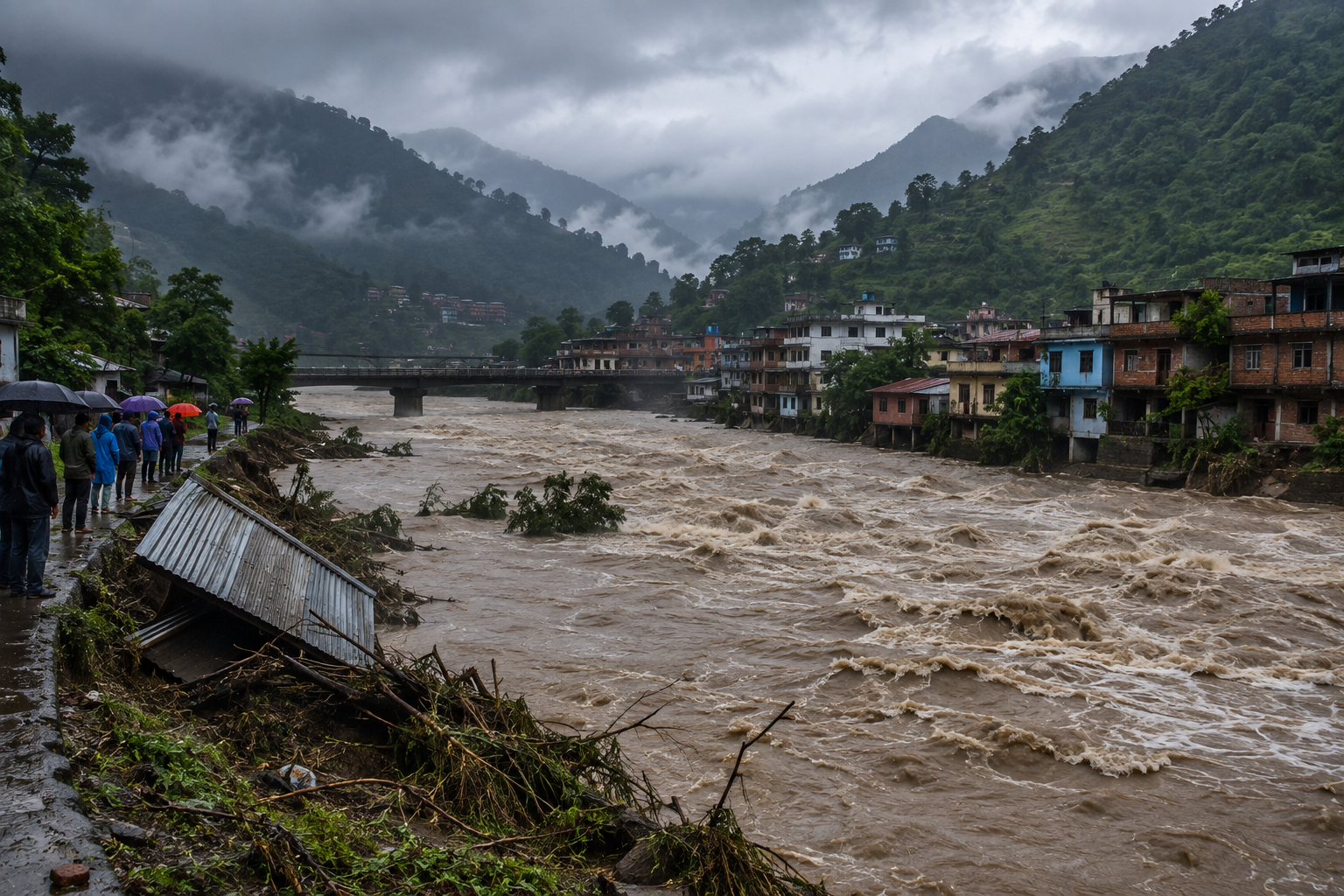
Continuous monsoon rainfall raises flood risk across Nepal as authorities urge downstream and riverbank communities to remain vigilant
Nepal has issued a fresh flood alert after water levels in several major rivers crossed warning thresholds following continuous monsoon rainfall across the country.
Authorities have urged people living in central, eastern and western parts of Nepal to remain alert, particularly communities located close to riverbanks and in low-lying downstream areas.
According to the Flood Forecasting Division of Nepal's Department of Hydrology and Meteorology, the Sun Koshi River in Sindhuli, Budhi Gandaki River in Gorkha and Mahakali River in Dadeldhura were above their respective alert levels as of 6 AM on September 2.
The situation is particularly serious along the Marsyangdi River in Lamjung district, where the water level has already crossed the danger mark and continues to rise.
Marsyangdi River crosses danger level
The Marsyangdi River has emerged as the most immediate flood concern.
The Flood Forecasting Division said the river crossed the danger level at the Bhukundebesi water-level monitoring centre at around 11:15 PM on Tuesday.
The latest monitoring information indicates that the water level remains on an upward trajectory.
With river flow continuing to increase, authorities have warned that the risk of flooding in downstream areas remains high.
The National Disaster Risk Reduction and Management Authority has also urged residents living downstream to remain vigilant and prepare for the possibility of further deterioration.
Sun Koshi, Budhi Gandaki and Mahakali above alert levels
The flood warning is not limited to the Marsyangdi River.
Three other major rivers have also crossed their alert thresholds:
-
Sun Koshi River — Sindhuli district
-
Budhi Gandaki River — Gorkha district
-
Mahakali River — Dadeldhura district
The simultaneous rise in water levels across multiple river systems highlights the widespread impact of ongoing rainfall.
Authorities are closely monitoring these rivers because continued rainfall in their respective catchment areas could lead to further increases in water flow.
Continuous monsoon rain raises concern
Nepal is experiencing continuous rainfall as the monsoon remains active across several parts of the country, including Kathmandu.
While monsoon rainfall is essential for agriculture and water resources, prolonged or intense precipitation can significantly increase the risk of flooding and landslides.
Rainfall accumulating over river catchment areas can quickly increase runoff and raise river levels.
In mountainous regions, the effect can be particularly rapid because steep terrain allows water to flow quickly into river channels.
Why river levels can rise quickly in Nepal
Nepal's geography makes the country particularly vulnerable to monsoon-related floods.
Large portions of the country are mountainous or hilly, while numerous rivers and tributaries originate in the Himalayas and surrounding highlands.
During periods of heavy rainfall, water can move rapidly through steep valleys before reaching downstream settlements.
This creates a relatively narrow window for communities to respond when river levels rise suddenly.
The risk can become even greater when rainfall continues over several days and the soil becomes saturated.
Downstream communities face the highest risk
Authorities have specifically warned people living in lower areas along the affected rivers.
Communities located immediately downstream from areas experiencing heavy rainfall can face rapidly rising water levels even when rainfall at their own location is relatively limited.
Residents living near riverbanks have therefore been urged to remain vigilant and monitor official announcements.
People in vulnerable areas have also been advised to identify safe locations in advance in case evacuation becomes necessary.
Flood risk depends on rainfall over the catchment areas
The immediate flood situation will depend heavily on rainfall intensity and duration in the catchment areas of the affected rivers.
Even if rainfall temporarily declines in one location, continued precipitation upstream can keep river levels elevated downstream.
This makes continuous hydrological monitoring important during the current period.
The Marsyangdi River is of particular concern because its water level has already crossed the danger mark and is still rising.
Landslide threat also increases
Heavy and prolonged rainfall in Nepal can create a dual natural-disaster risk involving both floods and landslides.
As soil becomes saturated, slopes in hilly and mountainous areas can become unstable.
Landslides can block roads, damage bridges, disrupt electricity networks and isolate communities.
In some cases, landslide-related road blockages can make it more difficult for emergency services to reach affected areas.
Residents in mountainous regions are therefore being advised to remain alert to both rising water levels and signs of slope instability.
Transport infrastructure could face disruption
Flooding and landslides can have a significant impact on Nepal's transport network.
Roads and bridges located near rivers are particularly vulnerable when water levels rise rapidly.
Flooding can damage road surfaces, weaken bridge foundations and force authorities to temporarily close routes.
Landslides can further disrupt road connectivity in mountainous areas.
Any prolonged disruption could affect the movement of food, fuel, medicines and other essential goods.
Agriculture faces a mixed impact
Monsoon rainfall is vital for Nepal's agricultural sector, but excessive precipitation can become damaging.
Adequate rainfall supports crop growth and water availability, while excessive rainfall can cause:
-
Crop damage
-
Soil erosion
-
Waterlogging
-
Loss of agricultural land
-
Damage to irrigation infrastructure
-
Livestock losses
-
Disruption to rural transport
The ultimate impact will depend on the geographical extent and duration of flooding.
Power infrastructure also remains vulnerable
Nepal's hydropower sector is particularly important to the country's economy, but extreme rainfall can pose risks to hydropower infrastructure.
Floods and landslides can affect access roads, transmission infrastructure and facilities located near rivers and steep slopes.
Sediment levels in rivers can also increase significantly during heavy rainfall, potentially creating operational challenges for hydropower projects.
The situation will therefore need to be monitored closely if rainfall remains intense.
Kathmandu continues to receive rainfall
The latest flood warning comes as rainfall continues across several parts of Nepal, including the capital Kathmandu.
Urban areas can also experience flooding when rainfall exceeds drainage capacity.
Heavy precipitation can affect roads, traffic movement, low-lying neighbourhoods and public infrastructure.
However, the most immediate river-flood concerns remain concentrated around the river systems where water levels have already crossed alert or danger thresholds.
Authorities urge residents to prepare early
Nepal's disaster-management authorities have stressed the importance of early preparation.
Residents living close to rivers and in low-lying areas are being encouraged to:
-
Follow official flood and weather advisories
-
Avoid unnecessary movement near riverbanks
-
Identify nearby safe locations
-
Prepare essential items in case evacuation becomes necessary
-
Keep emergency communication channels accessible
-
Follow evacuation instructions issued by authorities
-
Avoid crossing flooded roads or streams
Early action can significantly reduce risks when river levels rise rapidly.
Why official warnings are important
Flood conditions can change quickly during active monsoon periods.
River levels can rise even after rainfall appears to have weakened in a particular area because water from upstream catchments continues to flow downstream.
For this reason, residents should rely on official hydrological and disaster-management updates rather than assuming that a temporary reduction in local rainfall means the flood risk has passed.
Economic impact could increase if flooding persists
If the current rainfall and flooding situation continues, the economic impact could extend beyond immediately affected communities.
Potential areas of disruption include:
Transport: Road and bridge closures could interrupt the movement of goods and people.
Agriculture: Excessive rainfall and flooding could damage crops and farmland.
Energy: Hydropower and transmission infrastructure could face weather-related disruptions.
Tourism: Flooding, landslides and road closures could affect travel across affected regions.
Local businesses: Retailers, traders and small businesses in vulnerable communities could face temporary closures and supply disruptions.
The scale of the economic impact will depend on the severity and geographical spread of the flooding.
Regional water systems remain important
Nepal's rivers form part of the wider Himalayan and South Asian river system.
Water originating in the Himalayan region eventually flows into larger downstream river networks across the region.
This makes extreme rainfall and flood events in Nepal relevant to broader regional water management, agriculture and infrastructure planning.
However, the effects vary considerably between individual river systems and depend on rainfall distribution, upstream flows and downstream conditions.
Key rivers and areas under close watch
The current situation places several river systems under heightened monitoring.
| River | District | Current situation |
|---|---|---|
| Marsyangdi | Lamjung | Above danger level; water still rising |
| Sun Koshi | Sindhuli | Above alert level |
| Budhi Gandaki | Gorkha | Above alert level |
| Mahakali | Dadeldhura | Above alert level |
The situation could change rapidly depending on rainfall and upstream water flow.
What to watch over the next few days
The most important indicators will be:
-
Rainfall intensity across river catchment areas
-
Marsyangdi River water level
-
Water levels in Sun Koshi, Budhi Gandaki and Mahakali
-
Additional rivers crossing alert thresholds
-
Flooding in downstream settlements
-
Landslide activity
-
Road and bridge closures
-
Hydropower and electricity infrastructure
-
Government evacuation advisories
-
Changes in the monsoon pattern
Market Outlook
The immediate priority remains public safety and flood preparedness, with authorities closely monitoring multiple rivers across Nepal.
If rainfall continues at high intensity, the risk of additional river flooding, landslides, infrastructure damage and transportation disruption could increase. This could place pressure on agriculture, tourism, local commerce and infrastructure activity in vulnerable regions.
For investors and businesses with exposure to Nepal, the key economic variables to monitor will be the duration of the rainfall, damage to transport and power infrastructure, agricultural losses and the extent of disruption to local supply chains.
A gradual reduction in rainfall would help river levels stabilise and reduce the immediate risk. Until then, the Marsyangdi River and other rivers that have crossed alert levels will remain the key focus for authorities and communities across the affected regions.