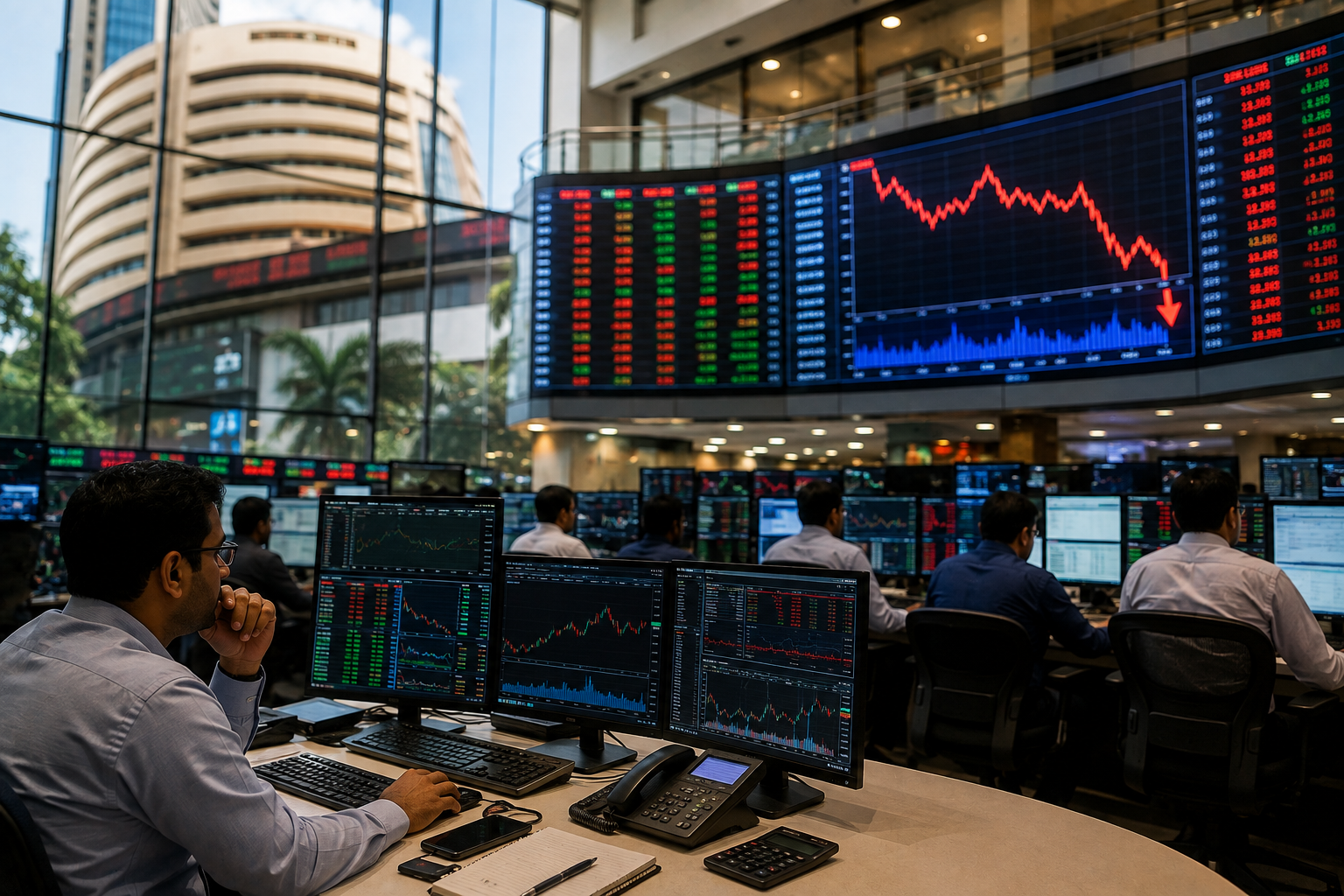
Record $4.2 Billion MSCI-Linked Trades Highlight Strength of New System, but Sharp Moves Raise Questions Over Market Makers and Two-Way Liquidity
India’s newly introduced stock-market closing auction is facing an important test as sharp price movements continue despite a substantial increase in trading activity.
The National Stock Exchange’s new 20-minute closing auction absorbed a record $4.2 billion of trades linked to MSCI index rebalancing on Monday. However, the surge in turnover did not completely eliminate the sharp price swings that have characterised the new mechanism since its launch.
Around 60 stocks ended the auction at their 3% price limits, while several heavily traded companies experienced significant reversals during the final 20 minutes.
The developments have shifted attention towards a critical question for India's market structure: Can the new closing auction provide efficient price discovery without deeper participation from professional market makers?
Market participants believe that the presence of market makers and proprietary trading firms could help absorb temporary imbalances between buyers and sellers and reduce excessive volatility during the closing period.
NSE’s New Closing Auction Comes Under the Spotlight
The NSE introduced its new closing mechanism on August 3.
Under the new system, investors submit buy and sell orders during a dedicated 20-minute auction window.
At the end of the auction, the exchange determines an equilibrium price based on the available buy and sell orders.
That price becomes the stock's official closing price.
The mechanism replaced the previous system, under which the closing price was determined using the volume-weighted average price of trades executed during the final 30 minutes of the regular trading session.
The objective of the new framework is to create a more structured and transparent process for determining the closing price.
However, the first few weeks have also revealed challenges related to liquidity and price volatility.
$4.2 Billion MSCI Rebalancing Trades Put System to the Test
Monday's trading session represented the biggest test of the new closing auction so far.
The mechanism processed approximately $4.2 billion of MSCI-linked trades associated with index rebalancing.
Turnover during the 20-minute auction was approximately 33 times the daily average recorded since the system's August 3 launch.
The exceptionally high turnover demonstrated that the mechanism can handle large institutional flows.
However, the simultaneous price swings showed that high turnover does not necessarily mean that the market has sufficient two-way liquidity.
Approximately 60 stocks finished the auction at their 3% price limits.
This has raised questions about how efficiently large buy and sell imbalances are being absorbed.
High Trading Volume Does Not Guarantee Deep Liquidity
One of the most important lessons from the new system is the difference between volume and liquidity.
Trading volume measures how much stock changes hands.
Liquidity measures how easily investors can buy or sell without significantly moving the price.
A market can therefore record extremely high turnover while remaining relatively illiquid if orders are heavily concentrated on one side.
For example:
Large selling pressure + limited buyers = sharp price decline
Large buying pressure + limited sellers = sharp price increase
This is particularly relevant during index rebalancing, when institutional investors may need to execute very large orders within a narrow time window.
Why Market Makers Could Become Critical
Market participants increasingly believe that market makers could help improve the functioning of the closing auction.
Market makers typically provide buy and sell quotes simultaneously.
Their role is to provide liquidity when natural demand and supply do not match perfectly.
Greater market-maker participation could potentially:
-
Increase order-book depth
-
Narrow bid-ask spreads
-
Absorb temporary order imbalances
-
Reduce abrupt price movements
-
Improve price discovery
-
Make large trades easier to execute
The presence of such participants could become particularly valuable during days involving large index rebalancing flows.
Proprietary Traders Could Help Fill the Liquidity Gap
Proprietary trading firms are another potentially important source of liquidity.
These firms trade using their own capital and frequently employ quantitative, arbitrage and market-making strategies.
They can help balance temporary differences between buying and selling interest.
However, market participants say many such firms have remained cautious about participating actively in the closing auction because of restrictions that make it difficult to short stocks and manage positions efficiently.
This limits their ability to provide liquidity on both sides of the market.
Why Short-Selling Flexibility Matters
A market maker needs to manage inventory risk.
Suppose a liquidity provider sells a large quantity of shares to buyers during the auction.
The market maker then needs the ability to manage the resulting short or reduced inventory position.
If regulatory restrictions make this difficult, the firm may be unwilling to provide aggressive quotes.
This can reduce the depth of the order book precisely when large institutional orders are entering the market.
Therefore, any future changes to the closing-auction framework may need to consider how professional liquidity providers can manage inventory while maintaining appropriate safeguards against market manipulation.
Nifty Bank Demonstrates the Extent of the Volatility
The Nifty Bank Index provided one of the clearest examples of the price swings.
The 14-stock index was heading for a third consecutive session of decline at the beginning of the closing auction, trading approximately 0.2% lower.
By the time the auction ended, however, the index had reversed and closed approximately 0.9% higher.
The move represents a substantial reversal within a very short period.
It illustrates how a concentration of buy and sell orders can influence the final benchmark price when liquidity is not sufficiently deep.
Reliance Industries Also Reverses During the Auction
Reliance Industries provided another example.
The stock was trading around 0.8% higher before the auction.
By the end of the closing window, it had reversed to approximately 0.8% lower.
Such a reversal is particularly significant because the auction price becomes the official closing price used for a range of market calculations.
Eternal Shows Why Even Highly Liquid Stocks Can Move
Eternal, one of India's highly liquid stocks based on free-float, also experienced a notable reversal.
The stock was down approximately 3% before the auction but ended the session broadly flat.
This indicates that the issue is not restricted to small-cap or relatively illiquid stocks.
Even highly traded companies can experience substantial price changes when large institutional orders enter a concentrated closing window.
Why the Official Closing Price Matters
The closing price is an important reference point across India's financial markets.
It is used for:
-
Portfolio valuation
-
Mutual fund NAV calculations
-
Index calculations
-
Derivative settlement
-
Margin requirements
-
Performance measurement
-
Institutional benchmarking
-
Risk management
Consequently, unusual volatility during the final auction can have effects beyond the stock's closing price itself.
Mutual Funds and Institutional Investors Are Directly Affected
Large institutional investors depend on accurate and reliable closing prices.
Mutual funds use end-of-day prices when calculating portfolio values and NAVs.
Similarly, portfolio managers use closing prices to measure performance against benchmarks.
If a temporary order imbalance pushes a stock sharply higher or lower during the auction, it can influence the valuation of portfolios holding that stock.
This makes the quality of closing-price discovery particularly important.
Index Rebalancing Can Amplify the Problem
Index rebalancing is one of the biggest challenges for any closing auction.
When a company enters or exits an index, passive funds and index-tracking portfolios may need to execute large transactions.
These trades are often concentrated around the closing price because fund managers want to minimise tracking differences against the benchmark.
As a result, index-rebalancing days can generate exceptionally large order flows.
Monday's $4.2 billion MSCI-linked activity provided an extreme example.
The new auction was able to process the volume, but the price swings demonstrated the importance of having enough liquidity to absorb the orders efficiently.
Why the New System Was Introduced
The previous closing mechanism relied on trades executed during the final 30 minutes of continuous trading.
The new auction model instead concentrates orders into a dedicated window and determines a single equilibrium price.
Potential advantages include:
More Structured Price Discovery
A large number of buy and sell orders can be matched through a defined mechanism.
Greater Transparency
Participants know when the closing auction begins and how the final price is determined.
Better Institutional Execution
Large investors can use the auction to execute benchmark-sensitive trades.
Reduced Influence of Individual Trades
A single late trade is less likely to determine the official closing price.
Improved Benchmarking Potential
A standardised auction process could eventually provide a more consistent reference price.
But Liquidity Remains the Core Challenge
The effectiveness of an auction ultimately depends on the depth and quality of orders entering the system.
If there are many buyers and sellers, the equilibrium price can be relatively stable.
If one side dominates, the equilibrium price can move sharply.
This is why market participants are increasingly focusing on two-way liquidity rather than simply total turnover.
The First Month Provides Valuable Market Data
The closing mechanism is still relatively new.
Since its launch on August 3, market participants have been able to observe how investors respond to the new system.
The initial period provides useful information about:
-
Auction participation
-
Order concentration
-
Institutional behaviour
-
Price reversals
-
Liquidity depth
-
Market-maker participation
-
Arbitrage activity
-
Price-limit behaviour
The experience could eventually help exchanges and regulators refine the framework.
Large Institutional Orders Are Becoming More Important
India's equity market has experienced significant growth in institutional participation.
Domestic mutual funds, insurance companies, foreign portfolio investors, passive funds and ETFs have increasingly become important sources of market liquidity.
At the same time, global index providers such as MSCI can generate substantial trading flows when index constituents or weightings change.
A closing mechanism must therefore be capable of handling large institutional orders without allowing temporary imbalances to create excessive price distortions.
What the New System Means for Retail Investors
Retail investors may not be responsible for most of the large closing-auction flows, but they can still be affected by the outcome.
The final closing price can influence:
-
Portfolio valuation
-
Next-day reference prices
-
Mutual fund NAVs
-
Derivative settlement values
-
Mark-to-market calculations
-
Technical chart levels
A stock that is trading at one price immediately before the auction may therefore close at a substantially different level.
Retail Traders Should Avoid Blindly Extrapolating Pre-Auction Trends
The new mechanism means that the direction of a stock before the auction may not accurately predict the final closing price.
A stock trading higher before the auction can reverse if large sell orders enter the system.
Similarly, a stock trading lower can recover if institutional buying dominates the auction.
Traders should therefore pay particular attention to closing-auction activity rather than relying solely on the pre-auction trend.
Large-Cap Stocks Are Also Vulnerable
The examples involving Reliance Industries, Eternal and Adani Enterprises show that the issue is not confined to smaller companies.
Large-cap stocks normally have deep order books and high trading volumes.
However, exceptionally large institutional orders can still overwhelm available liquidity during a concentrated auction window.
This means the effectiveness of the mechanism is important for the entire market.
Potential Role of Market Makers
A well-designed market-making framework could potentially reduce some of the observed volatility.
Professional market makers could provide:
Buy orders when selling pressure is excessive
Sell orders when buying pressure is excessive
This could help smooth temporary imbalances.
However, market makers also need adequate tools to manage their risk.
Any policy changes would therefore need to balance:
Liquidity + market integrity + investor protection
What Could Improve the Closing Auction?
Several areas could be considered as the mechanism evolves.
Greater Market-Maker Participation
Allowing qualified market makers to participate more efficiently could deepen liquidity.
Review of Trading Restrictions
Regulators could assess whether existing short-selling and position-management rules create unintended barriers to liquidity provision.
Better Monitoring of Price Swings
Exchanges could track the frequency and magnitude of pre-auction-to-closing price changes.
Greater Analysis of Rebalancing Days
Large index-rebalancing events can provide valuable stress tests for the mechanism.
Continuous Review
The framework could be refined based on empirical data gathered during the first several months.
What Regulators Need to Balance
Any changes should avoid creating an environment where market makers themselves become a source of excessive volatility.
The objective should not simply be to increase the number of trades.
Instead, the goal should be to create:
-
Deeper liquidity
-
Fairer price discovery
-
Lower transaction costs
-
Better institutional execution
-
Greater confidence in the closing price
The regulatory framework therefore needs to encourage liquidity while maintaining strong surveillance.
Key Numbers From the New Closing System
| Indicator | Latest Data |
|---|---|
| MSCI-linked trades | $4.2 billion |
| Auction duration | 20 minutes |
| Turnover vs daily average | ~33x |
| Stocks at 3% price limits | ~60 |
| System launch | August 3 |
| Nifty Bank before auction | -0.2% |
| Nifty Bank after auction | +0.9% |
| Reliance before auction | +0.8% |
| Reliance at close | -0.8% |
What Investors Should Monitor
As the system matures, investors should track whether the volatility observed during the initial period begins to decline.
Important indicators include:
Closing-Auction Turnover
Is activity becoming more evenly distributed?
Bid-Ask Spreads
Are spreads narrowing as liquidity improves?
Price Reversals
Are fewer stocks experiencing major pre-auction-to-close reversals?
Price-Limit Hits
Is the number of stocks reaching the 3% limits falling?
Market-Maker Participation
Are more professional liquidity providers entering the auction?
Institutional Flows
How are large index-rebalancing trades affecting individual stocks?
Closing-Price Stability
Does the auction produce increasingly stable and representative closing prices?
A Successful Auction Could Benefit India’s Market Infrastructure
If the liquidity challenge is resolved, the new closing auction could ultimately become a significant improvement in India's market structure.
A robust closing mechanism would be particularly valuable as:
-
Foreign institutional participation grows
-
Passive investing expands
-
Index-linked assets increase
-
Domestic mutual fund assets grow
-
Algorithmic trading becomes more widespread
-
Institutional order sizes increase
The ability to efficiently determine a reliable closing price will become increasingly important as India's capital markets deepen.
The Bigger Issue Is Not Volume — It Is Quality of Liquidity
The latest experience provides a broader lesson for India's equity market.
The fact that the NSE could process $4.2 billion of MSCI-related trades demonstrates considerable capacity.
But the simultaneous price swings show that processing orders is not the same as efficiently absorbing them.
The real test is whether large orders can be executed without excessive price distortion.
That requires sufficient liquidity on both sides of the market.
Market Outlook
India's new closing auction has passed an important early stress test by successfully absorbing approximately $4.2 billion of MSCI-linked trades, but the resulting price swings show that the mechanism still faces a significant liquidity challenge.
The fact that turnover during the 20-minute window reached around 33 times the daily average, while approximately 60 stocks ended at their 3% price limits, suggests that the primary issue is not the system's capacity to process orders.
The bigger issue is two-way liquidity.
The sharp reversal in the Nifty Bank from around -0.2% before the auction to +0.9% at the close, along with the reversal in Reliance Industries from approximately +0.8% to -0.8%, demonstrates how concentrated institutional flows can influence closing prices within a short period.
The potential solution increasingly points towards greater participation from professional market makers and proprietary trading firms.
If these participants can provide liquidity on both sides of the order book while being given sufficient tools to manage inventory risk, the closing auction could become more stable and efficient.
For investors, the immediate implication is that the final 20 minutes of trading deserve greater attention, particularly on index-rebalancing days and sessions involving large institutional flows.
The system is still in its early stages, and some volatility should be expected while market participants adapt. However, a sustained reduction in price reversals, price-limit hits and closing-price distortions would be a positive sign that the mechanism is maturing.
Overall, the new auction has the potential to strengthen India's market infrastructure and improve institutional price discovery. Its long-term success, however, will depend not merely on the volume it can process, but on whether it can attract enough deep, two-way liquidity to ensure that the official closing price remains an efficient representation of market demand and supply.