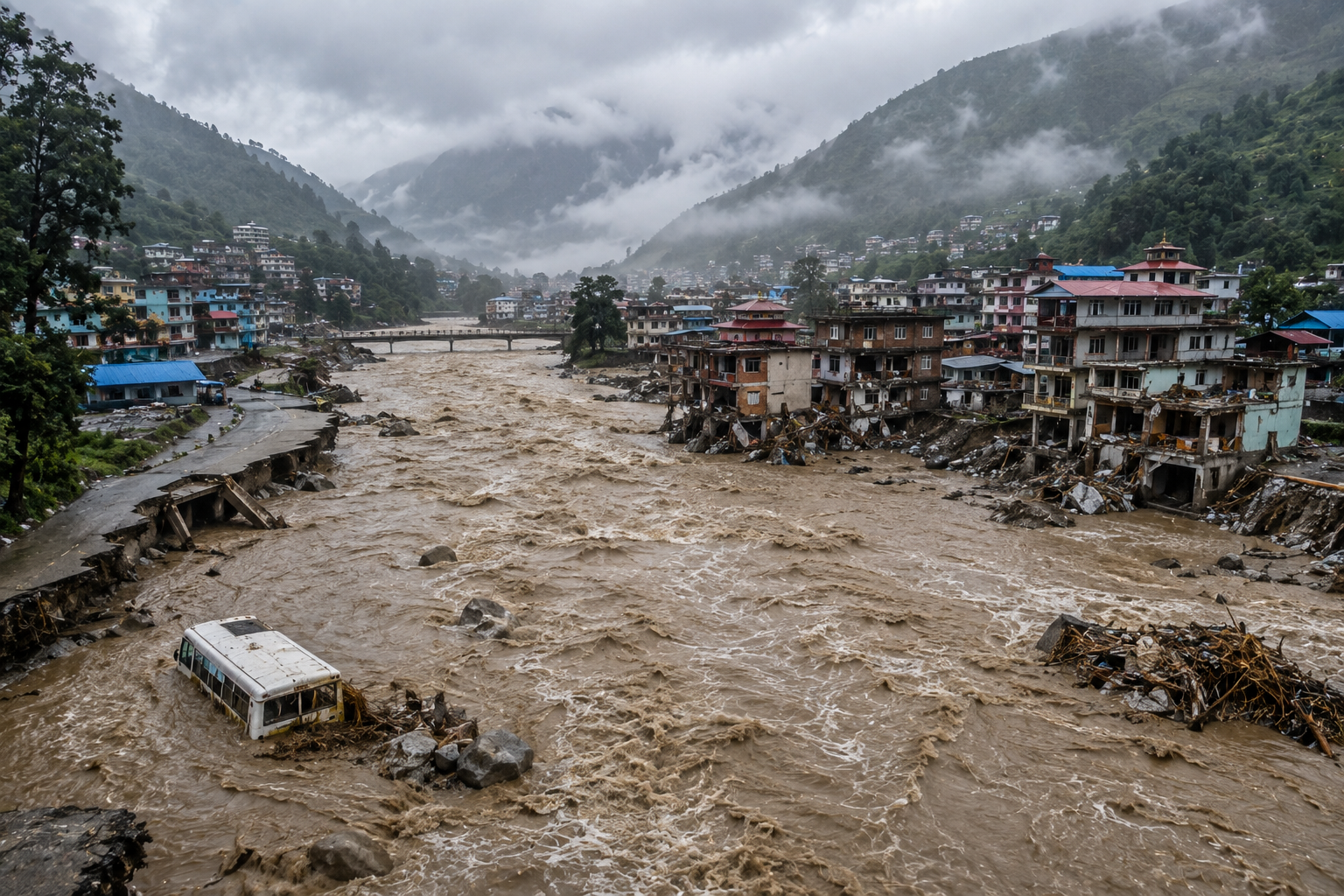
Nepal Faces One of Its Worst Flood Disasters as Rescue Operations Intensify
Nepal is facing a massive humanitarian crisis after devastating flash floods and landslides swept through several parts of the country, with the death toll rising to 903 and more than 4,200 people still missing.
According to the National Disaster Risk Reduction and Management Authority (NDRRMA), around 9,500 people have been rescued so far. However, rescue operations remain challenging as teams continue searching through damaged infrastructure, river channels, hydropower facilities and debris-covered areas.
The disaster began after an ice-and-rock collapse or avalanche near the Nepal-Tibet border on August 26, triggering powerful flows of water, mud and debris downstream.
The Bhotekoshi River and other connected waterways carried the floodwaters through towns and villages, causing extensive destruction to homes, roads, bridges and hydropower facilities.
More Than 4,200 People Remain Missing
The NDRRMA has reported 4,247 missing people, including 85 security personnel and 320 foreign nationals.
The number of missing people remains a major concern for authorities because many are believed to have been working at hydropower projects located in areas severely affected by the floods.
Rescue teams are continuing to search for people who may have survived inside tunnels, buildings and other structures.
The difficult terrain and damaged transportation network are slowing access to some of the worst-affected locations.
Nearly 10,000 People Rescued So Far
Despite the scale of the disaster, rescue teams have managed to bring approximately 9,500 people to safety.
Search and rescue operations are being conducted by Nepalese authorities with assistance from neighbouring countries.
Teams from India and China are involved in efforts to reach isolated communities and hydropower facilities.
The operation is particularly difficult because floodwaters have damaged access roads and bridges, while unstable slopes continue to create additional risks for rescue personnel.
Chitwan Records Highest Number of Recovered Bodies
The recovery of victims has continued across several districts.
According to NDRRMA figures, the number of recovered bodies includes:
-
Chitwan — 272
-
Nawalparasi East — 207
-
Nawalparasi West — 151
-
Nuwakot — 95
-
Gorkha — 62
-
Dhading — 55
-
Tanahu — 37
-
Rasuwa — 24
The wide geographical distribution of recovered bodies shows how far the floodwaters travelled after the initial disaster.
Search teams are continuing operations along rivers and in areas covered by mud, rocks and other debris.
Hydropower Workers Among Those Still Missing
Hydropower projects have emerged as some of the most challenging locations for rescue teams.
Several projects are situated along river valleys that were directly affected by the sudden surge of water and debris.
Hundreds of workers are believed to remain missing at various hydropower facilities.
The Trishuli-3A hydropower project is among the sites where rescue operations are being intensified.
Flooded tunnels and damaged access infrastructure have made it difficult for rescue crews to determine how many people may be trapped and whether sections of the facilities remain accessible.
India and China Join Rescue Operations
The scale of the emergency has resulted in international assistance.
Rescue personnel from India and China are helping Nepalese teams with search-and-rescue operations.
The participation of both countries is particularly important because the disaster originated in the Himalayan region close to the Nepal-China border and subsequently affected downstream areas.
The crisis has also highlighted the importance of regional cooperation in disaster management, particularly for countries sharing mountain ranges and river systems.
Bhotekoshi River Remains Under Close Watch
Authorities continue to monitor the Bhotekoshi River because water levels have shown signs of rising again.
The NDRRMA warned residents and rescue personnel in affected districts to remain cautious after observing an increase in the river's water level.
The renewed warning is significant because flood-affected mountain valleys remain vulnerable to secondary events.
Additional rainfall, unstable slopes, debris blockages and sudden releases of accumulated water could result in further changes in river levels.
Bihar Placed on High Alert
The disaster has also raised concerns downstream in India.
Bihar has been placed on high alert as authorities monitor the possibility of rising water levels in the Gandak River.
The Bihar government has instructed districts located along the river to remain vigilant.
The districts under heightened monitoring include:
-
West Champaran
-
East Champaran
-
Gopalganj
-
Saran
-
Muzaffarpur
-
Vaishali
Authorities are monitoring the river closely and preparing for possible flooding in vulnerable areas.
Gandak River Connects Nepal's Flood Risk With India
The Gandak River originates in the Himalayan region and flows through Nepal before entering India.
This means that major changes in upstream water flows can affect downstream communities across the border.
The latest situation illustrates how natural disasters in the Himalayan region can have consequences far beyond the location where the initial event occurs.
For Bihar, continued monitoring of river levels will remain important as floodwaters move through the interconnected river system.
Uttar Pradesh Also Reports Recovery of Bodies
The impact has also reached parts of Uttar Pradesh.
Officials in Kushinagar district recovered four additional bodies from the Gandak River on Sunday.
The bodies were believed to have drifted into Indian territory from Nepal.
Officials said a total of 13 bodies had been recovered in Kushinagar over four days.
The recovery operation demonstrates the downstream impact of the disaster and the difficulty of identifying and tracing victims after they are carried away by powerful river currents.
Mass Burials Conducted for Unidentified Victims
The humanitarian crisis has also created a major challenge involving unidentified victims.
In Nepal's Chitwan district, authorities have been conducting mass burials for bodies that have not yet been identified.
Hundreds of graves have been prepared in the Devghat forest.
Authorities buried 96 unidentified bodies on Saturday and planned to bury more than 100 additional victims as recovery operations continued.
The process has been undertaken while authorities attempt to preserve information that could help families identify missing relatives.
DNA Samples Being Preserved
Nepalese authorities are collecting DNA samples from unidentified bodies before burial.
This could allow the remains to be identified at a later stage through genetic testing, family claims or official records.
The approach is particularly important in a disaster where victims may have been carried far away from their original locations.
Preserving DNA evidence provides authorities with a mechanism to potentially reunite unidentified victims with their families even after burial.
Roads and Bridges Suffer Extensive Damage
The flood has caused major damage to Nepal's transportation infrastructure.
Roads and bridges located along affected rivers were swept away or damaged by the force of water, mud and large rocks.
This has created a secondary challenge for rescue teams because damaged infrastructure makes it difficult to transport personnel, equipment, food and medical supplies.
The disruption is also affecting local communities that depend on roads and bridges for access to markets, hospitals, schools and other essential services.
Power Generation Capacity Hit
Nepal's power infrastructure has also suffered significant damage.
Several hydropower facilities and associated infrastructure were affected by the floods.
Earlier assessments indicated that the disaster had knocked out more than 10% of Nepal's power-generation capacity.
The loss of generating capacity could have implications for households, businesses and industrial activity.
Restoring damaged hydropower facilities is therefore likely to become an important part of the country's reconstruction programme.
Economic Impact Extends Beyond the Humanitarian Crisis
The financial consequences of the disaster could be significant.
Nepal will have to spend substantial resources on:
-
Emergency relief
-
Search-and-rescue operations
-
Road reconstruction
-
Bridge repairs
-
Hydropower restoration
-
Rehabilitation of affected communities
-
Temporary housing
-
Medical assistance
-
Restoration of communications
-
Reconstruction of damaged public infrastructure
The economic impact could also extend to tourism, transportation, local businesses and agriculture in affected areas.
Infrastructure Reconstruction Could Take Time
Mountain infrastructure is particularly expensive and difficult to rebuild.
Roads and bridges often pass through steep terrain and require specialised engineering.
When these structures are destroyed by floods and landslides, rebuilding can take considerably longer than repairs in flat terrain.
The government will therefore face the dual challenge of restoring connectivity while ensuring that reconstructed infrastructure is better prepared for future extreme-weather events.
Glacier Collapse Raises Climate Concerns
The disaster has intensified concerns over the changing Himalayan environment.
The initial event involved an ice-and-rock collapse or avalanche, demonstrating the potential danger posed by unstable glaciers and mountain slopes.
The Hindu Kush Himalayas contain thousands of glaciers that feed major river systems across South Asia.
Changes in temperature, snowfall and rainfall patterns can alter the stability of these environments.
Climate Change Could Increase Disaster Risks
Scientists have increasingly warned that climate change is affecting glaciers and snow cover across the Himalayan region.
Glacier retreat can contribute to the formation and expansion of glacial lakes.
Heavy rainfall can then increase the risk of landslides, flash floods and glacial-lake outburst events.
The combination of these hazards makes early detection increasingly important for countries such as Nepal, India, Bhutan and China.
Nepal Had Sought More Glacier-Risk Data From China
The latest disaster has also brought renewed attention to Nepal's earlier discussions with China regarding glacier monitoring.
Officials from Nepal and China met in Kathmandu on May 27 to discuss cooperation on floods, weather and glacier-related hazards.
Nepal had sought greater access to information regarding glacier movements, water levels, avalanches and landslides.
Officials discussed measures including glacial-lake inventories and hazard mapping.
However, Nepali officials later said that information sharing remained more limited than they had hoped.
China Says It Shared Important Information
China has rejected suggestions that it failed to provide adequate information.
The Chinese embassy in Nepal said the two countries had remained in close contact and had made substantial progress on cross-border disaster information sharing.
China also said that Chinese and international experts faced significant challenges when monitoring remote Himalayan terrain.
Chinese authorities had shared heavy-rain forecasts with Nepal, including a warning about enhanced rainfall and potential secondary hazards before the latest disaster.
Real-Time Monitoring Could Become a Priority
Nepal is now seeking stronger and more frequent cross-border information sharing.
Officials have discussed the possibility of receiving information on precipitation and river levels at intervals of approximately 10 minutes.
Such a system could potentially give authorities more time to assess rapidly developing events and warn downstream communities.
However, effective early-warning systems require more than data.
Monitoring stations must remain operational, communications networks must function during disasters and authorities must be able to issue and act on warnings quickly.
Early-Warning Infrastructure Faces Its Own Risks
The latest disaster showed that monitoring systems themselves can be vulnerable.
At least several monitoring stations were damaged or destroyed by the flood.
When sensors stop transmitting data during an extreme event, authorities can lose visibility precisely when information is most critical.
Future systems may therefore need redundancy, satellite connectivity and multiple independent monitoring points to ensure that the loss of one station does not create a complete information gap.
Need for Better Regional Disaster Cooperation
The disaster has highlighted the interconnected nature of the Himalayan region.
Water originating in the mountains can move across borders, while infrastructure and communities downstream can be affected by events occurring hundreds of kilometres away.
Greater cooperation between Nepal, China and India could help improve:
-
Glacier monitoring
-
River-level tracking
-
Weather forecasting
-
Emergency communications
-
Hydropower safety
-
Flood forecasting
-
Evacuation planning
-
Search-and-rescue coordination
Such cooperation could become increasingly important as climate-related risks grow.
Rebuilding Must Account for Future Climate Risks
Reconstruction after the floods will provide Nepal with an opportunity to strengthen infrastructure rather than simply restore what was damaged.
New bridges and roads could be designed with greater flood resilience.
Hydropower projects could incorporate improved emergency procedures and monitoring systems.
Communications networks could be designed with backup systems so that warnings remain operational even if physical infrastructure is damaged.
The cost of such upgrades may be higher initially, but stronger resilience could reduce future economic losses.
Humanitarian Response Remains the Immediate Priority
Despite the focus on long-term reconstruction, the immediate priority remains locating missing people and providing assistance to survivors.
Thousands of families are waiting for information about relatives.
Rescue teams are continuing to search rivers, tunnels, damaged buildings and debris fields.
Medical assistance, temporary shelter, food supplies and transportation will also remain critical as affected communities begin to recover.
Nepal Disaster Has Regional Implications
The scale of the disaster means its consequences will not be limited to Nepal.
India is already monitoring downstream water levels in Bihar and recovering victims carried into Uttar Pradesh.
China is dealing with casualties and missing people on the Tibetan side of the border.
The event therefore demonstrates the need for regional disaster-response mechanisms capable of operating across political boundaries.
Long-Term Investment in Resilience Could Increase
The disaster is likely to increase the need for investment in climate-resilient infrastructure across the Himalayan region.
Potential areas of increased investment include:
-
Flood-resistant roads and bridges
-
Hydropower safety systems
-
Glacier-monitoring technology
-
Satellite-based weather observation
-
Automated river gauges
-
Emergency communication networks
-
Disaster-response equipment
-
Climate-risk mapping
-
Early-warning platforms
-
Resilient electricity infrastructure
Companies and institutions involved in these areas could potentially see increased demand as governments strengthen their disaster-preparedness programmes.
Market Outlook
The Nepal floods are likely to accelerate government and institutional focus on climate-resilient infrastructure, hydropower safety, early-warning systems, satellite monitoring, river-management technology and disaster-response infrastructure across the Himalayan region. In the immediate term, attention will remain on rescue operations, missing people, downstream flood risks in Bihar and Uttar Pradesh, and restoration of damaged power and transportation networks. Over the medium term, reconstruction spending could increase demand for roads, bridges, hydropower rehabilitation and emergency infrastructure. The proposed 10-minute cross-border data-sharing framework could also encourage greater investment in real-time glacier, rainfall and river monitoring systems. However, the pace of reconstruction and future investment will depend on government funding, international assistance, infrastructure damage assessments and the evolving flood and weather situation.
:::