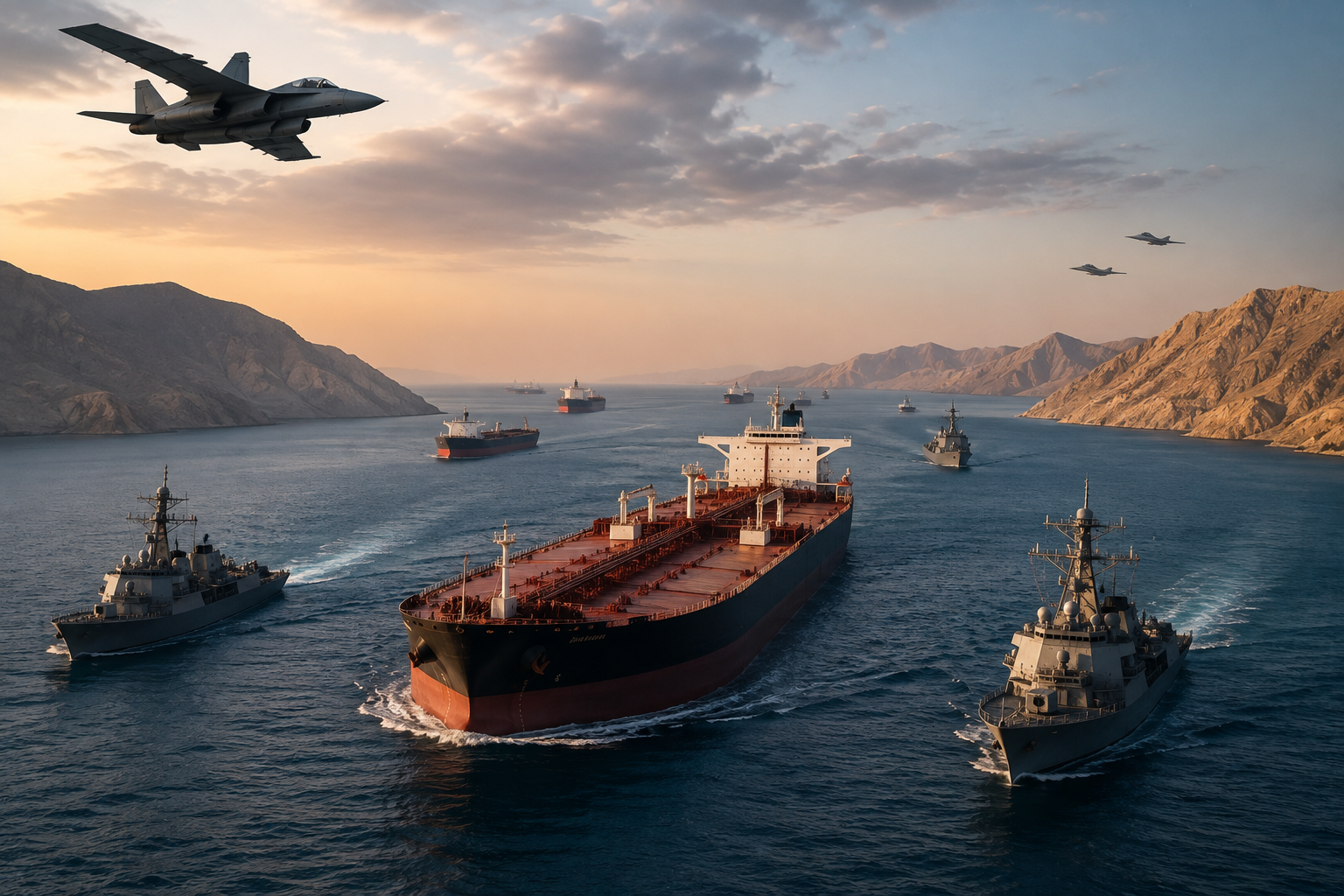
A discreet US-backed shipping corridor is reportedly moving millions of barrels of crude through the Strait of Hormuz, offering temporary relief to global oil markets while highlighting the continuing geopolitical risks surrounding the key energy chokepoint
The United States military has reportedly established a discreet shipping corridor through the Strait of Hormuz to facilitate the movement of crude oil amid continuing disruptions caused by the US-Iran conflict. According to a report by Axios, the operation has enabled millions of barrels of oil to move through the strategic waterway each day, helping reconnect Gulf oil producers with international markets.
The development could provide some relief to global energy markets, but it also underlines the fragile nature of oil supplies passing through one of the world's most important maritime chokepoints. Any renewed escalation in the region could quickly disrupt tanker movements, push up freight and insurance costs and trigger another sharp move in international crude prices.
US-backed corridor reportedly moves millions of barrels of oil
The reported operation has been running for several weeks and involves organised tanker movements through a southern channel along the coast of Oman. Around 15–20 tankers are reportedly entering or leaving the Strait of Hormuz each night under US military guidance.
According to the report, average oil flows through the corridor have reached around 10 million barrels per day, equivalent to roughly half of the pre-war volume. On some days, shipments have reportedly climbed as high as 15–20 million barrels.
The operation is not limited to escorting loaded tankers. Empty vessels are also being coordinated for inbound journeys through the strait so that they can reach Gulf ports, load crude and return to international waters.
How the reported tanker operation works
The US-led arrangement reportedly involves scheduled inbound and outbound convoys. Tankers are grouped into designated movements, with separate time windows for ships travelling in each direction.
The vessels then pass through the southern channel based on guidance from US military authorities. The report also said that US Air Force fighter aircraft are being used to provide protection against potential missile and drone threats.
The coordination reportedly involves a US task force working with regional Gulf partners. A daily list of vessels moving out of the Gulf and empty tankers heading toward Gulf ports is prepared as part of the operation.
Such coordination could help reduce uncertainty for shipping companies and oil traders, although the security risks associated with the route remain significant.
Why the Strait of Hormuz matters to global oil markets
The Strait of Hormuz is among the world's most strategically important oil chokepoints. A significant share of globally traded crude and petroleum products normally passes through the narrow waterway, making uninterrupted shipping through the region critical for major Asian energy-consuming economies.
Any prolonged disruption can have consequences well beyond the Middle East. Lower physical availability of crude can push benchmark prices higher, while tanker rates, insurance premiums and delivery costs can also rise sharply.
For countries that rely heavily on imported crude, higher oil prices can translate into increased fuel costs, inflationary pressure and a wider import bill.
India is particularly sensitive to movements in global crude prices because of its large dependence on imported oil. A sustained rise in crude can affect the country's trade balance, the rupee, inflation expectations and the profitability of oil-consuming industries.
US military campaign reportedly helped create the corridor
The reported shipping corridor appears to have become possible after a recent US Central Command military campaign that reportedly weakened Iran's radar and maritime surveillance capabilities.
The reduction in surveillance and potential threats may have made it easier for vessels to operate through selected parts of the waterway under military protection.
However, the situation remains fluid. The possibility of missile, drone or other attacks means that shipping companies still face substantial operational and security risks.
The continued military presence may therefore provide a degree of stability for oil shipments, but it does not eliminate the underlying geopolitical threat.
Trump steps up pressure on Iran
The development comes against the backdrop of an increasingly confrontational US stance towards Iran.
US President Donald Trump has warned that countries, financial institutions and businesses providing economic or commercial support to Tehran could face severe consequences.
Trump has also described the US campaign against Iran in highly aggressive terms and indicated that Washington is prepared to intensify economic pressure if Tehran does not agree to its demands.
The escalation has added another layer of uncertainty to global energy markets because any expansion of the conflict could threaten shipping infrastructure and crude production facilities across the wider Gulf region.
Hormuz remains a major geopolitical flashpoint
The Strait of Hormuz has repeatedly emerged as a central point of tension since the outbreak of the US-Iran conflict.
While the US has maintained that the waterway remains open, Iran has disputed that assessment and has maintained that shipping through the strait remains effectively restricted.
The conflicting positions have created uncertainty for ship operators, oil traders and energy-importing nations.
Even when physical shipments continue, perceived security risks can be enough to increase oil prices because traders tend to price in the possibility of future supply disruptions.
Temporary relief does not remove long-term supply risks
The reported movement of around 10 million barrels of oil a day through the corridor could provide important short-term relief to global markets. However, it remains well below normal flows, suggesting that the international energy market has not returned to a fully stable operating environment.
The biggest risk for crude prices remains the possibility of another disruption.
A significant attack on tankers, a closure of the southern channel, damage to Gulf energy infrastructure or a broader military escalation could rapidly reduce available supplies and trigger another surge in oil prices.
Conversely, a sustained improvement in security and a gradual restoration of normal tanker traffic could ease supply concerns and reduce the geopolitical premium currently embedded in crude prices.
Impact on India and Indian markets
For India, developments around the Strait of Hormuz remain particularly important because crude oil represents one of the country's largest import requirements.
A sharp increase in global oil prices could put pressure on India's import bill and the rupee while potentially complicating the inflation outlook. Airlines, logistics companies, chemicals, paints, tyres and other energy-intensive industries could face higher input costs if the increase in crude prices persists.
On the other hand, companies with relatively lower fuel sensitivity could remain more insulated. Oil marketing companies may also see mixed effects depending on crude procurement costs, retail pricing and government policy.
The rupee could become another important transmission channel. Higher crude prices generally increase demand for US dollars to finance imports, potentially putting pressure on the Indian currency.
For investors, therefore, movements in Brent crude, tanker traffic through Hormuz and developments in US-Iran relations could remain important indicators for Indian equities.
What investors should watch next
Investors should closely monitor five key developments in the coming sessions:
1. Strait of Hormuz tanker traffic: A sustained increase in shipments would indicate improving supply conditions, while another decline could revive crude-price concerns.
2. Brent and WTI crude prices: Oil remains the most immediate market indicator of geopolitical stress in the Gulf.
3. US-Iran negotiations: Any diplomatic breakthrough could reduce the geopolitical risk premium, while further escalation could have the opposite effect.
4. Rupee movement: A sustained rise in crude prices could increase pressure on the Indian currency.
5. Sector-wise impact: Aviation, paints, chemicals, logistics and other fuel-sensitive sectors could remain vulnerable to higher energy costs, while some upstream energy companies could benefit from elevated crude prices.
Market Outlook
The reported US-backed shipping corridor provides a temporary safety valve for global oil markets, but it does not eliminate the underlying geopolitical risk surrounding the Strait of Hormuz. The movement of millions of barrels of crude through the waterway should help prevent an immediate supply shock, provided the corridor continues to operate without major disruption.
For Indian investors, crude oil will remain a critical variable. A stable or declining oil price would be supportive for the rupee, inflation-sensitive sectors and the broader market, while a fresh surge in crude could increase volatility and pressure oil-import-dependent businesses.
The immediate focus should therefore remain on Brent crude, tanker flows through Hormuz, US-Iran developments and the rupee. Until there is greater clarity on the durability of the shipping corridor and the broader geopolitical situation, investors may need to factor in elevated volatility across energy, currency and equity markets.