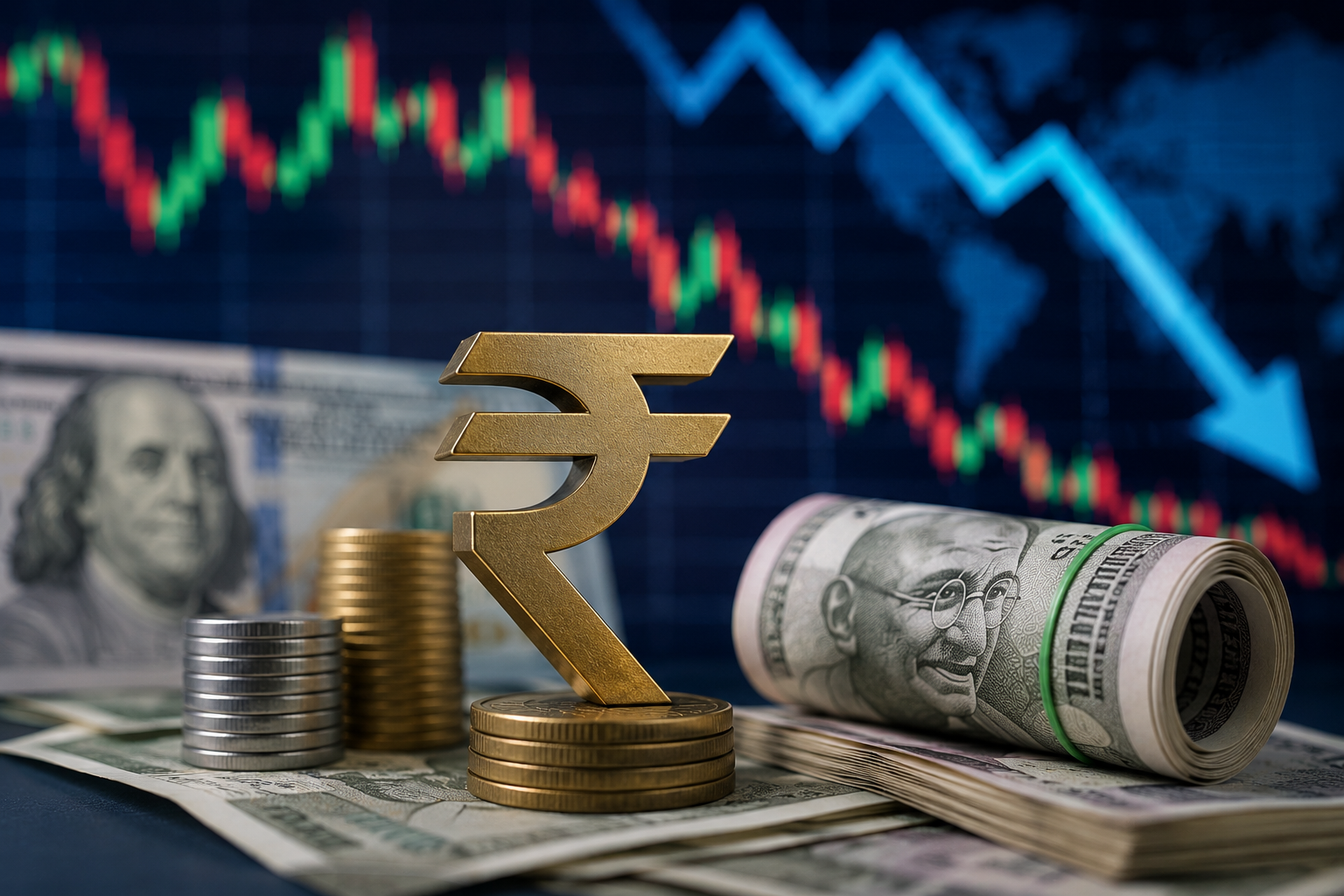
Indian currency strengthens in early trade after US Treasury announces higher buybacks of longer-dated bonds, pushing US yields lower; Brent crude above $90 remains a key concern for the rupee
The Indian rupee gained 17 paise against the US dollar in early trade on Thursday, August 20, as a weaker greenback and softer US long-term bond yields provided some relief to the domestic currency. The rupee opened at 95.57 against the US dollar and strengthened further to 95.56, compared with Wednesday's close of 95.73.
The recovery came after the US Treasury announced plans to increase its buyback operations for longer-dated Treasury securities. The move pushed US long-term yields lower and reduced the yield advantage of dollar assets, putting pressure on the greenback.
However, the rupee's gains remained constrained by elevated crude oil prices. Brent crude was trading above $90 per barrel, keeping concerns over India's import bill and external-sector pressures alive.
Rupee Extends Recovery After Flat Previous Session
The latest appreciation follows a largely stable session for the Indian currency on Wednesday.
The rupee had ended just 1 paisa higher at 95.73 against the US dollar in the previous session, reflecting the continued lack of a strong directional trend in the currency market.
Thursday's 17-paise gain therefore represents a sharper improvement, although traders remain cautious about interpreting the move as the beginning of a sustained recovery.
The currency continues to operate in an environment shaped by elevated oil prices, global monetary-policy uncertainty, foreign portfolio flows and movements in US Treasury yields.
US Treasury Buyback Announcement Weakens Dollar
The major trigger for the rupee's early gains was the US Treasury's announcement that it would increase purchases of longer-dated government bonds.
The Treasury plans to at least double the amount it buys back in longer-term government securities from $2 billion to $4 billion per operation, with the increased operations scheduled to begin from September 9.
The announcement pushed long-term US Treasury yields lower.
Lower yields can reduce the attractiveness of dollar-denominated assets for global investors, particularly when investors expect returns from US fixed-income securities to moderate.
This decline in the dollar's yield advantage helped emerging-market currencies, including the rupee, during early Asian trading.
Dollar Index Falls to Lowest Level Since Late May
The US dollar index also came under pressure following the Treasury announcement.
The index, which measures the value of the US dollar against a basket of six major currencies, was trading at 98.82, down 0.01 per cent during early trade.
Forex traders said the dollar index had fallen to its lowest level since late May.
A weaker dollar generally provides temporary relief to emerging-market currencies because it reduces pressure on countries that need dollars to pay for imports and service foreign-currency liabilities.
For India, this is particularly relevant because the country remains a major importer of crude oil.
Fed Policy Expectations Remain Important
Expectations surrounding the Federal Reserve's future monetary-policy path are another major influence on the dollar.
Markets have reduced expectations of further Fed tightening, although minutes from the July meeting showed that policymakers continued to have concerns over inflation.
This creates a complicated backdrop for the dollar.
On one hand, persistent inflation concerns could keep US monetary policy relatively restrictive. On the other, expectations of lower or stable interest rates can reduce the appeal of dollar assets and push US yields lower.
The rupee could therefore remain sensitive to every major US economic data release and communication from Federal Reserve officials.
Crude Oil Above $90 Caps Rupee Gains
The biggest domestic challenge for the rupee continues to come from crude oil.
Brent crude, the global benchmark, was trading 0.32 per cent higher at $91.91 per barrel in futures trade during early Asian hours.
For an oil-importing economy such as India, sustained crude prices above $90 can have significant implications.
Higher crude prices increase the country's import bill, raise demand for dollars from oil companies and can widen external-sector pressures. If the increase persists, it can offset the benefits of a weaker dollar.
This is why currency analysts continue to view oil as an important counterweight to the rupee's current recovery.
Why Oil Prices Matter So Much for the Rupee
India imports a substantial portion of its crude oil requirements. When international crude prices rise, Indian refiners and other importers need more dollars to pay for their purchases.
This creates additional demand for the US currency and can weaken the rupee.
Conversely, a sustained decline in oil prices can reduce India's import bill and ease pressure on the domestic currency.
The current situation is therefore mixed: the dollar is weakening, which is positive for the rupee, but crude oil remains expensive, limiting the currency's upside.
Key USD/INR Levels in Focus
Market participants are closely monitoring the 95.30-95.50 area as an immediate support zone for the rupee.
If the currency remains above this range, the USD/INR pair could gradually move towards 96.20-96.50, according to market commentary.
However, currency traders should watch the levels in conjunction with crude oil and global dollar movements rather than treating them as standalone signals.
A sharp rise in oil prices or renewed dollar strength could quickly alter the near-term setup.
FII Flows Provide Additional Support
Foreign portfolio flows are another important variable for the rupee.
Foreign institutional investors bought Indian equities worth ₹407.99 crore on a net basis on Wednesday, according to exchange data.
Although a single day's inflow is not enough to establish a trend, sustained foreign buying can provide support to the rupee.
When overseas investors purchase Indian equities, they typically need to convert foreign currency into rupees, creating demand for the domestic currency.
On the other hand, persistent foreign selling can increase dollar demand and place additional pressure on the rupee.
Indian Equity Markets Open Strong
The rupee's appreciation coincided with a positive opening in the domestic equity market.
The Sensex jumped 504.32 points to 77,416.16 in early trade, while the Nifty50 gained 118.85 points to 24,198.55.
The improvement in equity-market sentiment is another supportive factor for the rupee because stronger domestic equities can encourage foreign portfolio participation.
The relationship, however, is not always one-directional. Global risk appetite, interest-rate expectations and commodity prices can simultaneously influence both the currency and equity markets.
Impact on Indian Companies
Currency movements have different implications for different sectors of the Indian economy.
A stronger rupee can benefit companies that depend heavily on imported raw materials, equipment or other inputs because their dollar-denominated costs become relatively cheaper in rupee terms.
Import-heavy industries can therefore experience some margin relief when the domestic currency strengthens.
However, the opposite can be true for exporters.
Companies generating a large portion of their revenue in US dollars may see the rupee value of their overseas earnings decline when the domestic currency appreciates.
IT and Pharma Stocks Could See Currency Impact
Information technology companies and pharmaceutical exporters are among the sectors that can be particularly sensitive to rupee movements because of their significant overseas revenue exposure.
A weaker rupee generally increases the rupee value of dollar revenues, although the actual benefit depends on hedging positions, employee costs, subcontracting expenses and other foreign-currency exposures.
A stronger rupee can have the opposite translation effect.
Therefore, investors should assess currency movements alongside individual companies' hedging policies rather than assuming that every exporter will benefit equally from a weaker rupee.
Importers Could Benefit From Rupee Strength
Companies that rely significantly on imported components, raw materials or finished products can potentially benefit from a stronger domestic currency.
A stronger rupee reduces the rupee cost of dollar-denominated imports, provided other costs remain unchanged.
Sectors such as electronics, capital goods, aviation and certain manufacturing businesses can therefore experience varying degrees of benefit depending on their import dependence.
However, the impact on individual companies depends on their ability to pass changes in input costs through to customers.
RBI Remains an Important Factor
The Reserve Bank of India remains an important participant in India's foreign-exchange market.
The central bank can intervene in the currency market to manage excessive volatility and ensure orderly market conditions.
While the RBI does not target a specific exchange-rate level, its actions can influence liquidity and dollar availability in the domestic market.
Investors will therefore continue to watch RBI policy, foreign-exchange reserves and changes in liquidity conditions for clues about the broader currency environment.
Global Bond Yields Will Remain a Key Indicator
The latest rupee move highlights the growing importance of US Treasury yields for emerging-market currencies.
When US yields rise sharply, dollar assets can become more attractive, potentially drawing capital away from emerging markets.
When yields decline, the pressure can ease.
The US Treasury's decision to increase longer-duration bond buybacks has therefore become an important near-term factor for global currency markets.
Any subsequent reversal in US yields could quickly change the direction of the dollar and, consequently, the rupee.
Is the Rupee's Latest Gain a Trend Reversal?
At this stage, the latest appreciation should be viewed cautiously.
The 17-paise gain is encouraging, but it has largely been driven by external factors, particularly dollar weakness and lower US long-term yields.
The domestic fundamentals remain mixed.
Elevated crude oil prices continue to threaten India's import bill, while global capital flows remain sensitive to changes in interest-rate expectations.
A sustained rupee recovery would require more than one or two sessions of gains. Continued dollar weakness, stable oil prices, stronger foreign portfolio inflows and supportive domestic fundamentals would provide a more convincing foundation for a broader recovery.
Key Factors to Watch
Currency-market participants should monitor the following factors over the coming sessions:
-
Movement in the US dollar index.
-
US Treasury yields and Federal Reserve policy expectations.
-
Brent crude oil prices.
-
Foreign institutional investment flows.
-
RBI intervention and liquidity conditions.
-
India's trade deficit and current-account position.
-
Global risk appetite.
-
India's foreign-exchange reserves.
-
Domestic inflation and economic-growth data.
The interaction between these factors is likely to determine the rupee's next major move.
What It Means for Investors
For equity investors, currency movements should be considered while evaluating companies with significant foreign-currency exposure.
Export-oriented businesses can benefit from a weaker rupee, while import-heavy companies may benefit when the domestic currency strengthens.
For debt investors, changes in global yields can influence capital flows into emerging-market bonds and affect domestic borrowing conditions.
For retail investors, the key takeaway is that a single day's currency movement should not be interpreted in isolation. The broader trend in the dollar, oil prices, foreign flows and monetary policy is more important for assessing the medium-term direction.
Market Outlook
The rupee's 17-paise appreciation to 95.56 against the US dollar in early trade marks a positive start for the domestic currency, with the decline in the dollar providing relief after the US Treasury announced plans to double buyback operations for longer-dated Treasury bonds.
Lower US long-term yields and reduced expectations of further Federal Reserve tightening could remain supportive for emerging-market currencies in the short term.
However, the rupee continues to face a significant challenge from crude oil prices. Brent crude trading around $91.91 per barrel means India's import bill remains vulnerable to further increases in energy prices.
The immediate 95.30-95.50 zone remains important for the rupee. If this support holds, USD/INR could gradually move towards the 96.20-96.50 region. But the outlook remains sensitive to oil prices, global yields and foreign capital flows.
For the Indian stock market, a relatively stable or stronger rupee could provide some relief to import-dependent businesses, while export-heavy sectors may see currency-related headwinds. The broader market will therefore continue to watch the rupee alongside equities, crude oil and global bond yields.
At present, the rupee's recovery appears more like a period of short-term relief than a confirmed structural reversal. Sustained appreciation would require continued dollar weakness, manageable crude prices and stronger capital inflows. Until those conditions become clearer, investors and currency traders are likely to remain cautious and closely track global cues.