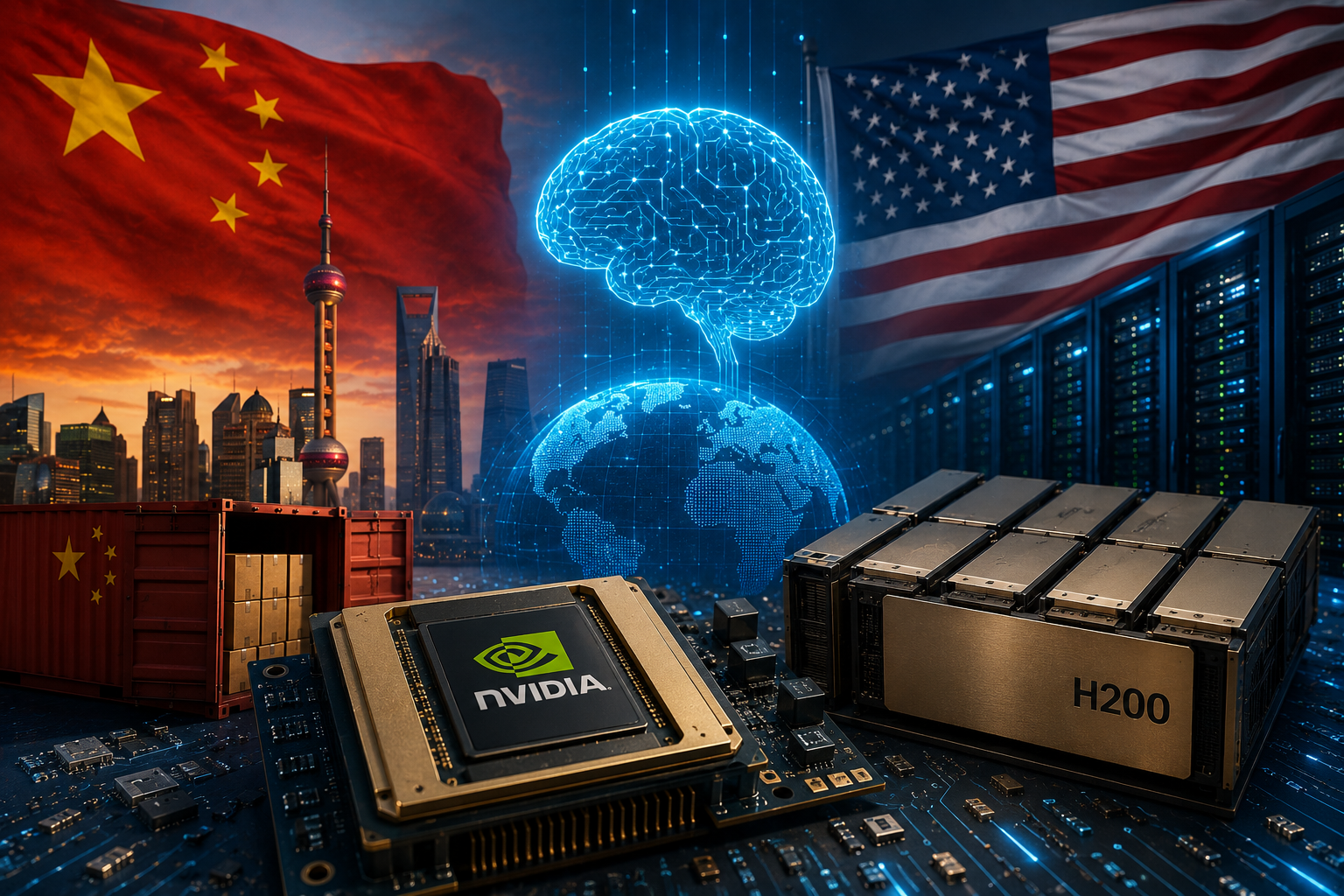
Beijing allows limited shipments of Nvidia’s H200 chips to leading technology firms, balancing the urgent need for AI computing power with its push for domestic semiconductor self-reliance.
China has started permitting limited shipments of Nvidia’s H200 artificial intelligence chips into the mainland, offering a measured relaxation of restrictions as Chinese technology companies seek greater computing capacity to compete with leading US AI developers.
The development comes against the backdrop of an intensifying US-China technology rivalry, where access to advanced semiconductors has become increasingly important for artificial intelligence, cloud computing and high-performance computing.
ByteDance and Tencent Among First Recipients
Reports indicate that ByteDance and Tencent have each received around 10,000 H200 processors in recent weeks. Other major Chinese technology companies could also receive approval for shipments of a similar size.
Chinese regulators have reportedly allowed companies to send H200 processors to Hong Kong and use them there as well. However, power availability and data-centre capacity could limit the extent to which large quantities of the chips can be deployed in the territory.
Nvidia has been holding a significant inventory of H200 processors intended for Chinese customers, but sales had been delayed amid regulatory uncertainty.
Some Nvidia partners have also resumed taking orders from Chinese customers for products containing H200 chips, although individual purchases remain subject to approval.
Why Is Beijing Loosening Restrictions?
Beijing is facing a strategic dilemma.
On one side, China wants to reduce its dependence on US technology and develop a strong domestic semiconductor ecosystem. On the other, its leading AI companies require powerful processors to train increasingly sophisticated models.
Chinese firms have made progress in using domestic chips for AI inference, the stage where trained models generate responses and perform tasks. But Nvidia processors continue to play an important role in AI training, which requires significantly greater computing resources.
Limited access to H200 chips could therefore help Chinese AI companies maintain development momentum while domestic chipmakers work to close the performance gap.
H200 Is Not Nvidia’s Most Advanced Chip
The latest development should not be interpreted as unrestricted access to Nvidia’s newest technology.
The H200 is older than Nvidia’s latest Blackwell-generation processors, which remain subject to US export restrictions.
Nevertheless, the H200 is considerably more capable than the H20 chips previously available to Chinese customers, making it valuable for large AI workloads.
This gives Beijing access to additional computing capacity without fully opening the Chinese market to Nvidia’s most advanced processors.
US and Chinese Rules Both Apply
Chinese companies seeking H200 processors must navigate restrictions imposed by both countries.
US export licensing requirements include safeguards related to security, end-use and potential military applications. Chinese authorities, meanwhile, continue to maintain their own approval process for imported advanced processors.
This means that even companies cleared by Washington may still require approval from Beijing before receiving their shipments.
The regulatory complexity reflects how semiconductors have become a central component of the broader geopolitical competition between the world's two largest economies.
China’s AI Industry Needs More Computing Power
China’s rapidly expanding AI sector is another major reason for the policy adjustment.
Several Chinese companies and research groups have launched increasingly sophisticated AI models, narrowing the gap with US competitors.
Alibaba, DeepSeek, Z.ai and Moonshot AI are among the companies and laboratories investing heavily in AI model development.
Training advanced AI systems requires enormous amounts of computing power. As model complexity increases, access to high-performance processors becomes increasingly important.
Beijing therefore has an incentive to ensure that leading Chinese AI developers do not face an immediate shortage of computing capacity.
Domestic Semiconductor Push Continues
Despite the limited relaxation, China has not abandoned its strategy of developing domestic alternatives.
Authorities reportedly want Chinese companies to retain much of the imported H200 capacity outside mainland China, reflecting Beijing’s desire to continue supporting local chip manufacturers.
The long-term objective remains greater technological self-reliance.
Chinese semiconductor companies have been investing heavily in AI accelerators, advanced manufacturing and supporting software ecosystems. However, developing a competitive alternative to Nvidia’s complete AI computing platform remains a major challenge.
Nvidia Faces a Complicated Chinese Market
For Nvidia, China remains a potentially significant commercial market but one surrounded by regulatory uncertainty.
The company has had to adjust its product offerings and supply plans in response to changing US export controls.
The H200’s partial return to China could provide Nvidia with additional revenue opportunities, but future sales will depend heavily on government approvals and the direction of US-China negotiations.
The situation also illustrates the increasingly difficult operating environment for global semiconductor companies with exposure to both markets.
AI Competition Becomes a Strategic Race
The H200 decision is part of a much larger contest between Washington and Beijing over artificial intelligence leadership.
The US has used export controls to limit China’s access to the most advanced computing hardware, arguing that certain technologies could have military and strategic applications.
China, meanwhile, is attempting to develop domestic alternatives while expanding its influence over international AI development.
Both countries increasingly see AI as critical to economic growth, defence capabilities, industrial productivity and technological leadership.
Implications for Technology and Semiconductor Investors
The development has broader implications for global technology markets.
Demand for AI processors remains a major growth driver for semiconductor companies, while data-centre operators are investing heavily in computing infrastructure, electricity and cooling systems.
At the same time, geopolitical restrictions have become an important investment risk.
Companies dependent on China for a significant portion of their revenue could face volatility if export controls tighten again. Conversely, domestic Chinese semiconductor companies could benefit from policies designed to accelerate technological self-sufficiency.
Investors therefore need to monitor not only AI demand but also export-control policies, licensing decisions and US-China trade relations.
What Comes Next?
China’s decision to permit limited H200 shipments appears to represent a controlled relaxation rather than a broad reversal of semiconductor restrictions.
Beijing needs additional computing power to sustain the rapid development of its AI industry, but it also wants to ensure that domestic chipmakers continue receiving policy support.
For Nvidia, the move reopens part of an important market while leaving the company exposed to regulatory uncertainty.
For Chinese AI developers, access to H200 processors could provide additional computing capacity in the near term. However, the strategic objective remains clear: build a domestic technology ecosystem capable of reducing reliance on foreign chips.
Market Outlook
The latest development reinforces the long-term investment theme around AI infrastructure, semiconductors, data centres and high-performance computing.
Global demand for AI computing is likely to remain strong, but the investment landscape is increasingly influenced by geopolitics. Any further easing of US-China semiconductor restrictions could benefit chipmakers and technology companies, while renewed restrictions could create supply-chain disruptions and volatility.
For investors, the key factors to watch will be Nvidia’s China sales, Chinese AI-chip development, US export-control decisions, data-centre investment and the pace of global AI spending. The H200 episode shows that the AI race is no longer only about better software models — access to advanced computing hardware is becoming an equally important competitive advantage.