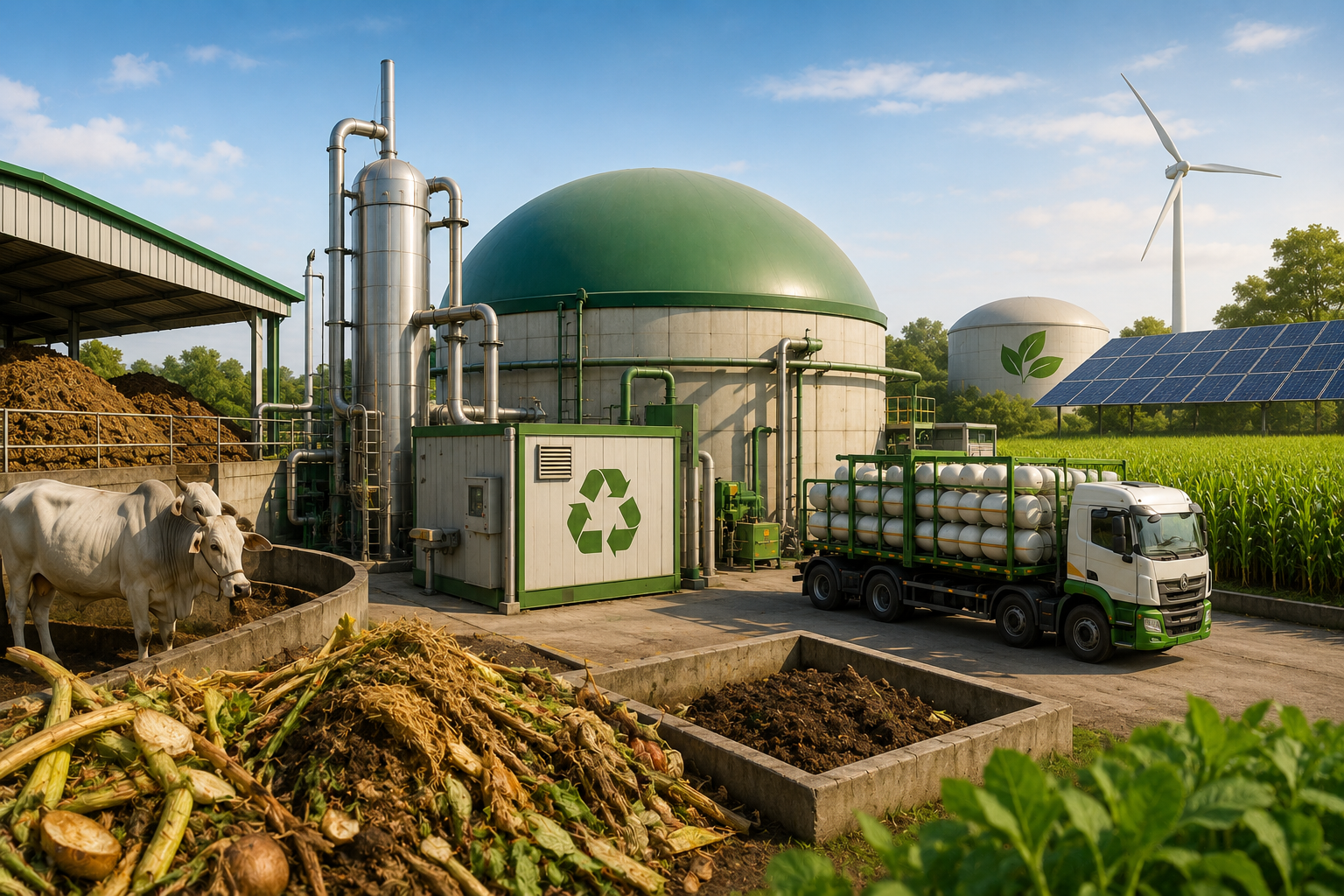
National Unified Scheme for Compressed Biogas combines capital support, assured offtake, pricing visibility and infrastructure funding to turn agricultural waste into a bankable energy asset
India's vast agricultural and organic waste could emerge as a significant source of clean energy under the government's newly approved GOBARdhan scheme, which seeks to accelerate the production and adoption of compressed biogas (CBG).
The National Unified Scheme for Compressed Biogas (CBG), also referred to as the National Circular Bioenergy Scheme, carries a total outlay of ₹23,731 crore for FY2026-27 to FY2035-36.
The scheme is aimed at addressing some of the biggest challenges that have slowed the growth of India's CBG industry, including inadequate feedstock aggregation, uncertain project economics, financing constraints, limited infrastructure and the need for reliable long-term demand.
The government's objective is to create conditions for a substantial expansion in domestic CBG production and mobilise private-sector capital into the bioenergy ecosystem.
From Agricultural Waste to Commercial Energy
Compressed biogas is produced by processing organic waste through anaerobic digestion and subsequently purifying and compressing the resulting gas.
Potential feedstock includes:
-
Cattle dung
-
Crop residue
-
Press mud
-
Food waste
-
Municipal organic waste
-
Other biodegradable material
The resulting CBG can be used as a cleaner alternative to conventional natural gas in suitable applications.
For India, the opportunity is considerably broader than fuel substitution.
A successful CBG ecosystem could simultaneously address agricultural waste management, reduce open burning of crop residue, generate rural employment, create additional income opportunities for farmers and reduce dependence on imported energy.
Why the Government Is Giving CBG a Fresh Push
India has already taken steps to promote CBG through initiatives such as the Sustainable Alternative Towards Affordable Transportation (SATAT) programme.
SATAT helped establish a market for CBG by encouraging oil marketing companies to enter into procurement arrangements with producers.
However, the industry has faced challenges in translating policy interest into large-scale commercial deployment.
These include high upfront capital requirements, inconsistent availability of feedstock, transportation costs, financing difficulties and uncertainty around project-level returns.
The GOBARdhan framework attempts to address these challenges together rather than focusing on only one part of the value chain.
Six Key Pillars Could Reshape the CBG Ecosystem
The new framework focuses on multiple aspects of the industry, including demand creation, pricing support, capital assistance, infrastructure development, financing and technology.
This broader approach could help move the sector from individual demonstration projects towards a more integrated national industry.
1. Assured Demand Through CBG Obligation
One of the most important components is the creation of predictable demand for CBG.
City Gas Distribution entities will procure CBG to meet the notified CBG obligation linked to CNG transportation and domestic PNG consumption.
The obligation is scheduled to increase progressively:
-
3% in FY2026-27
-
4% in FY2027-28
-
5% from FY2028-29
A predictable market can improve the bankability of CBG projects because developers need confidence that gas produced by a plant will have a buyer.
Administered Pricing Could Improve Revenue Visibility
The scheme also introduces a pricing framework intended to provide greater visibility to CBG producers.
The administered price has been reported at ₹2,110 per MMBTU, with the framework designed to provide longer-term certainty.
For capital-intensive projects, revenue visibility can make a significant difference to investment decisions.
It can also help lenders assess future cash flows when evaluating project-financing proposals.
However, investors will need to watch how the administered price compares with feedstock costs, operating expenses, transportation costs and prevailing prices of competing fuels.
Capital Assistance Could Lower Entry Barriers
High initial capital expenditure has been one of the key challenges for CBG developers.
Under the new framework, eligible projects can receive capital assistance linked to installed CBG capacity.
Support is intended to cover important parts of the ecosystem, including feedstock collection and transportation, biomass processing, organic manure handling and pipeline connectivity.
This could improve project economics and encourage private companies to consider investments that may previously have appeared commercially difficult.
Credit Guarantee May Help MSMEs
Access to affordable financing remains critical for scaling the CBG industry.
The scheme proposes a credit-guarantee mechanism for eligible MSME projects, which could make lenders more comfortable financing smaller and newer CBG developers.
Improved access to institutional credit could encourage more entrepreneurs to enter the sector and reduce dependence on promoters' own capital.
The success of this component will ultimately depend on the implementation framework, eligibility criteria and willingness of financial institutions to finance CBG projects.
Pipeline Connectivity Addresses a Major Bottleneck
A CBG plant's commercial viability depends not only on production but also on the ability to deliver the gas to customers.
The scheme therefore provides for infrastructure support, including connectivity with trunk pipelines and City Gas Distribution networks.
Better connectivity could reduce transportation costs and allow CBG producers to access larger markets.
It could also encourage development of plants in agricultural regions where substantial feedstock is available.
Feedstock Supply Will Remain the Critical Link
Despite the policy support, feedstock availability could remain one of the biggest challenges for the sector.
CBG plants need a consistent supply of biomass to operate efficiently.
Agricultural residue is often seasonal and spread across large geographic areas. If feedstock has to be transported over long distances, logistics costs can quickly erode project profitability.
The GOBARdhan framework therefore places emphasis on district-level feedstock mapping and aggregation, infrastructure development and technology adoption.
Creating efficient local supply chains will be essential for ensuring that plants operate at high utilisation levels.
Farmers Could Gain an Additional Revenue Stream
One of the potentially important economic benefits of the CBG programme is the creation of a commercial market for agricultural residue.
Instead of treating crop waste purely as a disposal problem, farmers and local aggregators could potentially monetise suitable biomass.
This could create additional rural income opportunities while reducing the incentive for crop-residue burning.
The emergence of organised biomass collection networks could also create employment in transportation, storage and processing.
Organic Manure Creates a Second Value Stream
CBG production does not only generate gas.
The anaerobic digestion process also produces organic material that can be processed into fermented organic manure and liquid fermented organic manure.
This creates another potential source of revenue for plant operators.
The use of such organic fertilisers could also support India's broader efforts to improve soil health and promote more sustainable agricultural practices.
The commercial success of this opportunity, however, will depend on product quality, farmer acceptance, distribution networks and competitive pricing.
CBG Could Strengthen India's Energy Security
India remains dependent on imported fossil fuels to meet a significant part of its energy requirements.
Increasing domestic production of CBG could provide an additional indigenous source of gaseous fuel.
While CBG is unlikely to replace imported natural gas on a large scale immediately, sustained capacity expansion over the next decade could create a meaningful domestic supply base.
This would support the government's broader objectives of improving energy security and diversifying India's fuel mix.
Environmental Benefits Could Be Significant
The scheme could also contribute to India's environmental objectives.
Crop residue and other organic waste are often burned, dumped or disposed of through inefficient methods.
Converting such material into CBG provides an economic incentive for collection and processing.
This could help reduce:
-
Crop-residue burning
-
Local air pollution
-
Organic waste accumulation
-
Methane emissions from unmanaged waste
The environmental benefit will depend on the efficiency of collection systems and the extent to which waste is actually diverted towards productive use.
Opportunity for Equipment and Infrastructure Companies
The growth of India's CBG industry could create opportunities beyond the companies that directly operate biogas plants.
A larger ecosystem will require equipment and services for:
-
Biomass collection
-
Waste processing
-
Anaerobic digestion
-
Gas purification
-
Compression
-
Storage
-
Pipeline connectivity
-
Transportation
-
Organic manure processing
-
Plant maintenance
This could create a broader industrial opportunity for engineering, infrastructure, waste-management and renewable-energy companies.
What the Scheme Could Mean for Investors
From an investment perspective, GOBARdhan could create a new policy-supported growth theme across the bioenergy value chain.
Potential beneficiaries could include companies involved in:
CBG production: Existing and upcoming plant operators could benefit from improved demand and project economics.
Waste management: Companies with access to organic waste streams could develop new revenue opportunities.
Engineering and equipment: Rising plant construction could increase demand for specialised equipment.
Gas infrastructure: Pipeline connectivity and distribution requirements could support infrastructure investment.
Agricultural logistics: Feedstock aggregation and transportation could become a new organised business opportunity.
However, investors should differentiate between companies with proven commercial operations and businesses whose prospects are based primarily on future projects.
Key Risks Investors Should Watch
Feedstock availability
A plant cannot operate efficiently without a stable and affordable supply of biomass.
Project execution
Construction delays, technology problems or cost overruns could affect returns on large CBG projects.
Pricing pressure
Even with an administered price framework, profitability will depend on the overall cost structure.
Logistics costs
Agricultural waste is bulky, and transporting it over long distances can significantly increase costs.
Offtake implementation
The success of the CBG obligation will depend on actual procurement by City Gas Distribution entities.
Financing
Large-scale CBG plants require substantial capital, and lenders will continue to evaluate project-level risks carefully.
GOBARdhan Could Take the Industry Beyond SATAT
SATAT was an important first step in creating a market for compressed biogas.
Its focus on procurement helped establish the concept of CBG offtake through oil marketing companies and encouraged entrepreneurs to enter the sector.
GOBARdhan attempts to build on that foundation by addressing a much wider set of challenges.
The combination of assured demand, pricing visibility, capital assistance, credit support, infrastructure and feedstock development could help create a more complete ecosystem.
This is important because the biggest challenge for the CBG industry is not simply building plants. It is ensuring that those plants have adequate feedstock, reliable customers, efficient logistics and sustainable economics.
The Road Ahead
The success of the scheme will ultimately depend on implementation.
The government will need to ensure that subsidies and capital assistance reach eligible projects efficiently, while CBG producers will need to develop reliable feedstock networks and maintain competitive production costs.
Financial institutions will also have to become more comfortable with the operating model of CBG plants and assess projects based on predictable long-term cash flows.
If these elements come together, India could witness a significant expansion in commercially viable bioenergy projects over the next decade.
Market Outlook
The ₹23,731-crore GOBARdhan scheme has the potential to transform India's CBG industry from a relatively small alternative-fuel segment into a larger organised bioenergy market.
Its biggest strength is that it addresses several structural problems simultaneously — demand, pricing, financing, infrastructure, feedstock aggregation and technology.
For the agricultural economy, the programme could turn crop residue and organic waste into an additional source of income. For India, it could support energy security and reduce waste-related pollution. For private companies, it could open a new investment cycle spanning CBG production, waste management, equipment, logistics and gas infrastructure.
However, the policy announcement alone will not guarantee commercial success. Feedstock availability, plant utilisation, project execution, financing costs and actual offtake will determine whether the sector can deliver attractive returns.
If implementation matches the ambition, GOBARdhan could fundamentally change how India views agricultural waste — from a costly disposal problem into a commercially valuable and bankable energy asset.