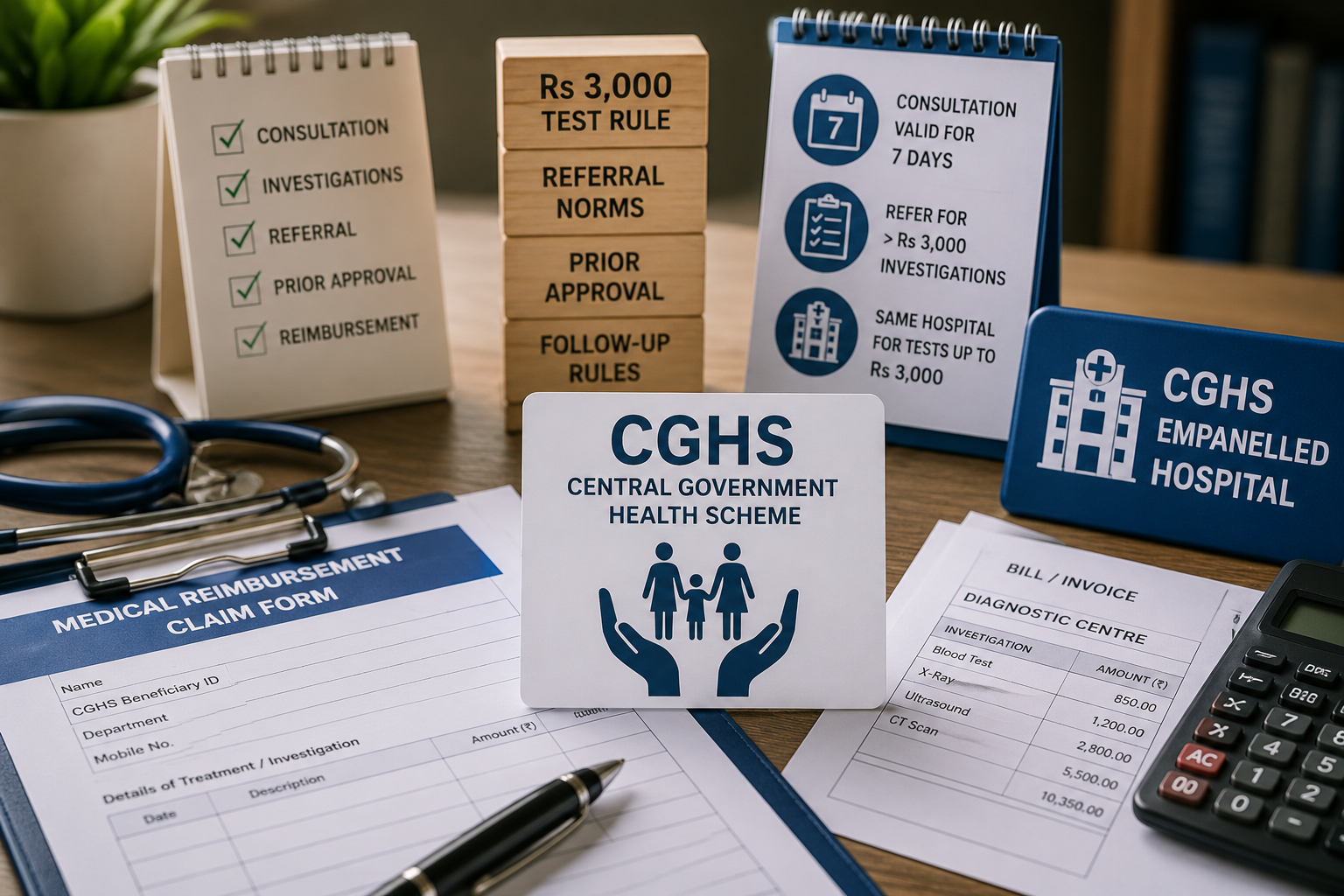
CGHS has clarified the rules governing diagnostic tests, follow-up consultations and unlisted procedures, helping government employees and pensioners understand when referrals or prior approvals are required for reimbursement
Government employees, pensioners and other beneficiaries covered under the Central Government Health Scheme (CGHS) need to follow certain procedural requirements when undergoing medical consultations, diagnostic tests and specialised procedures.
The latest clarification from CGHS addresses several issues that have led to confusion while processing medical reimbursement claims. The clarification covers investigations, follow-up treatment, referrals, special investigations and eye examinations.
One of the key points is the Rs 3,000 threshold for investigations. However, beneficiaries should note that this is not a blanket reimbursement limit. Instead, the threshold determines certain procedural requirements regarding where an investigation should be undertaken and whether a referral is required.
The clarification followed queries raised by the Union Public Service Commission (UPSC) regarding recurring difficulties in processing medical reimbursement claims.
What is the CGHS Rs 3,000 test rule?
Under the clarified framework, when a CGHS beneficiary consults a specialist at an empanelled hospital and the doctor recommends a diagnostic investigation costing up to Rs 3,000, the test should generally be conducted at the same empanelled hospital where the initial consultation took place.
This means beneficiaries should not automatically assume that they can take the doctor's prescription to any other CGHS-empanelled diagnostic centre and later claim reimbursement.
The rule is particularly relevant for follow-up investigations prescribed as part of treatment after the initial specialist consultation.
The Rs 3,000 threshold should therefore be understood as a procedural benchmark, rather than a maximum amount that CGHS will reimburse.
Can a beneficiary get the test done at another hospital?
There can be genuine situations where the beneficiary needs to undergo the investigation at another CGHS-empanelled hospital, healthcare organisation or diagnostic centre.
In such cases, the beneficiary should obtain the required referral or endorsement from the CGHS Wellness Centre before undergoing the investigation.
This is important because reimbursement eligibility may depend not only on whether the test was medically prescribed, but also on whether the prescribed CGHS procedure was followed.
Beneficiaries should therefore check the referral requirement before shifting a test from the hospital where the consultation was conducted to another facility.
What happens when the investigation costs more than Rs 3,000?
The referral requirement becomes particularly important for investigations costing more than Rs 3,000.
The CGHS clarification states that such investigations require a referral.
This can be relevant for expensive diagnostic procedures, including:
-
CT scans
-
MRI scans
-
PET scans
-
Other specialised and high-value investigations
Before undergoing such tests, beneficiaries should ensure that the necessary CGHS referral has been obtained.
A specialist's prescription and a CGHS referral are not necessarily the same thing. Beneficiaries should confirm whether the additional administrative approval is required in their particular case.
The Rs 3,000 rule is not a reimbursement ceiling
One of the most important points for beneficiaries to understand is that CGHS has not imposed a blanket Rs 3,000 limit on medical test reimbursement.
The amount relates to the procedural treatment of investigations.
Therefore, a diagnostic procedure costing more than Rs 3,000 is not automatically excluded from CGHS reimbursement. Instead, the applicable referral and approval requirements must be followed.
This distinction is important because misunderstanding the rule could lead beneficiaries to believe that CGHS will reimburse only up to Rs 3,000 for a test.
How long is a CGHS consultation valid?
The CGHS has also clarified the validity period of a consultation.
A consultation remains valid for seven days, provided the subsequent consultation is related to the same medical speciality.
For example, if a beneficiary consults a cardiologist and requires a follow-up consultation with the same speciality within the seven-day period, the consultation remains valid under the clarified rule.
The provision is aimed at reducing confusion around repeat consultations and follow-up treatment.
Beneficiaries should nevertheless preserve the original consultation papers and prescriptions for their records.
What does the eye consultation fee cover?
The CGHS has separately clarified the examinations included within the eye consultation fee.
The consultation fee covers three examinations:
-
Refraction
-
Tonometry
-
Fundus examination
This clarification helps beneficiaries understand which basic ophthalmic examinations are covered as part of the consultation and reduces uncertainty about separate charges.
Prior approval needed for unlisted procedures
Another important provision relates to unlisted investigations and procedures.
If a specialist at a CGHS-empanelled healthcare facility recommends an investigation or procedure that is not included in the prescribed CGHS list, beneficiaries should obtain prior permission from the concerned department or office before proceeding, subject to the applicable rules.
A specialist's recommendation alone should not be treated as automatic authorisation for an unlisted procedure.
Beneficiaries should therefore confirm the approval requirement before incurring the expense.
Why referral requirements matter for reimbursement
Medical reimbursement claims are examined not only on the basis of whether treatment was necessary but also on whether the applicable administrative procedures were followed.
A beneficiary could therefore face complications if:
-
A diagnostic test was performed at another facility without the required referral.
-
A high-value investigation was undertaken without the necessary CGHS referral.
-
An unlisted procedure was performed without prior approval.
-
Prescriptions or consultation records are missing.
-
Bills and medical reports do not clearly establish the treatment undertaken.
Following the correct procedure before the treatment can help reduce the risk of a reimbursement dispute later.
Keep all medical documents safely
CGHS beneficiaries should maintain a complete record of their medical treatment and reimbursement documents.
Important records include:
-
CGHS referral letters
-
Specialist prescriptions
-
Consultation slips
-
Diagnostic reports
-
Hospital bills
-
Payment receipts
-
Discharge summaries
-
Prior approval documents
-
Follow-up prescriptions
-
Investigation reports
A complete paper trail can help establish the medical reason for the treatment and demonstrate that the applicable CGHS process was followed.
What should beneficiaries do before undergoing an expensive test?
Before booking an expensive diagnostic investigation, beneficiaries should follow a few basic steps.
Check whether the facility is CGHS-empanelled
The beneficiary should confirm that the hospital or diagnostic centre is covered under the applicable CGHS arrangement.
Check the cost of the investigation
If the investigation exceeds the applicable threshold, the beneficiary should verify whether a CGHS referral is required.
Confirm whether the test is listed
If the investigation or procedure is not part of the prescribed CGHS list, beneficiaries should check whether prior approval is necessary.
Obtain approval before the procedure
Where prior permission is required, it should be obtained before undergoing the investigation or procedure.
Preserve the complete record
The prescription, referral, bills and reports should be retained until the reimbursement claim is fully processed.
Why pensioners should pay particular attention
CGHS is particularly important for retired government employees and pensioners who may require regular consultations, diagnostic investigations and follow-up treatment.
For beneficiaries who consult multiple specialists or use different empanelled hospitals, understanding referral requirements becomes even more important.
A beneficiary may have a valid medical prescription but still need to complete the appropriate CGHS referral process before getting the investigation done at another facility.
Checking the requirement in advance can prevent unnecessary reimbursement-related complications.
Follow-up treatment and investigations
Follow-up treatment is another area where beneficiaries can face confusion.
When a specialist recommends an investigation as part of continuing treatment, the beneficiary should generally remain with the hospital where the initial consultation took place, particularly for investigations within the Rs 3,000 threshold.
If the beneficiary needs to use another empanelled facility, the required referral or endorsement should be obtained.
This approach helps maintain a clear connection between the original consultation, prescribed investigation and subsequent treatment.
What beneficiaries should know about CT, MRI and PET scans
CT, MRI and PET scans can involve substantially higher costs than routine diagnostic tests.
Because such investigations can cross the Rs 3,000 threshold, beneficiaries should pay particular attention to the referral requirement.
The safest approach is to obtain confirmation from the CGHS Wellness Centre or relevant authority before scheduling the investigation.
This is especially important where the test is being conducted at a facility different from the one where the specialist consultation took place.
What if the beneficiary needs another diagnostic centre?
If the preferred or required diagnostic facility is different from the hospital where the initial consultation occurred, the beneficiary should not assume that reimbursement will automatically be available.
The beneficiary should first seek the required CGHS referral or endorsement.
This is particularly relevant when the second facility offers a specialised diagnostic service that may not be available at the original hospital.
Obtaining the necessary referral beforehand creates a clearer record for the reimbursement process.
Emergency treatment may follow separate provisions
Emergency medical situations can have separate provisions under CGHS rules.
Beneficiaries should distinguish between a planned investigation and genuine emergency treatment. Where emergency provisions apply, the documentation and reimbursement process can differ from that applicable to routine or planned treatment.
Therefore, beneficiaries should retain emergency records, medical certificates, hospital documents and bills wherever applicable.
Key CGHS Rules at a Glance
| Situation | Requirement |
|---|---|
| Investigation up to Rs 3,000 | Generally conducted at the same empanelled hospital where the initial consultation took place |
| Investigation at another empanelled facility | Prior CGHS referral/endorsement may be required |
| Investigation above Rs 3,000 | CGHS referral is required under the clarification |
| Same-speciality follow-up | Consultation remains valid for seven days |
| Eye consultation | Includes refraction, tonometry and fundus examination |
| Unlisted investigation/procedure | Prior permission is required from the concerned authority |
| Expensive diagnostic tests | Check referral requirements before undergoing the test |
| Reimbursement claim | Preserve prescriptions, referrals, bills and reports |
Common mistakes CGHS beneficiaries should avoid
Beneficiaries can reduce reimbursement problems by avoiding a few common mistakes.
Do not assume that every CGHS-empanelled hospital can be used interchangeably. The place where the initial consultation was conducted can matter.
Do not treat Rs 3,000 as a reimbursement cap. It is relevant to the procedural requirements surrounding investigations.
Do not undergo an expensive diagnostic test without checking referral requirements.
Do not proceed with an unlisted procedure solely on the basis of a specialist's recommendation without checking the approval process.
Do not discard prescriptions, bills or referral documents after treatment.
What the latest clarification means
The latest CGHS clarification provides greater clarity on how beneficiaries should approach medical investigations and follow-up treatment.
For routine investigations costing up to Rs 3,000, the preferred approach is to undergo the test at the same empanelled hospital where the initial consultation was conducted.
If the beneficiary wants to use another empanelled facility, the appropriate referral or endorsement should be obtained.
For investigations costing more than Rs 3,000, a CGHS referral becomes necessary under the clarified framework.
For unlisted procedures and investigations, prior permission is required from the concerned authority.
The overall message for beneficiaries is simple: medical necessity and procedural compliance both matter when seeking CGHS reimbursement.
Final Takeaway for CGHS Beneficiaries
The latest clarification does not mean that CGHS beneficiaries are restricted to tests costing Rs 3,000 or less. Instead, the Rs 3,000 threshold determines certain referral and facility-related requirements.
Beneficiaries should therefore check the applicable procedure before undergoing diagnostic tests, especially when the test is expensive or is being performed at a hospital or diagnostic centre different from the one where the initial consultation took place.
Keeping a complete record of prescriptions, referrals, approvals, bills and medical reports can also make the reimbursement process easier.
For government employees and pensioners relying on CGHS, the safest approach is to confirm the referral or approval requirement before undergoing the procedure rather than trying to resolve the issue after the medical expense has already been incurred.