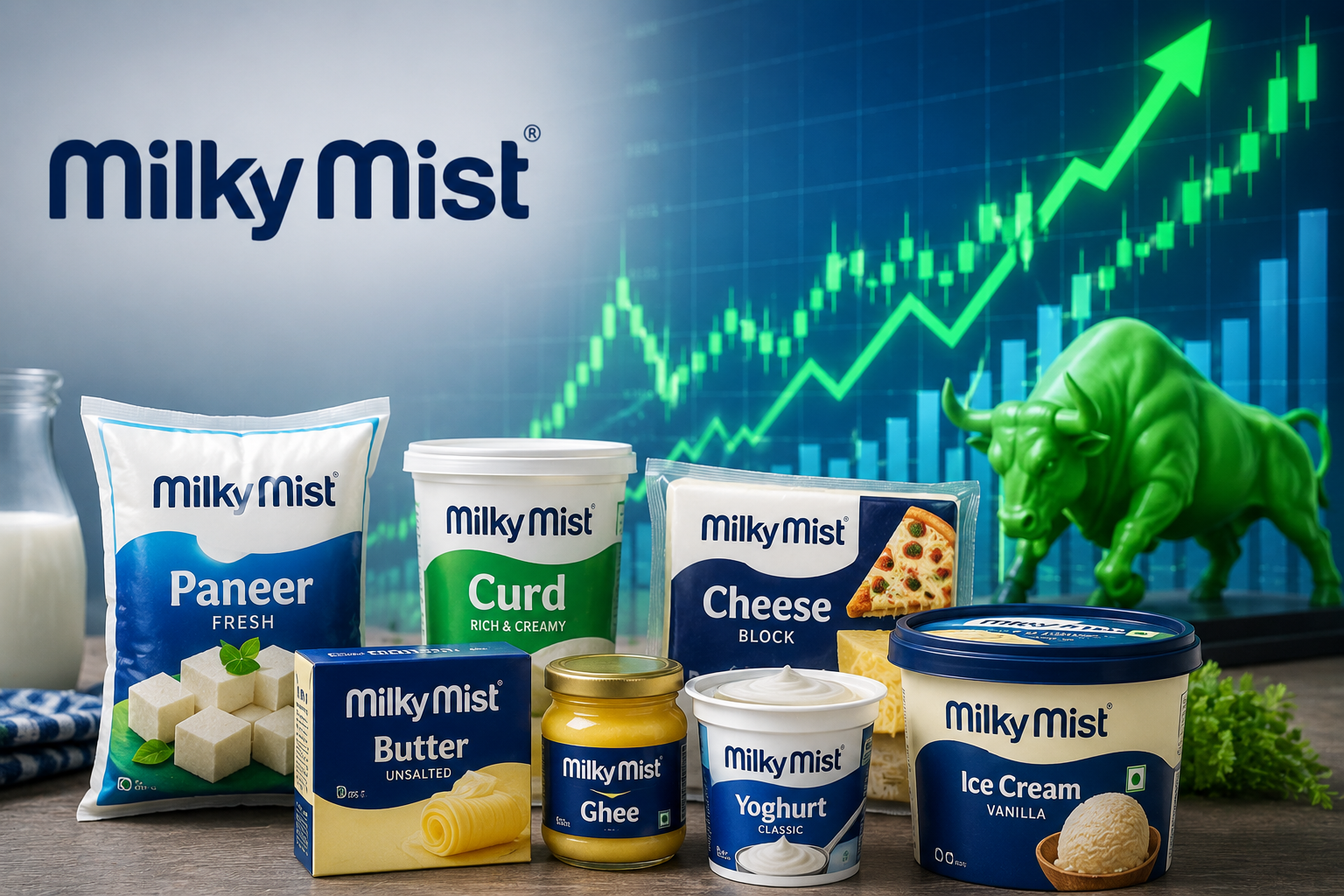
Strong investor demand pushes Milky Mist Dairy Food shares to ₹181.45 after an 18% listing gain, but analysts caution that premium valuations could limit near-term upside
Milky Mist Dairy Food made a strong debut on the Indian stock exchanges on Tuesday, August 18, with its shares opening at ₹165 apiece on both the NSE and BSE, compared with the IPO issue price of ₹140. The listing translated into a gain of ₹25 per share, or 17.86 per cent, for investors who received shares in the public offering.
The stock continued to attract strong buying interest after listing and subsequently hit the 10 per cent upper circuit at ₹181.45 on the BSE. At the upper-circuit price, Milky Mist shares were trading nearly 30 per cent above the IPO issue price, substantially increasing the wealth of IPO allottees within the first trading session.
The strong debut also came despite a subdued broader market, highlighting the strong investor interest in the company's value-added dairy business.
Milky Mist Listing Beats Grey Market Expectations
Milky Mist's market debut was stronger than grey market indications ahead of listing.
Market estimates had suggested a listing premium of around 14-15 per cent over the IPO price. However, the stock opened at ₹165, translating into a premium of nearly 18 per cent.
The stock's subsequent rise to ₹181.45 indicates that demand remained strong even after the initial listing gains.
At the listing price, Milky Mist Dairy Food commanded a market capitalisation of approximately ₹12,702 crore.
Stock Rises Nearly 30% Above IPO Price
The company's shares were issued to IPO investors at ₹140 per share.
Following the listing at ₹165 and subsequent rally to ₹181.45, the stock has delivered a gain of nearly 30 per cent over the issue price.
This means investors who received shares in the IPO have already witnessed a substantial increase in the value of their holdings within a single trading session.
However, the rapid price appreciation has also brought valuation concerns into focus.
What Is Driving Milky Mist Shares?
Milky Mist has attracted investor interest because of its strong position in the value-added dairy segment.
Unlike traditional dairy companies that focus heavily on liquid milk, Milky Mist has concentrated on products such as paneer, cheese, curd, yoghurt, butter, ghee and ice cream.
This product mix gives the company exposure to India's growing demand for packaged, branded and convenience-oriented dairy products.
The company's focus on higher-value products also supports its positioning as a consumer-facing food and FMCG-style business rather than a conventional liquid milk company.
Strong Revenue Growth Supports Business Story
One of the major factors supporting the company's premium valuation is its strong historical growth.
According to analyst commentary, Milky Mist has delivered a 33.6 per cent revenue CAGR, while its margins have expanded and return on equity has reached around 32 per cent.
Strong revenue growth combined with improving profitability has helped establish the company's premium positioning within the dairy industry.
The key challenge going forward will be whether Milky Mist can maintain this growth rate after becoming a listed company.
Value-Added Dairy Products Remain Key Growth Engine
Milky Mist's strategy is centred around increasing the share of value-added dairy products.
Products such as cheese, paneer, yoghurt and ice cream generally provide greater opportunities for branding, packaging and product differentiation compared with basic liquid milk.
India's consumption pattern is also evolving as consumers increasingly prefer packaged and branded food products.
Milky Mist is positioned to benefit from this structural change if it can continue expanding its distribution network and product portfolio.
Temasek-Backed Investment Adds Confidence
Another positive factor for the company is the participation of Jongsong Investments, an investment vehicle backed by Temasek.
Jongsong Investments invested approximately ₹482 crore in Milky Mist at ₹139.76 per share for around a 5.2 per cent stake.
The pre-IPO investment provided additional institutional validation of the company's business prospects and valuation.
While institutional participation does not eliminate investment risks, it can strengthen investor confidence in the company's long-term growth strategy.
Milky Mist IPO Was Heavily Subscribed
The strong stock-market debut followed an exceptionally strong response to the company's IPO.
The ₹1,553 crore IPO was subscribed 56.12 times during the bidding period.
Investors placed bids for approximately 459.04 crore shares against around 8.18 crore shares offered.
The overwhelming subscription indicated strong demand across institutional, non-institutional and retail investor categories.
QIB Portion Subscribed 155.83 Times
Qualified institutional buyers showed particularly strong interest in the IPO.
The QIB category was subscribed 155.83 times, reflecting substantial institutional demand.
The non-institutional investor category was subscribed 34.91 times, while the retail investor portion was subscribed 8.41 times.
The strong participation from institutional investors helped reinforce expectations of a strong market debut.
Details of the Milky Mist IPO
The mainboard IPO was offered in a price band of ₹133 to ₹140 per share.
The issue consisted of:
-
Fresh issue of shares worth up to ₹1,428 crore
-
Offer for Sale of shares worth up to ₹125 crore
-
Total IPO size of ₹1,553 crore
Before the IPO, the company also raised approximately ₹465.30 crore from anchor investors.
The fresh issue proceeds will primarily be used for debt reduction and expansion-related investments.
IPO Proceeds to Support Expansion
Milky Mist has outlined several uses for the funds raised through the fresh issue.
The company plans to use a portion of the proceeds for repayment or prepayment of borrowings.
It also plans to expand and modernise its manufacturing facility at Perundurai in Tamil Nadu.
The company intends to strengthen its cold-chain infrastructure, which is critical for a business dealing with perishable dairy products.
New Manufacturing Facilities Planned
Milky Mist also plans to invest in new production capacity.
The company has outlined investments in manufacturing facilities for:
-
Whey protein concentrate
-
Yoghurt
-
Cream cheese
It also plans to install ice cream freezers and chocolate coolers.
These investments could help the company expand its product portfolio and increase its presence in higher-margin dairy categories.
Debt Reduction Could Improve Financial Flexibility
Using IPO proceeds to reduce borrowings could strengthen the company's balance sheet.
Lower debt could reduce interest expenses and provide greater financial flexibility for future expansion.
A stronger balance sheet could also allow Milky Mist to invest more aggressively in manufacturing capacity, distribution and product development.
The success of this strategy will depend on the company's ability to convert additional capacity into sustainable revenue and earnings growth.
Cold-Chain Infrastructure Critical for Expansion
The dairy industry depends heavily on efficient cold-chain infrastructure.
Products such as paneer, cheese, yoghurt and ice cream require controlled temperatures throughout transportation and storage.
Milky Mist's planned investment in cold-chain infrastructure could help it expand its distribution network while maintaining product quality.
A stronger cold-chain network could also support expansion into new regions and markets.
India's Organised Dairy Market Offers Opportunity
India's dairy market is undergoing a structural shift from traditional and unorganised consumption towards packaged and branded products.
Consumers are increasingly purchasing processed dairy products such as cheese, paneer, yoghurt and ice cream.
This creates a long-term growth opportunity for organised dairy companies with strong brands and distribution networks.
Milky Mist's focus on value-added dairy products positions it to benefit from this trend.
Milky Mist Differs From Traditional Dairy Players
The company's business model is differentiated by its limited exposure to the liquid milk segment.
Instead, it focuses primarily on value-added products.
This strategy allows Milky Mist to participate in categories where branding and processing can potentially generate better margins.
The company has also expanded across multiple product categories, reducing its dependence on a single dairy product.
Competitive Landscape Remains Important
Milky Mist will compete with established listed dairy companies including Parag Milk Foods, Hatsun Agro Product and Dodla Dairy.
It also faces competition from large FMCG companies that have strong distribution networks and financial resources.
Competition could intensify as organised players increase investments in branded dairy products.
Maintaining product quality, brand recognition and distribution reach will therefore be critical for Milky Mist.
Valuation Becomes the Biggest Concern After Rally
While the company's fundamentals remain attractive, valuation is an important concern following the strong listing.
Analyst estimates indicate that the stock was trading at approximately 85 times FY26 earnings after its sharp post-listing rally.
This is substantially above the broader dairy-sector average P/E of around 52.5 times.
The premium valuation reflects investor expectations of strong future growth and higher profitability.
However, it also means that a significant portion of future earnings growth may already be reflected in the stock price.
Strong Listing Could Trigger Profit Booking
The stock's rapid rise from ₹140 to ₹181.45 creates the possibility of profit-booking.
Investors who received shares in the IPO may choose to lock in gains following the strong debut.
Such selling could result in increased volatility in the initial trading sessions.
The stock could therefore experience periods of sharp movement even if the underlying business remains strong.
Analyst View: Avoid Chasing at Current Levels
Shivani Nyati, head of wealth at Swastika Investmart, said the company's strong revenue CAGR, expanding margins and approximately 32 per cent RoE support its premium positioning.
However, she also highlighted that the valuation has become demanding after the strong listing.
According to the analyst, the premium valuation could lead to profit-booking in the near term.
Her view remains positive on the company's business prospects, but investors have been advised against aggressively chasing the stock at current levels.
Hold With ₹150 Stop-Loss, Add on Dips
For existing investors, the analyst view remains relatively constructive.
Investors who already hold the stock may continue to remain invested while maintaining appropriate risk controls.
A ₹150 stop-loss has been suggested, while fresh buying could be considered on meaningful declines rather than after the sharp post-listing rally.
This approach reflects the difference between Milky Mist's attractive long-term business prospects and its demanding current valuation.
Key Growth Drivers for Milky Mist
Several factors could support the company's long-term growth:
-
Strong revenue growth
-
Expanding value-added dairy portfolio
-
Growing branded dairy consumption
-
Strong return on equity
-
Margin expansion
-
Manufacturing capacity expansion
-
Cold-chain investment
-
Debt reduction
-
New product categories
-
Increasing distribution reach
If the company successfully executes its expansion strategy, these factors could support sustained earnings growth.
Key Risks Investors Should Monitor
Despite the positive business outlook, investors should monitor several risks.
The biggest immediate concern is valuation. At a substantial premium to the sector average, the stock has limited room for disappointing earnings growth.
Raw material costs, particularly milk prices, could also affect margins.
The company may need to spend significantly on branding, advertising and distribution as competition intensifies.
Expansion into new categories and geographies also brings execution risks.
Investors should therefore focus on earnings growth rather than relying solely on the stock's strong listing momentum.
Competition Could Pressure Margins
The value-added dairy market is becoming increasingly competitive.
Large dairy companies and FMCG players are expanding their presence across categories such as cheese, paneer, yoghurt and ice cream.
Greater competition could result in higher advertising expenditure, promotional activity and pricing pressure.
Milky Mist will need to maintain a strong balance between market-share expansion and profitability.
Input Costs Remain an Important Variable
Dairy businesses are sensitive to fluctuations in raw material prices.
Changes in milk procurement costs can directly influence gross margins.
If the company is unable to pass higher input costs on to consumers, profitability could come under pressure.
The company's ability to maintain margins while expanding its product portfolio will therefore remain an important metric for investors.
What Investors Should Track After Listing
Following the listing, investors should monitor the company's quarterly performance closely.
Important indicators include:
-
Revenue growth
-
EBITDA margins
-
Profit growth
-
Return on equity
-
Debt reduction
-
Value-added product contribution
-
Capacity utilisation
-
Distribution expansion
-
New product launches
-
Raw material costs
-
Advertising expenditure
-
Cash-flow generation
Sustained improvement across these metrics could help justify the company's premium valuation over time.
Market Outlook
Milky Mist's strong debut has reinforced investor interest in India's branded and value-added dairy opportunity. The shares opened at ₹165 against the IPO price of ₹140, delivering a listing gain of nearly 18 per cent, before hitting the 10 per cent upper circuit at ₹181.45.
At the upper-circuit level, the stock was nearly 30 per cent above its IPO price, creating substantial immediate gains for IPO allottees.
The company's 33.6 per cent revenue CAGR, expanding margins, approximately 32 per cent RoE and strong presence in value-added dairy products provide a favourable fundamental backdrop. The planned investments in manufacturing, cold-chain infrastructure and new product categories could further support its growth trajectory.
However, the sharp post-listing rally has made valuation the key factor to watch. At around 85 times FY26 earnings, the stock trades at a significant premium to the dairy-sector average of approximately 52.5 times P/E.
For existing IPO investors, the strong listing provides a substantial gain cushion, but fresh investors may need to avoid chasing the stock at elevated levels. The long-term investment case will depend on Milky Mist's ability to sustain high revenue growth, protect margins, expand its distribution network, execute capacity additions and strengthen its position in India's rapidly growing value-added dairy market. A meaningful correction or stronger-than-expected earnings growth could offer a more favourable entry point for investors who missed the IPO.