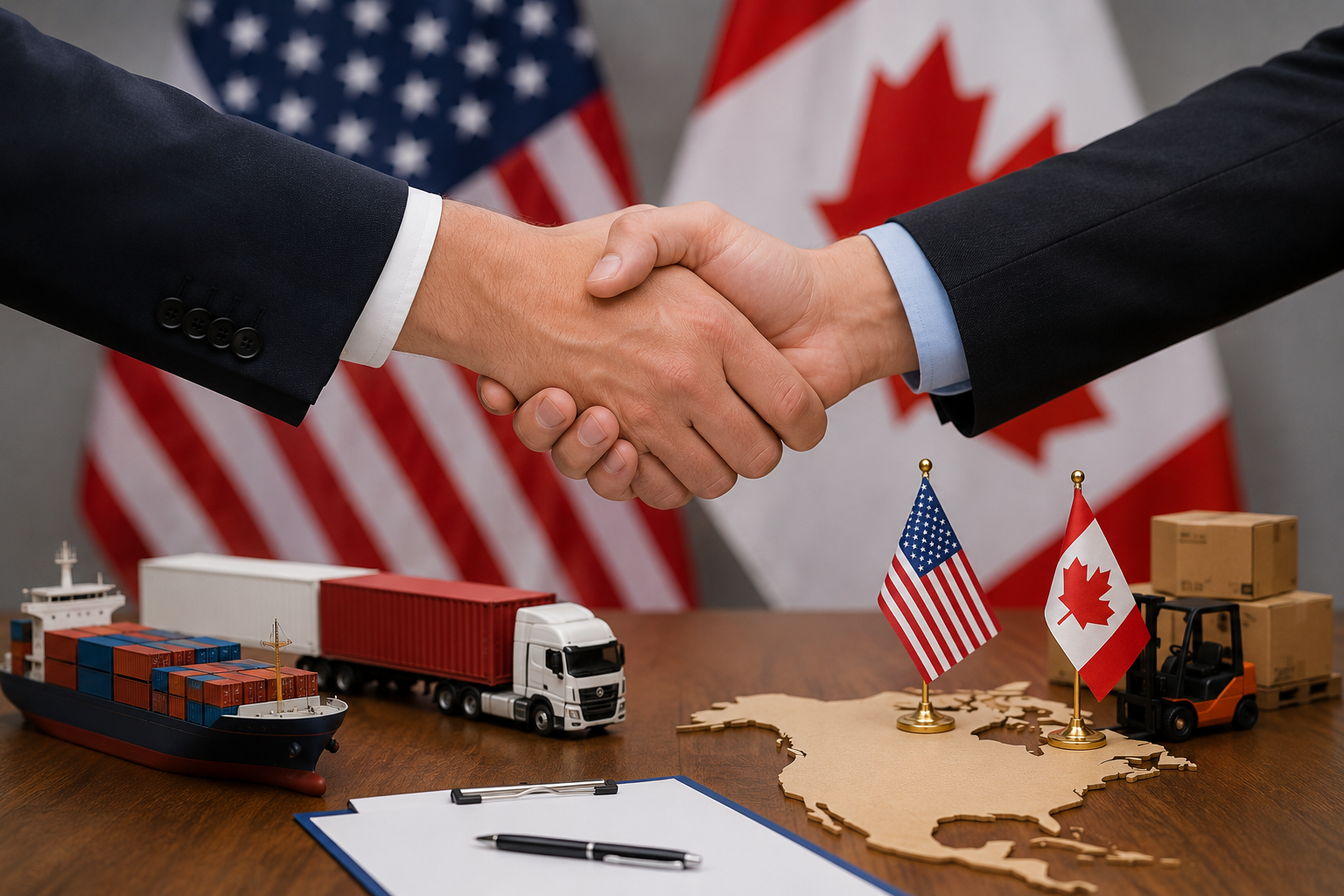
Washington and Ottawa are racing against a tariff deadline as President Donald Trump threatens 50% levies on around $20 billion of Canadian imports, raising concerns over North American supply chains, inflation and the future of the USMCA
The United States and Canada are engaged in intense last-minute negotiations to prevent a fresh escalation in their trade dispute, with US President Donald Trump threatening to impose 50% tariffs on around $20 billion worth of Canadian goods.
The proposed tariffs have added another layer of uncertainty to the economic relationship between the two neighbours, whose economies are deeply interconnected through trade, manufacturing, energy and cross-border supply chains.
Canadian Prime Minister Mark Carney said Monday that negotiations with Washington were continuing, describing the discussions as intense and delicate. Officials from both countries are attempting to find a compromise before the proposed tariffs take effect.
The immediate dispute could have consequences beyond the affected products. Businesses and investors are watching closely because another round of tariffs could disrupt supply chains, increase costs for importers and consumers, and complicate negotiations over the future of the US-Mexico-Canada Agreement (USMCA).
50% Tariff Threat Raises Stakes
The immediate issue is the proposed 50% tariff on about $20 billion worth of Canadian products.
The measures could cover a wide range of goods, including products such as hockey sticks and medical items including tongue depressors.
The tariffs are scheduled to take effect at 12:01 am Wednesday if Washington and Ottawa fail to reach an agreement.
The proposed duties would come on top of existing trade tensions between the two countries and could further complicate the movement of goods across the world's longest undefended international border.
For businesses operating on both sides of the border, the uncertainty itself is becoming an important economic issue.
Canada Heavily Dependent on the US Market
The potential impact on Canada is significant because of the country's dependence on the United States as an export destination.
Nearly 72% of Canadian goods exports last year went to the United States, making the American market critical for Canadian manufacturers, exporters and suppliers.
A sharp increase in tariffs could reduce the competitiveness of Canadian goods in the US market.
Canadian companies could face a difficult choice between absorbing some of the additional cost, raising prices for American customers or looking for alternative markets.
Each option carries its own economic challenges.
US Companies Could Also Face Higher Costs
Although tariffs are imposed on imported products, the financial burden is not necessarily absorbed entirely by foreign exporters.
US importers are responsible for paying the tariffs when goods enter the country. Businesses may then pass some or all of the additional costs through their supply chains.
This could eventually lead to higher prices for American businesses and consumers.
The impact would depend on the ability of companies to absorb the costs, renegotiate supplier agreements or find alternative sources.
The possibility of higher prices is particularly important because American households remain sensitive to the cost of living.
Why Both Sides Are Looking for an Off-Ramp
Trade experts believe both Washington and Ottawa have strong reasons to prevent the proposed tariffs from becoming a long-term measure.
For Canada, the economic importance of the US market makes a prolonged trade conflict particularly risky.
For the United States, tariffs could increase costs for domestic companies that rely on Canadian goods and raw materials.
The timing is also politically significant, with the November midterm elections approaching in the US.
A significant increase in prices for goods affected by tariffs could create additional pressure on the administration.
This gives both sides an incentive to find an agreement before the deadline.
Canada Seeks Relief From Existing Tariffs
Ottawa is looking for relief from several existing US trade measures.
Among Canada's priorities are tariffs affecting steel and aluminium, as well as duties on softwood lumber.
The United States has argued that Canadian softwood lumber benefits from unfair government support, a claim Canada has disputed.
Canadian officials are therefore expected to seek meaningful concessions from Washington as part of any broader agreement.
Simply accepting another round of tariffs without receiving relief elsewhere could create significant political pressure on the Canadian government.
US Seeks Defence and Critical Mineral Concessions
Washington is also looking for broader economic and strategic concessions from Canada.
The United States wants Canada to increase purchases of American military equipment, including F-35 fighter aircraft, according to the report.
The Trump administration is also seeking Canadian participation in its Golden Dome missile-defence programme.
Another important issue is access to critical minerals.
The US is seeking to reduce its dependence on China for strategically important raw materials used in batteries, electronics, defence equipment and advanced manufacturing.
Canada's natural-resource base could make it an important partner in this strategy.
Critical Minerals Could Become a Major Bargaining Tool
Critical minerals have become increasingly important in global trade and national-security discussions.
They are required for electric vehicles, batteries, renewable-energy equipment, semiconductors, aerospace systems and defence technologies.
China remains a major player in the global processing and supply chain for several strategically important minerals.
The US therefore has an incentive to develop more secure supply relationships with countries such as Canada.
Canada, meanwhile, could use its mineral resources as leverage in negotiations with Washington.
A deeper US-Canada critical-minerals partnership could potentially create investment opportunities in mining, processing and related infrastructure.
Trump Invokes Section 338
The proposed tariffs have attracted additional attention because of the legal mechanism being used by the Trump administration.
Trump has invoked Section 338 of the Tariff Act of 1930 to impose tariffs of up to 50% on selected Canadian imports.
The provision allows the US president to impose tariffs on imports from countries accused of discriminating against American businesses.
Unlike Section 301 of the Trade Act of 1974, the provision does not require the same type of investigation before tariffs can be imposed.
The use of Section 338 represents a significant development in modern US trade policy.
Smoot-Hawley Legacy Adds Historical Significance
Section 338 is part of a trade-law framework dating back to the early 20th century.
The provision is associated with the protectionist era surrounding the Tariff Act of 1930, which is also linked to the controversial Smoot-Hawley tariff regime.
The Smoot-Hawley tariffs are widely regarded by economists and historians as having contributed to a decline in international trade during the Great Depression.
The current use of Section 338 therefore carries historical significance and has raised questions about the direction of US trade policy.
Washington Accuses Canada of Discriminating Against US Goods
The Trump administration has argued that Canada discriminates against certain American exports.
The complaints include Canada's treatment of automobiles, alcohol and cheese.
Washington has also expressed frustration over Canada's previous retaliatory tariffs against US measures.
US Trade Representative Jamieson Greer has indicated that the United States would respond if Canada retaliates against the latest proposed tariffs.
This raises the risk of a fresh cycle of tariff escalation.
Canada Has Retaliation Options
If the 50% tariffs take effect, Canada could respond with retaliatory measures against US products.
Retaliation could target American exports to Canada, potentially affecting businesses in sectors such as agriculture, manufacturing and consumer goods.
The possibility of retaliation creates a significant risk because one tariff measure can quickly lead to another.
If both sides continue increasing duties, companies could face higher costs and greater uncertainty over cross-border trade.
Canadian Government Faces Domestic Pressure
Prime Minister Mark Carney is facing a difficult political balancing act.
Canada needs to protect its access to the US market while demonstrating that it will not simply accept Washington's demands.
Trump's repeated comments about Canada becoming the 51st US state have generated strong criticism among Canadians.
Public opposition to the Trump administration's approach could limit the government's ability to make major concessions.
A deal perceived as one-sided could create domestic political backlash.
Carney Calls Negotiations Intense and Delicate
Carney said Monday that negotiations with Washington were continuing but cautioned against publicly discussing details.
The Canadian prime minister described the talks as intense and delicate.
Canada's Minister for US Trade Dominic LeBlanc also met with US Trade Representative Jamieson Greer on Monday.
LeBlanc remained tight-lipped after the meeting, saying that discussions were continuing.
The limited public commentary indicates that both governments are trying to preserve room for negotiation.
USMCA Renegotiation Adds Another Dimension
The tariff dispute is taking place as Washington, Ottawa and Mexico prepare for negotiations concerning the US-Mexico-Canada Agreement.
The USMCA is central to North American trade and provides the framework for a huge volume of commerce between the three countries.
The threat of new tariffs gives Washington additional leverage as it seeks changes to the agreement.
For Canada, however, negotiating USMCA while facing a potential trade war with its largest trading partner could be extremely challenging.
A stable trading environment may be necessary for meaningful negotiations to take place.
Automotive Industry Could Be Particularly Vulnerable
The North American automotive sector is one of the industries most exposed to trade disruptions.
Vehicle manufacturing across the US, Canada and Mexico relies on highly integrated supply chains.
Automotive components can cross national borders multiple times before a finished vehicle reaches consumers.
A 50% tariff on selected Canadian products could therefore increase costs for manufacturers and suppliers.
Higher production costs could eventually affect vehicle prices, company margins and investment decisions.
Manufacturing Supply Chains Face Uncertainty
The impact could extend far beyond automobiles.
US and Canadian manufacturers rely on cross-border shipments of raw materials, components and finished goods.
If tariffs increase significantly, companies may be forced to look for alternative suppliers.
Changing suppliers, however, can be expensive and time-consuming.
Businesses may also delay investment decisions until there is greater clarity over the future trade regime.
Energy and Raw Materials Remain Central
Canada is an important supplier of natural resources and raw materials to the US economy.
Energy, metals and other commodities play a significant role in the bilateral economic relationship.
Any disruption to these flows could have implications for prices and supply security.
At the same time, the US desire to reduce dependence on China for critical minerals could encourage greater long-term cooperation with Canada.
This creates an unusual situation in which trade tensions and strategic cooperation are taking place simultaneously.
Inflation Risk Could Return to the Spotlight
Tariffs can create inflationary pressure when higher import costs are passed through supply chains.
US businesses importing Canadian products could face significantly higher costs if the proposed duties take effect.
Companies could absorb part of the increase through lower margins, but businesses may also raise prices.
Higher prices could affect consumer spending and complicate the broader economic outlook.
For policymakers, the issue is particularly sensitive because inflation expectations remain an important factor in monetary-policy decisions.
Canadian Dollar Could Remain Sensitive
Currency markets are likely to react quickly to developments in the negotiations.
A successful agreement could reduce the immediate economic risk facing Canada and potentially provide support to the Canadian dollar.
Conversely, implementation of the proposed 50% tariffs could increase pressure on the currency if investors begin pricing in weaker Canadian exports and slower economic growth.
The US dollar could also respond depending on expectations for inflation, interest rates and broader trade policy.
Currency volatility could therefore remain elevated until greater clarity emerges.
Commodity Markets Also in Focus
The dispute could influence commodity markets if tariffs affect energy, metals or critical minerals.
Any disruption to established North American supply chains could alter regional pricing and sourcing patterns.
Investors in industrial metals, energy and mining companies will therefore be watching the negotiations closely.
A longer-term agreement on critical-mineral cooperation could potentially create opportunities for North American mining and processing projects.
Businesses Want Predictability
For companies operating across the US-Canada border, the biggest issue may not be the level of one particular tariff but the lack of certainty over future trade rules.
Manufacturers make investment and supply-chain decisions years in advance.
Frequent changes in tariff rates can make it difficult to calculate the expected return on new factories, equipment and supplier relationships.
A negotiated settlement could therefore provide businesses with greater value by restoring predictability.
Canada Faces Difficulty in Diversifying Exports Quickly
Canada could attempt to reduce its dependence on the US market by increasing exports to Europe, Asia and other regions.
However, diversification cannot happen overnight.
Building new customer relationships, developing logistics networks and meeting regulatory requirements in other markets can take years.
This leaves Canada particularly exposed to changes in US trade policy in the short term.
US Also Has an Economic Interest in Stability
Despite Washington's negotiating leverage, the US economy is also deeply connected to Canada.
American companies depend on Canadian suppliers for raw materials, components and finished goods.
Disrupting these relationships could increase costs for US businesses and consumers.
This interdependence is one of the strongest reasons why a negotiated settlement remains possible.
Potential Impact on Global Trade
The US-Canada dispute also carries significance for the broader global trading system.
If Washington increasingly relies on tariffs as a negotiating instrument, other countries may respond by seeking their own protections or retaliatory measures.
This could increase uncertainty for multinational companies and encourage businesses to diversify supply chains across multiple countries.
The result could be a gradual shift away from highly concentrated global production networks towards more regional supply chains.
India Could See Both Opportunities and Risks
The dispute could have indirect implications for Indian companies.
If North American companies seek alternative suppliers outside the US-Canada trade corridor, Indian exporters could potentially find opportunities in selected manufacturing and industrial segments.
India could benefit from global companies looking to diversify supply chains and reduce geopolitical concentration.
However, the broader increase in US protectionism could create challenges for Indian exporters if Washington continues expanding tariffs and trade restrictions against other countries.
Indian investors should therefore monitor the dispute alongside other developments in US trade policy.
What Happens if the Talks Fail?
If Washington and Ottawa fail to reach an agreement before the deadline, the proposed 50% tariffs could come into effect.
Canada could then consider retaliatory measures.
The situation could escalate further if the US responds to Canadian retaliation with additional tariffs.
Such an outcome could negatively affect business confidence, supply chains and investment across North America.
The immediate market reaction would likely depend on the scope of retaliation and whether investors believe the dispute will remain limited or develop into a broader trade conflict.
What Happens if the Talks Succeed?
A last-minute agreement could provide immediate relief to businesses and financial markets.
If the US postpones or cancels the proposed tariffs in exchange for Canadian concessions, companies could gain greater clarity over their supply chains.
A deal could also create momentum for broader USMCA negotiations.
However, a temporary agreement may not resolve deeper disagreements over market access, critical minerals, defence spending and trade imbalances.
Key Developments Investors Should Watch
Investors should closely monitor:
-
Whether the proposed 50% tariffs take effect
-
Any last-minute agreement between Washington and Ottawa
-
Canada's possible retaliatory measures
-
US demands for Canadian critical minerals
-
Canadian defence purchases from the US
-
Steel and aluminium tariff negotiations
-
Softwood lumber duties
-
Progress on USMCA renegotiation
-
Impact on North American auto supply chains
-
Canadian dollar movement
-
Commodity-price reaction
-
US inflation expectations
-
Further changes in US trade policy
These developments could influence equities, currencies, commodities and global risk sentiment.
Market Outlook
The US-Canada tariff dispute adds another layer of uncertainty to the global economic and market environment.
A last-minute agreement that prevents the proposed 50% tariffs on Canadian goods would likely reduce immediate concerns over a wider North American trade war and could provide relief to companies dependent on integrated cross-border supply chains.
However, if the tariffs take effect and Canada retaliates, investors could begin pricing in higher input costs, weaker trade volumes and greater inflationary pressure. The automotive, manufacturing, metals, energy and consumer sectors could be particularly sensitive to the outcome.
Currency markets will remain important to watch, with the Canadian dollar likely to react strongly to expectations for Canada's export outlook and economic growth. Commodity markets could also respond to any disruption involving energy, industrial metals and critical minerals.
For India, the dispute is relevant primarily through its potential impact on global risk sentiment, commodity prices, currency movements and supply-chain diversification. Indian manufacturers and exporters could potentially benefit if global companies seek alternative production bases, but rising protectionism in the US could also create challenges for Indian exporters.
The immediate focus remains on whether Washington and Ottawa can find an off-ramp before the tariff deadline. The larger issue is whether the two countries can restore predictability to a trade relationship that has become increasingly politicised. A temporary compromise may prevent the next escalation, but a durable solution will likely require progress on USMCA, market access, critical minerals, defence cooperation and the broader structure of North American trade.