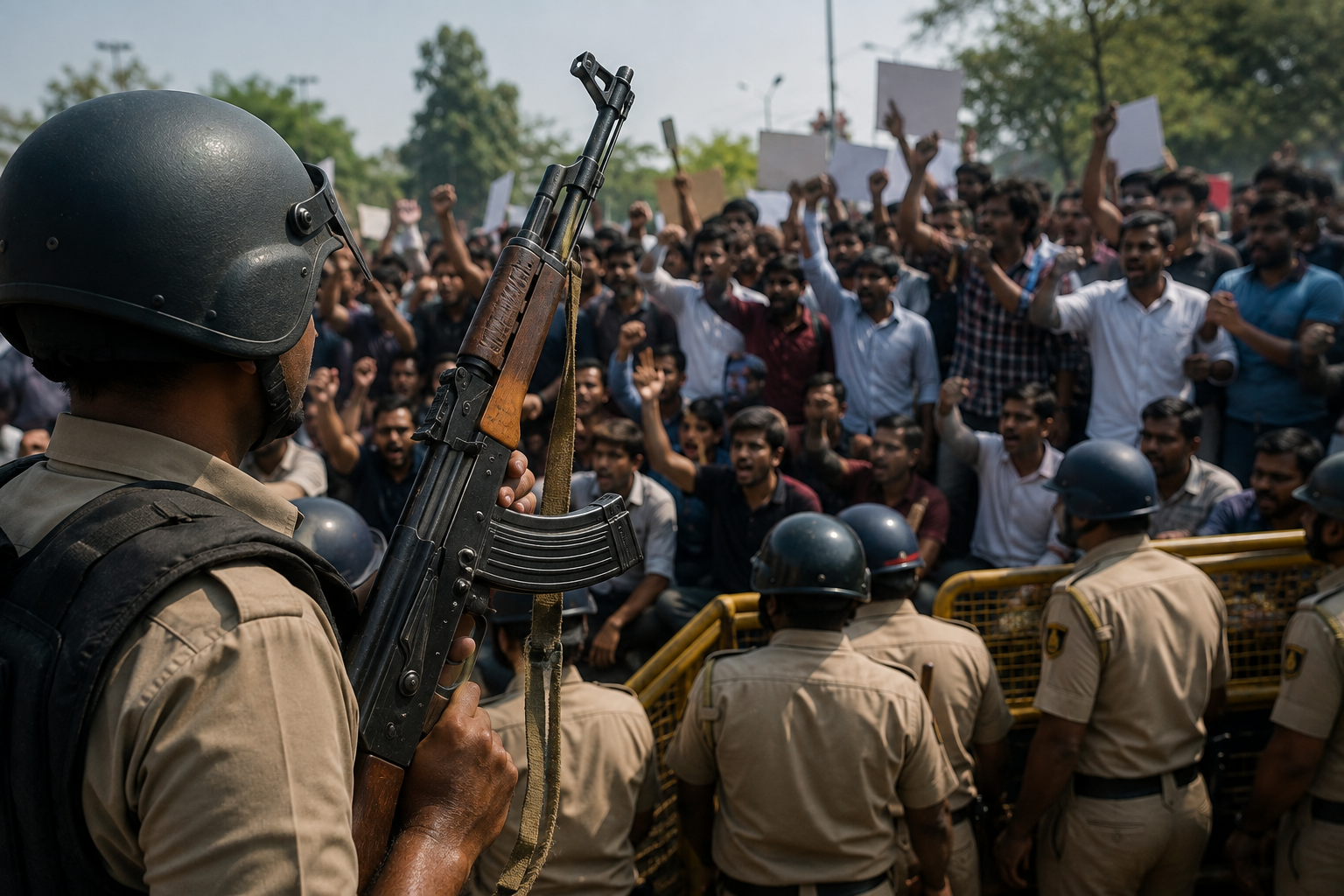
State government acknowledges four AK-47 rounds were fired into the air during Siwan protests, while three protesters suffered minor firearm injuries in a separate incident involving a 9 mm pistol
The Bihar government has told the Supreme Court that an AK-47 rifle was used during student protests in Siwan linked to the NEET paper-leak controversy, but maintained that none of the protesters was injured by the rifle fire.
In a counter-affidavit filed before the apex court, the state said a police constable, who became trapped in a crowd during the protest, fired four rounds from an AK-47 into the air to disperse the gathering and extricate himself.
The government, however, made an important admission: the AK-47 is a platoon-level weapon intended for special operations and not for routine law-and-order situations.
The constable involved in the incident has been suspended and departmental proceedings have been initiated against him.
The affidavit was filed in response to public-interest litigations alleging police brutality and the use of disproportionate force against students during protests over alleged irregularities in the NEET examination.
Bihar Government Says No One Was Injured by AK-47 Fire
According to the state's account, the four rounds fired from the AK-47 were directed into the air.
The Bihar government has specifically stated that no protester was injured by the AK-47 firing.
The state has sought to distinguish this incident from another firing that took place near Hathi Chowk, where an assistant sub-inspector reportedly fired two rounds from a 9 mm pistol to disperse the crowd.
Three protesters suffered minor firearm injuries in that separate incident, according to the affidavit.
The government has maintained that those three protesters were neither injured by the AK-47 nor present at the location where the rifle was used.
Constable Suspended, Departmental Action Initiated
The use of the AK-47 has nevertheless prompted disciplinary action.
The state said the constable who fired the weapon had been suspended for what it described as undesirable conduct.
Departmental proceedings have also been initiated against him.
The government further stated that the Bihar Director General of Police has issued instructions regarding the use of such weapons.
The disciplinary action is significant because the state's own affidavit acknowledges that an AK-47 is not intended for conventional crowd-control or routine law-and-order situations.
The case could therefore raise questions about whether the constable violated operational protocols and whether adequate instructions were communicated to officers deployed during the protests.
Three Protesters Suffered Minor Firearm Injuries
The affidavit separately records injuries suffered by three protesters near Hathi Chowk.
According to the state, an ASI fired two rounds from a 9 mm pistol while attempting to disperse the mob.
Three protesters sustained minor firearm injuries in that incident.
The government has stressed that this was a separate event from the AK-47 firing.
A ballistic examination is currently underway to establish details relating to the firing, including the type of weapon involved, firing distance and angle.
The forensic findings could become important evidence in the Supreme Court proceedings.
Ballistic Investigation Could Clarify the Events
The ongoing ballistic examination is expected to help authorities reconstruct the circumstances surrounding the firearm injuries.
Investigators are examining factors such as:
-
The type of firearm used
-
The distance from which the shots were fired
-
The direction and angle of firing
-
The nature of the projectiles
-
Whether the injuries correspond with the state's account
The findings could help establish whether the three injured protesters were hit during the 9 mm pistol firing, as claimed by the government.
They could also provide independent forensic evidence for the court while it considers allegations of excessive police force.
Government Denies Deliberate Use of Disproportionate Force
The Bihar government has denied allegations that police deliberately used disproportionate force to harm student protesters.
In its affidavit, the state has instead argued that protests turned violent in several parts of Bihar and that police personnel were also attacked.
The government said protesters damaged public property and that law-and-order personnel were confronted by what it described as anti-social elements.
The state's position is that the police response must be assessed in the context of the violence that occurred during the demonstrations.
Protests Spread Across Several Districts
According to the affidavit, violent incidents were reported in multiple locations, including:
-
Patna
-
Jehanabad
-
Chapra
-
Bhagalpur
-
Sitamarhi
-
Aurangabad
-
Katihar
-
Kishanganj
-
Siwan
The state said the unrest resulted in injuries to 157 police personnel and seven public servants.
The figures have been cited by the government to demonstrate the scale of the law-and-order challenge faced by authorities.
The Supreme Court will nevertheless have to assess whether the police response at individual locations was proportionate to the circumstances prevailing there.
Tear Gas and Water Cannons Were Also Used
The Bihar government has acknowledged that police used tear gas and water cannons during the protests.
The state also acknowledged that these crowd-control measures resulted in injuries to some protesters.
The use of non-lethal crowd-control measures is likely to form part of the wider judicial examination of police conduct.
The central issue will be whether officers followed established procedures and whether the level of force used was appropriate given the circumstances at each protest site.
Why the AK-47 Admission Is Significant
The government's acknowledgement that an AK-47 is a special-operations weapon rather than a law-and-order weapon is one of the most significant elements of the affidavit.
The question is not simply whether the weapon caused injuries.
The incident raises broader questions about why such a weapon was available during a student protest, what instructions officers had received and under what circumstances it could be used.
The suspension of the constable suggests that the state itself considers the firing to have been outside acceptable conduct.
The departmental inquiry will therefore be closely watched for findings about individual responsibility and operational procedures.
Supreme Court Examines Allegations of Police Brutality
The affidavit was filed in proceedings arising from PILs alleging police brutality during the NEET-related protests.
The petitions have placed the state's handling of the demonstrations under judicial scrutiny.
The Supreme Court's examination is significant because the case involves competing claims.
Students and protesters have raised concerns about excessive force and injuries, while the government has highlighted attacks on police personnel and damage to public property.
The court's assessment will depend on evidence concerning what happened at the different protest locations.
Government to Preserve Video and Other Evidence
In response to the Supreme Court's directions, the Bihar government said it had instructed the Additional Director General of Police to preserve video footage and other records connected with the protests.
Such evidence could be critical in reconstructing the sequence of events.
Video recordings may help determine the size and behaviour of crowds, the position of police personnel, the circumstances in which force was used and the actions immediately preceding any firing.
The preservation of evidence could therefore become an important part of the court's eventual assessment.
Privacy Protection for Student Protesters
The Bihar government has also addressed concerns regarding the personal information of protesters.
According to the affidavit, personal information and digital data collected from protesters will not be disclosed publicly or shared on social media for the time being.
The government said that details identifying protesters, particularly students, would not be published.
The move is significant because many of the individuals involved in the protests are students and young people who could face long-term consequences from public disclosure of their personal information.
No Coercive Action Against Students Without Criminal Antecedents
The state also told the Supreme Court that Bihar Police was not taking coercive action against students who had no criminal antecedents.
This distinction is intended to separate students participating in protests from individuals accused of violence or other criminal activity.
The government further stated that people below the age of 18 who had been arrested or detained in connection with the protests and had no criminal antecedents were released on simple bonds executed by themselves or their family members.
The approach appears aimed at limiting the consequences for minors and students who were not accused of serious criminal conduct.
Police Personnel Also Injured During Protests
A significant component of the state's defence is the number of police personnel who were reportedly injured.
The government has said that 157 police personnel and seven public servants suffered injuries during the protests.
It also alleged that protesters deliberately attacked police personnel and damaged public property.
These claims are likely to be examined alongside allegations of excessive force.
The broader legal question is whether police were responding to a genuine threat to public order and, if so, whether the methods used remained within the boundaries of law and established policing procedures.
The Proportionality Question
At the centre of the case is the principle of proportionality.
Police authorities have the responsibility to maintain public order and protect people and property. At the same time, protesters have legal rights, including the right to peaceful assembly subject to applicable restrictions.
When demonstrations become violent, authorities may need to use force.
However, the nature and degree of that force remain important.
The use of an AK-47, even if fired into the air, therefore raises a different level of concern from the deployment of ordinary crowd-control measures.
The Supreme Court's proceedings could help clarify how such situations should be handled in the future.
The NEET Controversy Adds to the Sensitivity
The protests took place against the backdrop of continuing concerns surrounding the integrity of the NEET examination.
For students, examination-related controversies are particularly sensitive because competitive tests can determine access to higher education and future careers.
Allegations of paper leaks or examination irregularities can therefore generate significant public anger.
The use of force during such protests can further intensify concerns about fairness and accountability.
This makes the Bihar case important not only from a policing perspective but also in the broader context of student rights and examination governance.
Questions the Supreme Court May Examine
Several questions could remain relevant as the proceedings continue:
-
Why was an AK-47 available during a law-and-order deployment?
-
Did the constable have authorisation to carry the weapon?
-
Were clear instructions issued regarding its use?
-
Were the four rounds fired only into the air?
-
Did any projectile from the AK-47 cause an injury?
-
What caused the injuries suffered by the three protesters?
-
Was the 9 mm pistol firing necessary and proportionate?
-
Were tear gas and water cannons deployed according to procedure?
-
Were police personnel themselves subjected to unlawful violence?
-
Were adequate safeguards in place to protect peaceful protesters?
-
What disciplinary action should follow if procedures were violated?
The answers will depend on documentary, video, medical, ballistic and departmental evidence.
Police Training and Crowd Management Under Scrutiny
The incident also highlights the importance of police training for large-scale protests.
Crowd management requires officers to make rapid decisions in unpredictable circumstances.
However, the availability and use of firearms must be governed by clear protocols.
The AK-47 incident could therefore prompt questions about the equipment carried by police units, command structures and the training provided to personnel deployed during protests.
The departmental inquiry could potentially identify whether the incident resulted from an individual decision or weaknesses in deployment procedures.
Evidence Will Be More Important Than Competing Claims
The government's affidavit provides its version of events, while the PILs before the Supreme Court raise allegations concerning police conduct.
The final assessment will require objective evidence.
Video footage, police records, medical reports, ballistic findings and witness accounts could all play a role.
The state's decision to preserve video and other records is therefore particularly important.
A transparent examination of this evidence could help establish accountability while also protecting police personnel from allegations that cannot be supported by facts.
What Happens Next?
The immediate focus will remain on the Supreme Court proceedings and the investigations into the firing incidents.
The ballistic examination will be important in establishing the circumstances surrounding the injuries suffered by the three protesters.
The departmental proceedings against the suspended constable will also determine whether further disciplinary action is warranted.
Meanwhile, the state will need to demonstrate that it is implementing appropriate safeguards for future protests and law-and-order deployments.
Broader Implications for Protest Policing
The Bihar case could have implications beyond the NEET protests.
Student demonstrations over examinations, recruitment and education policies frequently attract large crowds. Authorities therefore need clear protocols for dealing with such gatherings.
The challenge is to maintain public order without unnecessarily escalating tensions.
At the same time, protesters must also comply with the law and avoid violence, attacks on public servants or destruction of property.
The case illustrates the difficult balance between public order, police powers and the right to peaceful protest.
Accountability Will Be the Key Issue
The most important question going forward is whether the investigation establishes clear individual and institutional accountability.
If the suspended constable is found to have violated established procedures, appropriate disciplinary action will be necessary.
Similarly, if evidence establishes that other officers used excessive force, those actions will also require scrutiny.
At the same time, allegations of violence by protesters need to be investigated through due process.
An evidence-based approach will be essential to maintain public confidence in the outcome.
Conclusion
The Bihar government's affidavit before the Supreme Court has provided a detailed account of the controversial use of firearms during the NEET-related student protests.
The state has acknowledged that a constable fired four rounds from an AK-47 into the air after becoming trapped in a crowd, but maintains that no protester was injured by the rifle fire. The government has also admitted that the AK-47 is a weapon meant for special operations rather than routine law-and-order duties.
The constable has been suspended and departmental proceedings have begun.
Separately, the state says an ASI fired two rounds from a 9 mm pistol near Hathi Chowk and that three protesters suffered minor firearm injuries. A ballistic examination is underway to establish the circumstances surrounding those injuries.
The government has also acknowledged the use of tear gas and water cannons, while highlighting injuries to police personnel and public servants during violent incidents across several districts.
The Supreme Court's scrutiny will ultimately centre on evidence, proportionality and accountability.
The preservation of video footage, forensic examination of firearms and medical evidence could prove crucial in determining what happened at the protest sites.
For Bihar, the case is more than an examination-related dispute. It is also a test of how authorities balance public order with citizens' rights, particularly when protests involve students and young people.
The outcome could provide important guidance for future police responses to large-scale demonstrations and reinforce the principle that both public safety and police accountability must remain central to crowd-control operations.