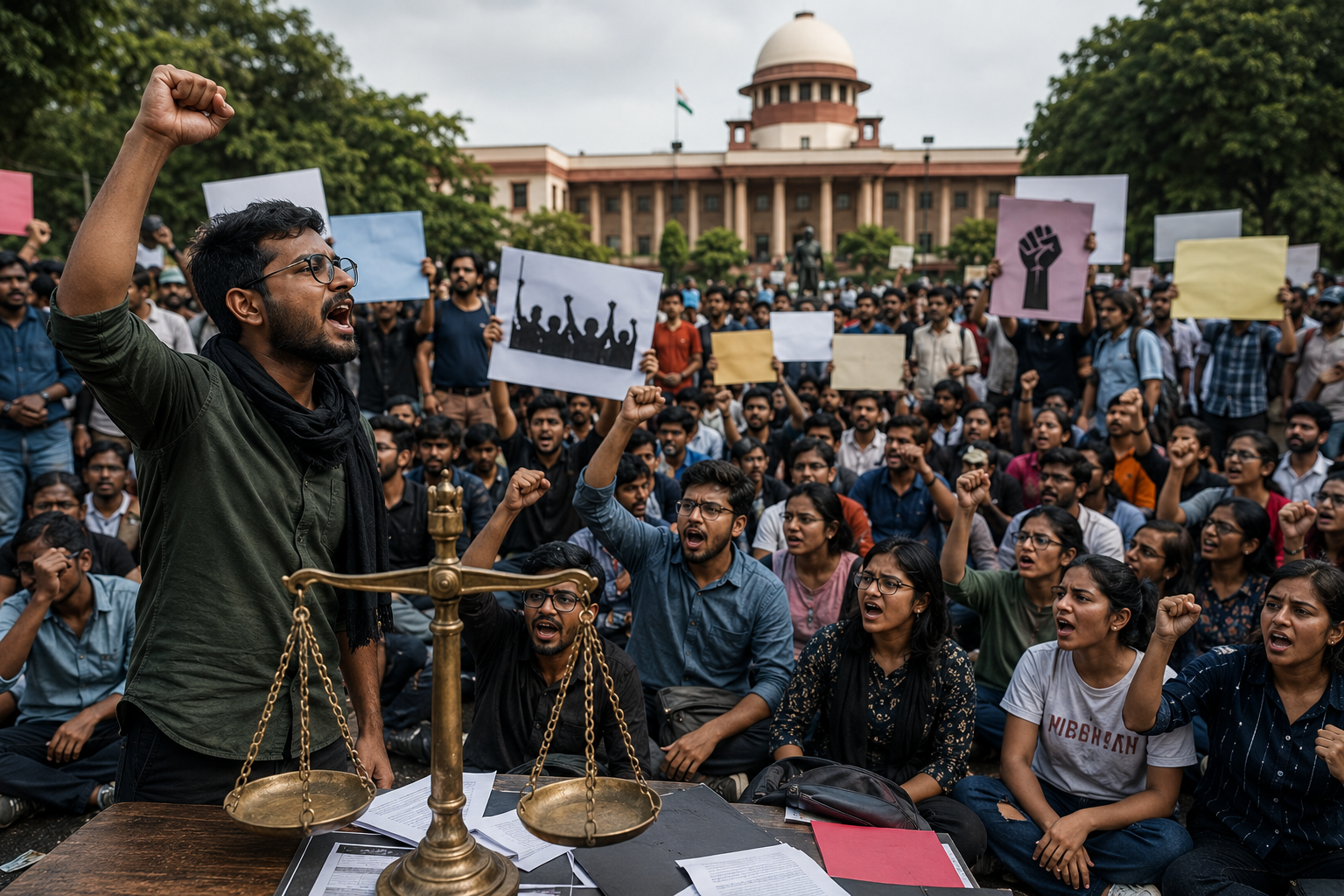
Government orders a comprehensive probe into recruitment examinations since 2014 and sets up an exam-reforms committee, but the demand for a CBI investigation remains unresolved
Jharkhand's prolonged student agitation over alleged irregularities in recruitment examinations reached a major turning point on Monday after the state government announced the cancellation of the Jharkhand Staff Selection Commission Combined Graduate Level (JSSC-CGL) examination and all recruitment examinations conducted by TSR Data Processing Private Limited (TDPL).
The announcement came on the 24th day of protests by students and government-job aspirants in Ranchi. Hours later, student leader Devendra Nath Mahto ended his 16-day hunger strike at Sadar Hospital, signalling a temporary de-escalation of the agitation.
The government has also ordered the CID to investigate alleged irregularities in recruitment examinations conducted since 2014 and announced an examination-reforms committee headed by senior IAS officer Amitabh Kaushal.
However, the dispute is not completely over. Protesters continue to demand a Central Bureau of Investigation (CBI) probe, while candidates who cleared the cancelled JSSC-CGL examination have begun questioning the government's decision and are considering legal action.
Government Accepts Two Major Demands
The Jharkhand government's latest decision addresses two of the protesters' central demands.
Chief Minister Hemant Soren, following a Cabinet meeting, announced that the JSSC-CGL examination would be cancelled and that all recruitment examinations conducted by TDPL would also be scrapped.
The government also decided to cancel the results and selections associated with the affected TDPL examinations.
The decision came after weeks of pressure from students who had demanded that disputed examinations be cancelled and the recruitment system be overhauled.
The government said its decision was influenced by findings emerging from ongoing CID and SIT investigations into alleged examination irregularities.
Why the JSSC-CGL Cancellation Matters
The JSSC-CGL examination was conducted in 2024, and the recruitment process had already progressed significantly.
Around 1,800 successful candidates had reportedly joined various Jharkhand government departments after clearing the examination.
That makes the cancellation considerably more complicated than simply scrapping an upcoming examination.
For candidates who had already secured government positions, the decision potentially affects employment, career plans and financial stability. Some successful candidates have argued that they cleared the examination fairly and should not be punished for alleged irregularities committed by others.
The government will now have to determine how the affected candidates are treated while simultaneously ensuring that the integrity of the recruitment process is protected.
Mahto Ends 16-Day Hunger Strike
Devendra Nath Mahto ended his hunger strike at Sadar Hospital after the Cabinet announcement.
Mahto broke his fast in the presence of state ministers Dipika Pandey Singh and Irfan Ansari. Student leaders Umme Habiba and Rahul Kranti also ended their hunger strikes.
Mahto welcomed the government's decision while making it clear that the broader campaign for examination reforms would continue.
He described the cancellation of the JSSC-CGL examination as a major achievement but said the movement's larger objective was to create a recruitment system in which examination processes are monitored and audited at every stage.
The student leader has therefore shifted from an immediate protest strategy toward continued pressure for structural reforms.
"Suspending the Protest" Does Not Mean the Issue Is Over
The end of Mahto's hunger strike should not be interpreted as the complete end of the student movement.
Mahto himself has said that he is suspending the protest while continuing the struggle for reform.
Other representatives have also maintained that the demand for an independent investigation has not been addressed.
Ravindra Paswan, a spokesperson for the protesters, said the movement could continue over the CBI probe demand. Some other protesters have also indicated that they will study the government's notification before deciding on their next course of action.
This leaves the government facing another round of negotiations even after making significant concessions.
CBI Probe Remains the Biggest Unresolved Demand
The most important issue separating the protesters and the state government is now the demand for a CBI investigation.
The government has opted for a state-level investigation through the CID, while protesters argue that a central agency would provide greater independence and credibility.
Their argument is that the investigation should examine the alleged irregularities across the recruitment process and identify those responsible, rather than focusing only on selected cases.
The protesters have therefore indicated that cancellation of the examinations alone will not completely satisfy them.
Government Orders Investigation Into Exams Since 2014
The state government has widened the scope of its investigation considerably.
The CID has been directed to examine alleged irregularities in recruitment examinations conducted in Jharkhand since 2014.
This is significant because the latest controversy is no longer limited to a single examination or recruitment agency.
The investigation could potentially examine the functioning of examination bodies, outsourced service providers, question-paper handling, examination administration and other stages of the recruitment process.
The findings could determine whether the alleged problems were isolated incidents or part of a broader systemic weakness.
Investigation Into the 14th JPSC Examination Triggered the Latest Crisis
The controversy intensified following allegations surrounding the 14th Jharkhand Public Service Commission Civil Services preliminary examination.
The CID registered a case in July to investigate alleged irregularities in the examination.
According to reports, the investigation has led to arrests, including that of former JPSC chairman L Khiangte, along with individuals associated with TDPL and alleged intermediaries. Authorities are examining whether links between the alleged irregularities in the JPSC examination and the JSSC-CGL recruitment process exist.
The investigation subsequently became a major catalyst for the student movement.
How the Protest Expanded
The agitation began with demands concerning alleged irregularities in competitive examinations but gradually expanded into a wider campaign for recruitment-system reforms.
Students and job aspirants gathered in Ranchi and held sit-ins, marches and hunger strikes.
The protesters eventually marched toward the state Assembly and warned that they could intensify the agitation, including a proposed gherao of the Chief Minister's residence, if their demands were not addressed.
The government was therefore facing growing pressure from a movement that had moved beyond a single examination and begun raising questions about the credibility of the state's recruitment system.
The 14th JPSC Exam Had Already Been Cancelled
The JSSC-CGL cancellation followed an earlier government decision concerning the 14th JPSC Civil Services examination.
Chief Minister Soren had already announced that the 14th JPSC examination would be cancelled, along with two other JPSC examinations.
The government subsequently said examinations conducted by TDPL would also be investigated.
The latest Cabinet decision now expands the cancellation to all recruitment examinations conducted by the outsourced agency, creating a much wider administrative challenge.
New Examination Reform Committee
Recognising that cancellation alone cannot solve the underlying problem, the government has announced an examination-reforms committee.
Senior IAS officer Amitabh Kaushal will head the panel, which is expected to examine the recruitment examination process and recommend corrective measures.
The objective is to strengthen the system and make future examinations more secure and transparent.
The committee's recommendations could potentially cover examination monitoring, paper security, technology, outsourced agencies, evaluation procedures and accountability mechanisms.
The effectiveness of the initiative, however, will depend on how quickly its recommendations are implemented.
Why Examination Reform Has Become Critical
Government recruitment examinations affect thousands of candidates who invest significant amounts of time and money preparing for competitive tests.
Any allegation of paper leaks or manipulation can therefore have consequences far beyond one examination.
A cancelled examination can force candidates to repeat months or years of preparation. At the same time, allowing a potentially compromised examination to stand could undermine confidence in the recruitment process.
The government now faces the difficult task of balancing fairness to genuine candidates with accountability for alleged irregularities.
Candidates Who Cleared the Exam Raise New Concerns
The cancellation has produced a second wave of uncertainty among successful JSSC-CGL candidates.
Some candidates who cleared the examination have protested the government's decision, arguing that they followed the rules and should not lose their jobs because of allegations against others.
Reports indicate that affected candidates may approach the courts and are expected to discuss their future course of action.
This could turn the recruitment controversy into a prolonged legal dispute.
The government may therefore have to defend its decision before the judiciary and demonstrate why cancellation was necessary and proportionate.
Legal Challenge Could Become the Next Flashpoint
The potential court challenge is likely to be one of the most important developments to watch.
The affected candidates could seek protection for appointments already made or request that the government investigate individual cases rather than cancel the entire recruitment process.
The state, on the other hand, may argue that preserving the credibility of the examination requires cancellation where the integrity of the process is sufficiently questioned.
The eventual legal outcome could have implications for how governments across India deal with recruitment examinations where alleged irregularities emerge after results or appointments.
Political Dimension of the Jharkhand Protest
The examination controversy has also attracted political attention.
Opposition leaders and public figures have urged the state government to engage directly with protesting students.
Congress leader Rahul Gandhi urged Chief Minister Hemant Soren to meet the students and resolve the dispute.
The government's decision to cancel the JSSC-CGL and TDPL examinations came after this growing political and public pressure.
The issue could remain politically significant if protests continue over the CBI investigation or if legal challenges by successful candidates gain momentum.
What Happens to the Cancelled Examinations?
The next immediate challenge will be the government's implementation plan.
Candidates will need clarity on whether fresh examinations will be conducted, how existing candidates will be accommodated and whether age limits and application conditions will be adjusted.
For candidates who spent years preparing for the affected examinations, a fresh recruitment cycle could create additional financial and time burdens.
The government may therefore need to provide a detailed roadmap rather than simply announcing cancellations.
Key Questions the Government Must Answer
Several questions now require clear answers:
-
When will fresh examinations be conducted?
-
Will candidates receive any relaxation in age limits?
-
Will fresh application fees be waived?
-
What happens to candidates who have already joined government departments?
-
Will previous candidates receive priority or special consideration?
-
What action will be taken against individuals found responsible for irregularities?
-
Will the government agree to a CBI investigation?
-
When will the examination-reforms committee submit its recommendations?
-
How will outsourced examination agencies be monitored in the future?
The answers to these questions will determine whether the latest government decision becomes a long-term solution or simply the beginning of another phase of the dispute.
From Cancellation to Systemic Reform
The Jharkhand government's decision has resolved the immediate question of whether the disputed examinations will continue.
But the larger challenge is rebuilding trust.
A credible recruitment system requires more than secure question papers. It needs transparency across the entire examination chain—from paper preparation and transportation to candidate verification, examination centres, evaluation, result publication and appointment.
Every stage needs clear accountability.
Mahto's demand for monitoring and auditing at every stage reflects this broader concern.
What Students Want Next
The protesters' next focus is likely to shift toward three major areas:
Independent investigation: Students want the CBI to investigate alleged irregularities.
Accountability: They want individuals found responsible for wrongdoing to face action.
Structural reforms: They want safeguards that prevent similar controversies from occurring in future examinations.
The government's response to these three issues will determine whether the movement gradually winds down or continues.
What Comes Next for the Government?
For the Hemant Soren government, the immediate priority will be implementing the Cabinet decision without creating further uncertainty.
The administration must simultaneously manage three sensitive areas: the investigation, the recruitment reforms and the future of candidates affected by the cancellations.
A transparent timeline could help reduce uncertainty.
The government may also need to communicate regularly with candidates and publish detailed information about future recruitment processes.
Without clear communication, the cancellation could create another layer of dissatisfaction among students.
A Test of Administrative Credibility
The Jharkhand recruitment controversy has now moved beyond a student protest.
It has become a test of the state's ability to investigate alleged wrongdoing, protect genuine candidates and reform its recruitment infrastructure.
The government has made a significant concession by cancelling the JSSC-CGL and TDPL examinations. It has also widened the investigation and announced an examination-reforms committee.
But implementation will ultimately determine the credibility of these measures.
Market Outlook
The Jharkhand examination controversy has limited direct implications for the stock market, but it carries wider significance for governance, employment and public administration.
For the state government, the immediate political pressure has eased after the cancellation of the disputed examinations and the end of Mahto's hunger strike. However, the situation remains fluid because the CBI investigation demand has not been accepted, while successful JSSC-CGL candidates are considering legal action.
The next phase will therefore be closely watched for four developments: the scope and findings of the CID investigation, the functioning of the Amitabh Kaushal-led reform committee, the government's treatment of already-appointed candidates and the possibility of court intervention.
For students and job aspirants, the key issue is no longer only whether examinations are cancelled. It is whether Jharkhand can create a recruitment system in which examinations are secure, results are credible and candidates can trust the process from application to appointment.
The latest decision marks an important victory for the protesting students, but the real test for the Jharkhand government begins now—with investigation, accountability and implementation of meaningful examination reforms.