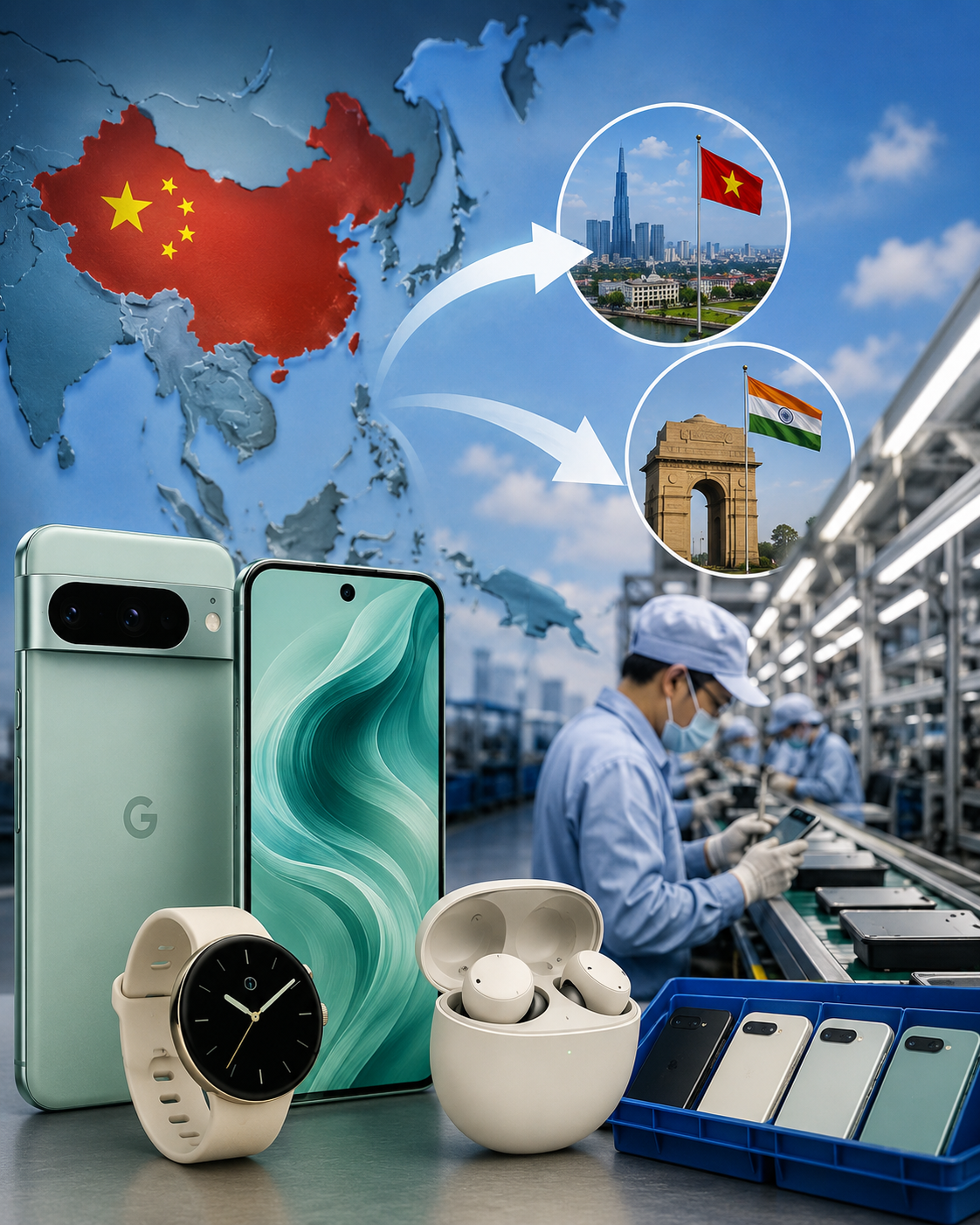
Google is accelerating its supply-chain diversification strategy, with Vietnam and India emerging as key manufacturing hubs as US-China tensions reshape the global electronics industry
Google is reportedly preparing to completely move production of its Pixel smartphones, smartwatches and wireless earbuds out of China by 2027, marking a significant shift in the technology giant’s global manufacturing strategy.
According to a report by Nikkei Asia, Google plans to stop manufacturing its Pixel devices in China from 2027 as it seeks to reduce its exposure to geopolitical and supply-chain risks arising from continuing tensions between the United States and China.
The company has been steadily expanding manufacturing operations in Vietnam and India, and the successful production of advanced Pixel smartphones in Vietnam has reportedly given Google greater confidence that it can achieve its China-exit target.
If implemented, Google would become the second major global smartphone manufacturer after Samsung to completely shift smartphone production away from China.
Google Moves Beyond China-Centric Manufacturing
For years, China has been one of the world's most important manufacturing centres for smartphones and consumer electronics. The country offers an extensive supplier ecosystem, skilled labour, established component networks and large-scale manufacturing capacity.
However, increasing US-China tensions, trade restrictions and supply-chain disruptions have encouraged global technology companies to diversify production.
Google has already been following this trend.
The company began expanding Pixel manufacturing outside China several years ago, with Vietnam becoming an increasingly important production base. India has also emerged as a major part of Google's manufacturing strategy.
The latest reported target represents a much larger step: instead of simply reducing its dependence on China, Google is looking to remove China from the Pixel production chain altogether.
Vietnam Becomes a Critical Manufacturing Base
Vietnam is expected to play a central role in Google's production strategy.
The company has reportedly successfully developed and manufactured high-end Pixel smartphones in Vietnam this year. This is particularly significant because flagship smartphones require more sophisticated production capabilities than relatively simpler products such as wireless earbuds and smartwatches.
The successful production of premium Pixel devices in Vietnam has reportedly increased Google's confidence in shifting the remaining manufacturing activity out of China.
Vietnam has become one of the most important alternative manufacturing destinations for global electronics companies, particularly those seeking to reduce their dependence on China while remaining within the broader Asian supply chain.
India Emerges as Another Strategic Hub
India is also becoming increasingly important to Google's manufacturing plans.
The company has expanded local Pixel assembly in India, supported by the country's growing electronics manufacturing ecosystem and government efforts to attract global technology companies.
India offers Google two major advantages: a large and growing domestic smartphone market and the potential to develop the country into a manufacturing and export hub.
Earlier industry reports indicated that Google has been increasing Pixel production in India and working with manufacturing partners including Foxconn and Dixon Technologies.
The latest reported strategy could therefore accelerate India's role in Google's global Pixel supply chain.
Why Google Wants to Leave China
The reported decision is closely linked to the changing geopolitical environment.
US-China tensions have made supply-chain concentration a strategic risk for global technology companies. Tariffs, trade restrictions, export controls and geopolitical uncertainty can potentially increase manufacturing costs and create disruptions.
By spreading production across Vietnam and India, Google can reduce its dependence on a single manufacturing geography.
This strategy is commonly described as "China plus one", in which companies maintain some Chinese operations while establishing alternative manufacturing centres elsewhere.
Google's reported plan goes a step further by potentially removing China entirely from Pixel manufacturing.
Pixel Not Being Sold in China May Make Transition Easier
One factor could make Google's transition comparatively straightforward: Pixel smartphones are not officially sold in the Chinese market.
That means Google does not need to maintain a major Pixel manufacturing base in China specifically to serve Chinese consumers.
The absence of a significant domestic Pixel sales market could give the company greater flexibility to relocate production without simultaneously having to redesign its China-specific distribution network.
This could be an important strategic advantage compared with smartphone companies that have significant sales and manufacturing operations inside China.
Google Targets 8-10% Growth in Pixel Shipments
Google is not reducing its manufacturing ambitions despite the supply-chain restructuring.
According to the reported Nikkei Asia information, Google expects Pixel shipments to rise by approximately 8-10 per cent this year, from around 12 million units last year.
Maintaining shipment growth while relocating manufacturing is a significant operational challenge.
The company will need to ensure that production capacity in Vietnam and India can expand quickly enough to meet demand without affecting product availability.
Any disruption during the transition could potentially affect shipments, inventory levels and product launches.
Gemini AI Is Central to Google's Pixel Strategy
Pixel smartphones are strategically important to Google for reasons beyond hardware sales.
Google increasingly sees its smartphones as a way to bring more users into its artificial-intelligence ecosystem, particularly its Gemini AI services.
The company can use Pixel devices to showcase new AI capabilities and integrate Gemini more deeply into Android.
This creates a strategic relationship between Pixel hardware and Google's broader AI ambitions.
As competition in generative AI intensifies, having a large installed base of smartphones capable of running Google's AI services could become increasingly valuable.
Therefore, maintaining Pixel shipment growth is important not only for hardware revenue but also for Google's broader consumer AI strategy.
Pixel 11 Raises the Stakes in the Premium Segment
Google recently launched its latest Pixel 11 series, including the Pixel 11, Pixel 11 Pro and Pixel 11 Pro Fold.
The new generation starts at $899 for the 256GB version, compared with the previous-generation Pixel 10's starting price of $799 for a 128GB model.
The higher starting price reflects Google's continued effort to strengthen Pixel's position in the premium smartphone market.
The company is competing directly with Apple and Samsung in a segment where consumers place significant importance on cameras, artificial intelligence, performance, software support and ecosystem integration.
Recent coverage of the Pixel 11 launch indicates that Google is placing an even greater emphasis on Gemini-powered features and AI-driven user experiences.
Google Could Benefit From Higher iPhone Prices
Another potential opportunity for Google is Apple's pricing strategy.
The Nikkei report said Google could potentially gain market share in the United States, Japan and Europe if Apple increases iPhone prices.
Premium smartphone buyers are often willing to compare alternatives when flagship prices rise significantly.
Google could attempt to position Pixel as a premium alternative offering advanced AI features, high-end cameras and Android integration at a relatively competitive price.
However, converting this opportunity into meaningful market-share gains will depend on Google's ability to improve retail distribution, brand recognition and consumer adoption.
Memory Chip Prices Create a Major Challenge
Google's expansion strategy comes at a time when smartphone manufacturers are facing higher memory-chip prices.
Rising memory costs can put pressure on margins and potentially force manufacturers to increase retail prices or reduce shipment targets.
The reported Nikkei information indicates that Google has maintained its shipment ambitions despite these cost pressures.
The company is also reportedly combining orders for chips used in its cloud-computing operations with smartphone orders while negotiating with major memory suppliers such as Micron, Samsung and SK Hynix.
Such purchasing scale could strengthen Google's negotiating position and potentially help manage component-cost pressures.
Xiaomi, Oppo and Vivo Take a More Cautious Approach
Google's strategy stands in contrast to several Chinese smartphone manufacturers.
According to the report, Xiaomi, Oppo and Vivo have reduced their shipment forecasts multiple times this year as higher memory and component costs put pressure on the industry.
Apple and Huawei are also attempting to maintain shipment growth, highlighting the uneven impact of the memory-chip shortage across manufacturers.
Apple CEO Tim Cook has previously indicated that higher memory costs would affect the company's product portfolio, while Apple has already raised prices for some products in selected markets.
For Google, maintaining its shipment target despite these pressures could help it gain incremental market share if competitors become more cautious.
Supply-Chain Shift Could Benefit Indian Electronics Manufacturing
Google's reported China exit could have wider implications for India's electronics manufacturing industry.
India has been attempting to establish itself as a major global electronics production hub, with smartphone manufacturing among the strongest areas of growth.
The expansion of Pixel manufacturing could create opportunities across the wider ecosystem, including component suppliers, contract manufacturers, logistics providers and electronics assembly companies.
The increasing presence of companies such as Dixon Technologies and Foxconn-related manufacturing operations also indicates that India's electronics ecosystem is becoming more integrated into global smartphone supply chains.
If Google increases exports of India-made Pixel devices, the impact could extend beyond domestic sales and strengthen India's position as an export-oriented electronics manufacturing base.
Vietnam and India Could Divide Google's Manufacturing Role
Google's future supply chain could increasingly rely on a combination of Vietnam and India rather than one dominant manufacturing location.
Vietnam is already experienced in high-end electronics production and has established supplier relationships with global technology companies.
India, meanwhile, offers a large domestic market, expanding manufacturing capabilities and the potential to become a global export base.
A multi-country manufacturing network could allow Google to distribute production risk and respond more efficiently to changes in tariffs, demand and regional supply-chain conditions.
What the Move Means for China's Electronics Industry
Google's reported decision also highlights the pressure facing China's role as the dominant manufacturing base for global technology companies.
The shift does not mean China will lose its importance overnight. The country continues to possess one of the world's most comprehensive electronics ecosystems.
However, if more multinational companies establish large-scale manufacturing operations elsewhere, China's share of incremental global electronics production could gradually decline.
The development is therefore part of a broader structural trend rather than an isolated corporate decision.
A Broader Shift in Global Manufacturing
Google's reported strategy reflects a fundamental change in how technology companies think about manufacturing.
Earlier, companies largely focused on cost efficiency and supply-chain scale. Increasingly, they are also considering geopolitical risk, tariff exposure, supply-chain resilience and access to multiple manufacturing locations.
The result is a gradual diversification of production across countries such as India, Vietnam, Mexico and others.
For global electronics companies, maintaining multiple manufacturing hubs can increase costs in some areas, but it can also reduce the potential impact of a disruption in any one country.
Key Takeaways for Investors
For investors, Google's reported manufacturing shift has several broader implications.
First, it highlights the continued rise of India and Vietnam as alternatives to China for electronics manufacturing.
Second, it shows that geopolitical risk is increasingly influencing corporate capital-allocation and supply-chain decisions.
Third, Google's continued Pixel shipment ambitions indicate that the company remains committed to expanding its hardware business despite rising component costs.
Fourth, the connection between Pixel devices and Gemini AI means smartphone sales could become increasingly important to Google's broader AI strategy.
Finally, the shift could create opportunities for companies involved in Indian electronics manufacturing, component supply and contract manufacturing if Google and other global technology companies continue expanding local production.
Market Outlook
Google's reported plan to move all Pixel production out of China by 2027 is a significant development for the global electronics manufacturing industry and potentially positive for countries such as India and Vietnam, which are emerging as alternative production hubs.
For Google, however, the transition will need to be executed without disrupting Pixel supply or increasing costs to an extent that hurts margins.
The company's ability to grow Pixel shipments by 8-10 per cent while dealing with higher memory prices will remain an important test. At the same time, the growing integration of Gemini AI into Pixel devices could give Google a stronger strategic reason to expand its smartphone ecosystem.
For India, the development reinforces the country's growing role in global electronics manufacturing. If Google continues to scale local production and exports, the impact could extend beyond Pixel phones to the broader electronics supply chain.
Overall, the reported China exit reflects a much larger trend: global technology manufacturing is moving from a China-centric model toward a diversified network led by countries such as India and Vietnam.