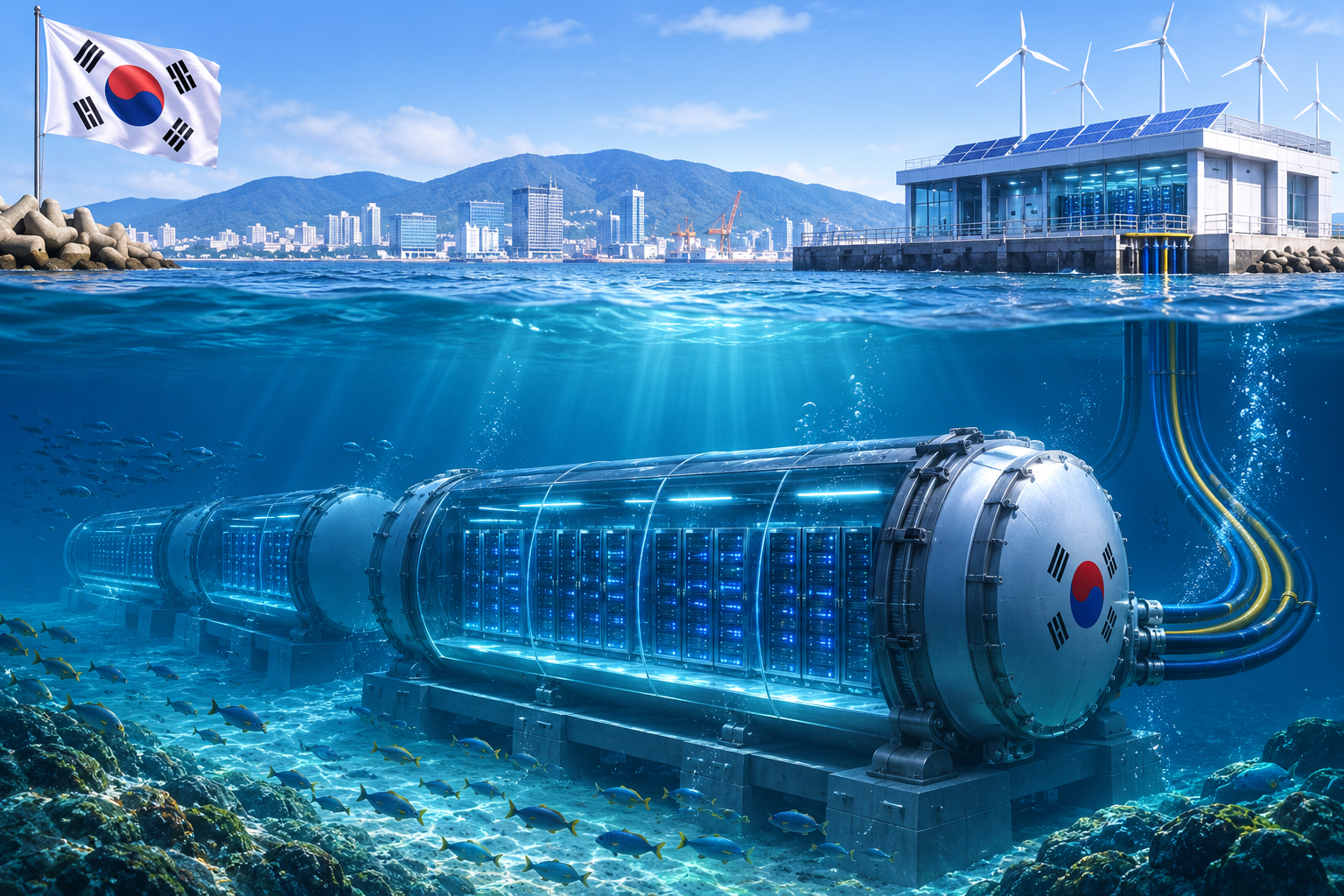
Ulsan's ambitious subsea computing project could eventually support 100,000 servers, using naturally cool seawater to reduce cooling requirements and create a new model for AI infrastructure
South Korea is exploring an unconventional solution to one of the biggest challenges created by the artificial intelligence boom: building enough computing infrastructure without running into shortages of land, electricity and cooling capacity.
The city of Ulsan is developing an underwater data-centre project that could eventually accommodate around 100,000 servers. The initiative is being developed with the Korea Institute of Ocean Science and Technology and a group of industrial, academic and research organisations.
The concept is straightforward but technologically demanding: place specialised data-centre infrastructure beneath the sea and use the surrounding seawater as a natural cooling resource.
If successful, the project could provide a new blueprint for high-density AI computing in coastal regions where conventional data-centre development faces physical constraints.
AI Boom Is Creating a Physical Infrastructure Challenge
The global AI expansion has created unprecedented demand for computing power.
Training and operating advanced AI models requires enormous quantities of high-performance processors, particularly GPUs. These chips consume substantial amounts of electricity and generate large quantities of heat.
As computing density increases, data-centre operators must solve three fundamental problems:
- Where to build the facility
- How to supply sufficient electricity
- How to remove the heat generated by servers
Traditional data centres address these problems through large land-based facilities, extensive power connections and increasingly sophisticated cooling systems.
South Korea is now examining whether the ocean can help solve at least part of the equation.
Ulsan Wants to Create a New Data-Centre Model
The Ulsan project is not simply an experiment involving servers placed underwater.
Engineers are working on a dedicated infrastructure model involving pressure-resistant enclosures, modular server systems, specialised power equipment and high-efficiency cooling technology.
The broader objective is to create a standardised underwater data-centre model that could eventually be commercialised and replicated.
This could transform the concept from a technology demonstration into a potential infrastructure platform.
Seawater Becomes a Natural Cooling Resource
Cooling is one of the most important considerations in modern AI data centres.
High-performance GPUs generate substantial heat, requiring powerful cooling systems to maintain safe operating temperatures.
Ulsan's coastal environment offers an important advantage.
The relatively cool seawater can act as a natural heat sink, potentially reducing the amount of electricity required by conventional cooling systems.
This is particularly attractive as AI workloads increase the amount of heat generated per square metre of data-centre space.
Why Cooling Efficiency Matters
A data centre does not use electricity only to operate servers.
Additional power is required for cooling, networking, backup systems, lighting and other infrastructure.
The more efficiently a facility can remove heat, the greater the proportion of electricity that can be directed towards actual computing.
This is measured partly through Power Usage Effectiveness, or PUE.
A lower PUE generally indicates a more energy-efficient data-centre operation.
The Ulsan project is targeting a highly efficient cooling architecture as part of its technology demonstration.
AI Is Increasing Server Heat Density
The cooling challenge is becoming more significant because AI computing is fundamentally different from many traditional workloads.
Large AI models require clusters of high-performance processors operating simultaneously.
As more GPUs are packed into smaller spaces, heat density increases.
Conventional air cooling becomes less effective at extremely high densities, encouraging the industry to explore liquid cooling and other advanced thermal-management technologies.
Underwater infrastructure represents another possible extension of this trend.
Underwater Computing Could Reduce Land Requirements
Large data centres require significant amounts of land.
Suitable sites must also have access to electricity, fibre connectivity, roads and cooling infrastructure.
In densely populated regions, finding such land can be difficult and expensive.
Moving computing infrastructure offshore could create access to an entirely different physical environment.
For countries with limited land availability, this could become increasingly attractive if the technology proves commercially viable.
Power Availability Remains the Bigger Constraint
Land availability is only one part of the problem.
The AI industry is increasingly competing for access to electricity.
Large AI data centres can require enormous amounts of power, and connecting new facilities to the grid can take considerable time.
South Korea's experience highlights the challenge of expanding computing infrastructure while ensuring sufficient grid capacity.
An underwater data centre does not automatically solve the electricity problem, but it could allow infrastructure planners to rethink where high-density computing facilities are located.
Ulsan Is Building a Broader AI Infrastructure Ecosystem
The underwater project is taking place alongside wider efforts to establish Ulsan as an AI infrastructure hub.
The city already has a strong industrial base, including energy, manufacturing and engineering capabilities.
The presence of telecommunications companies, technology providers and industrial engineering firms could help create an ecosystem around advanced data-centre infrastructure.
This combination could make Ulsan an important testing ground for new approaches to AI computing.
SK Telecom Brings AI Expertise
SK Telecom is participating in the project and is responsible for developing the AI GPU infrastructure and server-operation model.
Its involvement is important because underwater computing requires more than marine engineering.
The facility must also be designed around actual AI workloads, server management, networking requirements and commercial operating conditions.
Bringing an experienced telecommunications and technology operator into the project can help bridge the gap between laboratory research and commercial deployment.
KIOST Provides Marine Technology Expertise
The Korea Institute of Ocean Science and Technology brings specialised knowledge of underwater environments.
This expertise is essential because subsea data centres must operate under conditions very different from traditional land-based facilities.
Engineers must account for:
- Water pressure
- Corrosion
- Marine currents
- Temperature changes
- Structural integrity
- Equipment recovery
- Subsea connectivity
The project therefore combines information technology with marine engineering.
Pressure Resistance Is Critical
An underwater facility cannot simply use conventional data-centre equipment.
As depth increases, water pressure also increases.
The proposed facility is expected to operate around 20 metres below the surface, requiring specially engineered enclosures capable of protecting computing and electrical equipment.
The ability to maintain a controlled internal environment will be central to the project's reliability.
Corrosion Could Become a Long-Term Challenge
Seawater is highly corrosive, creating an additional challenge for subsea infrastructure.
Electrical equipment, connectors and structural components must be protected against long-term exposure.
Materials selection and sealing technologies will therefore play an important role.
A cooling system that saves electricity but requires frequent replacement of expensive components may not ultimately provide a commercial advantage.
Maintenance Is One of the Biggest Questions
Perhaps the most important unanswered question is maintenance.
A conventional data centre allows engineers to walk into a server room and replace a faulty component.
An underwater facility requires specialised access procedures.
Equipment could potentially need to be recovered to the surface before repairs can be carried out.
This makes reliability particularly important.
The more reliable each underwater module becomes, the less frequently operators would need to intervene.
Modular Architecture Could Solve Some Maintenance Problems
The Ulsan project is exploring modular systems.
Rather than creating one enormous underwater structure, computing capacity could potentially be divided into modules.
If a module experiences a problem, it could theoretically be isolated or recovered without disrupting the entire facility.
Modularity could therefore improve both scalability and maintainability.
The Ocean Could Offer Virtually Unlimited Cooling Capacity
One of the strongest arguments for subsea computing is the availability of a huge natural heat sink.
Unlike conventional cooling towers or mechanical refrigeration systems, the ocean provides a massive surrounding environment into which heat can potentially be transferred.
The challenge is ensuring that this process remains environmentally responsible and does not create unacceptable effects on marine ecosystems.
Environmental Impact Will Need to Be Monitored
An underwater data centre could reduce electricity consumption associated with cooling, potentially lowering carbon emissions.
However, the environmental assessment must consider the entire system.
Questions include:
- How much energy does construction require?
- What is the impact of underwater installation?
- Does heat discharge affect marine life?
- How are underwater modules eventually removed?
- What happens to equipment at the end of its operating life?
A genuinely sustainable data-centre model will need to address these questions comprehensively.
Renewable Energy Could Strengthen the Model
The environmental case becomes stronger when underwater data centres are powered by low-carbon electricity.
South Korea has been expanding renewable-energy capacity, while offshore wind is also developing.
An underwater computing facility located near renewable generation could potentially combine clean electricity with natural seawater cooling.
This creates the possibility of an integrated renewable energy + underwater cooling + AI computing ecosystem.
Offshore Wind and Data Centres Could Work Together
Offshore wind farms generate electricity close to the ocean environment.
An underwater data centre located near offshore renewable generation could potentially reduce some transmission requirements, depending on the final architecture.
This could create a new model in which power generation and computing infrastructure are developed together.
The concept remains technologically and economically challenging, but the convergence of renewable energy and AI demand makes it increasingly relevant.
South Korea's Semiconductor Industry Adds Another Advantage
South Korea is already one of the world's major semiconductor manufacturing centres.
That creates an important strategic advantage as AI infrastructure expands.
The country has expertise across:
- Memory semiconductors
- Electronics
- Telecommunications
- Industrial engineering
- Advanced manufacturing
- Battery technology
An underwater AI infrastructure industry could potentially build on this existing technology ecosystem.
Underwater Data Centres Are Not Entirely New
South Korea is not the first country to investigate subsea computing.
Microsoft's Project Natick demonstrated the possibility of operating sealed data-centre modules underwater.
China has also developed underwater data-centre projects.
These experiments have helped establish that subsea computing is technically possible.
The next challenge is determining whether it can become economically competitive at commercial scale.
China Is Moving Toward Larger Deployments
China's underwater data-centre initiatives demonstrate growing interest in the technology.
The country's experience provides another indication that subsea computing could move beyond experimental projects.
For South Korea, developing its own technology could allow domestic companies to build expertise in an emerging segment of the global data-centre industry.
Commercial Viability Remains the Biggest Test
Technology alone will not determine whether underwater data centres succeed.
The economics must also work.
Developers will have to compare:
Potential savings
- Lower cooling energy
- Reduced land requirements
- Potentially higher computing density
against:
Additional costs
- Specialised construction
- Marine engineering
- Corrosion protection
- Installation
- Maintenance
- Equipment recovery
- Subsea connectivity
If the total cost of ownership becomes competitive with land-based facilities, commercial adoption could accelerate.
Reliability Could Be More Important Than Construction Cost
For AI operators, downtime can be extremely expensive.
A large AI data centre may support critical workloads for cloud platforms, enterprises and research institutions.
Consequently, operators are likely to prioritise reliability over theoretical energy savings.
The underwater technology will therefore need to demonstrate extremely high uptime before major operators commit large amounts of AI infrastructure to the model.
Fibre Connectivity Will Be Essential
Data centres are not useful without high-capacity network connections.
An underwater facility would need reliable fibre links to terrestrial networks and other computing locations.
Latency is also important for certain AI applications.
Ulsan's broader infrastructure plans therefore need to integrate subsea computing with high-speed terrestrial and submarine networks.
AI Data Centres Are Becoming Infrastructure Projects
The rise of AI is changing how data centres are viewed.
They are no longer simply buildings filled with computers.
They are becoming major infrastructure assets requiring:
- Electricity
- Water or cooling resources
- Semiconductor supply
- Fibre networks
- Construction
- Land
- Energy storage
- Backup power
The underwater project illustrates how governments and companies are increasingly treating AI computing as a strategic infrastructure issue.
The Data-Centre Industry Is Moving Toward Liquid Cooling
Even without underwater facilities, the industry is increasingly adopting liquid cooling.
Direct-to-chip cooling and other liquid-based systems can remove heat more efficiently than conventional air cooling.
This trend is important because it means underwater data centres are not an isolated concept.
They form part of a broader industry shift towards advanced thermal-management technologies.
Potential Opportunity for Industrial Technology Companies
If underwater data centres move towards commercial deployment, several industrial sectors could benefit.
Potential technology opportunities could emerge in:
- Cooling systems
- Power electronics
- Pressure-resistant equipment
- Subsea cables
- Marine engineering
- Sensors
- Monitoring systems
- Data-centre construction
- AI servers
- Power management
The technology ecosystem could become almost as important as the data-centre operators themselves.
Ulsan Could Become an Export Hub for the Technology
If South Korea successfully develops a standardised underwater data-centre model, the technology could potentially be exported.
Other coastal regions facing land and cooling constraints could become prospective markets.
Potential applications could emerge across densely populated coastal economies in Asia and elsewhere.
This would transform the Ulsan project from a local infrastructure experiment into a potential technology-export opportunity.
The Model Could Be Particularly Relevant for Coastal Cities
The concept is naturally suited to regions where:
- Land is expensive
- Data-centre demand is high
- Seawater is relatively cool
- Electricity infrastructure is available
- Fibre connectivity is strong
This could make coastal technology hubs particularly interested in subsea computing.
Not Every AI Workload Will Move Underwater
The technology is unlikely to replace conventional data centres entirely.
Some applications require extremely easy physical access, specialised equipment or proximity to terrestrial networks.
Large land-based facilities will remain important.
Underwater facilities are more likely to become a specialised infrastructure layer within the broader AI ecosystem.
The 100,000-Server Target Raises the Stakes
A facility capable of supporting 100,000 servers would represent a significant increase from a small-scale demonstration.
Such a deployment would require extremely robust infrastructure.
It would need:
- Redundant power
- High-capacity networking
- Advanced cooling
- Modular computing
- Automated monitoring
- Emergency recovery
- Strong physical security
The demonstration phase will determine whether these requirements can be met economically.
AI Infrastructure Investment Is Entering a New Phase
The AI boom initially focused investor attention on chips and cloud companies.
The next stage is increasingly about the infrastructure supporting those chips.
That includes:
Power generation → grid infrastructure → data centres → cooling → networking → semiconductors.
Companies exposed to these areas could benefit as global AI investment expands.
Energy Efficiency Could Become a Competitive Advantage
As AI computing becomes more energy-intensive, operators will increasingly compete on energy efficiency.
The ability to deliver more computing per unit of electricity could improve operating economics.
This makes cooling efficiency particularly important.
If underwater systems can demonstrate substantially lower cooling energy consumption without compromising reliability, they could become commercially attractive.
Market Outlook
South Korea's underwater data-centre initiative represents a bold attempt to address the physical limits of the AI boom.
The concept combines high-density computing with naturally cool seawater, potentially reducing cooling requirements while creating a new source of data-centre space. Ulsan's broader AI ambitions, industrial ecosystem and participation from technology and engineering companies provide a strong environment for testing the model.
However, the path to commercialisation remains challenging. Maintenance, corrosion, pressure management, network connectivity, marine environmental impact and total ownership costs will determine whether subsea computing can compete with rapidly evolving land-based and liquid-cooled data centres.
The most important development to watch will be whether the demonstration can prove that energy savings and land advantages outweigh the additional complexity of operating infrastructure beneath the sea.
If successful, the technology could create a new category within the global data-centre industry. Coastal markets facing shortages of land, electricity and cooling capacity could eventually consider underwater facilities alongside conventional hyperscale campuses.
For investors, the broader opportunity extends beyond the underwater project itself. The accelerating AI infrastructure cycle could support demand for power equipment, cooling technologies, semiconductors, networking, fibre, renewable energy, marine engineering and specialised data-centre infrastructure.
The Ulsan experiment therefore represents more than an unusual engineering project. It is a sign that as AI computing requirements grow, the next major breakthroughs may come not only from better chips and models, but from completely rethinking where and how those chips operate.