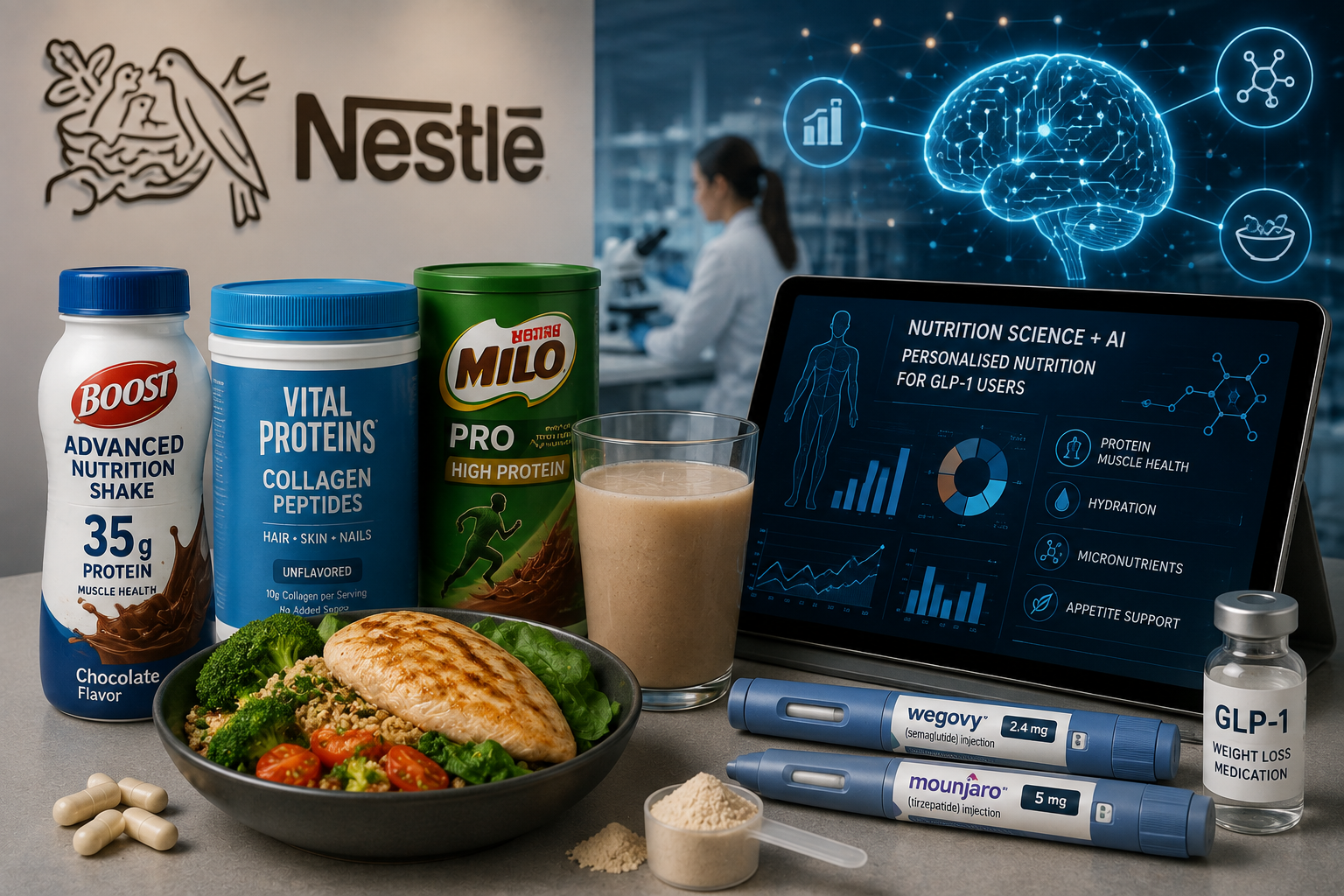
Food giant turns the rise of appetite-suppressing medicines into a potential growth opportunity, using AI, nutritional science and high-protein products to address changing consumer needs
Nestle is looking to turn the rapid growth of GLP-1 weight-loss medicines from a potential threat to the packaged-food industry into a new business opportunity.
The increasing use of medicines such as Ozempic, Wegovy, Mounjaro and Zepbound has raised concerns among food and beverage companies that appetite suppression could permanently change consumption patterns.
Nestle, however, believes the emerging market could create demand for a new generation of products designed specifically for people using these medicines.
The company is combining artificial intelligence, clinical research and nutritional science to identify nutrient combinations and develop products that address nutritional challenges associated with rapid weight loss.
GLP-1 Drugs Are Changing Consumer Behaviour
The growing popularity of GLP-1 medicines is reshaping the weight-management market.
These drugs can suppress appetite and help users reduce food intake, potentially affecting demand for traditional packaged foods, snacks and beverages.
For food manufacturers, the development presents a fundamental challenge: consumers who eat less may also purchase fewer calorie-dense products.
Nestle is attempting to respond by identifying new consumption occasions rather than relying entirely on existing categories.
Millions of Consumers Could Form a New Market
According to Boston Consulting Group data cited in the report, around 16 million Americans are currently taking GLP-1 medicines, with the number expected to rise significantly by the end of the decade.
A growing user base could create substantial demand for products focused on nutritional adequacy during weight loss.
This could potentially open a new market spanning protein beverages, nutrition products, smaller portions, supplements and functional foods.
For Nestle, the opportunity is significant because many of these categories already overlap with its existing portfolio.
Nestle Sees Opportunity Beyond Traditional Packaged Foods
Nestle Chief Technology Officer Stefan Palzer said the company believes it is well positioned to benefit from the changing market.
Instead of simply trying to defend conventional food categories against reduced consumption, the company is developing products designed around the needs of GLP-1 users.
The strategy represents a broader transition towards health, wellness and specialised nutrition.
Muscle Loss Is a Major Focus
One of Nestle's key areas of research is the potential loss of lean muscle mass during rapid weight reduction.
The company is studying nutritional combinations that could support muscle health while consumers lose weight.
Protein is central to this strategy.
Nestle is also examining combinations of micronutrients that could complement protein intake and support muscle recovery.
Protein Could Become a Bigger Part of Nestle's Portfolio
The growing emphasis on protein is not limited to GLP-1 users.
Consumers increasingly associate protein with fitness, healthy ageing, weight management and muscle maintenance.
This creates a potentially large market for products that offer higher protein content in convenient formats.
Nestle's existing presence in beverages, nutrition products and health-focused brands gives it an opportunity to expand in this area.
Boost Advanced Nutrition Shake Targets Weight-Loss Consumers
Nestle's US business has already introduced Boost Advanced Nutrition Shake, marketed as providing 35 grams of protein to support muscle health during weight loss.
The product demonstrates how the company is attempting to convert scientific concerns around muscle loss into a commercial product opportunity.
High-protein beverages also offer convenience for consumers who may find it difficult to consume enough protein through regular meals when appetite is suppressed.
Vital Proteins Expands Into the Opportunity
Nestle has also been adapting its Vital Proteins portfolio.
The company has added collagen protein to products while exploring nutritional concerns relating to skin, hair and nail health associated with rapid weight loss.
This strategy allows Nestle to leverage an existing health-oriented brand rather than creating an entirely new product platform.
Milo PRO High Protein Targets Changing Preferences
In Asia and Australia, Nestle has introduced Milo PRO High Protein, a higher-protein version of its popular malt beverage.
The product demonstrates how the company can incorporate the protein trend into established brands.
The strategy could also appeal to consumers who are not taking GLP-1 medicines but are increasingly looking for higher-protein products.
AI Is Becoming a Product Development Tool
Artificial intelligence is playing a growing role in Nestle's innovation strategy.
The company is using AI to analyse large volumes of scientific literature, identify nutritional combinations and assist product developers in evaluating potential formulations.
The technology could reduce the time required to process research and identify commercially useful nutritional concepts.
Nestle Has Around 120,000 Recipes in Its Database
Nestle's enormous recipe database provides a potentially valuable source of proprietary data.
The company has around 120,000 recipes that can be analysed through AI-driven systems.
The larger the dataset, the more opportunities the company has to identify patterns in ingredients, nutritional composition and consumer preferences.
This could become an important competitive advantage as food companies increasingly incorporate AI into product development.
Food Genie Helps Reformulate Products
Nestle's internal Food Genie platform is designed to help scientists and product developers analyse recipes and predict how formulations could perform.
AI can potentially help identify which ingredients can be substituted, how nutritional profiles can be improved and how products can be adapted to new consumer requirements.
The technology could become increasingly important as Nestle seeks to reformulate thousands of products across different markets.
AI Can Simulate Consumer Behaviour
Nestle is also testing AI-driven consumer simulations.
The objective is to predict how consumers may respond to new products, recipes and health claims before those products reach the market.
Such simulations could potentially reduce the cost and time associated with traditional product testing.
They could also help Nestle identify which product concepts have the greatest commercial potential.
Social Media Provides Early Consumer Signals
Nestle is using AI to monitor social-media conversations and identify emerging trends.
Social media can provide early indications of changes in consumer preferences.
The challenge is distinguishing short-lived online trends from sustainable shifts in consumer behaviour.
AI tools could help Nestle analyse large amounts of data and identify patterns that might otherwise be difficult to detect.
Food Industry Faces a Potential Consumption Shock
The rapid expansion of GLP-1 drugs has created concerns across the food industry.
If consumers experience sustained reductions in appetite, they could purchase fewer snacks, desserts and sugary beverages.
Categories potentially exposed to this trend include:
- Confectionery
- Ice cream
- Salty snacks
- Sugary beverages
- High-calorie packaged foods
- Large-portion meals
Companies may need to rethink both product composition and portion sizes.
Smaller Portions Could Become More Popular
Consumers taking appetite-suppressing medicines may prefer smaller portions.
That could create opportunities for food manufacturers to introduce smaller packs without abandoning established brands.
Smaller portions could also allow consumers to continue purchasing familiar products while reducing overall consumption.
This may eventually influence packaging sizes, pricing models and promotional strategies.
Higher-Protein Products Could Become Mainstream
The GLP-1 trend could accelerate the already growing consumer interest in protein.
Higher-protein products may appeal to consumers seeking to maintain muscle while reducing calorie intake.
Potential categories include:
- Protein drinks
- Nutrition shakes
- Protein bars
- Dairy products
- Breakfast foods
- Snacks
- Ready-to-eat meals
The opportunity could therefore extend well beyond pharmaceutical users.
Silver Lining for Food Companies
The same drugs that could reduce demand for conventional food products could create demand for specialised nutrition.
This creates a potentially important strategic shift for food companies.
Instead of measuring success only by how much food consumers consume, companies could increasingly focus on the nutritional value of each serving.
That could encourage a move from volume-driven consumption towards value-added nutrition.
Competitors Are Also Responding
Nestle is not the only food company adjusting to the GLP-1 trend.
Other food manufacturers are exploring:
- High-protein products
- Reduced portion sizes
- Simpler ingredient lists
- Lower-calorie alternatives
- Functional nutrition
- Health-focused products
Competition could intensify as companies seek to establish leadership in the emerging category.
GLP-1 Nutrition Could Become a Standalone Category
The market could eventually develop into a distinct category of products specifically designed around the needs of people taking appetite-suppressing medicines.
Possible products could include:
High-protein foods: designed to help consumers meet protein requirements despite lower food intake.
Hydration products: aimed at consumers who may struggle to maintain adequate fluid intake.
Smaller meals: designed around reduced appetite and portion requirements.
Functional nutrition: products containing specific combinations of nutrients.
Recovery-focused products: designed around muscle and nutritional maintenance.
The Opportunity Could Extend Beyond GLP-1 Users
Nestle's products could have a much larger potential market than GLP-1 users alone.
Protein-rich foods and beverages are increasingly popular among consumers focused on:
- Fitness
- Weight management
- Healthy ageing
- Muscle maintenance
- Convenience
- Preventive health
This means GLP-1-focused innovation could accelerate Nestle's broader health and wellness strategy.
Nutrition Experts Question Specialised Products
Not everyone is convinced that consumers need products specifically designed for GLP-1 users.
Nutrition experts argue that conventional foods can provide many of the same nutrients without the premium pricing associated with specialised products.
Protein can be obtained from foods including:
- Eggs
- Fish
- Meat
- Dairy
- Beans
- Pulses
- Nuts
The challenge for Nestle will therefore be proving that specialised products provide meaningful benefits beyond convenience and marketing.
Whole Foods Remain an Important Alternative
A balanced diet based on whole and minimally processed foods remains an important source of protein, vitamins and minerals.
This could limit the willingness of some consumers to pay premium prices for specialised nutrition products.
Nestle will need to compete not only with other packaged-food companies but also with consumers' existing food choices.
Consumer Trust Will Be Critical
The GLP-1 nutrition category is closely connected to health and medical issues.
As a result, consumers may demand stronger evidence behind nutritional claims.
Companies will need to ensure that product benefits are supported by credible scientific research.
Any disconnect between marketing claims and nutritional evidence could create reputational and regulatory risks.
Regulatory Scrutiny Could Increase
Products marketed specifically to consumers taking medicines may attract additional regulatory attention.
Claims relating to muscle preservation, weight management, appetite control or other health outcomes will need to be carefully supported.
Nestle's use of clinical research and scientific analysis could therefore become important in establishing credibility.
GLP-1 Drugs Could Accelerate Personalised Nutrition
The biggest long-term opportunity may not be GLP-1 products themselves but the wider move towards personalised nutrition.
Consumers increasingly want products designed around specific objectives.
These include:
- Weight management
- Muscle health
- Healthy ageing
- Sports performance
- Hydration
- Digestive health
- Metabolic health
Companies with access to large datasets, scientific expertise and global manufacturing networks could be well positioned to participate in this shift.
AI Could Give Large Food Companies an Advantage
Nestle's scale could become an important competitive advantage as AI becomes more deeply integrated into food research.
Large datasets can help AI systems identify patterns and improve predictions.
Nestle's combination of scientific research, recipes, consumer information and product-development capabilities provides a significant data foundation.
The ability to rapidly convert those insights into commercially scalable products could differentiate the company from smaller competitors.
The Business Model Could Shift From Volume to Value
Traditional packaged-food businesses often depend on selling large volumes of products.
The GLP-1 trend could push the industry towards a different model.
Consumers may eat less but potentially spend more on specialised, nutrient-dense products.
This could allow food companies to generate value through higher nutritional content, premium positioning and specialised formulations, rather than relying entirely on greater consumption volumes.
Nestle Faces Several Risks
The opportunity is substantial, but there are uncertainties.
Key risks include:
- Uncertainty over long-term GLP-1 adoption
- Changing consumer behaviour
- Competition from pharmaceutical and nutrition companies
- Regulatory scrutiny
- High product-development costs
- Consumer preference for whole foods
- Pricing pressure
- Changing scientific research
- Potential slowdown in GLP-1 demand
The company will need to ensure that its products have genuine consumer value rather than simply being positioned around a popular trend.
Pharmaceutical Companies Could Enter Nutrition
Another potential competitive challenge comes from the pharmaceutical industry itself.
Companies developing GLP-1 medicines have direct relationships with millions of patients.
As the market develops, pharmaceutical companies could potentially explore partnerships or nutritional solutions around weight management.
This could create additional competition for traditional food companies.
The GLP-1 Trend Could Reshape the Food Industry
The impact of weight-loss medicines could ultimately extend far beyond pharmaceutical sales.
If millions of consumers change how much and what they eat, food manufacturers may need to redesign portfolios around new consumption patterns.
The industry could see greater emphasis on:
- Protein
- Nutrient density
- Portion control
- Functional ingredients
- Convenience
- Personalised nutrition
Nestle's strategy suggests that the company is preparing for precisely this shift.
Market Outlook
The rise of GLP-1 weight-loss medicines represents both a structural challenge and a potential growth opportunity for the global food industry.
For Nestle, the strategy is to move beyond the threat of reduced food consumption and develop products designed around the changing nutritional needs of consumers. Its focus on protein, muscle health, hydration, specialised nutrition and functional foods could create new revenue opportunities while supporting the company's broader shift towards health and wellness.
The use of AI could become an important competitive advantage. Nestle's large recipe database, scientific research and consumer data give it the ability to identify trends, reformulate products and test concepts at scale. If the company can successfully translate these capabilities into products consumers are willing to pay for, the GLP-1 trend could become a meaningful new growth category.
However, investors should also watch the risks. Consumer adoption of GLP-1 drugs, regulatory requirements, competition, pricing and the actual nutritional benefits of specialised products will determine how large the opportunity ultimately becomes.
The bigger theme is likely to extend beyond GLP-1 users. Rising demand for high-protein foods, healthy ageing, weight management and personalised nutrition could reshape the packaged-food industry over the coming years.
For Nestle, the ability to move from a traditional volume-driven food model towards higher-value, science-backed and personalised nutrition could determine whether the GLP-1 disruption becomes a headwind or a new engine of growth.