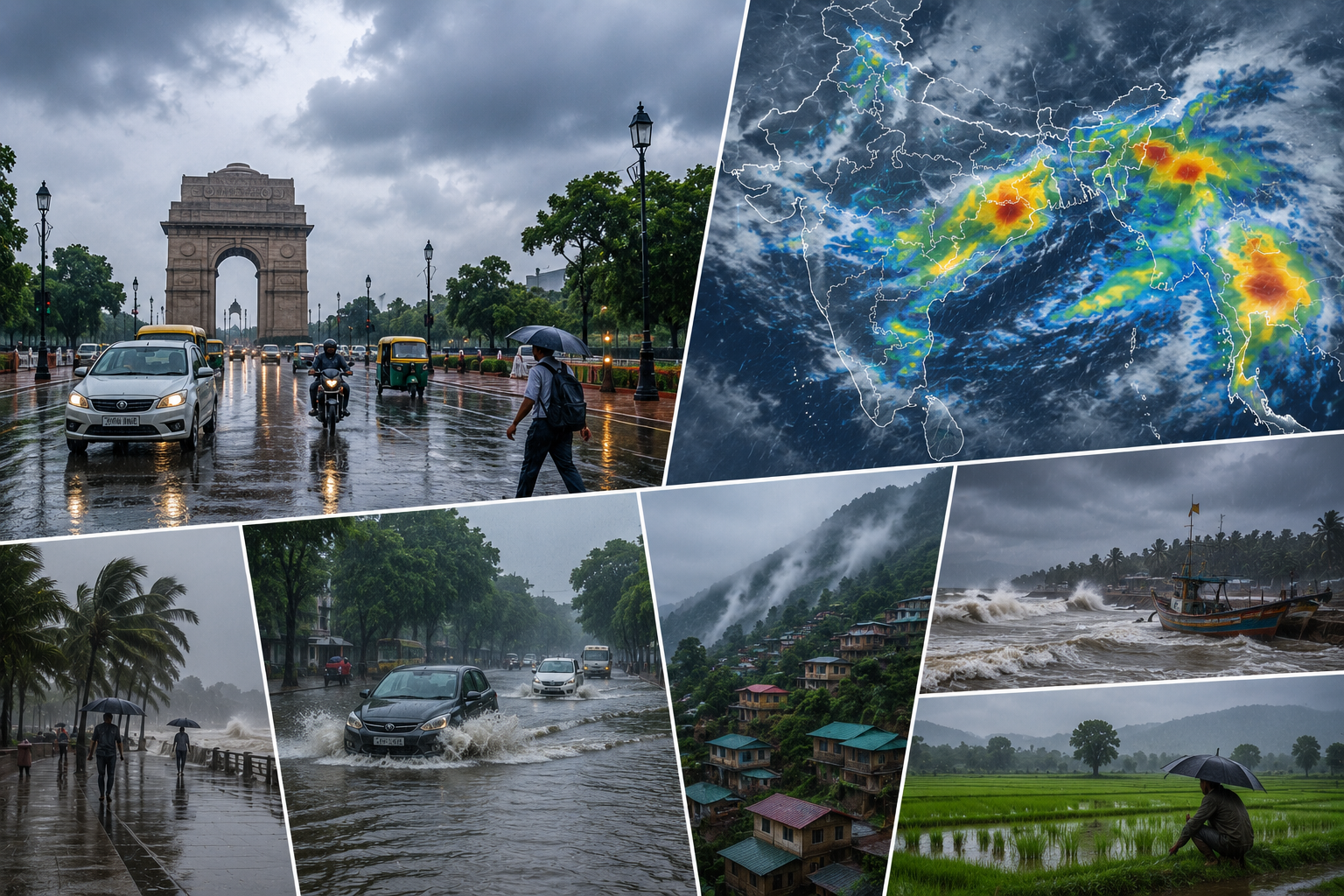
IMD forecasts isolated extremely heavy rainfall over West Bengal and Odisha, while several northern, eastern, northeastern and central states could see heavy to very heavy showers
Delhi is likely to experience a relatively pleasant but cloudy weather pattern, with light rainfall expected during the day as the southwest monsoon remains active across several parts of India.
The national capital could witness one or two spells of light rain from morning to afternoon, followed by another spell of very light rain from evening to night. Temperatures are expected to remain moderate, although humidity could rise after rainfall.
At the same time, much stronger monsoon activity is expected across eastern, northeastern, northern and central India, with isolated extremely heavy rainfall forecast over West Bengal and Odisha.
Delhi Weather to Remain Mostly Cloudy
The national capital is expected to remain under generally cloudy skies, with light rain possible at different times of the day.
The maximum temperature is likely to remain around 33–35°C, while the minimum temperature could stay close to 24–26°C.
Light showers may provide temporary relief from daytime heat. However, increased moisture after rainfall could cause humidity levels to rise again.
The current outlook does not indicate widespread heavy rainfall in Delhi over the coming days.
Light Rain Could Continue Intermittently
Delhi could see scattered spells rather than continuous rainfall.
One or two light spells are possible from morning to afternoon, with another spell potentially developing between evening and night.
Such intermittent rainfall could keep temperatures relatively comfortable while limiting the risk of prolonged disruption.
However, localised waterlogging cannot be completely ruled out if rainfall becomes intense over particular areas.
Monsoon Remains Active Across Large Parts of India
The southwest monsoon continues to remain active over several parts of the country.
Rainfall activity is expected to remain particularly strong across:
- Northern India
- Eastern India
- Northeastern India
- Central India
- Himalayan regions
The intensity of rainfall will vary considerably between regions, with some locations facing extremely heavy showers while others receive moderate or light rain.
West Bengal and Odisha Face Extremely Heavy Rainfall Risk
West Bengal and Odisha are among the regions expected to receive the strongest rainfall.
Isolated extremely heavy rainfall has been forecast over parts of the two states.
Intense rainfall could result in waterlogging, temporary flooding and disruption to road and transport networks, particularly in low-lying areas.
Residents in vulnerable locations may need to remain alert as rainfall intensity increases.
Very Heavy Rainfall Expected in Several States
Very heavy rainfall is possible at isolated locations over a wide area covering parts of northern, central and eastern India.
The regions include:
- Arunachal Pradesh
- Chhattisgarh
- Madhya Pradesh
- Himachal Pradesh
- Jammu and Kashmir-Ladakh
- Jharkhand
- Uttar Pradesh
- Uttarakhand
The combination of heavy rainfall and mountainous terrain could increase the possibility of landslides and flash flooding in parts of the Himalayan belt.
Uttar Pradesh Could Receive Heavy Showers
Uttar Pradesh is likely to remain under the influence of active monsoon conditions.
Very heavy rainfall could occur at isolated locations, accompanied by thunderstorms and lightning in some areas.
Heavy showers could temporarily affect visibility and road conditions, particularly during intense rainfall episodes.
Central India Remains Under Monsoon Pressure
Madhya Pradesh and Chhattisgarh could experience heavy to very heavy rainfall.
While continued rainfall can benefit agriculture and water resources, concentrated heavy showers can also increase the risk of waterlogging, overflowing drainage systems and localised flooding.
Authorities and residents in vulnerable areas will need to monitor rainfall intensity closely.
Himalayan States Could Face Disruptions
Parts of Himachal Pradesh, Uttarakhand and Jammu and Kashmir-Ladakh are expected to receive very heavy rainfall at isolated locations.
Heavy rain in mountainous areas can create additional risks because steep slopes are vulnerable to landslides and rockfalls.
Road connectivity can also be affected if debris or floodwater blocks mountain routes.
Travellers should therefore exercise additional caution during periods of intense rainfall.
Northeast India to Remain Rain-Active
The northeastern region is also expected to receive widespread rainfall.
Heavy showers are possible over Assam and Meghalaya, while very heavy rainfall could affect parts of Arunachal Pradesh.
Nagaland, Manipur, Mizoram and Tripura could also experience thunderstorms and rainfall.
The combination of steep terrain and heavy rainfall makes parts of the Northeast vulnerable to landslides and flash floods.
Bihar, Punjab and Haryana Also on Rainfall Watch
Heavy rainfall is also possible over parts of Bihar, Punjab and Haryana.
Haryana and Chandigarh could experience periods of heavy showers, while thunderstorm activity may develop in some areas.
The rainfall could provide additional moisture for agricultural activity, although intense downpours may temporarily affect transport and urban drainage.
Maharashtra and Konkan-Goa Could Receive Heavy Rain
The monsoon is also expected to remain active over parts of Maharashtra and the Konkan-Goa region.
Heavy rainfall in coastal areas can lead to waterlogging and difficult driving conditions.
The hilly areas of the Western Ghats can also experience localised landslides during periods of intense rainfall.
Thunderstorms and Lightning Remain a Major Risk
Several parts of the country could experience thunderstorms accompanied by lightning and gusty winds.
Thunderstorm activity is possible over parts of:
- Andaman and Nicobar Islands
- Andhra Pradesh
- West Bengal
- Jharkhand
- Odisha
- Tamil Nadu
- Puducherry
Lightning remains a significant weather hazard during thunderstorms, particularly in open areas.
Gusty Winds Could Accompany Rainfall
Winds of 40–50 kmph, with higher gusts possible in isolated locations, are expected in some areas experiencing thunderstorms.
Strong winds could affect trees, temporary structures, outdoor installations and electricity infrastructure.
Parts of Bihar, Jammu and Kashmir-Ladakh, Madhya Pradesh, West Bengal, Sikkim and Telangana could also experience gusty winds of around 30–40 kmph.
Andhra Pradesh and Telangana Under Weather Watch
Andhra Pradesh and Telangana could experience strong surface winds in isolated areas.
Thunderstorms and lightning are also possible over parts of Andhra Pradesh.
Weather conditions could change quickly during thunderstorm activity, particularly in the afternoon and evening.
Tamil Nadu and Puducherry Could See Thunderstorms
Parts of Tamil Nadu and Puducherry could also experience thunderstorms accompanied by lightning and gusty winds.
Although the strongest rainfall activity is concentrated in northern, eastern and central parts of the country, southern regions could continue to see localised weather developments.
Bay of Bengal Sea Conditions Expected to Remain Rough
The weather system over the Bay of Bengal is expected to keep sea conditions unsettled.
Squally winds of 45–55 kmph, with gusts reaching up to 65 kmph, are possible over parts of the southwest Bay of Bengal.
Winds of around 40–50 kmph, gusting up to 60 kmph, could also occur along and off the coasts of West Bengal, Odisha and northern Andhra Pradesh, as well as adjoining waters.
Coastal Communities Need to Exercise Caution
Rough sea conditions could affect fishing and other marine activities.
Small boats and vessels are particularly vulnerable to strong winds and high waves.
Coastal communities and marine operators are likely to remain cautious as the weather system continues to influence the Bay of Bengal.
Monsoon Rainfall Important for Agriculture
The continuation of monsoon rainfall is important for India's agricultural economy.
Rainfall supports:
- Crop sowing and growth
- Soil moisture
- Irrigation availability
- Reservoir replenishment
- Groundwater recharge
- Rural incomes
However, the distribution of rainfall remains crucial.
Moderate and well-distributed rainfall can support agricultural production, while excessive rainfall concentrated over a short period can damage crops.
Excessive Rain Could Affect Standing Crops
Heavy rainfall can create problems for farmers if fields remain waterlogged for extended periods.
Excess moisture can damage crops, wash away topsoil and increase the risk of crop diseases.
For this reason, the economic impact of the monsoon will depend not only on the total amount of rainfall but also on its timing and geographical distribution.
Reservoir Levels Could Improve
Continued rainfall across central, northern and eastern India could support reservoir levels and improve water availability.
Higher reservoir storage can benefit irrigation and drinking-water supplies.
In regions with significant hydropower capacity, improved water availability can also support electricity generation.
However, very heavy rainfall can create challenges for water-management systems if inflows increase sharply over a short period.
Rural Economy Could Benefit From a Healthy Monsoon
A favourable monsoon can have a broad impact on the rural economy.
Better agricultural output can increase farm incomes and improve spending on consumer goods, vehicles, agricultural equipment and financial products.
Rural demand is therefore an important transmission channel between monsoon performance and India's broader economic growth.
Food Inflation Remains an Important Variable
Rainfall conditions can also influence food prices.
A favourable monsoon can support supplies of agricultural commodities and help contain food inflation.
On the other hand, crop damage caused by excessive rainfall or uneven rainfall can reduce supplies and push prices higher.
The impact on inflation will therefore depend on crop-specific rainfall conditions over the coming weeks.
Urban Infrastructure Could Face Pressure
Heavy rainfall can expose weaknesses in urban drainage systems.
Short-duration intense showers can cause:
- Waterlogging
- Traffic congestion
- Road damage
- Drainage overflow
- Power interruptions
- Localised flooding
Cities receiving repeated heavy rainfall could face greater infrastructure stress even when cumulative rainfall remains within normal levels.
Travel Conditions Could Change Quickly
Heavy rainfall and thunderstorms could affect road, rail and air travel in several parts of the country.
The risk is particularly significant in mountainous areas, where landslides can temporarily block roads.
Coastal regions could also experience transportation disruptions if rainfall combines with strong winds.
Travellers should therefore remain alert to local weather conditions when moving through areas under heavy-rainfall alerts.
Monsoon Has Implications for the Indian Economy
The monsoon remains one of the most important weather variables for India's economy.
Agriculture, rural consumption, food prices, water availability and electricity generation can all be influenced by rainfall.
A broadly favourable monsoon can provide support to economic growth, while extreme weather events can create temporary disruptions.
The current rainfall pattern therefore remains important not only from a weather perspective but also for economic and market conditions.
Markets to Watch Monsoon Impact
Investors could monitor the impact of rainfall on sectors such as:
- Agriculture
- Fertilisers
- Tractors
- Two-wheelers
- Consumer goods
- Rural finance
- Power
- Irrigation
- Infrastructure
- Cement
A healthy monsoon could support rural demand, while extreme rainfall could create short-term pressure on supply chains and agricultural output.
Commodity Markets Could Also React
Weather conditions can influence commodity prices through changes in agricultural production and supply.
Heavy rainfall can affect crops and food commodities, while improved rainfall can increase expectations of better production.
Energy markets can also be influenced indirectly through changes in hydropower generation and agricultural demand.
Market Outlook
The Indian monsoon remains active but uneven, with the strongest rainfall activity currently concentrated across parts of eastern, northeastern, northern and central India. Delhi is likely to see only light rainfall, while West Bengal and Odisha face the possibility of isolated extremely heavy showers.
For the economy, the key issue will be the distribution of rainfall rather than rainfall alone. Well-distributed monsoon showers could support crop output, reservoir levels, rural incomes and consumption. However, concentrated extreme rainfall could create crop losses, flooding, infrastructure damage and temporary supply disruptions.
For financial markets, investors will closely monitor the impact on food inflation, rural consumption, agricultural commodities, fertiliser demand, tractors, two-wheelers, consumer goods and rural financial services.
If monsoon conditions remain broadly supportive while extreme-weather events remain localised, the overall economic impact could remain positive. However, persistent heavy rainfall across key agricultural regions could create volatility in food prices and supply chains.
The coming weeks will therefore be important for assessing whether the active monsoon translates into a broad-based boost for agriculture and rural demand or creates pockets of disruption from excessive rainfall.