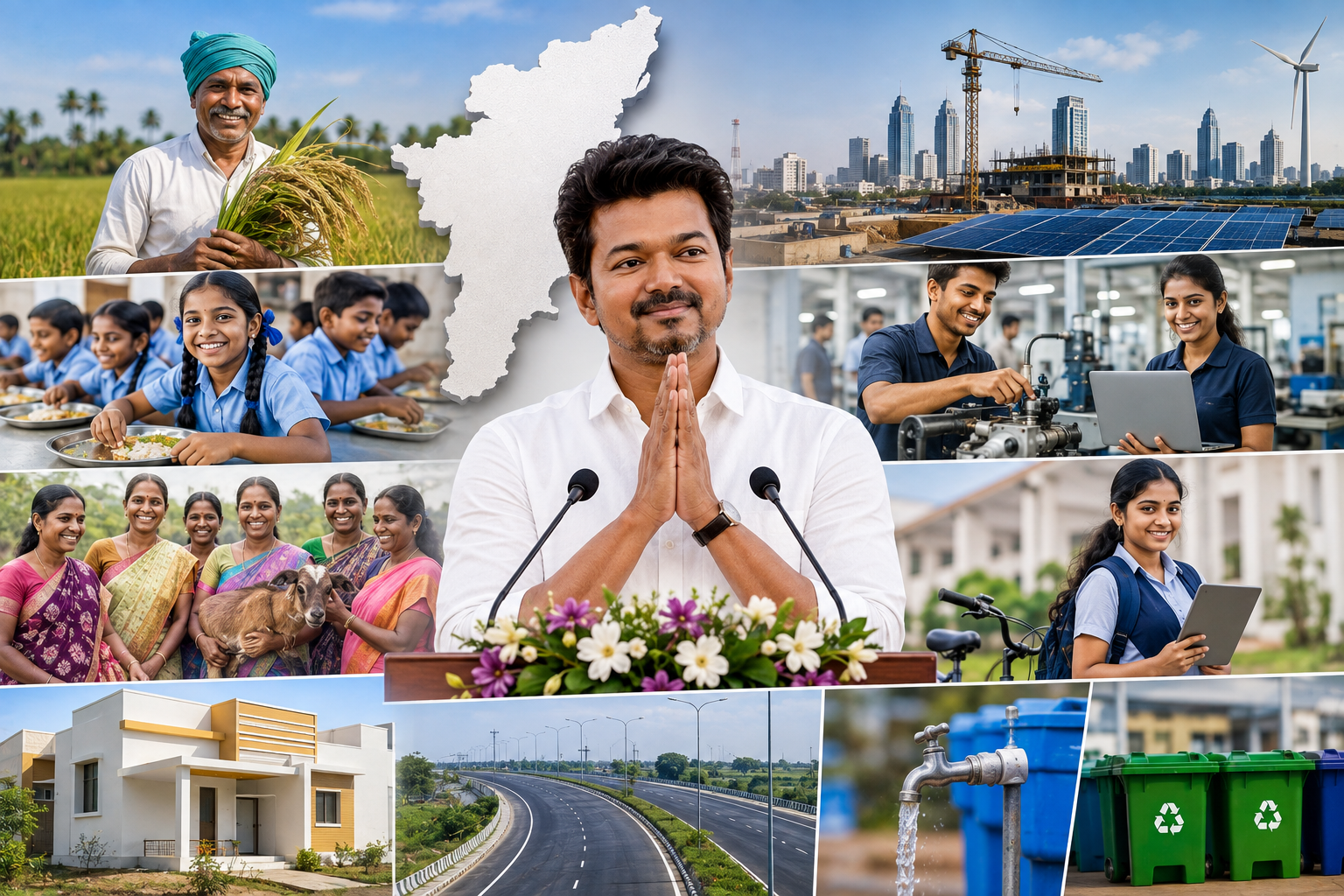
Government showcases initiatives spanning education, farmer welfare, women’s empowerment, rural infrastructure, employment and industrial investment
Tamil Nadu Chief Minister C. Joseph Vijay has completed the first 100 days of his administration, using the milestone to present a broad set of welfare, education, agriculture, employment and investment initiatives under the theme “100 Days of Governance – A Government for Generations.”
The government has highlighted women's safety, farmer welfare, youth skill development, education, rural infrastructure and administrative reforms as major priorities. At the same time, the administration has sought to position Tamil Nadu as an attractive destination for domestic and international investment.
A key economic highlight is the government's claim of ₹1 lakh crore in investment commitments through the Vettri Tamil Nadu Investment Conclave 2026. The announcement comes alongside a broader push to strengthen the state's manufacturing and infrastructure ecosystem.
Welfare and Economic Growth at the Centre of the Agenda
The government's 100-day programme combines direct welfare measures with initiatives intended to strengthen employment and economic activity.
The major areas highlighted include:
- Education and digital access
- Youth skill development
- Farmer income support
- Housing
- Rural employment
- Water and sanitation
- Women's livelihood programmes
- Industrial investment
- Public safety
- Administrative digitisation
The approach indicates an attempt to combine immediate household support with longer-term investments in human capital and infrastructure.
Skill Development Reaches 13 Lakh Beneficiaries
Under the Vettri Skill Training Scheme, the government said skill-development training has been provided to 12 lakh students and 1 lakh youth.
The programme is aimed at improving employability by providing young people with skills aligned with industry requirements.
This could become increasingly important as Tamil Nadu seeks to attract investment in manufacturing, electronics, technology, automotive and other high-value industries.
A stronger pipeline of trained workers can help companies establish operations and expand existing facilities.
Breakfast Scheme Expanded Across 15,414 Schools
The Perunthalaivar Kamarajar Breakfast Scheme has also been expanded to cover an additional 15.14 lakh students in Classes 6 to 8.
The programme now extends across 15,414 schools, with an allocation of ₹710 crore.
The initiative combines a social-welfare objective with an education outcome, as improved nutrition can support school attendance, concentration and learning.
For families, school meal programmes can also reduce part of the daily cost of education.
₹2,000 Crore Laptop Programme for College Students
Digital education has been another focus of the government's first 100 days.
Under the Vettri Laptop Scheme, the government has earmarked ₹2,000 crore to provide laptops to college students.
Access to computers can be particularly important for students pursuing technology-intensive courses and those relying on online learning resources.
The programme is also intended to address differences in access to digital devices among students from different income groups.
Bicycles, Helmets and Water Bottles for Class XI Students
The government is providing branded bicycles to Class XI students in government and government-aided schools.
The bicycles are being distributed with helmets and water bottles, combining mobility support with road-safety considerations.
For students in rural and semi-urban areas, improved access to transportation can reduce the distance and time involved in travelling to school.
₹6,000 Crore Crop Loan Waiver Announced
Farmer welfare forms another major pillar of the government's 100-day programme.
The administration has announced a ₹6,000 crore crop loan waiver aimed at providing financial relief to agricultural households.
Debt relief can provide immediate support to farmers facing pressure from input costs, weather-related challenges and uncertain crop income.
However, the longer-term impact will depend on whether farmers also gain access to affordable institutional credit and improved farm returns.
Sugarcane and Paddy Farmers Get Additional Support
The government has announced incentives of ₹4,000 per tonne for sugarcane and ₹2,750 per quintal for paddy.
The objective is to improve returns for farmers producing key crops.
Higher agricultural income can have a wider economic effect because additional rural income often flows into consumption of consumer goods, two-wheelers, agricultural equipment and other products.
₹3,500 Crore Housing Scheme
The Vettri Housing Scheme has been allocated ₹3,500 crore.
Housing programmes can create both social and economic benefits.
Apart from providing households with improved living conditions, construction activity generates demand for cement, steel, electrical equipment, building materials, transportation and labour.
This creates a potential multiplier effect for the broader economy.
₹6,000 Crore Annual Allocation for TN-VETTRI
The government has announced an annual allocation of ₹6,000 crore for TN-VETTRI, covering areas such as water supply, solid-waste management, sanitation and rural connectivity.
Investment in basic infrastructure is important for both quality of life and economic development.
Improved roads and connectivity can reduce transportation costs, while better water and sanitation infrastructure can support healthier communities.
Vettri 150 Scheme Focuses on Employment
The Vettri 150 Scheme aims to guarantee 150 days of employment.
The programme is intended to provide income support while creating community-level assets and infrastructure.
Employment programmes can be particularly significant for rural households that depend on seasonal agricultural activity.
The effectiveness of the scheme will depend on the quality of work generated and the timely delivery of wages.
Livelihood Scheme for Disadvantaged Women
Under the Vettri Magalir Goat Rearing Scheme, disadvantaged women and transgender individuals will receive five goats or sheep.
The initiative is designed around livelihood creation rather than only direct financial assistance.
Livestock can provide beneficiaries with an income-generating asset that can potentially produce recurring earnings through breeding and sale of animals and related agricultural activity.
₹1 Lakh Crore Investment Commitments
The government's biggest economic highlight is the ₹1 lakh crore in investment commitments secured through the Vettri Tamil Nadu Investment Conclave 2026.
The investment push is significant for a state that already has a strong industrial base spanning automobiles, electronics, engineering, textiles and other manufacturing sectors.
Fresh investment could create additional capacity, strengthen supply chains and generate employment.
However, the critical test will be converting announced commitments into actual projects and capital expenditure.
Investment Announcements Need Execution
Investment commitments announced at business conclaves do not immediately become operational assets.
Companies still need to complete:
- Land acquisition
- Regulatory approvals
- Financing
- Construction
- Equipment installation
- Recruitment
- Commercial production
The government's ability to accelerate these processes will determine how much of the committed investment ultimately reaches the ground.
Recent investment activity provides some evidence of this broader push. Tamil Nadu has also announced agreements involving overseas investors, including projects across manufacturing and industrial sectors.
Manufacturing Could Remain a Major Growth Engine
Tamil Nadu's established industrial ecosystem gives it an advantage in attracting new investment.
The state has significant presence in automotive manufacturing, electronics, engineering, textiles and other industries.
Large industrial clusters also create opportunities for smaller suppliers and ancillary businesses.
As companies diversify supply chains and increase manufacturing capacity in India, Tamil Nadu could benefit from its existing infrastructure and skilled workforce.
Electronics and Advanced Manufacturing Offer Opportunities
The state's industrial strategy could increasingly focus on higher-value manufacturing.
Electronics, components, automotive technologies, defence-related manufacturing and advanced engineering can generate higher-value employment and support export growth.
The ability to provide skilled labour, reliable infrastructure and efficient approvals will be important in attracting these industries.
Drug Trafficking Targeted Through 65 Special Task Forces
Public safety is another major component of the government's agenda.
The administration has constituted 65 special task forces under STING — Special Task Force for Interdiction of Narcotics and Gangs.
The units are intended to target drug trafficking networks and organised gangs.
The government has positioned the initiative as part of a broader effort to improve public safety and protect young people from narcotics-related activity.
717 Liquor Shops Closed
The government has also closed 717 liquor shops located near educational institutions, temples and bus stands.
The measure reflects an effort to regulate the location of liquor outlets around sensitive public areas.
The policy has both social and fiscal dimensions, as liquor-related revenue represents an important source of income for the state.
The longer-term challenge will be to balance public-health objectives with the financial implications for state revenues.
Focus on Women’s Safety and Empowerment
Women's safety has been identified as a central priority.
The government's approach combines safety-related measures with initiatives aimed at improving education, employment and livelihood opportunities for women.
Programmes such as the goat-rearing initiative are intended to provide disadvantaged women with productive assets and an opportunity to generate income.
Improved economic independence can complement broader measures aimed at women's welfare.
Push Towards Transparent Governance
The administration has also highlighted its commitment to “Honest and Transparent governance.”
Among the measures highlighted are faster plan approvals and faceless property registration.
Digitising government procedures can reduce paperwork, improve tracking and potentially reduce the scope for delays.
For businesses and citizens, faster administrative processing can improve the overall efficiency of interacting with government departments.
Faster Approvals Could Support Investment
Administrative efficiency can have a direct impact on investment decisions.
Companies evaluating new projects consider factors such as land availability, infrastructure, taxation, labour, logistics and the speed of regulatory approvals.
If Tamil Nadu can reduce approval timelines and improve transparency, it could strengthen the state's competitiveness relative to other manufacturing destinations.
This becomes particularly important as the state seeks to convert large investment commitments into operational projects.
Electricity Support for Domestic Consumers
The government has also highlighted a proposal under which domestic consumers using up to 500 units every two months would receive 200 units of free electricity.
The measure is intended to reduce electricity costs for eligible households.
At the same time, such subsidies carry fiscal implications for the state and the electricity distribution system.
The sustainability of the programme will therefore depend on how the government balances consumer support with the financial health of the power sector.
Education Policy Linked With Employment
The combination of breakfast support, bicycles, laptops and skill training reflects a broad approach to youth development.
Each programme addresses a different barrier.
Nutrition can improve attendance and learning, bicycles can improve access, laptops can strengthen digital education, while skill programmes can help students transition into employment.
The success of this approach will ultimately depend on whether educational support translates into better learning outcomes and higher employment.
Rural Development Could Support Consumption
Farmer support, housing, employment and rural infrastructure initiatives could have an impact beyond the immediate beneficiaries.
Higher rural income can stimulate demand for consumer products and services.
Infrastructure spending can also generate employment and improve connectivity for businesses.
If implemented effectively, rural development programmes could therefore contribute to both social welfare and economic activity.
Fiscal Management Will Remain Important
The scale of welfare commitments means fiscal management will remain an important consideration.
Loan waivers, free electricity, employment guarantees, education programmes and housing initiatives all require government expenditure.
At the same time, the government is seeking large private investments and infrastructure expansion.
The ability to combine welfare spending with sustainable public finances will be crucial for the state's long-term economic performance.
Investment Could Create a Broader Economic Multiplier
Successful implementation of new industrial projects can generate benefits beyond the initial investment.
A new manufacturing plant can create direct employment while also supporting suppliers, logistics companies, construction firms, service providers and local businesses.
Higher employment can increase household income and consumption.
This is why converting investment commitments into operational projects is likely to remain one of the most important economic priorities for the government.
Tamil Nadu's Manufacturing Position Remains Important
Tamil Nadu is already a major manufacturing hub, with established industrial ecosystems and a large skilled workforce.
The government's investment strategy seeks to build on this foundation rather than create an industrial base from scratch.
Expansion of existing clusters could provide faster results because suppliers, logistics networks and skilled labour are already available.
The challenge will be ensuring that new investments are distributed across regions and sectors rather than remaining concentrated around established industrial centres.
Market Outlook
Tamil Nadu's first 100 days under Chief Minister C. Joseph Vijay present a combination of welfare expansion, human-capital investment, rural support and industrial development. The government's reported ₹1 lakh crore investment commitments are particularly important from an economic perspective because successful execution could strengthen manufacturing, infrastructure and employment across the state.
For investors, the next phase will be less about headline announcements and more about execution. The conversion of investment commitments into actual factories, capacity additions, capital expenditure and jobs will be a key measure of the government's economic performance.
The welfare side will also require careful fiscal management. Farmer loan waivers, electricity support, housing, employment programmes and education initiatives can improve household welfare and potentially support consumption, but their long-term sustainability will depend on revenue growth and expenditure management.
If Tamil Nadu can combine faster approvals, infrastructure development, skilled workforce creation and successful execution of investment projects with disciplined fiscal management, the state could further strengthen its position as one of India's leading manufacturing and investment destinations.