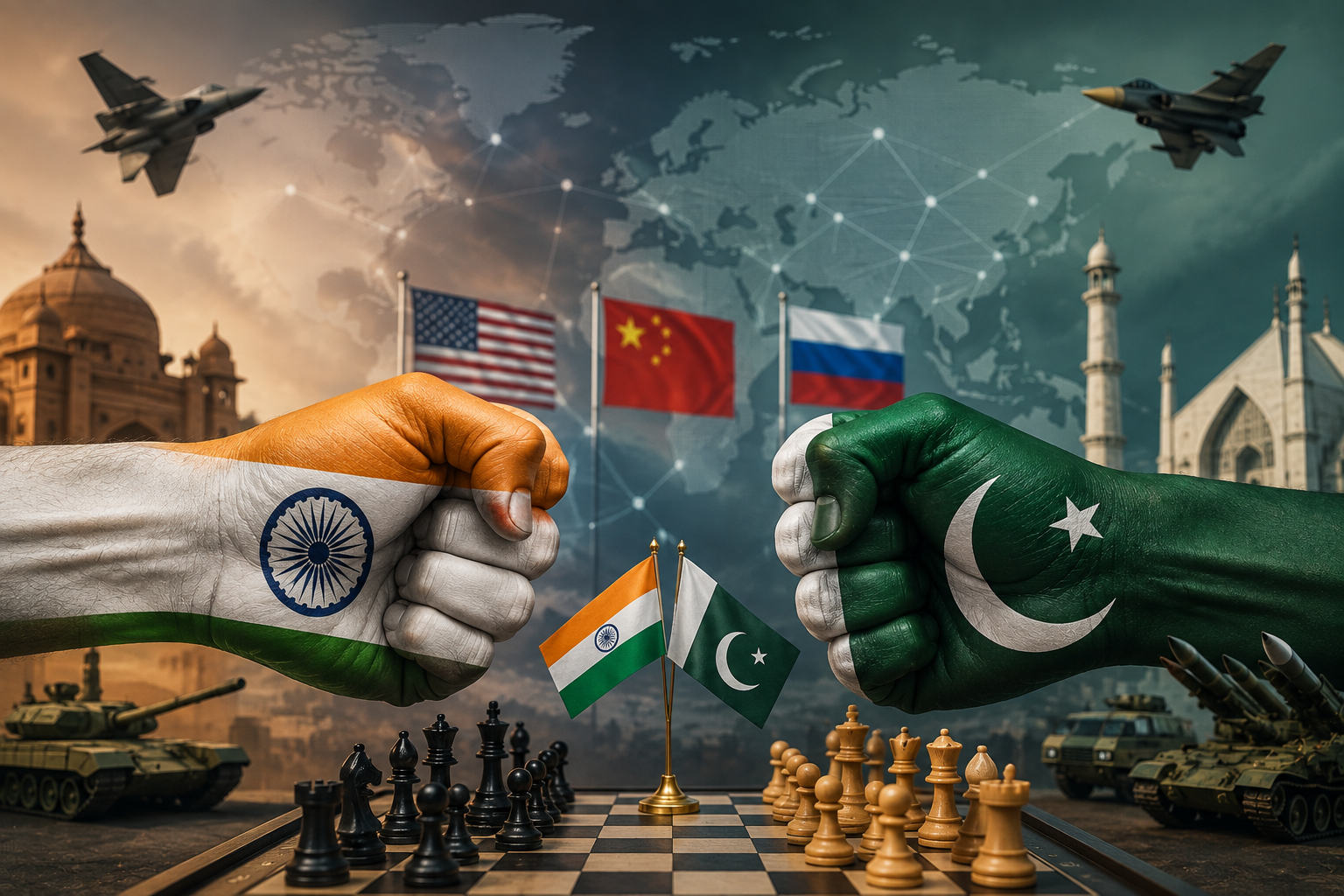
Survey Highlights Deep Distrust Between India and Pakistan; Russia Remains India's Most-Preferred Ally While China Dominates Pakistan's Strategic Outlook
A new survey by the Pew Research Center highlights the deep geopolitical divide between India and Pakistan, with respondents in both countries identifying each other as their biggest perceived threat.
According to the survey, 54 per cent of Indian adults identified Pakistan as India's greatest geopolitical threat, while 21 per cent named China. In Pakistan, 43 per cent of respondents identified India as the country's biggest threat.
The findings underline how longstanding security concerns continue to influence public perceptions across South Asia, even as the region's economic and diplomatic relationships evolve.
Pakistan Tops India's Threat Perception
Pakistan remains the most frequently cited geopolitical concern among Indian respondents.
More than half of those surveyed in India — 54 per cent — identified Pakistan as the country's greatest threat. China followed at 21 per cent.
The relatively large gap between the two figures indicates that Pakistan continues to occupy a particularly prominent position in India's security perceptions.
The findings also demonstrate that geopolitical tensions can influence public sentiment well beyond government-to-government relations.
India Is Pakistan's Biggest Perceived Threat
The perception is broadly mirrored in Pakistan.
Around 43 per cent of Pakistani respondents identified India as their country's greatest geopolitical threat.
China and Israel followed, with approximately 24 per cent each naming them as major threats.
The figures illustrate the continuing influence of regional security concerns on public opinion in both countries.
China Is Pakistan's Most Important Ally
While China features among Pakistan's perceived threats for a significant minority, it remains overwhelmingly viewed as the country's most important ally.
Approximately 75 per cent of Pakistani respondents identified China as their most important ally.
Saudi Arabia was a distant second, with 12 per cent selecting the country.
The result highlights the depth of China's strategic and economic relationship with Pakistan.
China's role extends across infrastructure, investment, trade, defence and major development projects, making Beijing a central component of Pakistan's foreign-policy outlook.
Russia Leads India's Ally Preferences
India's preferred geopolitical alignment looks substantially different.
Around 36 per cent of Indian respondents identified Russia as the country's most important ally, making Moscow the most frequently selected country.
The United States followed with 16 per cent.
Approximately one-third of Indian respondents did not answer the question.
The strong perception of Russia as an ally reflects decades of defence, diplomatic and strategic cooperation between New Delhi and Moscow.
Why Russia Remains Important to India
Russia has historically played a major role in India's defence ecosystem.
The relationship has also expanded into areas such as energy, trade and strategic cooperation.
Even as India has strengthened ties with the United States, Europe, Japan and other partners, the survey suggests that Russia continues to retain significant public goodwill in India.
This is consistent with India's broader approach of maintaining relationships with multiple global powers rather than aligning exclusively with one geopolitical bloc.
Indians Remain Cautious Towards China
China's image among Indian respondents remains considerably less favourable.
Only 23 per cent of Indians expressed a favourable opinion of China, while approximately 25 per cent expressed confidence in Chinese President Xi Jinping's global leadership.
The numbers reflect the complicated nature of India-China relations.
The two countries maintain substantial economic ties, but strategic competition and unresolved border issues continue to influence public perceptions.
Indian Views of the US Are More Positive
The United States receives a more favourable assessment from Indians.
Approximately 45 per cent of Indian respondents expressed a favourable view of the US.
Around 39 per cent also said they had confidence in US President Donald Trump to do the right thing in world affairs.
While the figures do not represent an overwhelming majority, they indicate a significantly warmer perception of the US in India compared with Pakistan.
Pakistan's Public Opinion of the US Remains Weak
Despite strategic engagement between Washington and Islamabad, Pakistani public sentiment towards the US remains relatively negative.
Only around 15 per cent of Pakistani respondents expressed a favourable view of the United States.
Just 12 per cent expressed confidence in Trump to do the right thing in international affairs.
The contrast with China is striking.
Around 90 per cent of Pakistanis expressed a favourable view of China, while 83 per cent expressed confidence in Xi Jinping.
South Asia Presents a Diverse Geopolitical Picture
The survey covered adults in four South Asian countries:
- India
- Pakistan
- Bangladesh
- Sri Lanka
The responses show that perceptions of neighbouring countries vary dramatically across the region.
India is viewed extremely positively in Sri Lanka but much less favourably in Pakistan. Bangladesh occupies a more complicated middle ground.
Sri Lanka Has Strongest Positive View of India
Sri Lanka recorded the strongest positive sentiment towards India.
Approximately 79 per cent of Sri Lankans expressed a favourable view of India.
Furthermore, 63 per cent identified India as their country's most important ally.
The findings reflect India's important geographical, economic, cultural and strategic relationship with Sri Lanka.
Bangladesh Shows Mixed Sentiment
Around 42 per cent of Bangladeshis expressed a favourable view of India.
However, the survey also found that Bangladeshis frequently identified India as their country's greatest threat.
This combination highlights the complexity of India-Bangladesh relations, where substantial economic and cultural links coexist with disagreements and political sensitivities.
Pakistan Has the Lowest Positive View of India
Only approximately 7 per cent of Pakistani respondents expressed a favourable opinion of India.
At the same time, India was the most frequently identified geopolitical threat in Pakistan.
The contrast between the Indian and Pakistani responses demonstrates how deeply bilateral tensions have shaped public perceptions on both sides.
Americans Have Mixed Views of India
The survey also examined how Americans perceive India.
Around 45 per cent of Americans expressed a favourable opinion of India, while 50 per cent expressed an unfavourable view.
Political affiliation played a role in these perceptions.
Approximately 50 per cent of Democrats and Democratic-leaning independents viewed India favourably, compared with around 42 per cent of Republicans and Republican-leaning respondents.
India's Global Influence Is Seen as Stable or Rising
The survey also examined perceptions of India's growing influence in international affairs.
More than 54 per cent of Americans said India's global influence had remained broadly unchanged in recent years.
Around 30 per cent believed India's influence was increasing, while only 13 per cent thought it was declining.
The results indicate that a substantial proportion of Americans recognise India's growing role in global affairs.
India's Multi-Alignment Strategy Gains Importance
The survey results are particularly relevant to India's foreign-policy strategy.
New Delhi has increasingly pursued a policy of maintaining strong relationships with multiple major powers rather than relying exclusively on one alliance.
India maintains strategic relationships with:
- The United States
- Russia
- Japan
- European economies
- Australia
- Gulf countries
- Other emerging markets
This approach provides India with greater flexibility in managing trade, energy, defence and geopolitical interests.
US-India Relationship Could Remain Important
The relatively positive perception of the US among Indian respondents comes as bilateral economic and strategic engagement continues to expand.
The two countries have strengthened cooperation in areas including:
- Defence
- Technology
- Semiconductor manufacturing
- Space
- Energy
- Critical minerals
- Supply-chain diversification
The relationship is also relevant to India's broader efforts to attract global manufacturing investment.
China Remains Both Economic Partner and Strategic Rival
The survey highlights the complicated position China occupies in India's strategic landscape.
China remains an important trading partner and manufacturing economy, but strategic competition has increased.
For India, the challenge is to maintain necessary economic engagement while reducing vulnerabilities in strategically important supply chains.
This has helped strengthen India's interest in domestic manufacturing and the broader China+1 strategy.
Geopolitical Perceptions Can Affect Economic Decisions
Public sentiment does not directly determine foreign policy, but it can influence the political environment in which governments make economic and strategic decisions.
Persistent geopolitical tensions can affect:
- Defence spending
- Trade policy
- Energy security
- Supply chains
- Foreign investment
- Manufacturing strategy
- Technology partnerships
For businesses and investors, these developments can create both risks and opportunities.
Defence Could Remain a Structural Investment Theme
The continuing perception of geopolitical threats could support India's long-term emphasis on defence modernisation.
Greater domestic defence production could benefit companies operating in:
- Aerospace
- Missiles
- Electronics
- Shipbuilding
- Radar systems
- Unmanned systems
- Precision engineering
The government's emphasis on reducing dependence on imported defence equipment could also create opportunities for Indian manufacturers.
China+1 Could Benefit Indian Manufacturing
Strategic competition between China and Western economies has accelerated efforts to diversify global supply chains.
India is seeking to position itself as an alternative manufacturing base in sectors such as:
- Electronics
- Pharmaceuticals
- Automotive components
- Chemicals
- Textiles
- Engineering
- Renewable-energy equipment
If geopolitical diversification continues, Indian companies with strong manufacturing capabilities could potentially benefit from increased global sourcing.
Energy Security Remains Critical
Geopolitical tensions also highlight the importance of energy security.
India remains highly dependent on imported crude oil, making global energy prices and shipping routes important variables for the domestic economy.
Any major disruption to global oil supplies could increase India's import bill, put pressure on the rupee and potentially influence inflation.
This makes diversification of energy sources and long-term investment in renewable energy strategically important.
Regional Stability Matters for India's Economy
A stable South Asian region is important for India's long-term economic ambitions.
Persistent tensions with Pakistan could increase security expenditure and create periods of market volatility.
At the same time, stronger economic relationships with countries such as Bangladesh and Sri Lanka can help deepen India's regional trade and connectivity.
Greater regional integration could potentially support India's broader growth ambitions.
Geopolitical Risks for Investors
Investors should remain alert to several potential risks arising from the current geopolitical environment.
India-Pakistan tensions
Any escalation could trigger short-term volatility in equities, bonds and the rupee.
India-China competition
Trade restrictions or border tensions could affect specific industries and supply chains.
US-China rivalry
Further trade restrictions could create both opportunities and disruptions for Indian manufacturers.
Oil-price shocks
Geopolitical disruptions could increase crude prices and pressure India's current account and inflation.
Global capital flows
Periods of geopolitical uncertainty can lead foreign investors to reduce exposure to emerging markets.
Potential Opportunities for India
At the same time, India's geopolitical positioning can create significant long-term opportunities.
Defence Manufacturing
Domestic defence production could accelerate.
Electronics Manufacturing
Global companies could increase sourcing from India.
Pharmaceuticals
India could benefit from diversification of global healthcare supply chains.
Renewable Energy
Energy-security concerns could accelerate investment in domestic clean-energy capacity.
Infrastructure
Greater trade and manufacturing activity could support logistics and infrastructure investment.
Technology
India's role in global technology and digital services could continue expanding.
Market Outlook
The Pew survey is primarily a measure of geopolitical sentiment rather than an economic indicator, but its findings have important implications for investors.
The survey reinforces three major themes relevant to India's long-term economic outlook.
First, Pakistan remains India's most prominent perceived geopolitical threat, while China remains the second-largest concern. This means defence preparedness, border infrastructure and domestic security could continue receiving policy attention.
Second, India's relatively strong public preference for Russia, combined with its increasingly positive relationship with the US and other Western economies, supports the country's multi-alignment strategy. Maintaining these relationships simultaneously could provide India with greater flexibility in defence, energy, technology and trade.
Third, India's growing global influence could strengthen the China+1 manufacturing opportunity. If global companies continue diversifying supply chains, India could attract greater investment into electronics, pharmaceuticals, engineering, defence and other strategic sectors.
For equity investors, the longer-term beneficiaries could include companies exposed to defence manufacturing, aerospace, capital goods, electronics, infrastructure, pharmaceuticals, renewable energy and industrial supply-chain localisation.
However, geopolitical escalation remains a key risk. Any sharp deterioration in India-Pakistan relations, India-China tensions or a global conflict involving major economies could increase crude prices, weaken the rupee, trigger foreign outflows and raise market volatility.
Overall, the survey underlines that geopolitics will remain an important factor in India's economic and market narrative. India's ability to maintain strategic autonomy while strengthening relationships with multiple global powers could be a major long-term advantage. For investors, the focus should remain on companies that can convert these geopolitical shifts into sustainable earnings growth rather than simply trading short-term geopolitical headlines.