AI Recruiting Agent Moka Eva Cuts Time-to-Hire From 15.4 Days to 3.8 Days, Highlighting the Growing Role of Automation in High-Volume Recruitment
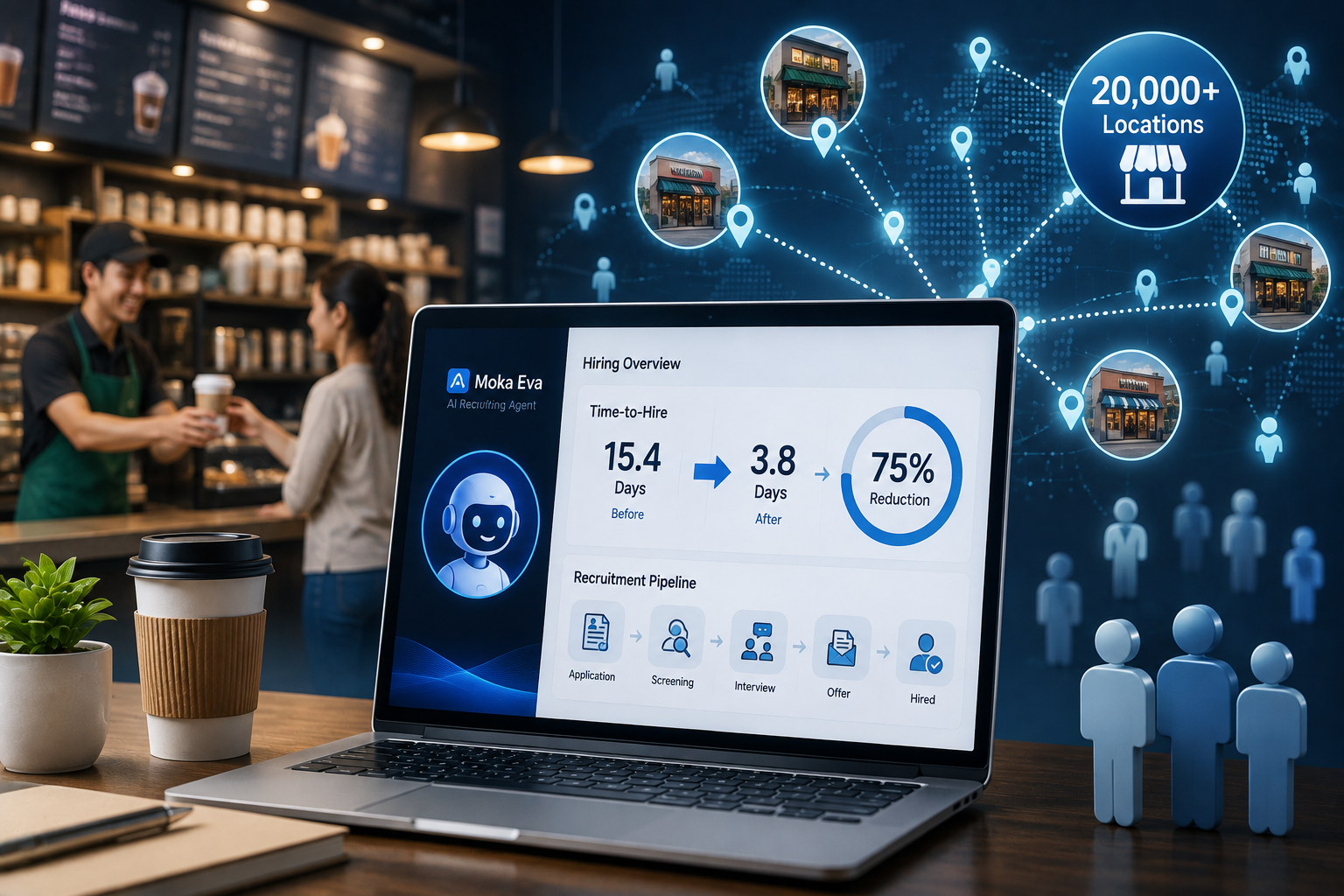
Moka AI, formerly known as MokaHR, has reported a significant improvement in recruitment efficiency following the deployment of its AI-powered recruiting agent, Moka Eva, at a leading international coffee and tea chain with more than 20,000 locations.
According to the company, Moka Eva reduced the average per-store time-to-hire from 15.4 days to 3.8 days, representing an approximately 75 per cent reduction in the time required to complete the hiring process.
The results highlight the potential of artificial intelligence to automate repetitive recruitment workflows, particularly for businesses that operate large numbers of locations and have continuous frontline hiring requirements.
Moka Eva Delivers Significant Reduction in Hiring Time
The reported improvement is substantial.
Before deployment, the average per-store hiring process took approximately 15.4 days. Following the introduction of Moka Eva, the time declined to just 3.8 days.
That represents a reduction of approximately 11.6 days per hire.
For a business operating more than 20,000 locations, even a small improvement in hiring efficiency can potentially translate into considerable operational benefits when applied across the entire network.
AI Deployment Scaled Across More Than 20,000 Locations
One of the most notable aspects of the announcement is the scale of deployment.
Moka AI said the same evaluation standard was applied across more than 20,000 locations, rather than measuring results from a limited pilot programme.
Large restaurant, retail and hospitality networks often face complex recruitment challenges because hiring needs can vary by location, season and workforce availability.
Applying a common AI-enabled recruitment process across such a large network can potentially improve consistency while reducing administrative workload.
What Is Moka Eva?
Moka Eva is an AI recruiting agent developed by Moka AI to automate parts of the recruitment process.
AI recruiting platforms can assist with a range of repetitive activities, including:
- Candidate engagement
- Application processing
- Candidate screening
- Interview scheduling
- Recruitment communication
- Follow-ups
- Hiring workflow coordination
- Candidate status management
The objective is to reduce the amount of manual administrative work required from recruiters and hiring managers.
Why High-Volume Recruitment Is Ideal for AI
High-volume recruitment is particularly suitable for automation because many of the processes involved are repetitive and structured.
A store manager or recruiter may have to perform the same activities repeatedly for hundreds or thousands of candidates.
A conventional process can involve:
- Reviewing applications.
- Contacting candidates.
- Checking availability.
- Scheduling interviews.
- Sending reminders.
- Following up with candidates.
- Updating recruitment systems.
- Coordinating hiring decisions.
AI can potentially automate significant portions of these workflows, allowing human employees to focus on tasks requiring judgement.
Faster Hiring Can Reduce Vacancy Pressure
For businesses such as restaurants, coffee chains and retail stores, staffing shortages can directly affect day-to-day operations.
An unfilled position may require existing employees to take additional shifts or managers to spend more time covering operational gaps.
This can potentially result in:
- Higher overtime costs
- Greater employee workload
- Lower workforce productivity
- Longer customer waiting times
- Reduced service capacity
- Higher employee burnout risk
Reducing the time required to fill vacancies could therefore provide benefits beyond the HR department.
Managers Could Spend More Time on Store Operations
Store managers typically have responsibilities extending far beyond recruitment.
They may oversee sales, customer service, inventory, scheduling, employee training and daily operations.
Recruitment administration can consume valuable managerial time, particularly when employee turnover is high.
By automating candidate communication and scheduling, an AI recruiting agent could allow managers to spend more time on operational priorities.
Standardisation Across Thousands of Locations
Another potential advantage of AI recruitment is consistency.
Large organisations can experience differences in hiring practices between individual locations.
An AI-enabled recruitment workflow can potentially establish a common process across locations.
This can help standardise:
- Candidate communication
- Screening procedures
- Interview scheduling
- Recruitment timelines
- Data collection
- Candidate follow-ups
For an organisation operating more than 20,000 locations, standardisation can be particularly valuable.
AI Can Operate at Enterprise Scale
The Moka AI deployment demonstrates an important characteristic of enterprise software: scale can significantly increase the economic value of automation.
If a system saves only a few hours at one location, the benefit may appear relatively small.
But when the same process is repeated across thousands of stores, the cumulative impact can become substantial.
This makes recruitment automation particularly attractive to companies with large, geographically distributed workforces.
Potential Economic Benefits
A faster recruitment process could generate several types of economic benefits.
Lower Administrative Costs
Automation can reduce the amount of manual work required to manage candidates.
Reduced Vacancy Costs
Positions can potentially be filled faster, reducing the period during which stores operate below planned staffing levels.
Lower Overtime Requirements
Faster hiring may reduce the need for existing employees to cover vacant positions.
Higher Manager Productivity
Managers can potentially devote more time to business operations rather than recruitment administration.
Improved Recruitment Scalability
Companies can potentially process higher volumes of candidates without increasing recruitment staff at the same rate.
AI Recruitment Is Moving Beyond Experimentation
The Moka AI announcement reflects a broader transition in enterprise artificial intelligence.
Companies are increasingly looking for AI applications that can demonstrate measurable operational improvements.
Rather than simply asking whether AI can perform a task, businesses are increasingly asking whether it can improve:
- Productivity
- Costs
- Speed
- Revenue
- Customer experience
- Employee experience
The reported reduction in time-to-hire provides a measurable metric for evaluating the impact of the technology.
Time-to-Hire Is an Important Business Metric
Recruitment performance can be measured using several indicators.
Among them, time-to-hire is particularly important for high-turnover industries.
A shorter hiring cycle can potentially improve workforce availability while reducing the administrative burden associated with vacant positions.
However, speed should not be considered in isolation.
A successful AI recruiting system should ideally improve hiring speed without compromising candidate quality or fairness.
Hiring Quality Remains Critical
One potential limitation of focusing primarily on hiring speed is that faster recruitment does not necessarily mean better recruitment.
Companies adopting AI recruiting technology need to evaluate whether automation affects:
- Candidate quality
- Employee retention
- Performance after hiring
- Candidate satisfaction
- Diversity
- Hiring fairness
The long-term value of AI recruitment will ultimately depend on whether faster hiring also produces sustainable workforce outcomes.
Human Oversight Will Remain Important
Recruitment involves decisions that can have significant consequences for candidates.
AI systems therefore need appropriate human oversight.
Human recruiters and managers can remain responsible for complex decisions, while AI handles repetitive administrative activities.
This could create a human-AI recruitment model, where technology manages workflow and people retain responsibility for important hiring decisions.
Data Privacy Is Another Consideration
Recruitment systems process sensitive candidate information.
This can include resumes, contact information, employment history, interview responses and other personal data.
Companies deploying AI recruitment systems therefore need robust policies covering:
- Data security
- Candidate consent
- Data retention
- Access controls
- Regulatory compliance
- Third-party data processing
As AI adoption increases, data governance is likely to become an increasingly important factor in enterprise procurement decisions.
Bias and Fairness Need Continuous Monitoring
AI-powered recruitment also raises questions around potential algorithmic bias.
If an AI system learns from historical recruitment data that contains biases, those patterns could potentially be reproduced through automated processes.
Organisations therefore need to monitor AI systems for unintended disparities and maintain appropriate human review.
The goal should be to use AI to improve recruitment efficiency without compromising fairness.
Potential Applications Across Multiple Industries
The potential market for AI recruitment extends beyond coffee and restaurant chains.
Retail
Large retail networks frequently recruit employees across thousands of locations.
Hospitality
Hotels and hospitality companies have substantial seasonal and frontline hiring requirements.
Logistics
Warehouses and distribution centres regularly require large numbers of workers.
E-commerce
Fulfilment centres and delivery networks can experience high recruitment volumes.
Manufacturing
Factories can use automation to support recruitment for repetitive operational roles.
Customer Service
Call centres can potentially automate candidate engagement and scheduling.
AI Could Change the Role of Recruiters
The growing adoption of recruitment AI does not necessarily mean that human recruiters will disappear.
Instead, their roles could increasingly shift towards higher-value activities.
AI can potentially handle repetitive tasks such as:
- Candidate messaging
- Scheduling
- Follow-ups
- Application processing
- Workflow updates
Human recruiters can then focus on:
- Workforce planning
- Candidate assessment
- Employer branding
- Complex hiring decisions
- Employee engagement
- Recruitment strategy
This could make recruiters more strategic rather than purely administrative.
The Importance of Measuring Return on AI Investment
As companies spend more on AI technology, measuring return on investment will become increasingly important.
Businesses may evaluate AI recruitment platforms based on:
- Cost per hire
- Time-to-hire
- Recruiter productivity
- Vacancy duration
- Employee retention
- Hiring quality
- Candidate satisfaction
- Implementation costs
The Moka Eva deployment demonstrates how operational metrics can provide a more concrete measure of AI's business value.
Scale Could Strengthen Moka AI's Enterprise Proposition
A deployment across more than 20,000 locations provides Moka AI with a potentially significant enterprise case study.
Large employers often look for technology platforms capable of operating consistently across geographically distributed operations.
If the reported efficiency gains can be replicated across additional customers and industries, Moka AI could potentially strengthen its position in the growing AI-enabled human resources technology market.
Challenges for AI Recruitment Platforms
Despite the potential opportunity, AI recruitment companies face several challenges.
Integration Complexity
Recruitment AI needs to integrate with existing HR and applicant tracking systems.
Candidate Acceptance
Candidates may prefer human interaction for certain stages of the hiring process.
Accuracy
Automated systems must reliably interpret candidate information and communication.
Compliance
Employment and data-protection requirements can vary across markets.
Human Oversight
Companies need mechanisms to review and challenge automated outcomes.
Measuring Long-Term Outcomes
Reducing time-to-hire is useful, but businesses ultimately need to determine whether AI improves overall workforce performance.
What Businesses Should Look For
Companies evaluating AI recruiting platforms should consider more than automation features.
Important questions include:
- How much does the technology reduce recruitment costs?
- Does it improve hiring speed?
- Does candidate quality remain stable or improve?
- How does it integrate with existing HR systems?
- What safeguards exist against algorithmic bias?
- How is candidate data protected?
- What level of human oversight is available?
- Can the system scale across multiple locations?
- What measurable ROI has been demonstrated?
- Can performance be independently verified?
What the Moka Eva Results Could Mean for Enterprise AI
The reported results highlight a broader theme in enterprise technology: AI adoption is increasingly moving from experimentation to measurable workflow transformation.
The ability to reduce a process from 15.4 days to 3.8 days provides a tangible business metric.
If such improvements can be consistently achieved at scale, AI could become a core component of recruitment infrastructure for businesses with large frontline workforces.
The next stage will be determining whether similar improvements can be achieved across different employers, geographies and job categories.
Market Outlook
Moka AI's reported 75 per cent reduction in per-store time-to-hire, from 15.4 days to 3.8 days across a network exceeding 20,000 locations, highlights the potential of AI to deliver measurable efficiency gains in high-volume recruitment.
The most important takeaway is the scale of deployment. For businesses with thousands of locations, automating repetitive recruitment tasks can potentially generate meaningful savings in managerial time, administrative costs and vacancy-related expenses.
The development also reinforces a broader investment theme around enterprise AI shifting from experimentation towards measurable productivity gains. Companies are increasingly likely to prioritise AI applications where returns can be quantified through metrics such as cost reduction, faster workflows and improved employee productivity.
However, the long-term success of AI recruitment platforms will depend on factors beyond hiring speed. Candidate quality, retention, data privacy, regulatory compliance, algorithmic fairness and human oversight will remain critical.
For businesses with large frontline workforces, AI-powered recruitment could become an increasingly important productivity tool. If the efficiency gains reported by Moka AI are replicated across additional customers and industries, the opportunity for AI-driven HR automation could expand significantly.
For investors and businesses evaluating this segment, the key metric going forward will be whether AI recruitment platforms can convert automation into sustainable financial ROI at enterprise scale. Moka Eva's reported results provide an encouraging example, but broader customer adoption, recurring revenue growth and independently measurable outcomes will be important indicators of the sector's long-term potential.