Startup Combines Canine Sense of Smell, Sensors and AI to Develop Low-Cost, Non-Invasive Multi-Cancer Prescreening Technology
A Bengaluru-based startup is attempting to turn one of nature's most powerful biological sensors — a dog's nose — into a new tool for early cancer detection.
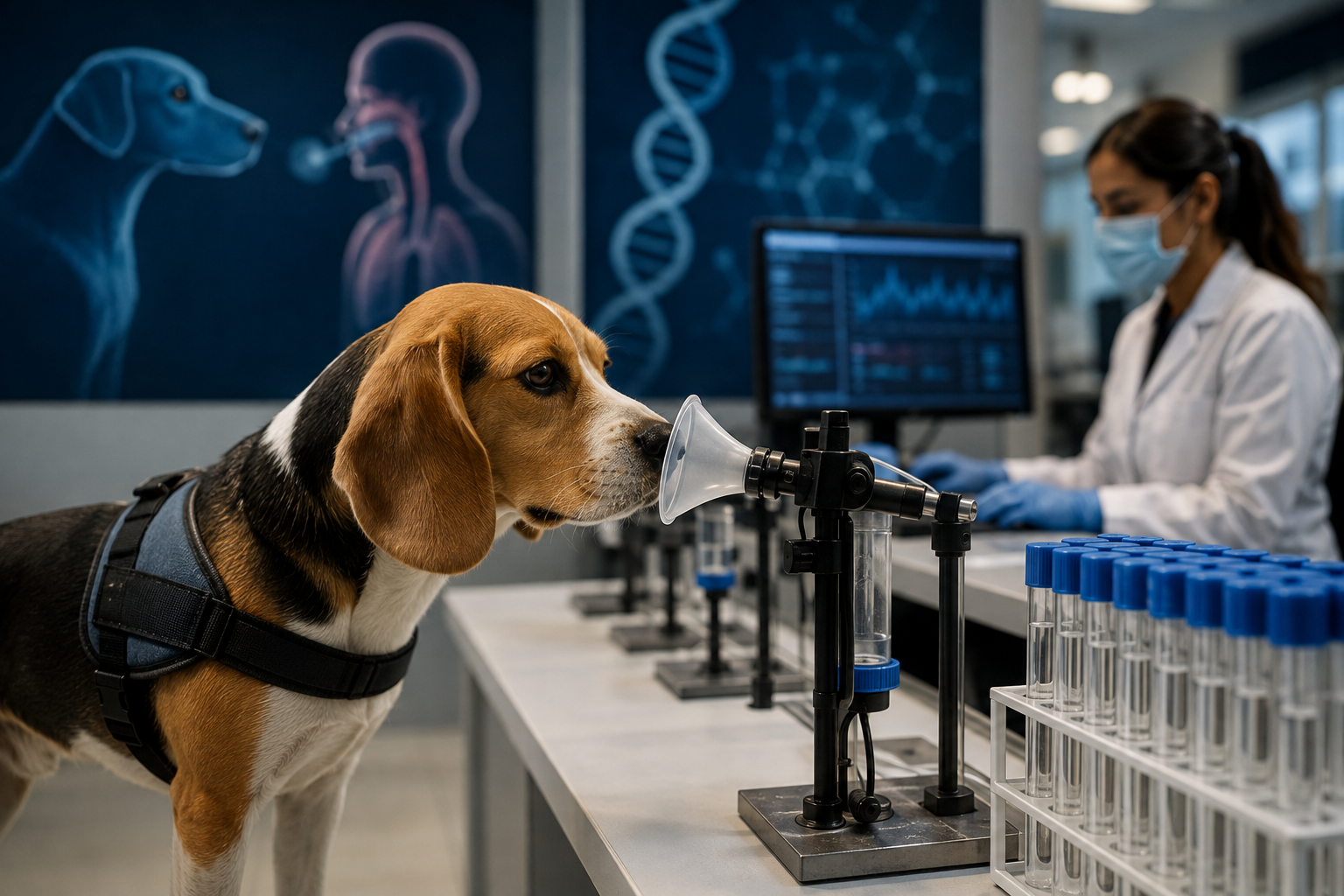
Dognosis is training specially selected dogs to identify cancer-related signals in human breath samples and combining their responses with sensors and artificial intelligence. The startup believes the approach could eventually provide a low-cost, non-invasive prescreening option for people who may otherwise have limited access to conventional screening.
The company is now moving from controlled research towards large-scale clinical validation, with its Phase 3 trial expected to become a critical test of whether the technology can work reliably across a much broader population.
From Drug Detection to Cancer Screening
Dogs have traditionally been trained to detect drugs, explosives and other substances because of their highly sensitive sense of smell.
Dognosis is attempting to repurpose this biological capability for healthcare.
At its facility outside Bengaluru, beagles, labradors, Dutch shepherds and other breeds are trained to analyse human breath samples. The animals are exposed to samples in a controlled environment and their responses are recorded.
The startup is not relying solely on whether a dog reacts to a particular sample.
Instead, it is using technology to capture several behavioural and physiological signals, including:
- Movement
- Respiration
- Body language
- Behavioural responses
- Brain activity
Artificial intelligence is then being used to interpret these signals and determine whether a sample shows patterns associated with cancer.
How the Dognosis Technology Works
The proposed process is designed to make the dog's biological sensing capability measurable and potentially scalable.
A simplified version of the system works as follows:
Patient breath sample → Sample processing → Canine scent detection → Sensor data collection → AI analysis → Prescreening result → Conventional medical testing
The approach is intended to identify people who may require further investigation rather than replace established diagnostic procedures.
That distinction could become increasingly important as the company moves into larger clinical trials.
Dogs Are Trained Through a Reward-Based System
The dogs at Dognosis live together at the company's farm and laboratory near Bengaluru.
Their detection work is structured like a game, with treats used as rewards.
The dogs typically spend around 30 minutes to an hour a day working on the detection platform.
During a testing session, the animal is presented with multiple samples.
In one example cited by the company, a beagle named Whiskey moved past several samples before stopping at one, sniffing it repeatedly and returning to investigate it before the system recorded a positive response.
The objective is to train the dogs to recognise subtle scent patterns associated with disease.
Dognosis Reports Around 90% Sensitivity
Dognosis reported approximately 90 per cent sensitivity for early-stage cancers across seven broad cancer groups covering more than 20 cancer types in a Phase 2 study published in the Journal of Clinical Oncology.
The company has also reported an interesting finding from its research.
According to co-founder Akash Kulgod, dogs trained using samples from 10 cancer types were able to identify another cancer type that they had not specifically encountered during training.
If replicated in larger studies, such findings could be important for the development of multi-cancer prescreening.
However, the crucial challenge is determining whether the performance observed in controlled studies can be reproduced across large, diverse real-world populations.
Phase 3 Trial Could Be a Major Turning Point
Dognosis has already begun its Phase 3 clinical trial, involving 10 hospitals across India.
The company plans to recruit approximately 10,000 people over a 12-month period.
The study will focus on people who do not have obvious symptoms but are at higher risk of cancer, as well as cancer survivors who may be at risk of recurrence.
Participants flagged by the Dognosis system will undergo conventional follow-up procedures, including imaging and biopsy where required.
This design allows researchers to compare the prescreening results with established medical methods.
Why India's Cancer Burden Creates a Large Opportunity
The potential market for accessible cancer screening in India is substantial.
The information cited in the report estimates around 1.5 million new cancer cases and more than 900,000 cancer deaths in India in 2024.
At the same time, routine screening remains limited.
Low screening penetration means many cancers may not be detected until patients develop symptoms or reach a more advanced stage.
This creates a significant gap between the need for early detection and the availability and accessibility of screening infrastructure.
Screening Penetration Remains Low
The report cites survey data from 2019-2021 showing particularly low screening rates among Indian adults.
Among women surveyed:
- Around 1.9 per cent reported having undergone cervical cancer screening.
- Around 0.9 per cent reported breast or oral cancer examinations.
Among men, around 1.2 per cent reported having undergone oral cancer screening.
These numbers illustrate the scale of the challenge facing India's healthcare system.
A screening technology that is affordable, convenient and non-invasive could potentially help increase participation — provided its clinical performance is established.
At-Home Multi-Cancer Test Planned
Dognosis plans to introduce an at-home, multi-cancer prescreening test in India next year, with an expected cost of a few thousand rupees.
The proposed model could make the initial screening process significantly more convenient.
Patients would provide breath samples using specially designed masks, with the samples subsequently sent to the company's facility for testing.
This model could allow patients to access screening without requiring trained dogs to be physically present at hospitals or diagnostic centres.
Centralised Testing Could Help Scale the Business
The company's operating model could potentially combine decentralised sample collection with centralised canine testing.
Instead of establishing a full canine laboratory at every hospital, samples could be collected at home or through healthcare partners and transported to Dognosis facilities.
This could make the model more scalable.
However, the company would need to develop robust systems for:
- Sample collection
- Packaging
- Transportation
- Storage
- Sample identification
- Laboratory processing
- Data management
- Result delivery
The logistics challenge could become considerably larger if testing volumes reach hundreds of thousands or millions of samples annually.
Dognosis Targets One Million Tests Annually
The startup has set ambitious expansion goals.
It eventually wants to process 1 million tests a year, increase its canine workforce to around 30 dogs and reduce turnaround time to approximately one week.
The company is also considering international expansion and could potentially establish a facility in the US by late 2027 or early 2028, according to co-founder Kulgod.
Achieving these targets would require significant investment in infrastructure, technology, clinical validation and healthcare partnerships.
Startup Has Raised Funding From Global Investors
Dognosis has attracted early-stage backing from investors including Accel India and San Francisco-based Caffeinated Capital.
The company raised $1.5 million in a pre-seed round in 2024, followed by another undisclosed funding round.
According to Kulgod, the funding provides sufficient runway for around two years based on the company's current growth plans.
The next stage of funding could depend heavily on the outcome of the Phase 3 study and the company's ability to demonstrate commercial scalability.
Standardising a Dog's Nose Is the Biggest Challenge
The fundamental challenge facing Dognosis is not simply whether dogs can detect disease.
The larger question is whether the ability can be standardised, quantified and reproduced consistently.
Individual dogs can differ in behaviour, motivation, sensitivity and response.
Environmental conditions, sample handling and training can also influence performance.
Dognosis is attempting to address these challenges through sensors and AI.
The goal is to transform an animal's response into measurable data that can be analysed consistently.
AI Could Make Canine Detection More Scalable
Artificial intelligence could play a central role in converting canine behaviour into a repeatable screening process.
Instead of recording only a binary response — positive or negative — the system can potentially analyse multiple signals simultaneously.
These could include how long the dog spends investigating a sample, how it moves around the platform and changes in physiological or behavioural patterns.
Over time, a larger dataset could potentially help identify patterns that are difficult to observe through human assessment alone.
The technology could therefore create a bridge between biological sensing and digital diagnostics.
Dognosis Is Not Trying to Replace Biopsies
An important part of the company's strategy is positioning the technology as a prescreening tool.
A positive result would not necessarily mean that a patient has cancer.
Instead, the result would indicate that additional medical investigation may be warranted.
Follow-up could involve imaging, blood tests, biopsy or other established diagnostic methods.
This could allow the canine-AI system to function as an initial filter that helps identify people who should undergo more detailed testing.
False Positives and False Negatives Remain Critical
As with any screening technology, accuracy will be a major factor in determining its usefulness.
A false positive could result in unnecessary anxiety and additional diagnostic procedures.
A false negative could potentially provide false reassurance and delay further medical evaluation.
Consequently, overall accuracy alone will not be sufficient to assess the technology.
The Phase 3 study will need to establish how consistently the system performs across different patient groups and cancer types.
Experts Stress That New Technology Should Complement Screening
Pankaj Chaturvedi, deputy director of the Centre for Cancer Epidemiology at Tata Memorial Centre in Mumbai, said emerging technologies could offer exciting opportunities but should strengthen rather than replace existing screening programmes.
This is particularly relevant for Dognosis because the technology is still undergoing clinical validation.
The success of the platform will ultimately depend on whether healthcare professionals can incorporate its results into established clinical pathways.
India's Healthcare Infrastructure Could Benefit From Low-Cost Screening
If validated, Dognosis' model could potentially have applications beyond metropolitan cities.
India's healthcare infrastructure varies considerably between urban and rural regions.
A centralised testing system combined with sample collection through homes, diagnostic centres or healthcare partners could potentially expand access to screening.
The economics will be critical.
A lower-cost screening test could make periodic testing more accessible to a larger population, particularly if it can identify individuals who need further investigation before symptoms become severe.
Potential Applications Beyond Initial Cancer Screening
Dognosis is initially focused on cancer, but the broader concept of disease detection through volatile compounds could potentially have applications across healthcare.
Dogs have previously been studied for their ability to identify different illnesses.
However, expanding into additional diseases would require separate clinical validation.
For Dognosis, the immediate priority remains establishing the reliability and scalability of its cancer prescreening platform.
Competitive Landscape Is Still at an Early Stage
Dognosis is entering an emerging field.
New Jersey-based SpotitEarly has also reported results from canine cancer-detection trials.
However, canine-based cancer screening has yet to become a widely commercialised diagnostic category.
This creates both an opportunity and a risk.
Dognosis could potentially establish an early position if it successfully completes clinical validation and builds a scalable testing network.
At the same time, competing technologies based on biomarkers, blood tests, imaging and AI could develop rapidly.
Key Challenges Ahead for Dognosis
Clinical Validation
The Phase 3 trial will be crucial in establishing whether earlier results hold across a much larger population.
Scalability
Training and managing enough dogs while maintaining consistent performance will be a major operational challenge.
Sample Logistics
Processing large numbers of breath samples will require reliable collection and transportation infrastructure.
Healthcare Adoption
Doctors and diagnostic providers will need confidence in the clinical relevance of the results.
Patient Acceptance
Convincing patients to trust a dog-and-AI-based screening platform could require extensive education.
Economics
The company will need to balance affordable pricing with the costs associated with training dogs, maintaining laboratories and processing samples.
Regulatory Evolution
As the product develops and its intended use expands, regulatory requirements could become increasingly important.
What Could Make the Business Model Attractive?
Dognosis has several features that could make its business model potentially scalable if clinical validation succeeds.
The proposed model combines:
- At-home sample collection
- Centralised laboratory processing
- Trained canine detection
- Sensor-based data capture
- AI-assisted interpretation
- Multi-cancer screening
- Healthcare partnerships
This could potentially allow the company to serve a large number of customers without requiring a full laboratory infrastructure at every location.
The Next Two Years Could Be Crucial
Dognosis is entering a period in which scientific validation and commercial execution will need to progress together.
The Phase 3 trial could establish whether the technology works outside tightly controlled conditions.
At the same time, the company will need to prepare its laboratory capacity, sample logistics, technology platform and healthcare partnerships.
If clinical results are strong, the company could move rapidly towards commercialisation.
If performance falls significantly outside controlled environments, the business model could face substantial challenges.
Why the Story Matters for India's Startup Ecosystem
Dognosis represents a broader trend in India's startup ecosystem: combining AI with unconventional biological and scientific capabilities to address large healthcare problems.
The company is attempting to solve two challenges simultaneously — improving early detection and lowering the barriers to screening.
The outcome of its clinical trials could therefore be relevant not only to Dognosis but also to the broader development of technology-driven healthcare in India.
Market Outlook
Dognosis sits at the intersection of healthcare technology, artificial intelligence, biotechnology and diagnostics, making it an interesting emerging startup story.
The potential market opportunity is substantial because India has a significant cancer burden and relatively low screening penetration. If Dognosis can demonstrate reliable performance at scale, a low-cost, non-invasive prescreening platform could potentially address an important gap in the healthcare ecosystem.
However, the investment and business case remains dependent on clinical validation, accuracy, scalability and commercial economics. The Phase 3 trial involving around 10,000 participants is therefore the most important milestone to watch.
For the startup ecosystem, successful validation could open a new category of AI-assisted biological diagnostics and attract greater investor interest in unconventional healthcare technologies. For Dognosis itself, the challenge will be converting the remarkable sensing capabilities of trained dogs into a standardised, reproducible and affordable healthcare service.
The company's ambition to eventually process 1 million tests annually is significant, but achieving that scale will require more than scientific accuracy. It will require efficient logistics, healthcare partnerships, regulatory clarity, patient trust and a sustainable cost structure.
The next major trigger is therefore not the number of dogs Dognosis can train, but whether its Phase 3 clinical evidence can prove that a dog's nose, combined with AI, can become a reliable and scalable early-warning system for cancer.